
Does My Phone Support eSIM in Canada? Compatible Phones and Devices
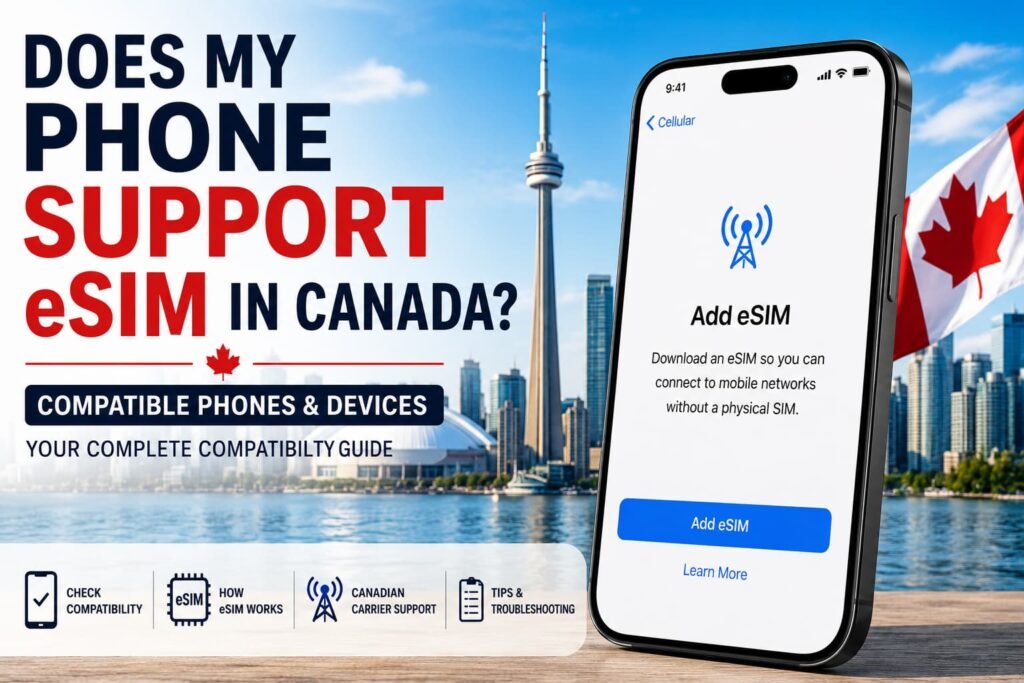
Does my phone support eSIM in Canada? That is one of the most common questions Canadian users ask before switching carriers, buying a travel eSIM, upgrading devices, or purchasing a used phone.
eSIM compatibility in Canada can become surprisingly confusing, especially when different phones, carriers, firmware versions, and imported models all behave differently. A lot of people only discover compatibility problems after arriving at the airport, switching carriers, upgrading devices, or trying to activate a travel eSIM at the last minute. One of the biggest misconceptions is assuming every newer phone automatically supports eSIM on every Canadian carrier. In reality, compatibility can still vary depending on the phone model, firmware region, carrier provisioning, and where the device was originally sold.
Some phones work perfectly with Canadian eSIM carriers right out of the box, while others only support eSIM in certain regions or on specific firmware versions. Imported devices can behave very differently, prepaid carriers sometimes apply extra activation restrictions, and some phones hide the Add eSIM option entirely depending on the original sales region.
This is especially common with:
- travelers bringing U.S. iPhones into Canada
- Canadians using imported Samsung Galaxy phones
- users switching between prepaid and postpaid carriers
- travelers trying to activate eSIMs at airports or while abroad
- imported Samsung Galaxy phones
- U.S. carrier locked devices
- regional Pixel models
- Moto G variants
- Chinese-market iPhones
- budget Android devices
The good news is that most modern flagship phones now support eSIM in Canada across major carriers like Bell, Rogers, TELUS, Fido, Freedom Mobile, Koodo, Public Mobile, Virgin Plus, Videotron, and SaskTel.
If you are new to eSIMs entirely, you can also start with our complete eSIM Canada: Best Providers, Setup & Guide for Travelers & Locals covering Canadian carriers, activation, travel usage, and provider comparisons.
Quick eSIM Compatibility Overview
| Brand | eSIM Support in Canada | Important Notes |
|---|---|---|
| iPhone | Excellent | Best overall compatibility across Canadian carriers |
| Samsung Galaxy | Strong | Imported and regional models can vary |
| Google Pixel | Excellent | Some imported models may restrict eSIM |
| Motorola | Moderate | Moto G compatibility varies heavily |
| Xiaomi | Mixed | Imported firmware may disable eSIM |
| OnePlus | Good | Global models usually work best |
This guide explains:
- which phones support eSIM in Canada
- which models do not
- how to check compatibility
- important regional restrictions
- Canadian carrier limitations
- dual SIM behavior
- imported device issues
- troubleshooting tips if Add eSIM is missing
If you are looking for setup instructions after confirming compatibility, you can also follow:
- How to Activate eSIM on iPhone in Canada
- Activate eSIM on Android Canada
- How to Activate eSIM on Samsung Galaxy in Canada
- How to Activate eSIM on Google Pixel in Canada
- How to Activate eSIM on Motorola Phones in Canada
What Is eSIM and How Does It Work in Canada?
An eSIM is a digital SIM card built directly into your phone. Instead of inserting a physical SIM card, your carrier downloads the mobile plan directly to your device through software.
In Canada, eSIM activation is now supported by most major carriers and many prepaid providers.
This allows you to:
- activate service without a physical SIM
- switch carriers faster
- use dual SIM on compatible devices
- install travel eSIMs
- transfer service between devices
- store multiple cellular profiles on one phone
Most Canadian carriers now support:
- QR code activation
- carrier app activation
- manual SM-DP+ activation
- device-to-device eSIM transfer
However, support still depends on:
- your exact phone model
- carrier provisioning
- software region
- firmware restrictions
- whether the phone is unlocked
That is why compatibility confusion still happens so often.
Important Things to Know Before Using eSIM in Canada
Before checking your device compatibility, there are a few important things most people do not realize about eSIM support in Canada.
Carrier Support Still Matters
Even if your phone supports eSIM, your Canadian carrier must also support:
- your specific device
- your plan type
- your account provisioning
Some prepaid carriers still require:
- manual QR code requests
- customer support activation
- in-store verification
Support can also vary between:
- prepaid plans
- postpaid plans
- tablets
- smartwatches
- business accounts
Imported Phones Can Behave Differently
This is extremely common with:
- Samsung Galaxy phones
- Google Pixel devices
- Xiaomi phones
- Chinese-market iPhones
Examples:
- some Japanese Pixel models disable eSIM entirely
- certain Samsung CSC regions hide Add eSIM
- China-region iPhones may use dual physical SIM instead of eSIM
- imported Moto G devices may lose eSIM support depending on region
Even if the hardware normally supports eSIM, firmware restrictions can still block activation in Canada.
Carrier-Locked Devices May Restrict eSIM
Some phones purchased through:
- Verizon
- AT&T
- T-Mobile
- international carriers
may restrict:
- eSIM activation
- dual SIM functionality
- carrier switching
This is especially common on:
- older Samsung Galaxy models
- Pixel 3a and Pixel 4 Verizon variants
- some Motorola devices
eSIM Support Is Different From Dual SIM Support
A phone may support:
- eSIM only
- physical SIM + eSIM
- dual active eSIM
- multiple stored eSIM profiles
This depends heavily on:
- device generation
- carrier support
- regional firmware
Newer iPhones and Samsung flagships support multiple active eSIM profiles, while older models usually support:
- one physical SIM
- one active eSIM
Deleting an eSIM Does NOT Cancel Your Plan
Many users assume removing an eSIM cancels their account.
It does not.
Deleting the profile only removes it from the phone. Your mobile plan remains active with the carrier until cancelled separately.
How to Check if Your Phone Supports eSIM in Canada
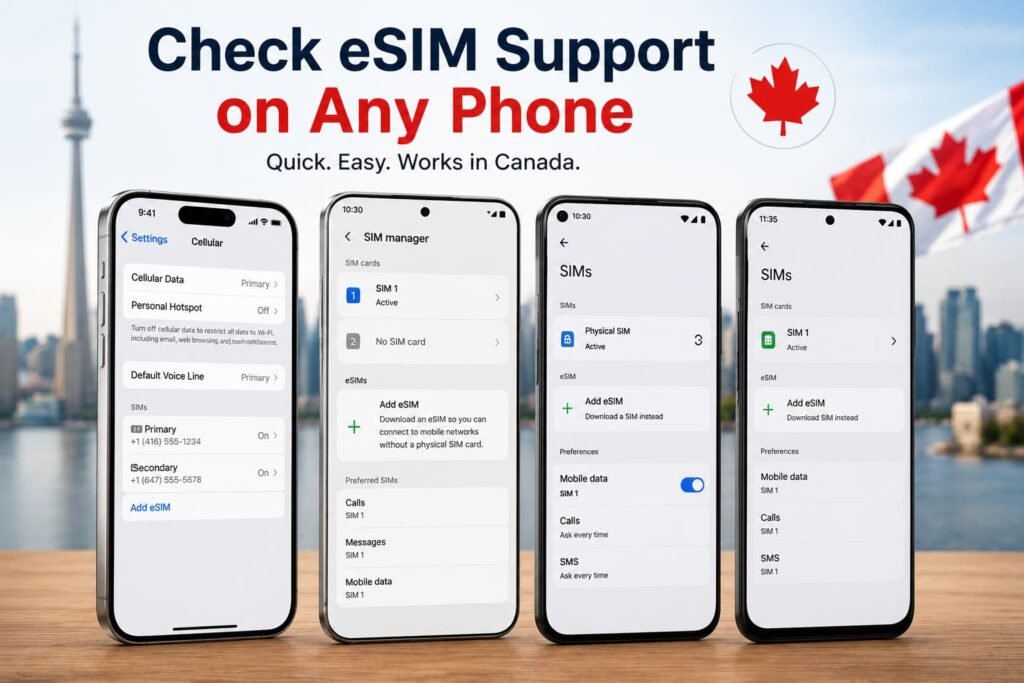
The fastest way to confirm eSIM compatibility in Canada is by checking whether your phone shows an Add eSIM option inside the settings menu.
Most eSIM-compatible phones also include a second IMEI number called IMEI2. If Add eSIM and IMEI2 are both present, the device usually supports eSIM.
Quick iPhone Check
Go to:
Settings > Cellular > Add eSIM
If the option appears, your iPhone supports eSIM.
You can also:
- dial *#06#
- look for an EID number
- confirm IMEI2 exists
An EID and IMEI2 confirm eSIM hardware exists on the device.
How to Check eSIM Support on Samsung Galaxy
Go to:
Settings > Connections > SIM Manager
Look for:
- Add eSIM
- Download SIM
- SIM Manager options
If the option is missing:
- update One UI
- confirm Canadian CSC compatibility
- verify your model supports eSIM in Canada
Imported Samsung devices may hide eSIM entirely depending on region.
How to Check eSIM Support on Google Pixel
Go to:
Settings > Network and Internet > SIMs
Look for:
- Add eSIM
- Download a SIM
If the option does not appear:
- the device may be region restricted
- firmware may block eSIM
- the phone may not support eSIM in Canada
How to Check eSIM Support on Motorola
Go to:
Settings > Network and Internet > SIMs
Look for:
- Add eSIM
- Download SIM
Moto G models vary heavily by region and carrier. Not all Canadian Motorola variants support eSIM.
Which iPhone Models Support eSIM in Canada
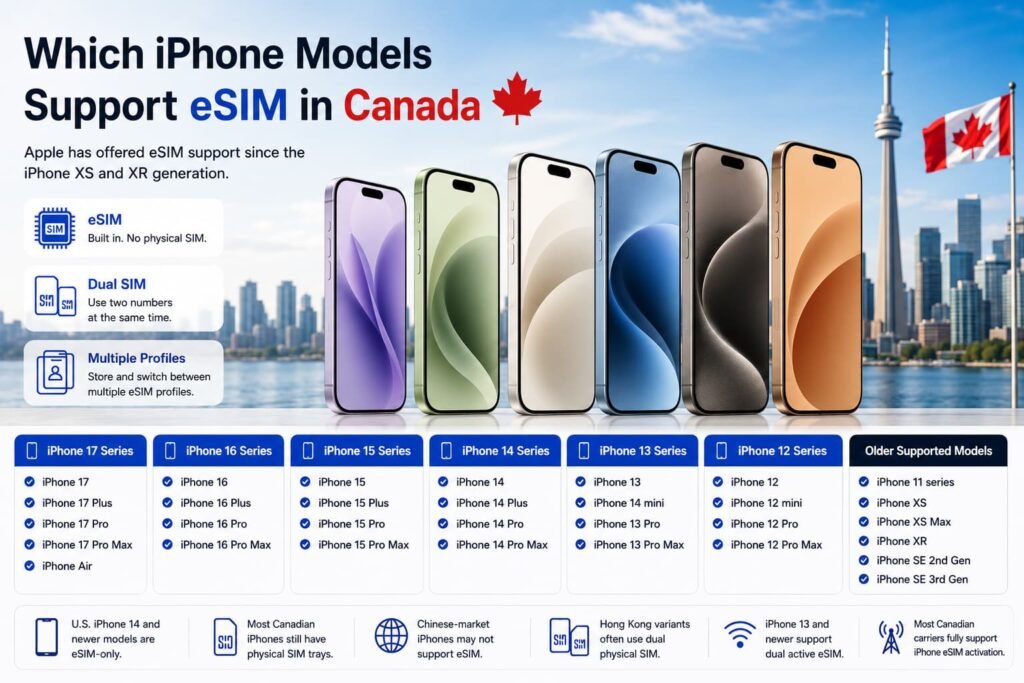
Apple has offered eSIM support since the iPhone XS and XR generation.
Most newer iPhones sold in Canada fully support:
- eSIM
- dual SIM
- multiple stored eSIM profiles
Newer North American iPhones are also shifting toward eSIM-only hardware, especially on newer U.S. models that no longer include a physical SIM tray.
Supported iPhone Models
iPhone 17 Series
- iPhone 17
- iPhone 17 Plus
- iPhone 17 Pro
- iPhone 17 Pro Max
- iPhone Air
iPhone 16 Series
- iPhone 16
- iPhone 16 Plus
- iPhone 16 Pro
- iPhone 16 Pro Max
iPhone 15 Series
- iPhone 15
- iPhone 15 Plus
- iPhone 15 Pro
- iPhone 15 Pro Max
iPhone 14 Series
- iPhone 14
- iPhone 14 Plus
- iPhone 14 Pro
- iPhone 14 Pro Max
iPhone 13 Series
- iPhone 13
- iPhone 13 mini
- iPhone 13 Pro
- iPhone 13 Pro Max
iPhone 12 Series
- iPhone 12
- iPhone 12 mini
- iPhone 12 Pro
- iPhone 12 Pro Max
Older Supported Models
- iPhone 11 series
- iPhone XS
- iPhone XS Max
- iPhone XR
- iPhone SE 2nd Gen
- iPhone SE 3rd Gen
Important iPhone eSIM Notes for Canada
- U.S. iPhone 14 and newer models are eSIM-only
- Most Canadian iPhones still supported physical SIM trays longer than the U.S.
- Chinese-market iPhones may not support eSIM at all
- Hong Kong variants often use dual physical SIM
- iPhone 13 and newer support dual active eSIM
- Most Canadian carriers fully support iPhone eSIM activation
If you need step-by-step setup instructions, follow our How to Activate eSIM on iPhone in Canada guide for activation, transfers, and troubleshooting help.
Which Samsung Galaxy Phones Support eSIM in Canada
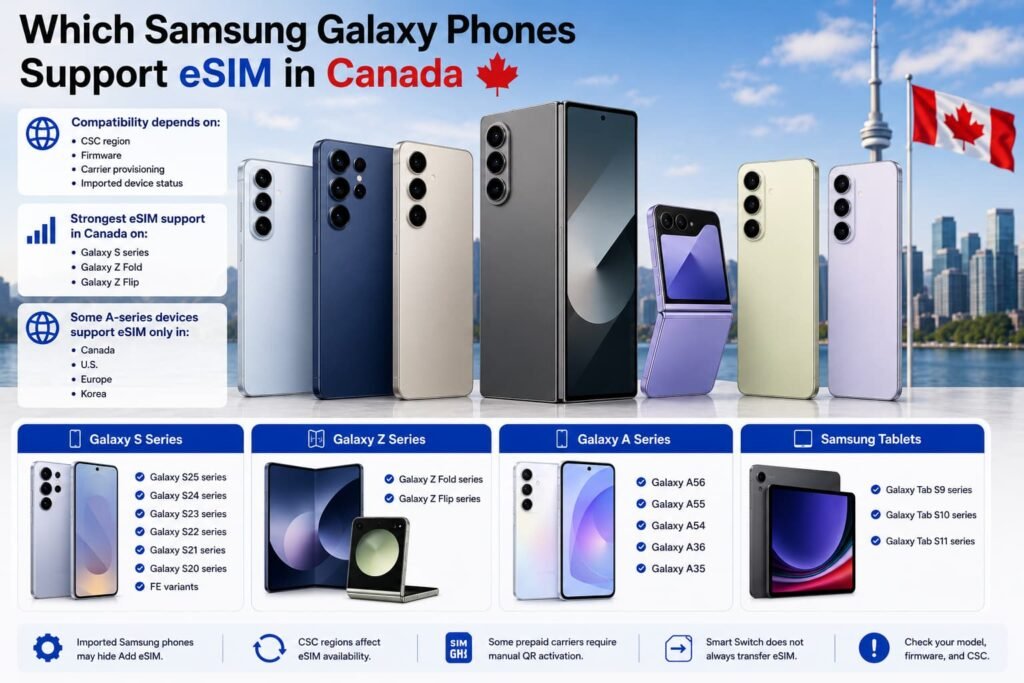
Samsung compatibility in Canada can be a little messy because support often depends on:
- CSC region
- firmware
- carrier provisioning
- imported device status
Samsung Galaxy eSIM support in Canada is strongest on:
- Galaxy S series
- Galaxy Z Fold
- Galaxy Z Flip
Some A-series devices only support eSIM in:
- Canada
- U.S.
- Europe
- Korea
Supported Samsung Galaxy Models
Galaxy S Series
- Galaxy S25 series
- Galaxy S24 series
- Galaxy S23 series
- Galaxy S22 series
- Galaxy S21 series
- Galaxy S20 series
- FE variants
Galaxy Z Series
- Galaxy Z Fold series
- Galaxy Z Flip series
Galaxy A Series
- Galaxy A56
- Galaxy A55
- Galaxy A54
- Galaxy A36
- Galaxy A35
Samsung Tablets
- Galaxy Tab S9 series
- Galaxy Tab S10 series
- Galaxy Tab S11 series
Important Samsung eSIM Notes for Canada
- Imported Samsung phones may hide Add eSIM
- CSC regions affect eSIM availability
- Some A-series phones support eSIM only in certain markets
- Canadian CSC is usually XAC
- Some prepaid carriers require manual QR activation
- Smart Switch does not always transfer eSIM correctly
For full Samsung setup instructions, troubleshooting, and SIM Manager guidance, see our How to Activate eSIM on Samsung Galaxy in Canada guide.
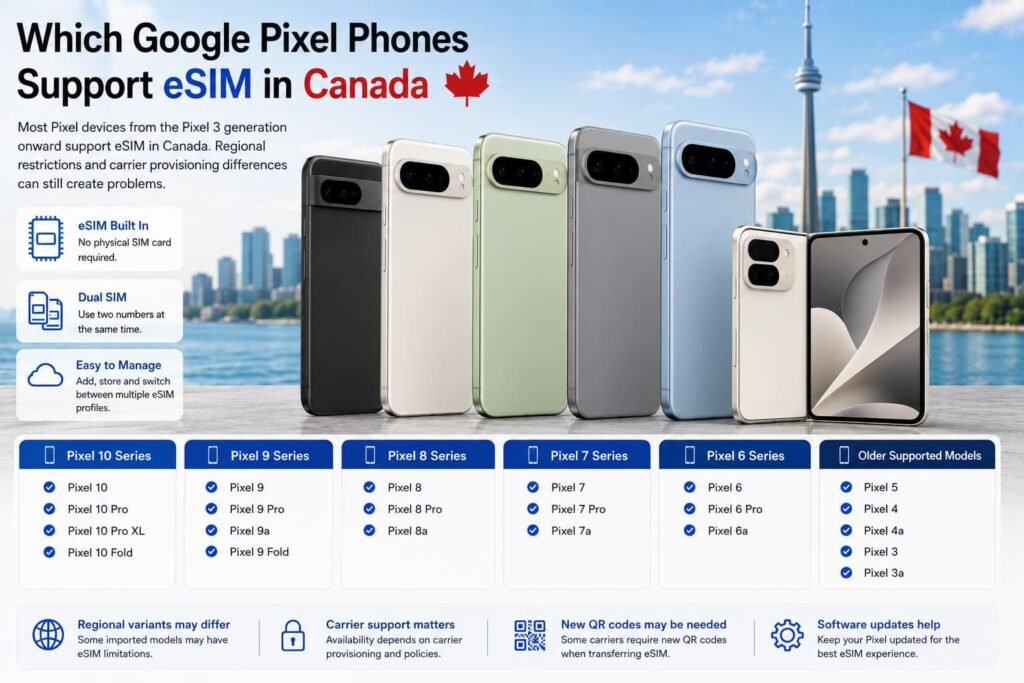
Which Google Pixel Phones Support eSIM in Canada
Google Pixel phones generally offer one of the cleanest eSIM experiences on Android, but regional restrictions and carrier provisioning differences can still create problems in Canada.
Most Pixel devices from the Pixel 3 generation onward support eSIM in Canada, although imported regional variants can still behave differently depending on firmware and carrier provisioning.
Supported Pixel Models
Pixel 10 Series
- Pixel 10
- Pixel 10 Pro
- Pixel 10 Pro XL
- Pixel 10 Fold
Pixel 9 Series
- Pixel 9
- Pixel 9 Pro
- Pixel 9a
- Pixel 9 Fold
Pixel 8 Series
- Pixel 8
- Pixel 8 Pro
- Pixel 8a
Pixel 7 Series
- Pixel 7
- Pixel 7 Pro
- Pixel 7a
Pixel 6 Series
- Pixel 6
- Pixel 6 Pro
- Pixel 6a
Older Supported Models
- Pixel 5
- Pixel 4
- Pixel 4a
- Pixel 3
- Pixel 3a
Important Pixel eSIM Notes for Canada
- Japan Pixel models may disable eSIM
- Verizon Pixel variants may block activation
- Pixel 10 U.S. models are eSIM-only
- Dual eSIM support varies by carrier
- Some Canadian carriers require new QR codes during transfer
If you need activation instructions or troubleshooting help, follow our How to Activate eSIM on Google Pixel in Canada walkthrough.
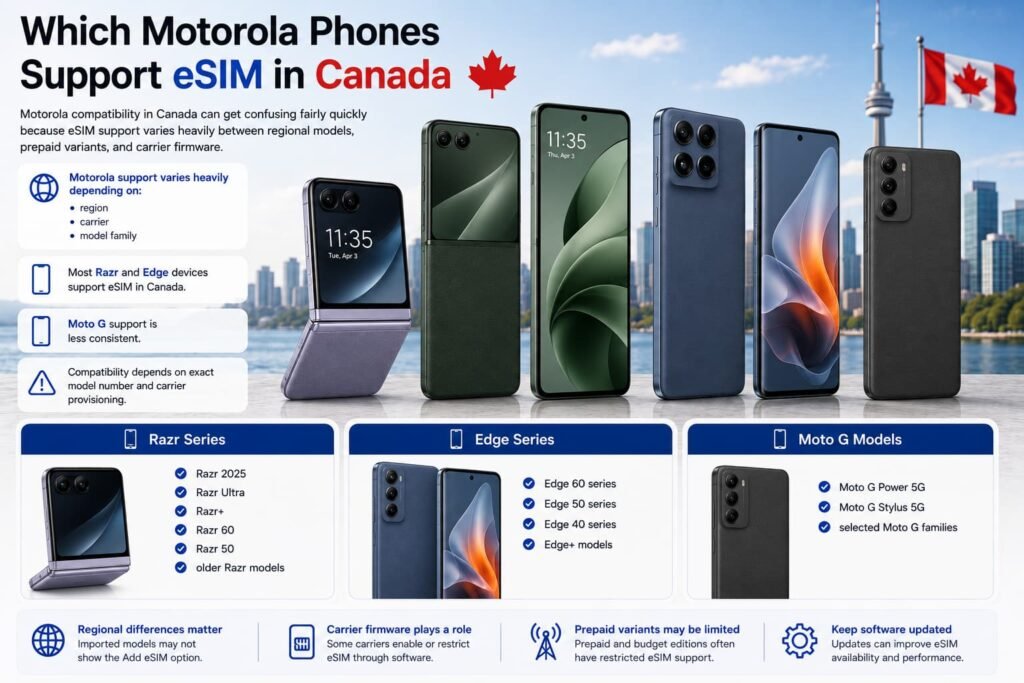
Which Motorola Phones Support eSIM in Canada
Motorola compatibility in Canada can get confusing fairly quickly because eSIM support varies heavily between regional models, prepaid variants, and carrier firmware.
Some Motorola phones support eSIM perfectly across Canadian carriers, while others may completely hide the Add eSIM option even when the hardware technically supports it.
This is especially common with:
- Moto G variants
- prepaid carrier editions
- imported international models
- carrier-customized firmware
Razr and Edge devices generally offer the most consistent eSIM support in Canada, while Moto G compatibility often depends on the exact model number and carrier provisioning.
Motorola support varies heavily depending on:
- region
- carrier
- model family
Most Razr and Edge devices support eSIM in Canada.
Moto G support is less consistent.
Supported Motorola Models
Razr Series
- Razr 2025
- Razr Ultra
- Razr+
- Razr 60
- Razr 50
- older Razr models
Edge Series
- Edge 60 series
- Edge 50 series
- Edge 40 series
- Edge+ models
Moto G Models
- Moto G Power 5G
- Moto G Stylus 5G
- selected Moto G families
Important Motorola eSIM Notes for Canada
- Some Moto G models are physical SIM only
- Imported variants may disable eSIM
- Canadian carrier support varies
- Carrier provisioning differences are common
If you are setting up a Razr, Edge, or Moto G device, follow our How to Activate eSIM on Motorola Phones in Canada guide for full setup instructions and troubleshooting.
Xiaomi, OnePlus, Oppo and Huawei eSIM Compatibility in Canada
These brands are becoming more common in Canada, especially among users importing phones internationally or buying unlocked global models online.
Some imported Android brands also support eSIM in Canada, although compatibility depends heavily on the exact regional model and firmware.
Xiaomi
Newer Xiaomi flagship devices may support eSIM internationally, but many Canadian users import models that disable eSIM entirely.
OnePlus
Some newer OnePlus flagship phones support eSIM in Canada, especially global models. Carrier compatibility may still vary.
Oppo
Certain premium Oppo devices support eSIM, but support is inconsistent across Canadian carriers.
Important Note About Imported Android Phones
Many imported Android phones sold online may advertise eSIM support globally while still creating problems in Canada because of:
- missing LTE Band 66
- unsupported firmware regions
- disabled carrier provisioning
- missing Canadian VoLTE certification
- restricted firmware builds
This is one of the biggest reasons compatibility checks matter before buying imported devices.
Huawei
Huawei eSIM support remains limited in Canada due to software and carrier restrictions.
Imported-device compatibility can vary heavily across these brands, so always verify the exact model number before purchasing.
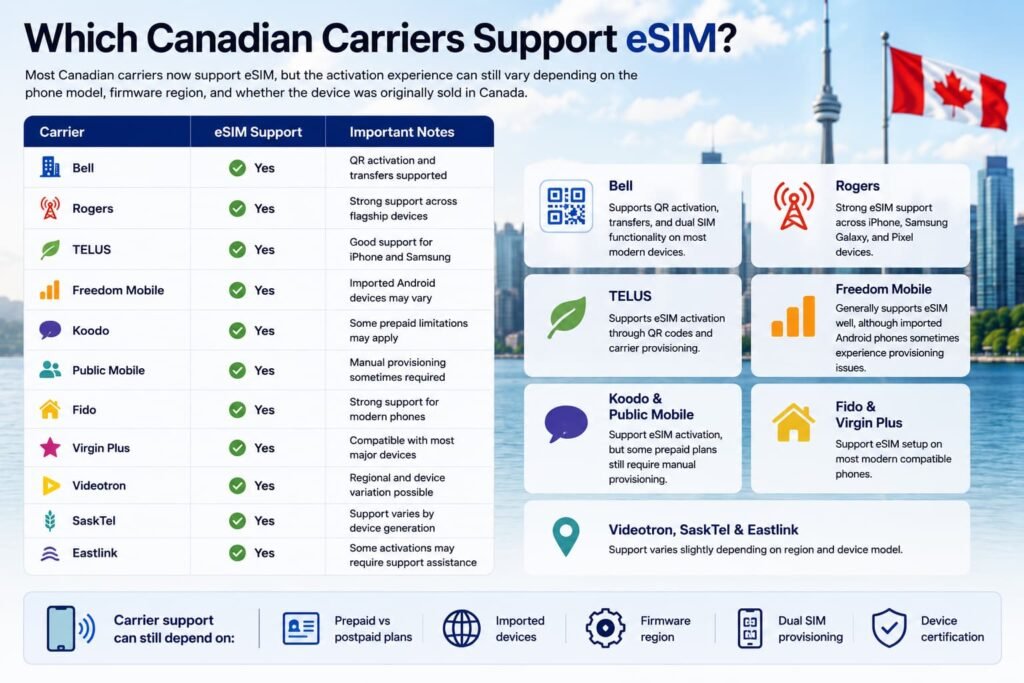
Which Canadian Carriers Support eSIM?
Most Canadian carriers now support eSIM, but the activation experience can still vary depending on the phone model, firmware region, and whether the device was originally sold in Canada.
Some carriers offer very smooth activation directly through their app, while others may still require manual QR provisioning or customer support assistance.
| Carrier | eSIM Support | Important Notes |
|---|---|---|
| Bell | Yes | QR activation and transfers supported |
| Rogers | Yes | Strong support across flagship devices |
| TELUS | Yes | Good support for iPhone and Samsung |
| Freedom Mobile | Yes | Imported Android devices may vary |
| Koodo | Yes | Some prepaid limitations may apply |
| Public Mobile | Yes | Manual provisioning sometimes required |
| Fido | Yes | Strong support for modern phones |
| Virgin Plus | Yes | Compatible with most major devices |
| Videotron | Yes | Regional and device variation possible |
| SaskTel | Yes | Support varies by device generation |
| Eastlink | Yes | Some activations may require support assistance |
Most major Canadian carriers now support eSIM activation, although the setup process and transfer experience can still vary quite a bit depending on the carrier and device.
Bell
Supports QR activation, transfers, and dual SIM functionality on most modern devices.
Rogers
Strong eSIM support across iPhone, Samsung Galaxy, and Pixel devices.
TELUS
Supports eSIM activation through QR codes and carrier provisioning.
Freedom Mobile
Generally supports eSIM well, although imported Android phones sometimes experience provisioning issues.
Koodo and Public Mobile
Support eSIM activation, but some prepaid plans still require manual provisioning.
Fido and Virgin Plus
Support eSIM setup on most modern compatible phones.
Videotron, SaskTel and Eastlink
Support varies slightly depending on region and device model.
Carrier support can still depend on:
- prepaid vs postpaid plans
- imported devices
- firmware region
- dual SIM provisioning
- device certification
Why Your Phone Supports eSIM Globally But Not in Canada
One of the most frustrating eSIM situations in Canada happens when a phone technically supports eSIM hardware but still refuses to activate properly on Canadian carriers.
This usually happens because of:
- firmware restrictions
- CSC region limitations
- imported carrier software
- disabled eSIM provisioning
- unsupported regional variants
- Canadian carrier certification requirements
This is especially common on:
- imported Samsung Galaxy devices
- Verizon Pixel phones
- Moto G regional variants
- Chinese-market iPhones
- international Xiaomi models
In many cases, the hardware itself supports eSIM perfectly. The issue comes from software restrictions or carrier provisioning differences.
This is why two identical-looking phones may behave completely differently in Canada depending on where they were originally sold.
Which Phones Do Not Support eSIM in Canada
| Device | eSIM Support |
|---|---|
| iPhone X | No |
| iPhone 8 Series | No |
| iPhone 7 Series | No |
| Galaxy S10 and Older | No |
| Older Moto G Models | Usually No |
| Many Budget Android Phones | Usually No |
Many older phones still rely entirely on physical SIM cards.
Examples include:
Older iPhones
- iPhone X
- iPhone 8 series
- iPhone 7 series
- iPhone 6 series
Older Samsung Phones
- Galaxy S10 and older
- many older A-series devices
Budget Android Devices
Many:
- entry-level phones
- prepaid Android devices
- older Moto G models
still do not support eSIM in Canada.
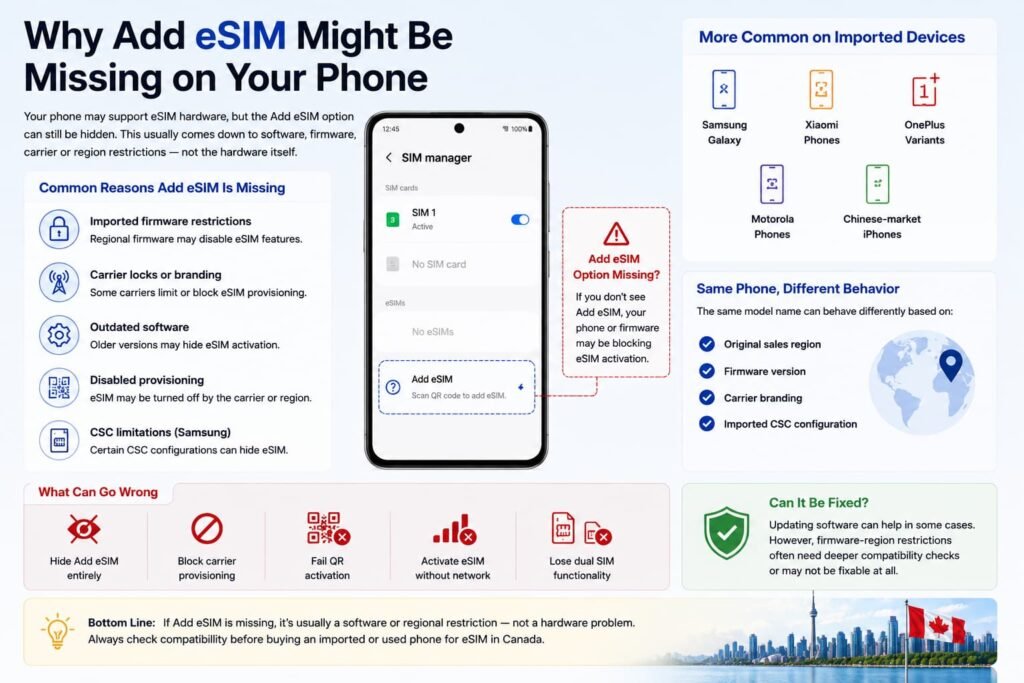
Why Add eSIM Might Be Missing on Your Phone
One of the most common eSIM problems in Canada happens when a phone technically supports eSIM hardware but the Add eSIM option never appears inside the settings menu.
This usually happens because of imported firmware restrictions, carrier locks, outdated software, disabled provisioning, or CSC limitations on Samsung devices. In many cases, the hardware itself fully supports eSIM, but the regional firmware disables activation features for Canadian carriers.
This problem is especially common with imported:
- Samsung Galaxy devices
- Xiaomi phones
- OnePlus variants
- Motorola phones
- Chinese-market iPhones
Two phones with the exact same commercial name can behave completely differently depending on:
- original sales region
- firmware version
- carrier branding
- imported CSC configuration
Some imported devices may:
- hide Add eSIM entirely
- block carrier provisioning
- fail QR activation
- activate eSIM without network access
- lose dual SIM functionality
Updating the device software can sometimes restore eSIM visibility, but firmware-region restrictions often require much deeper compatibility checks before activation.
Common eSIM Compatibility Mistakes in Canada
A lot of Canadian users run into eSIM problems because of a few very common setup mistakes.
The most frequent issues include:
- buying imported phones without checking IMEI2
- assuming every Samsung A-series model supports eSIM
- forgetting to unlock carrier devices before switching providers
- ignoring LTE Band 66 compatibility
- deleting an eSIM before completing a transfer
- buying used marketplace phones without checking the firmware region
We see these problems happen most often with imported Android devices, grey-market Samsung phones, and second-hand phones purchased online.
Taking a few minutes to verify compatibility before activation can prevent a lot of frustration later.
Grey Market and Imported Phone Risks in Canada
Grey-market phones are one of the biggest reasons eSIM activation problems happen in Canada. We regularly see compatibility issues with imported devices that technically support eSIM but still fail during Canadian carrier activation.
A device may look identical to the Canadian version but still:
- disable eSIM in firmware
- hide the Add eSIM menu
- miss LTE Band 66
- fail Canadian VoLTE provisioning
- activate eSIM but never connect properly
This is extremely common with:
- Korean Samsung variants
- Chinese Xiaomi devices
- Indian OnePlus models
- Mainland China iPhones
- imported Oppo devices
High-Risk Regions for Canadian eSIM
These regions commonly create compatibility problems:
- Mainland China
- Korea
- India
- some Middle East variants
- some Southeast Asian variants
Safer Regions for Canadian eSIM
These regions generally work well in Canada:
- Canada
- USA unlocked
- UK
- European Union
- Australia
- Global variants
Major Warning Signs Before Buying a Used Phone
| Warning Sign | Potential Risk |
|---|---|
| No IMEI2 | No eSIM hardware present |
| No Add eSIM Option | Firmware or regional restrictions |
| Korean Samsung Variant | CSC compatibility issues |
| Chinese Firmware | Canadian carrier compatibility problems |
| Missing LTE Band 66 | Weak Canadian network support |
| Carrier Lock | eSIM activation restrictions |
Avoid devices if you notice:
- no IMEI2
- no Add eSIM option
- suspiciously low price
- carrier lock
- Chinese firmware
- Korean model numbers ending in N
- missing LTE Band 66
A lot of imported phones technically support eSIM globally but still struggle on Canadian carriers because of firmware restrictions, missing LTE bands, or provisioning differences. This is especially common with marketplace imports and region-specific firmware versions.
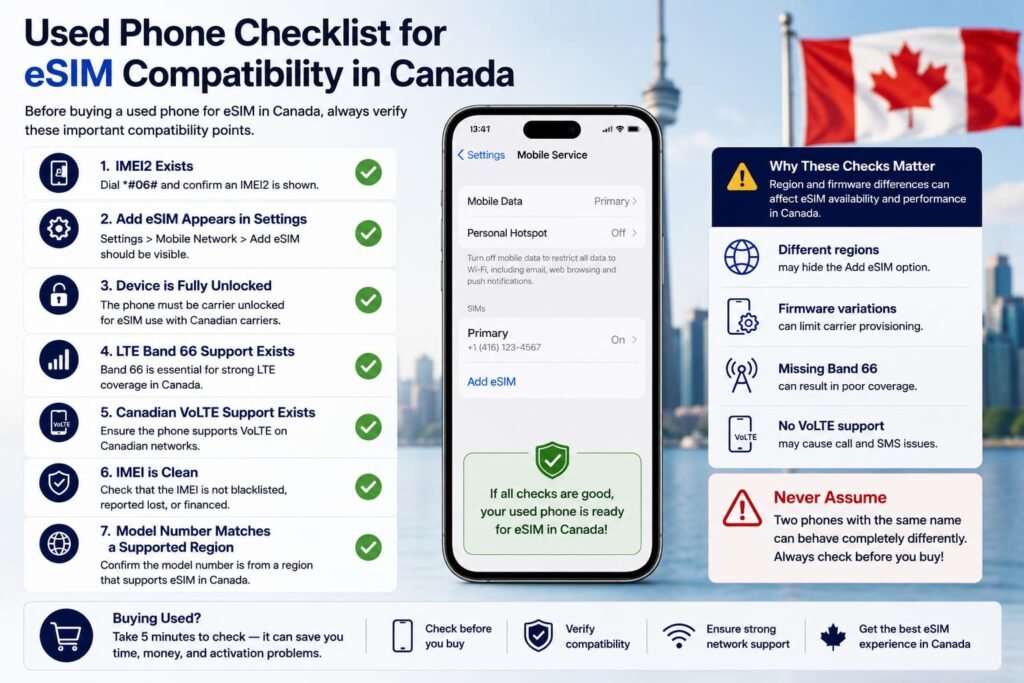
Used Phone Checklist for eSIM Compatibility in Canada
Before buying a used phone for eSIM in Canada, always verify:
- IMEI2 exists
- Add eSIM appears in settings
- the device is fully unlocked
- LTE Band 66 support exists
- Canadian VoLTE support exists
- the IMEI is clean
- the model number matches a supported region
Never assume two phones with the same name behave the same way.
Region and firmware differences matter heavily for eSIM in Canada.
Common Canadian eSIM Compatibility Problems
Imported Samsung Device
Some imported Samsung Galaxy phones technically support eSIM hardware but still fail in Canada because the regional CSC firmware disables carrier provisioning or hides the Add eSIM menu entirely.
This is especially common with:
- Korean-market Samsung devices
- international marketplace imports
- carrier-customized firmware versions
In many cases, the phone looks identical to the Canadian version but behaves very differently during activation.
Verizon Pixel
Older Verizon Pixel models may block eSIM functionality until the device is fully carrier unlocked.
Even when the hardware supports eSIM, some Verizon firmware versions restrict activation outside the original carrier environment.
Moto G Variant Differences
Motorola compatibility can vary heavily between regional variants.
One Moto G model may fully support eSIM in Canada while another version with a nearly identical name may only support physical SIM.
This is one of the biggest reasons Canadian users should always verify the exact model number before purchasing imported Motorola phones.
Chinese-Market iPhone
Some Chinese-market iPhones do not support eSIM at all because Apple uses dual physical SIM hardware instead of eSIM in certain mainland China models.
These phones may still appear identical to Canadian iPhones externally while lacking eSIM capability internally.
Prepaid Carrier Restrictions
Some Canadian prepaid carriers still handle eSIM differently from postpaid plans.
In certain cases:
- manual QR provisioning may be required
- customer support activation may be necessary
- prepaid eSIM transfers may be more limited
This can vary significantly between carriers and device models.
Frequently Asked Questions About Does My Phone Support eSIM in Canada
Does My Phone Need to Be Unlocked to Use eSIM in Canada?
In most situations, your phone needs to be fully unlocked before you can activate an eSIM with a different Canadian carrier or travel provider. A carrier-locked phone may still support eSIM hardware internally, but the software restrictions can prevent activation outside the original network.
This is especially common with older U.S. carrier phones from Verizon, AT&T, and T-Mobile. Some locked devices may hide the Add eSIM option entirely, while others block carrier provisioning during setup.
If you plan to switch Canadian carriers or use travel eSIM providers like Airalo or Holafly, unlocking the phone first is usually the safest approach.
Can I Transfer My eSIM Between Phones in Canada?
Most Canadian carriers now allow eSIM transfers between compatible devices, although the process still varies quite a bit between providers. Some carriers support automatic device-to-device transfer directly during setup, while others still require a brand-new QR code or manual account verification before activation can continue. Imported devices and prepaid accounts sometimes create additional complications during transfer. If you need step-by-step instructions, follow our How to Switch eSIM Between Devices in Canada and How to Reinstall or Reactivate an eSIM in Canada guides for detailed troubleshooting and transfer help.
Related eSIM Canada Guides
If you are researching device compatibility, activation, or troubleshooting in Canada, these related guides can help.
- Activate eSIM on Android Canada for general activation steps
- How to eSIM on Samsung Galaxy in Canada for specific setup instructions
- How to Activate eSIM on Google Pixel in Canada for activation and troubleshooting
- How to Activate eSIM on Motorola Phones in Canada for setup guidance
- How to Activate eSIM on iPhone in Canada for iPhone eSIM activation instructions
- How to Switch eSIM Between Devices in Canada for transfer and migration help
- How to Reinstall or Reactivate an eSIM in Canada for QR reinstallation and recovery
- How to Remove or Delete an eSIM in Canada for profile removal instructions
- What to Do If eSIM Activation Fails in Canada for activation troubleshooting
- How to Fix eSIM Not Working in Canada for connectivity troubleshooting
- Compare Canadian eSIM Providers for carrier and provider comparisons
- eSIM Canada: Best Providers, Setup & Guide for Travelers & Locals for the main Canadian eSIM pillar guide
Final Thoughts
eSIM support in Canada has improved significantly over the last few years, and most modern smartphones now support eSIM activation across major Canadian carriers. The confusing part is that compatibility still depends on much more than just the phone name printed on the box.
Two phones with the exact same commercial name can behave completely differently depending on:
- firmware region
- carrier branding
- imported software
- CSC configuration
- SIM lock status
- Canadian network certification
This is why imported phones, marketplace devices, and grey-market models continue to cause so many activation problems across Canada.
Before activating eSIM, always take a few minutes to:
- confirm your exact model number
- verify IMEI2 exists
- check that Add eSIM appears inside settings
- confirm LTE Band 66 and Canadian VoLTE support
- make sure the device is fully unlocked
- verify your carrier officially supports the model
These small checks can prevent hours of troubleshooting later.
Once compatibility is confirmed, eSIM activation in Canada is usually very simple. Most newer iPhone, Samsung Galaxy, Google Pixel, and Motorola devices can activate eSIM in just a few minutes using a QR code, carrier app, or built-in transfer system.
As Canadian carriers continue expanding eSIM support, understanding device compatibility is becoming more important than ever, especially if you buy imported phones, travel frequently, switch carriers often, or plan to use dual SIM functionality regularly.


