If you have researched travel eSIMs at all, you have probably come across Airalo.
There is a reason for that.
Airalo has become the default global travel eSIM for a huge number of travelers because it balances three things better than most competitors:
- affordable pricing
- broad international coverage
- simple setup
It is not trying to be the most premium provider, and it is not built around unlimited data. Instead, Airalo focuses on giving travelers an easy way to get connected almost anywhere without dealing with physical SIM cards or expensive roaming.
That balance is what made Airalo one of the biggest names in the travel eSIM space.
Airalo is also frequently included among the top recommendations in the eSIM Providers by Country guide because of its balance between affordability, coverage, and ease of use.
In this Airalo eSIM review, you will see how the service actually performs during travel, where it works best, how pricing compares to competitors like Holafly and Nomad, and whether Airalo is still worth using in 2026.
Airalo eSIM Review: What You Need to Know
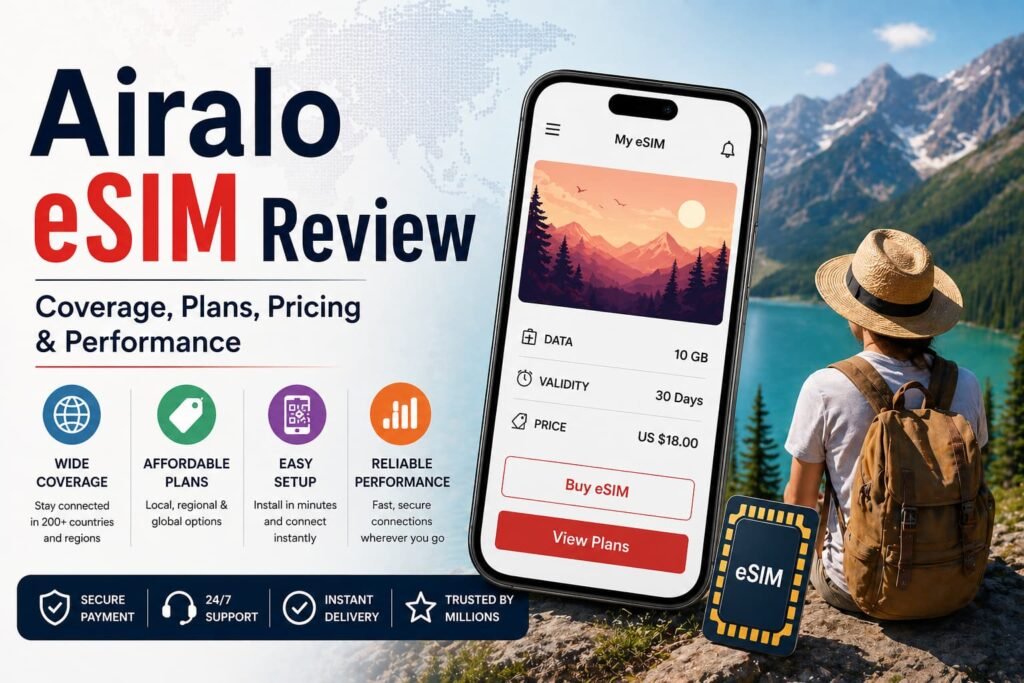
Airalo is one of the most widely used travel eSIM providers in the world.
It offers prepaid mobile data plans in more than 200 countries and regions, allowing travelers to connect to local networks without swapping physical SIM cards.
Unlike premium providers focused on infrastructure control or unlimited data, Airalo positions itself as a flexible and approachable travel connectivity platform.
That distinction matters.
Airalo sits between two different types of providers:
- simple beginner-friendly providers like Saily
- marketplace-style platforms like Mobimatter and Airhub
Compared to beginner-focused providers, Airalo offers more flexibility, while still feeling far more standardized and easier to manage than marketplace-style platforms.
That balance is a major reason why so many travelers use it.
Airalo works especially well for:
- short international trips
- budget-conscious travel
- multi-country travel
- backpacking
- city-based travel
- first-time eSIM users
- travelers who want quick setup without paying premium prices
It is less ideal for:
- travelers needing unlimited high-speed data
- heavy streaming and hotspot use
- enterprise-grade business travel
- users prioritizing premium low-latency performance
For most travelers, though, Airalo delivers one of the best balances between affordability, flexibility, and ease of use.
What is Airalo eSIM and How Does It Work
Airalo is a global travel eSIM platform that connects travelers to local mobile networks through roaming partnerships and regional telecom agreements.
Instead of operating its own towers or mobile infrastructure, Airalo works with carrier partners in different countries to provide prepaid data access.
In practice, this means:
- you purchase a data plan
- install the eSIM on your device
- activate the line when you arrive
- connect to a local partner network automatically
Most plans are data-only.
Apps like:
- FaceTime
- Telegram
- iMessage
- Google Maps
continue working normally.
One important thing to understand is that Airalo behaves more like a curated travel eSIM ecosystem than a traditional telecom provider.
Different plans may rely on different regional suppliers and roaming agreements behind the scenes.
That means:
- performance can vary by country
- some regional plans perform differently than local plans
- routing depends on local carrier partnerships
- speeds vary depending on network congestion and roaming priority
Compared to marketplace-style platforms like Mobimatter or Airhub, Airalo feels much more standardized.
Compared to premium providers like Ubigi or GigSky, Airalo focuses more on affordability and accessibility than infrastructure control.
That positioning is exactly why Airalo became so popular with everyday travelers.
Before You Buy Airalo
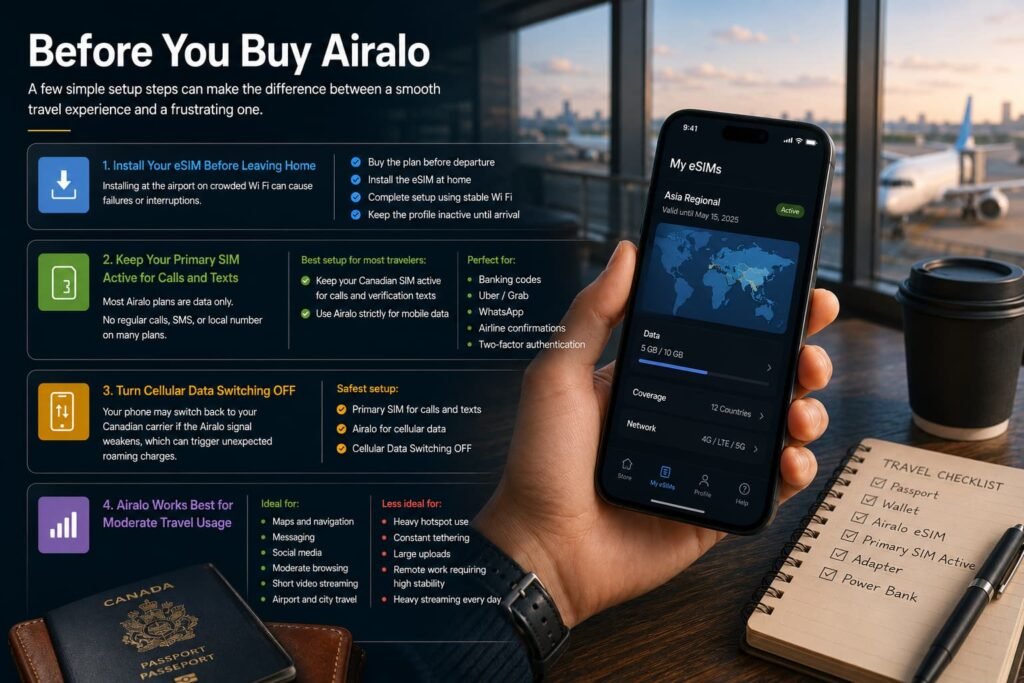
Before buying an Airalo plan, there are a few important things most travelers do not realize until they are already standing in an airport trying to troubleshoot their connection.
These small setup mistakes are responsible for many of the negative experiences people report online.
Install Your eSIM Before Leaving Home
One of the biggest mistakes travelers make is trying to install and activate their Airalo eSIM after landing using crowded airport Wi Fi.
Airport networks are often overloaded, unstable, or require repeated browser logins. If the installation process gets interrupted halfway through, the eSIM profile may fail to configure properly.
It is much safer to:
- buy the plan before departure
- install the eSIM at home
- complete setup using stable Wi Fi
- keep the profile inactive until arrival
This alone prevents a huge number of activation problems.
Keep Your Primary SIM Active for Calls and Texts
Most Airalo plans are data only.
That means:
- no regular voice calls
- no standard SMS support on many plans
- no local number in most regions
For most travelers, the best setup is:
- keep your primary Canadian SIM active for calls and verification texts
- use Airalo strictly for mobile data
This setup works especially well for:
- banking verification codes
- Uber and Grab accounts
- WhatsApp registration
- airline confirmations
- two-factor authentication
Turn Cellular Data Switching OFF
This is one of the most overlooked settings.
On iPhone and Android devices that support multiple lines, the phone may automatically switch back to your Canadian carrier if the Airalo signal weakens temporarily.
If your Canadian carrier roaming remains active, that can trigger unexpected roaming charges.
The safest setup is usually:
- Primary SIM for calls and texts
- Airalo for cellular data
- Cellular Data Switching OFF
Airalo Works Best for Moderate Travel Usage
Airalo performs best for:
- maps and navigation
- messaging
- social media
- moderate browsing
- short video streaming
- airport and city travel
It is less ideal for:
- heavy hotspot use
- constant tethering
- large uploads
- remote work requiring high stability
- heavy streaming every day
For casual travel, though, it handles everyday connectivity very well.
What Makes Airalo Different
Airalo became one of the biggest travel eSIM providers because it solved a simple problem:
Most travelers do not want to think too much about mobile connectivity.
They just want affordable data that works when they land.
Airalo focuses heavily on reducing travel friction.
What makes it stand out:
- broad global coverage
- affordable entry pricing
- easy app-based setup
- flexible regional plans
- simple top-up system
- reliable onboarding experience
- strong support for multi-country travel
Unlike providers focused on premium infrastructure, Airalo prioritizes simplicity and flexibility.
It also avoids the complexity of open marketplace platforms where travelers need to compare dozens of suppliers manually.
That creates a very approachable experience for travelers who want something practical without spending hours researching roaming systems.
At the same time, there are tradeoffs.
Airalo is not:
- the cheapest provider in every country
- the strongest premium infrastructure provider
- the best unlimited-data solution
- the lowest-latency option for business users
Its strength is balance.
Airalo performs best when:
- convenience matters
- moderate pricing matters
- multi-country flexibility matters
- quick setup matters
That broad usability is what made Airalo the benchmark global travel eSIM provider.
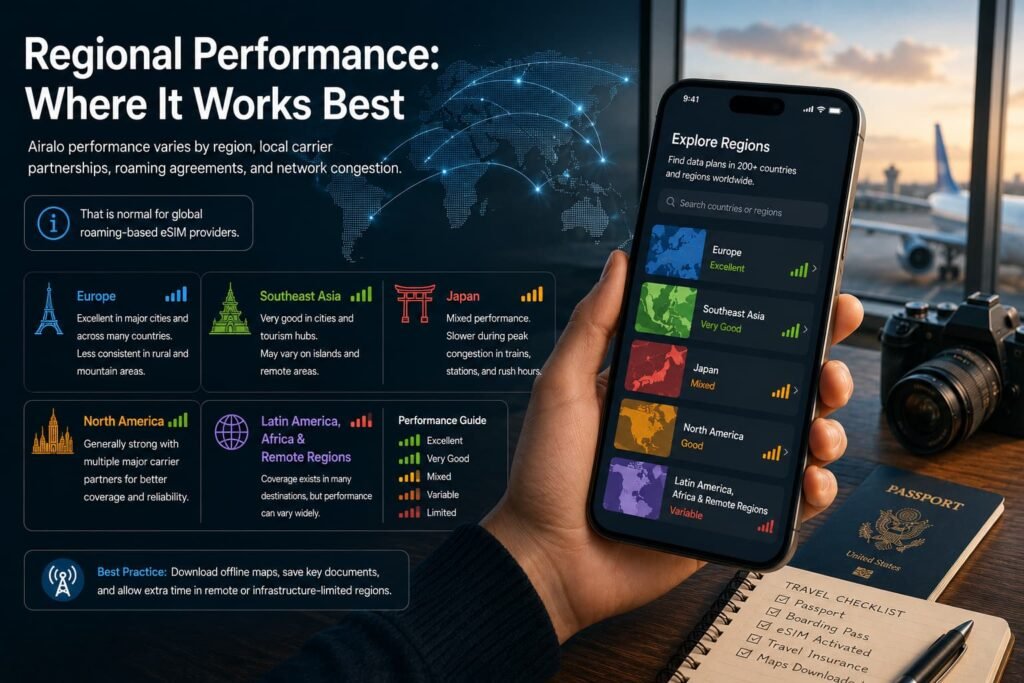
Regional Performance: Where Airalo Works Best
Airalo performs differently depending on the region, local carrier partnerships, roaming agreements, and network congestion.
That is normal for global roaming-based eSIM providers.
Europe
Europe is still one of Airalo’s strongest regions overall.
Travelers moving between countries like:
- France
- Germany
- Spain
- Italy
- Portugal
- Netherlands
usually report smooth transitions between networks without needing to reinstall profiles or manually switch plans.
Performance in major European cities is generally excellent for:
- navigation
- WhatsApp calls
- browsing
- public transit apps
- social media
In Western Europe, Airalo often feels very close to using a local SIM.
Performance can become less consistent in:
- rural zones
- mountain regions
- smaller Mediterranean destinations
- lower-priority roaming regions
Southeast Asia
Airalo performs very well in:
- Thailand
- Singapore
- Malaysia
- Bali
- Vietnam
especially in cities and major tourism corridors.
Urban connectivity is usually reliable and setup tends to work smoothly across multiple countries.
Travelers using regional Asia plans often like the ability to cross borders without changing SIMs repeatedly.
Performance becomes more unpredictable in:
- islands
- remote beaches
- rural areas
- lower-priority local networks
Japan
Japan is one of the more mixed regions for Airalo.
Basic browsing and messaging usually work fine in:
- Tokyo
- Osaka
- Kyoto
But many travelers report slower real-world responsiveness during peak congestion periods.
This is especially noticeable during:
- train commutes
- crowded transit hubs
- rush-hour periods
- major stations
In practice, pages may feel slower to load even when the phone still shows strong LTE or 5G signal bars.
Travelers who prioritize lower latency and stronger real-time responsiveness in Japan often compare Airalo against providers like Ubigi.
North America
Airalo generally performs well across:
- Canada
- United States
- Mexico
especially in cities and airport-heavy travel.
One advantage in North America is that Airalo often connects through multiple major carrier partners depending on the region.
This can help improve:
- coverage flexibility
- travel reliability
- urban redundancy
especially if one local carrier experiences congestion.
Latin America, Africa and Remote Regions
Coverage exists in many destinations, but performance can vary much more heavily depending on:
- local infrastructure
- roaming agreements
- regional congestion
- tower priority
Travelers visiting remote or infrastructure-limited regions should expect less consistency compared to Europe or North America.
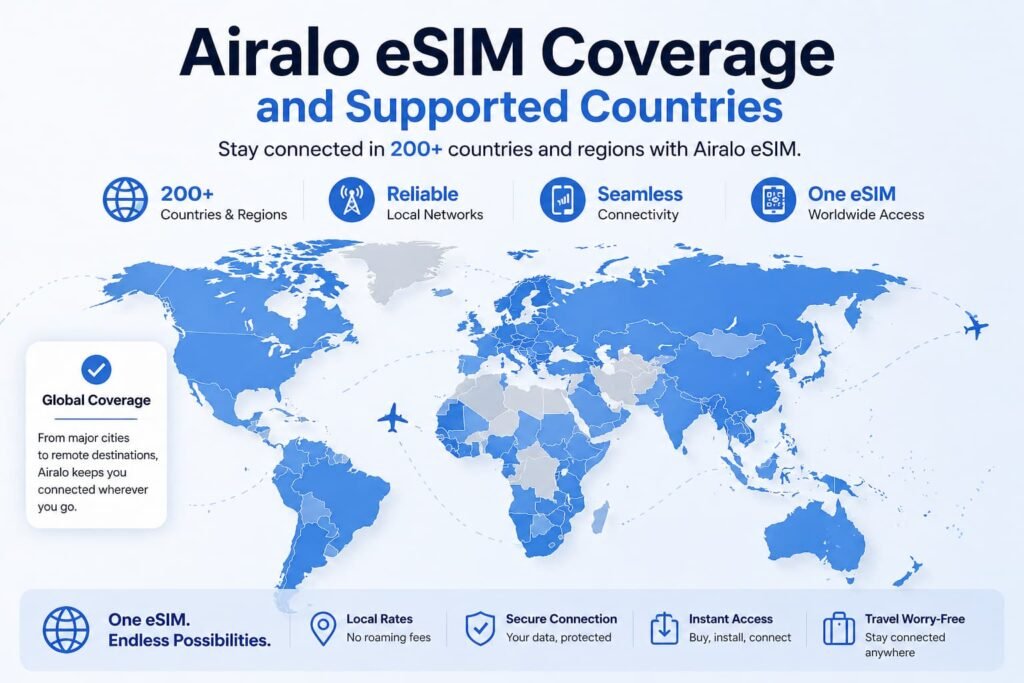
Airalo Coverage and Supported Countries
Airalo covers more than 200 countries and regions worldwide.
Coverage includes:
| Region | Example Countries |
|---|---|
| Europe | UK, France, Germany, Italy, Spain, Portugal |
| North America | USA, Canada, Mexico |
| Asia | Japan, South Korea, Thailand, Singapore, Indonesia |
| Oceania | Australia, New Zealand |
| South America | Brazil, Argentina, Chile, Colombia |
| Africa | South Africa, Morocco, Kenya |
| Middle East | UAE, Saudi Arabia, Turkey |
One of Airalo’s biggest strengths is regional travel.
Instead of switching eSIMs every time you cross a border, Airalo offers:
- Europe regional plans
- Asia regional plans
- North America plans
- global plans
That makes travel much easier for:
- backpackers
- multi-country vacations
- long-term travelers
- digital nomads
Airalo generally performs best in:
- major cities
- airports
- tourism-heavy regions
- established travel corridors
- Europe
- Southeast Asia
- North America
Performance becomes less predictable in:
- rural areas
- remote destinations
- low-priority roaming regions
- developing infrastructure markets
Like all roaming-based eSIM providers, performance depends heavily on local carrier partnerships.

Airalo Network Partners by Country
Airalo connects to local carriers depending on the destination.
Examples include:
- USA: T-Mobile, Verizon, AT&T
- Canada: Bell, TELUS, Rogers
- UK: Vodafone, O2, Three
- Japan: SoftBank, KDDI, Docomo
- France: Orange, Bouygues, SFR
In some countries, Airalo can switch between multiple carrier partners to maintain stronger coverage.
This usually improves:
- urban reliability
- airport connectivity
- travel corridor stability
- multi-city travel performance
In real-world use, that means fewer situations where travelers need to manually troubleshoot connectivity after landing.
Airalo Pricing and Plan Costs
Airalo became popular partly because it made travel data feel affordable and predictable.
Instead of paying expensive roaming fees, travelers can purchase prepaid plans directly through the official Airalo website or inside the Airalo app.
Typical pricing:
| Destination | Data | Duration | Price (USD) |
|---|---|---|---|
| USA | 10GB | 30 Days | ~$18–$26 |
| Canada | 10GB | 30 Days | ~$20–$30 |
| Japan | 10GB | 30 Days | ~$18–$28 |
| Europe Regional | 10GB | 30 Days | ~$20–$35 |
| Thailand | 5GB | 30 Days | ~$9–$16 |
| Global Plan | 5GB | 60 Days | ~$35–$59 |
Typical pricing tiers:
- 1GB: around $4 to $7
- 5GB: around $12 to $22
- 10GB: around $18 to $35
- regional plans vary depending on countries included
Airalo works especially well for:
- budget-conscious travelers
- moderate data users
- short-term trips
- travelers visiting multiple countries
Compared to competitors:
- Holafly focuses more on unlimited data
- Nomad focuses more on structured regional flexibility
- Mobimatter focuses more on marketplace pricing competition
- Saily focuses more on guided simplicity
Airalo sits comfortably in the middle of the market.
For travelers who want affordable prepaid data without moving into premium pricing territory, Airalo remains one of the strongest flexible-budget travel eSIM options available.
It gives travelers enough flexibility without becoming overly complicated.
Airalo Speeds and Real-World Performance
In real-world travel use, Airalo performs reliably in most cities, airports, and major tourist destinations.
You can typically expect:
- 4G LTE in most countries
- 5G in supported urban areas
- stable messaging and browsing
- reliable navigation performance
- smooth app usage in cities
For everyday travel, Airalo handles:
- maps and navigation
- messaging apps
- browsing and email
- social media
- light streaming
- airport connectivity
One thing many travelers notice is that raw speed tests do not always reflect real-world responsiveness.
For example, a phone may show:
- strong 5G signal
- fast download speeds
- full bars
but still feel slightly delayed when:
- opening maps
- starting WhatsApp calls
- loading ride-share apps
- switching between apps
This usually happens because roaming-based eSIM providers can introduce additional latency depending on how traffic is routed through international roaming infrastructure.
In simple terms:
download speeds may still look fast even when responsiveness feels slower.
This is most noticeable in:
- Japan
- remote regions
- lower-priority roaming zones
- congested transit areas
For normal travel use, most users will never notice this heavily.
But:
- remote workers
- gamers
- heavy hotspot users
- video-call-heavy travelers
may notice the difference compared to local carrier SIMs or premium infrastructure-focused providers.
Performance depends heavily on:
- local carrier quality
- roaming agreements
- congestion levels
- regional routing
- local infrastructure
Where Airalo performs strongest:
- Europe
- Japan urban centers
- Southeast Asia cities
- North America
- major international airports
- urban travel corridors
Where performance can become less predictable:
- rural areas
- remote islands
- lower-priority roaming regions
- congested local networks
Compared to providers like Ubigi or GigSky, Airalo prioritizes accessibility and pricing flexibility over premium infrastructure consistency.
That tradeoff works well for most casual and moderate travelers.
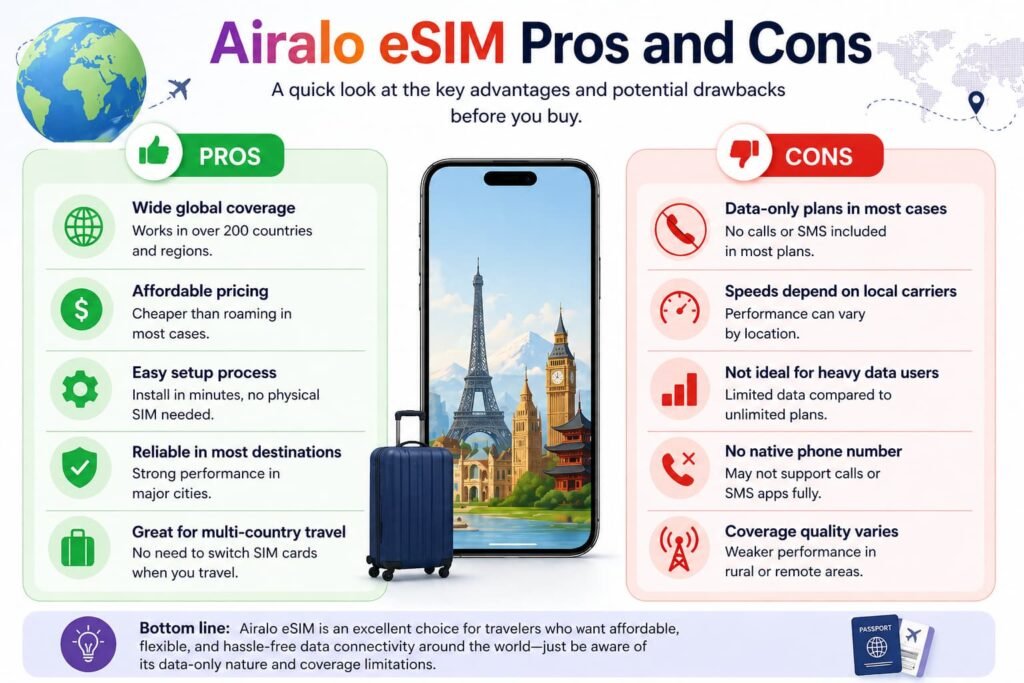
Airalo eSIM Pros and Cons
| Pros | Cons |
|---|---|
| Wide global coverage – works in over 200 countries | Data-only plans in most cases – no calls or SMS included |
| Affordable pricing – cheaper than roaming in most cases | Speeds depend on local carriers – performance can vary by location |
| Easy setup process – install in minutes, no physical SIM needed | Not ideal for heavy data users – limited compared to unlimited plans |
| Reliable in most destinations – strong performance in major cities | No native phone number – may not support calls or SMS apps fully |
| Great for multi-country travel – no need to switch SIM cards | Coverage quality varies – weaker performance in rural areas |
Is Airalo eSIM Worth It
Airalo is worth it for travelers who need affordable and flexible mobile data without relying on expensive roaming.
It is particularly useful if you:
- want quick connectivity upon arrival
- are traveling across multiple countries
- need basic data for navigation and communication
If you rely heavily on streaming, remote work, or high data usage, you may want to consider alternatives.
Airalo vs Other eSIM Providers
Airalo vs Holafly
Holafly is built much more around unlimited travel data.
For a deeper comparison of unlimited travel data plans, see the Holafly eSIM Review.
Airalo focuses more on affordable fixed-data flexibility.
If unlimited streaming and heavy daily usage matter most, Holafly is usually the better option.
If pricing flexibility and moderate usage matter more, Airalo is often the better fit.
Quick take: Holafly for unlimited data, Airalo for affordable flexibility.
Airalo vs Nomad
Nomad is designed more around structured regional travel flexibility.
You can compare regional travel pricing and multi-country flexibility further in the Nomad eSIM Review.
Airalo focuses more on broad mainstream usability.
Nomad often works better for travelers moving across multiple countries within one region.
Airalo usually feels more approachable for everyday travel.
Quick take: Nomad for regional flexibility, Airalo for mainstream travel simplicity.
Airalo vs Saily
Saily focuses heavily on guided simplicity.
If you want to compare beginner-friendly onboarding and simplified setup, see the Saily eSIM Review.
Airalo gives travelers more plan flexibility and broader choices.
If simplicity alone matters most, Saily feels easier.
If broader coverage and plan variety matter more, Airalo is usually stronger.
Quick take: Saily for simplicity, Airalo for flexibility.
Airalo vs Ubigi
Ubigi is built more around stable infrastructure and performance consistency.
For stronger premium connectivity and lower-latency travel performance, compare the Ubigi eSIM Review.
Airalo focuses more on accessibility and pricing.
If premium connection stability matters most, Ubigi is usually the stronger option.
If budget and flexibility matter more, Airalo is usually more practical.
Quick take: Ubigi for premium stability, Airalo for affordability.
Airalo vs GigSky
GigSky is built more for premium global business-style travel connectivity.
If premium business-style travel connectivity matters more, see the GigSky eSIM Review.
Airalo focuses on mainstream travel usability.
If enterprise-level reliability matters most, GigSky is stronger.
If affordability and accessibility matter more, Airalo is usually the better fit.
Quick take: GigSky for premium global performance, Airalo for everyday travel.
Airalo vs Mobimatter
Mobimatter operates more like a marketplace platform where travelers compare multiple providers, pricing structures, and network options.
For broader provider comparison and marketplace pricing flexibility, see the Mobimatter eSIM Review.
Airalo feels more curated and standardized.
If comparing multiple providers and pricing structures matters most, Mobimatter becomes more attractive.
If cleaner onboarding and easier setup matter more, Airalo usually feels simpler.
Quick take: Mobimatter for marketplace flexibility, Airalo for streamlined usability.
Airalo vs Jetpac
Jetpac focuses heavily on travel perks and convenience.
Travelers who value airport perks and travel convenience can also compare the Jetpac eSIM Review.
Airalo focuses more on broad global flexibility.
If airport perks and travel extras matter most, Jetpac is appealing.
If broader country coverage and standardized travel usability matter more, Airalo is usually stronger.
Quick take: Jetpac for travel perks, Airalo for broad travel flexibility.
Airalo vs Keepgo
Keepgo focuses heavily on long-validity rollover connectivity and persistent travel data.
Travelers focused on long-validity rollover connectivity across multiple trips can compare the Keepgo eSIM Review.
Airalo focuses more on mainstream short-to-medium-term travel flexibility.
If persistent rollover data matters most, Keepgo is usually stronger.
If flexible mainstream travel usability matters more, Airalo is usually easier to manage.
Quick take: Keepgo for rollover persistence, Airalo for mainstream travel flexibility.
Airalo vs Flexiroam
Flexiroam focuses more on roaming continuity and long-term travel persistence.
Travelers planning longer multi-country trips may also want to explore the Flexiroam eSIM Review for stronger roaming continuity.
Airalo focuses more on straightforward short-to-medium-term travel.
If long-term roaming continuity matters most, Flexiroam is stronger.
If mainstream vacation travel matters more, Airalo is usually easier to manage.
Quick take: Flexiroam for roaming continuity, Airalo for mainstream travel.
Airalo vs Yesim
Travelers who want more flexible purchasing structures and adaptable plan options may prefer Yesim.
For more adaptable purchasing structures and flexible plan management, see the Yesim eSIM Review.
Airalo focuses more on standardized travel simplicity.
If adaptable purchasing models matter most, Yesim offers more flexibility.
If predictable mainstream usability matters more, Airalo is usually easier.
Quick take: Yesim for flexible pricing, Airalo for consistency.
Airalo vs aloSIM
Travelers looking for a more guided and predictable onboarding experience may prefer aloSIM.
Travelers who prefer a more guided setup experience can also explore the aloSIM eSIM Review.
Airalo focuses more on global flexibility and larger ecosystem coverage.
If highly guided setup matters most, aloSIM feels simpler.
If broader destination support matters more, Airalo is usually stronger.
Quick take: aloSIM for predictable simplicity, Airalo for broader flexibility.
Airalo vs Airhub
Airhub operates more like an aggressive marketplace platform focused heavily on pricing competition.
Travelers comparing aggressive marketplace pricing can also see the Airhub eSIM Review.
Airalo feels more curated and structured.
If aggressive marketplace pricing matters most, Airhub can sometimes offer lower prices.
If cleaner comparison and easier onboarding matter more, Airalo is usually easier to use.
Quick take: Airhub for marketplace pricing, Airalo for mainstream usability.
Best Use Cases for Airalo
Airalo works best for:
- backpackers
- casual travelers
- short international trips
- moderate data users
- city-focused travel
- multi-country Europe trips
- airport-heavy travel
- travelers wanting immediate connectivity after landing
- first-time eSIM users
- budget-conscious travelers
Airalo is less ideal for:
- unlimited streaming
- constant hotspot usage
- enterprise business travel
- advanced network optimization
- premium low-latency requirements
For most travelers, Airalo offers one of the best overall balances between simplicity, affordability, and global flexibility.
Real-World Usage
One reason Airalo became so popular is that it removes a lot of the friction travelers normally deal with after landing.
Instead of searching for local SIM cards in airports, train stations, or convenience stores, travelers can install their eSIM before departure and connect almost immediately after arrival.
This works especially well for:
- short vacations
- multi-country travel
- airport-heavy trips
- city-based travel
- travelers who want quick setup without dealing with local carriers
For moderate everyday travel usage, Airalo offers one of the easiest and most flexible prepaid travel setups currently available.
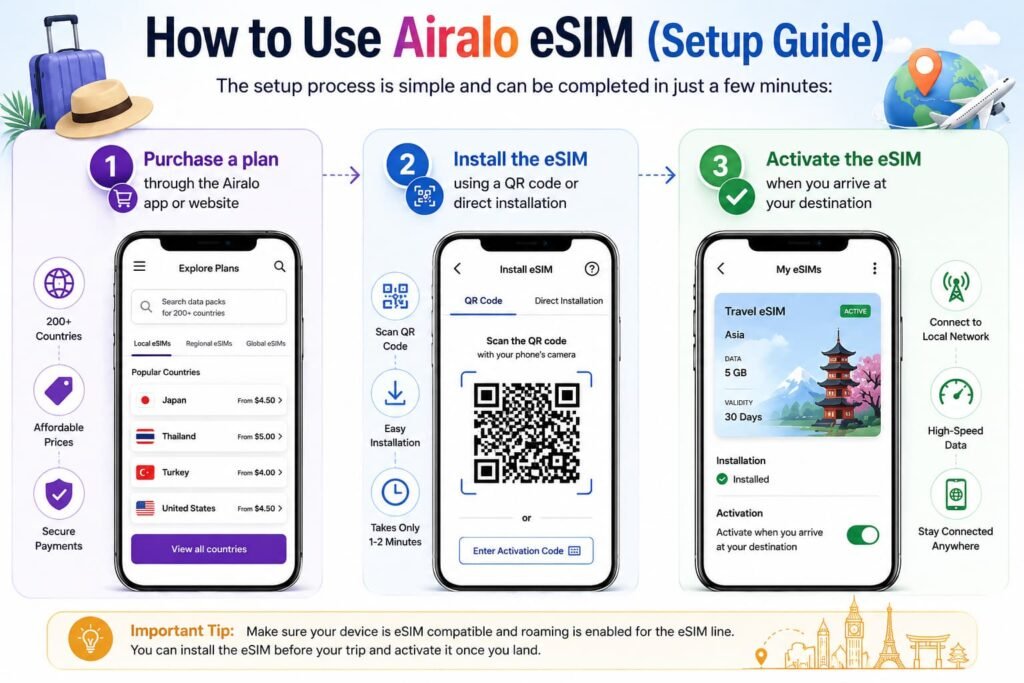
How to Use Airalo eSIM (Setup Guide)
The setup process is simple and usually takes just a few minutes:
- Purchase a plan through the Airalo app or website
- Install the eSIM using a QR code or direct installation
- Activate the eSIM when you arrive at your destination
Your device must be eSIM-compatible and carrier unlocked for this to work properly.
If you need detailed step-by-step instructions, see the Airalo eSIM Activation Guide for iPhone and Android.
You can also follow Airalo’s official Help Center for device-specific setup instructions and troubleshooting guidance.
Once activated, your device should automatically connect to a supported local network.
Common Issues and Troubleshooting
While Airalo is generally reliable, some travelers may run into issues during installation or while reconnecting to local networks after arrival.
Most problems are temporary and can usually be resolved with a few quick checks.
eSIM Stuck on Activating
It is common for the eSIM to take a few minutes to activate after installation.
If it remains stuck:
- restart your device
- toggle airplane mode on and off
- ensure you have a stable internet connection
This commonly happens when devices switch between airport Wi Fi, roaming networks, and local carrier connections during arrival.
In most cases, the connection completes shortly afterward.
No Internet Connection
If the eSIM installs successfully but mobile data does not work:
- make sure mobile data is enabled for the Airalo line
- turn data roaming ON for the eSIM
- confirm your primary SIM is not being used for cellular data
These are the most common causes of connectivity problems after setup.
Incorrect APN Settings
Some Airalo plans require manual APN configuration.
If data does not work properly:
- check the APN details inside the Airalo app
- enter the settings exactly as shown
Incorrect APN settings can prevent mobile data from working even when the eSIM is active.
Weak Signal or Slow Speeds
Performance depends heavily on the local carrier network, roaming agreements, and regional congestion.
If speeds feel inconsistent:
- move to another location
- toggle airplane mode to reconnect
- manually switch carrier networks if your device allows it
Airalo often supports multiple carrier partners in the same country, so reconnecting can sometimes improve performance significantly.
Device Compatibility Issues
Airalo only works on:
- eSIM-compatible devices
- carrier-unlocked phones
If your device is locked or does not support eSIM technology, the service will not work properly.
Most issues are temporary and easy to resolve.
If problems continue, Airalo support can usually be reached directly through the app or through Airalo’s official Help Center.
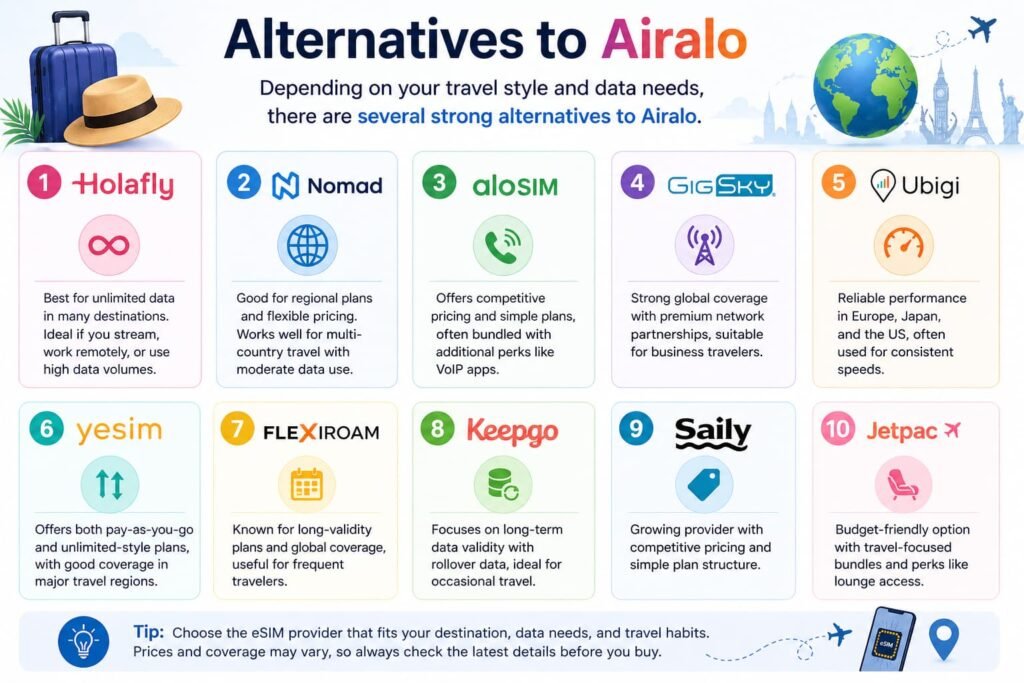
Alternatives to Airalo
Airalo works well for mainstream travel, but it is not the perfect fit for every type of traveler.
Depending on your destination, travel style, and data usage, some providers may align better with specific needs.
- Holafly for unlimited travel data and heavy daily usage
- Nomad for structured regional travel flexibility across multiple countries
- Saily for beginner-friendly onboarding and simple setup
- aloSIM for predictable travel plans and guided activation
- Ubigi for premium infrastructure consistency and lower-latency performance
- GigSky for premium global business-style connectivity
- Mobimatter for marketplace provider comparisons and flexible pricing structures
- Airhub for aggressive marketplace pricing and deal-focused plan comparisons
- Jetpac for airport travel convenience and travel-oriented perks
- Flexiroam for roaming continuity and long-term international travel
- Yesim for adaptable purchasing models and flexible plan management
- Keepgo for long-validity rollover connectivity across multiple trips
Each provider approaches travel connectivity differently.
The best option depends on:
- whether you prioritize pricing, simplicity, premium performance, or unlimited usage
- your destination
- how much data you use
Related Guides
If you are still comparing travel eSIM providers, these related guides can help you choose the right setup for your trip.
- Holafly eSIM Review for unlimited travel data
- Keepgo eSIM Review for long-validity rollover connectivity
- Jetpac eSIM Review for travel convenience and airport perks
- Nomad eSIM Review for structured regional travel plans
- Saily eSIM Review for beginner-friendly simplicity
- Flexiroam eSIM Review for roaming continuity across long-term travel
- aloSIM eSIM Review for predictable setup and straightforward plans
- Ubigi eSIM Review for premium infrastructure consistency
- GigSky eSIM Review for premium global connectivity
- Airhub eSIM Review for marketplace pricing flexibility
- Mobimatter eSIM Review for marketplace pricing and provider comparisons
- eSIM Providers by Country for destination-based provider comparisons
- Best eSIM for International Travel for broader travel recommendations
- How to Activate eSIM on iPhone in Canada
- How to Activate eSIM on Android Canada
Final Thoughts
Airalo became one of the biggest names in travel eSIMs because it gets the balance right for most travelers.
It is not the cheapest provider in every country.
It is not the most premium infrastructure provider.
And it is not built around unlimited data.
What Airalo does extremely well is combine affordable prepaid flexibility with:
- broad international coverage
- approachable pricing
- flexible regional plans
- simple setup
- reliable everyday travel usability
That combination makes it one of the easiest and most practical ways to stay connected while traveling internationally.
For travelers who want a straightforward and affordable travel eSIM without getting pulled into complicated marketplace comparisons or premium business-style infrastructure, Airalo remains one of the strongest overall options available.
More than most providers in this category, Airalo feels designed for real everyday travel.