The best eSIM for Germany needs to work for more than checking messages in Berlin or Munich. Germany is an easy place to underestimate your mobile-data needs. One minute you are checking an ICE platform, and the next you are using maps to find a hotel, translating a menu or navigating a rural road toward the Black Forest.
I recently spent three weeks in Germany on a business trip, with roughly a week each around Frankfurt, Munich and Berlin. During that trip, I tested all eight travel eSIM providers in this guide across cities, airports and train routes, taking speed and latency readings along the way.
That experience reinforced something I already considered important when comparing a Germany eSIM from Canada: the lowest price does not always tell you much about how useful the connection will be once you start moving around. A plan using O2 may be perfectly suitable for a city-focused visit, while access to Vodafone or more than one German network can become more useful on long train journeys, road trips or visits outside the largest cities.
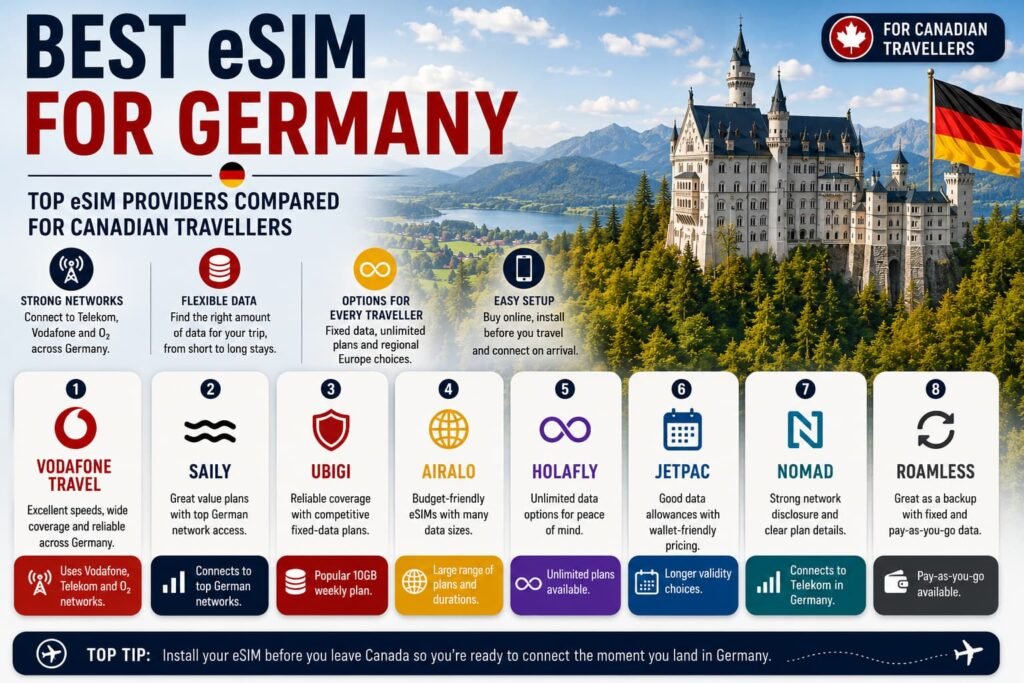
Nomad remains my strongest overall starting point because it combines competitive fixed-data and unlimited-style plans with access to O2 and Vodafone. Ubigi offers particularly good fixed-data value and performed very well during my testing. Saily keeps the setup simple, while Vodafone Travel currently combines unusually competitive high-data packages with the strongest speed result I recorded in Germany.
My Verdict: What’s the Best eSIM for Germany?
Nomad offers the strongest overall balance for many Germany trips because its current plan range covers light, moderate and heavy data use with access to O2 and Vodafone. It also performed strongly during my Germany testing, making it a particularly well-rounded option rather than simply a good plan on paper.
Ubigi is particularly attractive when 10 GB is enough. It produced one of my strongest representative download results during the trip and remained useful on city routes and longer train journeys.
Saily is an easy starting point for travellers who value a straightforward app, automatic activation and useful security features. Its speeds were more modest during my testing, but still more than adequate for maps, messaging, email and ordinary travel use.
Vodafone Travel deserves a close look for heavier data use. Its current Germany promotion includes generous fixed-data packages and an unlimited option, and my Germany result was the fastest of the eight providers compared here.
Holafly suits travellers who want unlimited phone data for an exact number of days, Jetpac is useful for unrestricted hotspot sharing, and Roamless works particularly well as flexible backup data while also performing strongly in my testing.
The final choice should still reflect the itinerary. Speed is only one part of the decision. Price, allowance, hotspot rules, validity and the German networks available through the plan can matter just as much, particularly when the trip includes ICE trains, rural roads, the Black Forest or the Bavarian Alps.
Best eSIMs for Germany Compared
| Provider | Representative Germany plan | CAD | German network information | Calls and SMS | Best suited to |
|---|---|---|---|---|---|
| Nomad | 10 GB for 30 days at US$14 | C$19.43 | O2 and Vodafone | Usually data-only, check plan details | Overall balance and plan flexibility |
| Ubigi | 10 GB for 30 days at US$12.50 | C$17.34 | O2 | Data-only | Fixed-data value and hotspot use |
| Saily | 10 GB for 30 days at €14.99 | C$24.07 | Local partner not named | Optional US number with a separate call and text plan | Simple setup and security tools |
| Jetpac | 10 GB for 30 days at US$14.50 | C$20.12 | Multi-network support, exact partners depend on the plan | In-app outgoing voice packs, no regular SMS | Hotspot sharing and larger allowances |
| Holafly | Unlimited for 7 days at US$27.50 | C$38.16 | Vodafone and Telefónica | Data-only | Unlimited phone data for exact trip dates |
| Roamless | 10 GB for 30 days at US$15.95 | C$22.13 | O2 and Vodafone | In-app calls and optional Roamless Numbers | Backup data and repeat travel |
| Vodafone Travel | 20 GB for 7 days at €10.20 during the current promotion | C$16.38 | Deutsche Telekom, Vodafone and Telefónica | Data-only | Current high-data value |
| Airalo | Regional Europe plans from US$4 | Check current price | Confirm the network on the selected package | Usually data-only, plan dependent | Familiar app and regional Europe coverage |
Prices and promotions can change, so check the current plan details and final checkout price before buying.
You can also use the eSIM Plan Comparison Tool to compare popular travel plans with prices shown in Canadian dollars.
My Germany eSIM Speed Test Results
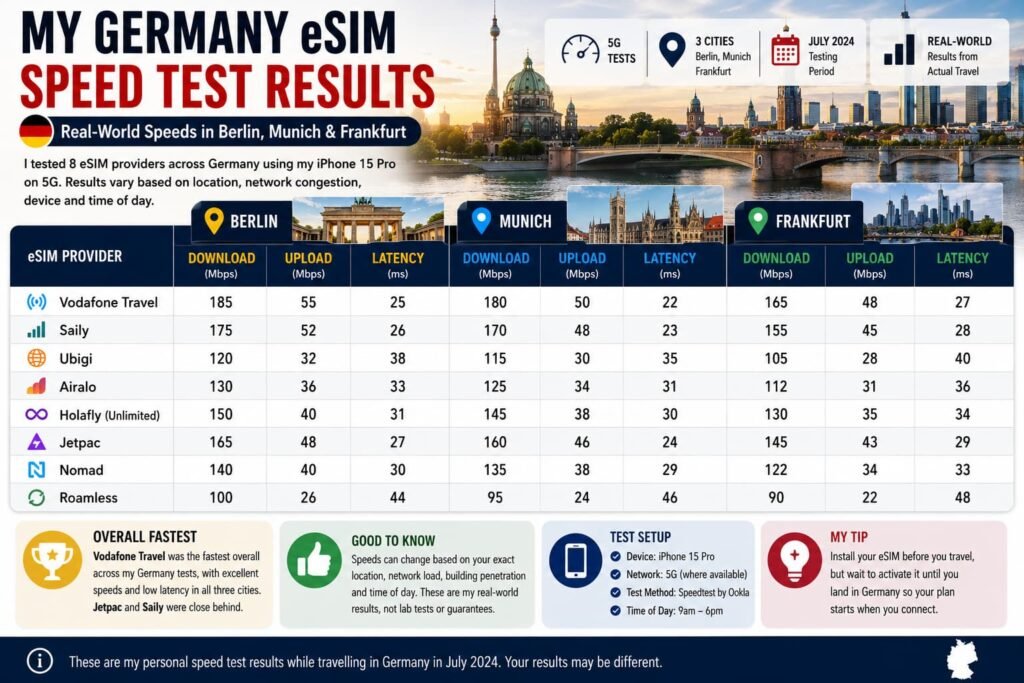
My testing was done during real travel rather than under controlled laboratory conditions. All eight providers were tested during the same three-week business trip through Germany, with roughly a week spent in each of Frankfurt, Munich and Berlin and additional use on train routes between major cities.
For providers where I recorded a range of results, I use the midpoint of that range below as one representative figure. That keeps the comparison easy to read without suggesting that every connection in Germany will produce the same speed.
| Provider | Approx. download | Approx. upload | Approx. latency |
|---|---|---|---|
| Vodafone Travel | 185 Mbps | 55 Mbps | 25 ms |
| Ubigi | 155 Mbps | 43 Mbps | 93 ms |
| Roamless | 140 Mbps | 38 Mbps | 78 ms |
| Nomad | 128 Mbps | 33 Mbps | 110 ms |
| Jetpac | 113 Mbps | 28 Mbps | 113 ms |
| Holafly | 60 Mbps | 23 Mbps | 150 ms |
| Saily | 58 Mbps | 20 Mbps | 130 ms |
| Airalo | 53 Mbps | 20 Mbps | 120 ms |
Vodafone Travel eSIM produced the strongest result during this test, but I would not choose a Germany eSIM from the speed table alone. Ubigi, Roamless, Nomad and Jetpac also gave me strong real-world performance, while the slower results from Saily, Holafly and Airalo were still sufficient for normal travel tasks.
The more useful takeaway is that every provider behaved differently once network routing, location and local coverage came into play. A speed test in central Frankfurt does not predict what will happen inside an ICE carriage, in a hotel or on a rural stretch of road.
Mobile performance can also change with congestion, the phone being used, local network conditions and the roaming arrangement behind the eSIM. These figures reflect what I recorded during this particular three-week Germany trip rather than guaranteed Germany-wide averages.
Start With the German Network, Not Just the Price
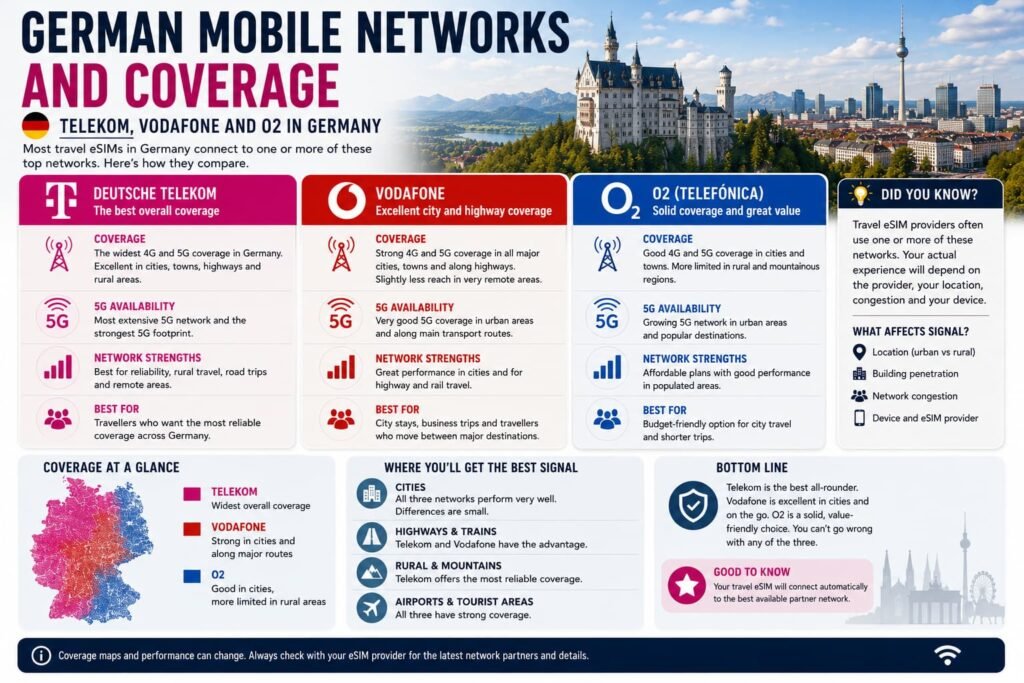
Germany has three main mobile network operators:
- Deutsche Telekom
- Vodafone
- Telefónica Germany, commonly known as O2
According to Germany’s Federal Network Agency, approximately 98% of the country had 4G or 5G mobile broadband coverage as of October 2025. The regulator reported 5G surface coverage of about 87% for Deutsche Telekom, 75% for Vodafone and 76% for Telefónica.
Those national figures do not mean that one provider will maintain uninterrupted service everywhere. Signal quality can still change with terrain, buildings, congestion, tunnels and the roaming agreements attached to a specific eSIM.
I noticed the practical side of this during the Germany trip. A connection that was excellent in central Frankfurt or Munich could behave differently once the train left a major urban area. That is why I would not choose solely from a speed-test ranking.
The practical lesson is to look beyond a simple “5G supported” label. An eSIM can support 5G while still limiting you to one local operator. Another product may include more than one German network, but automatic switching and manual network selection can differ by plan and phone.
For a city-only trip involving Berlin, Hamburg, Munich, Frankfurt or Cologne, all three major networks can be workable. I would pay closer attention to the disclosed network when travelling through rural Bavaria, the Black Forest, Alpine areas or less populated parts of eastern Germany.
Nomad eSIM for Germany: Best Overall Balance
Nomad is my strongest starting point for a typical Germany trip because it combines a useful range of allowances with better network transparency than many competitors.
Its current fixed plans run from a small 1 GB package to 50 GB, with 30-day validity on most larger options. Nomad identifies O2 and Vodafone as its German network partners, and its plans support hotspot sharing.
Nomad was consistently strong in my Germany testing at a representative 128 Mbps. I used it around Frankfurt, Munich and Berlin, and the connection remained dependable across normal business-trip use.
That performance matters more to me than chasing an occasional peak speed. Maps, messaging, email, cloud apps and normal work tasks all benefited from having a connection that did not require much attention.
Nomad also sells unlimited-style daily plans. You select an amount of high-speed data for each 24-hour period. Once that daily allowance is used, service continues at up to 512 Kbps until the next reset.
That reduced speed can keep messaging and some basic browsing working, but it is not a comfortable substitute for regular high-speed data. Video, large uploads, cloud work and hotspot use may become frustrating.
Most Nomad Germany plans activate automatically when they connect to a supported destination network. Nomad says the plan must be activated within 60 days of purchase, after which it can begin automatically. A few products may use manual activation, so the installation email and plan details remain important.
Nomad is particularly suitable when you want competitive fixed data, more than one disclosed German network, hotspot support and a choice between country-specific and regional coverage.
Most packages are data-only, although Nomad advises checking the individual plan details because features can vary. For the broader provider experience, see my Nomad eSIM review.
Ubigi eSIM for Germany: Best Fixed-Data Value
Ubigi is especially competitive for travellers who know approximately how much data they need.
Its 10 GB plan remains valid for 30 days and should be enough for many one-week or two-week itineraries involving maps, messaging, train tickets, restaurant searches, email and normal social-media use.
Ubigi was one of my fastest Germany tests at about 155 Mbps. I used it around Frankfurt and Munich and on rural train routes between major hubs.
That was enough performance for far more than basic navigation. Hotspot use and laptop connectivity were comfortable during the trip, which makes Ubigi particularly interesting for travellers combining sightseeing with remote work.
Ubigi identifies O2 as the local network for this package. The plan supports data sharing, so you can use your phone as a hotspot when the device and local network conditions allow it.
Another practical advantage is Smartstart. You can install the Ubigi eSIM before departure, and the plan’s validity begins when it first connects in a covered destination. Ubigi says an unactivated plan expires six months after purchase.
Ubigi works well when you want a predictable fixed allowance, hotspot support and a reusable eSIM that can stay installed for future trips. Its main trade-off is reliance on O2 rather than disclosed access to several German networks.
That may not matter for an ordinary city itinerary, but travellers spending substantial time in rural or mountainous areas may prefer a plan with additional network options. You can compare the broader service in my Ubigi eSIM review.
Saily eSIM for Germany: Best for Simple Setup and Security Features
Saily is a practical choice for travellers who want to buy a plan, install one app and avoid unnecessary setup decisions.
Its Germany selection includes fixed packages from 1 GB to 20 GB, along with unlimited options. Fixed plans are valid for either seven or 30 days, depending on the allowance.
Saily was more modest in my Germany testing at about 58 Mbps, but that was still comfortably fast for navigation, messaging, airport apps, email, browsing and normal social-media use.
I used Saily around Berlin and Frankfurt Airport. It never felt as though the plan needed triple-digit speeds to do the job I was actually asking it to do.
Saily says its Germany plan activates automatically after arrival when the eSIM is enabled and data roaming is turned on for that line. An unused plan has a 30-day activation window before it activates automatically, so it should not be purchased too far in advance without checking the current policy.
Hotspot use is unrestricted. The app also includes security features such as web protection, an ad blocker and virtual location options.
The main weakness is network transparency. Saily says it connects to local German carriers but does not name them on the main destination page. That makes the plan harder to evaluate for a rural or route-heavy itinerary.
Saily now offers an optional phone-number feature with separate call and text packages. The supplied number is from the United States, not Germany, so it does not replace a local +49 number.
Saily makes the most sense when simple activation, app-based management, hotspot access and built-in security tools matter more than having the fastest result in a comparison. My Saily eSIM review explains its broader strengths and limitations.
Jetpac eSIM for Germany: Best for Hotspot Sharing
Jetpac is worth comparing when you need a larger allowance, want to share data or value its additional travel features.
Its current Germany range includes several fixed-data packages up to 40 GB, along with unlimited plans. The price ladder can be irregular during promotions, so compare the complete checkout price rather than assuming a smaller package will always cost less.
Jetpac delivered about 113 Mbps in my testing around Munich and Frankfurt. That placed it behind Vodafone Travel, Ubigi, Roamless and Nomad, but it was still comfortably fast for the work and travel use I was doing.
Its hotspot-friendly approach also makes that performance more useful if you plan to connect a laptop or another device.
Jetpac allows unrestricted hotspot sharing and promotes multi-network connectivity. Its Germany page says the eSIM connects to the strongest supported local network, but it does not name the German partners in the public plan summary. The exact network should therefore be confirmed in the selected plan details.
Jetpac’s unlimited product provides 3 GB at standard network speed during each 24-hour period. Service then continues at up to 1 Mbps until the allowance resets.
One megabit per second can keep messaging, light browsing and some navigation working. It is not equivalent to unrestricted high-speed data and may be limiting for video, large downloads or a shared laptop connection.
The eSIM activates after arrival and an unactivated data pack remains available for three months from purchase. Jetpac does not include conventional SMS, but it sells in-app voice packs for outgoing calls to supported countries.
Jetpac is strongest for travellers who need generous hotspot access, a larger fixed package or a reusable travel eSIM with extra features such as SmartDelay. The Jetpac eSIM review covers its perks and voice features in more detail.
Holafly eSIM for Germany: Best Exact-Day Unlimited Plan
Holafly takes a different approach from most fixed-data providers. You choose the exact number of travel days and receive unlimited phone data for that period.
That can be convenient for travellers who use their phones heavily and do not want to monitor a total allowance. Holafly identifies Vodafone Germany and Telefónica Germany as its partner networks, with 5G available where supported by the local network and device.
Holafly was slower than the fixed-data leaders in my testing at about 60 Mbps, but it remained stable for everyday phone use across Berlin, Munich and Frankfurt.
The reason to choose Holafly is not that it won my speed testing. It is the convenience of buying an unlimited plan for the exact number of days you need.
The main restriction is hotspot use. Holafly allows up to 1 GB of shared data per day. That may be enough for occasional laptop work or helping another traveller, but it is not suitable for continuously tethering several devices.
Holafly does not publish a simple fixed daily high-speed threshold for its Germany product. Its terms still permit traffic management and other measures under a fair-use policy, so unlimited data should not be interpreted as a guarantee of unrestricted speed under every usage pattern.
The plan begins when you arrive in Germany and turn on the eSIM. It is data-only and does not include a German phone number.
Holafly works best when unlimited phone data and exact trip dates matter more than price or extensive hotspot sharing. Read my Holafly eSIM review before choosing it solely because it uses the word unlimited.
Roamless eSIM for Germany: Best Flexible Backup
Roamless is useful when you do not want every trip to require a new short-validity data package.
Its FLEX service uses pay-as-you-go credit that does not expire. You install one global eSIM, add a balance and use it across supported destinations. Germany also has 30-day FIX packages for travellers who prefer a defined allowance.
Roamless was one of the strongest performers in my Germany testing at about 140 Mbps around Frankfurt and Berlin.
Latency was also comparatively good in my notes at approximately 78 ms, which made the connection feel responsive in normal use rather than simply fast on a download test.
Roamless identifies O2 and Vodafone as its German networks, supports 5G where available and allows unrestricted hotspot use. The Germany page also says there is no provider-imposed speed limit on the plan.
FLEX is most useful for a short stop, light data use, repeat trips or an emergency connection. A FIX package is more predictable when you expect regular navigation, social-media use or hotspot activity.
Roamless also supports outgoing calls through the app using FLEX credit. FIX data cannot be used to pay for those calls. Optional Roamless Numbers can add calling and SMS features, but travellers should check the available country codes rather than assuming they will receive a German number.
The eSIM activates and connects automatically after arrival. My Roamless eSIM review explains how FLEX credit, FIX plans, calls and optional numbers work together.
Vodafone Travel eSIM for Germany: Best Current High-Data Deal
Vodafone Travel currently has some of the most aggressive high-data options in this comparison.
The official Germany page continues to show a 15% discount and double-data promotion. Its current line-up includes 10 GB and 20 GB seven-day packages, 40 GB for fifteen days, 100 GB for thirty days and an unlimited plan. These are promotional offers and may change quickly.
Vodafone Travel produced the strongest result during my three-week Germany test: approximately 185 Mbps download, 55 Mbps upload and 25 ms latency.
I have also tested Vodafone Travel on other trips during the year, but those other results are not mixed into this Germany comparison. The figures here are the results I recorded during the same Germany testing period used for the other providers in this guide.
What stood out was not only the download speed. The low latency made the connection feel particularly responsive for maps, web apps and calls. That is a useful reminder that two connections with similar download speeds can still feel different in everyday use.
The unlimited option includes 5 GB of high-speed data each day. After that allowance is used, service continues at up to 5 Mbps until the daily reset. That reduced speed remains much more usable than the heavily throttled service attached to some unlimited-style plans.
Vodafone Travel says its Germany eSIM can use Deutsche Telekom, Vodafone and Telefónica, with the device automatically selecting the strongest available supported network. The plans are data-only, 5G ready and eligible for top-ups.
The eSIM can be installed before departure and is designed to connect after arrival when the line and data roaming are enabled. Germany-specific packages do not continue into neighbouring countries, so multi-country travellers should compare Vodafone’s Europe product instead.
Vodafone Travel is particularly attractive for heavy data use while the current promotion remains active. The unusual value is also the reason to recheck the live price, included data and validity period immediately before purchasing.
Airalo for Germany: Familiar Regional Options
Airalo remains one of the most familiar travel eSIM apps, but its current Germany page is better treated as an entry point to regional Europe and global plans rather than assuming that a Germany-only package will always be available.
That can still be useful if your itinerary includes Germany and neighbouring countries, or if you already have Airalo installed and prefer to keep using the same account.
During my testing around Berlin, Munich and Frankfurt, Airalo produced a representative result of about 53 Mbps.
That made it the slowest of my eight representative Germany results, but around 53 Mbps is still easily enough for maps, rail apps, messaging, browsing, social media and normal travel use.
Airalo’s plan inventory can change, so check the selected package for its allowance, validity, included countries, German carrier, 4G or 5G support, hotspot rules, activation trigger and any unlimited-plan restrictions.
Airalo is a reasonable option when one of its current regional plans fits the broader itinerary or when you already use the service regularly. Brand familiarity alone, however, is not enough reason to choose it over a provider that better matches your Germany trip.
See my Airalo eSIM review for a broader look at its plan model and regional options.
Germany-Only eSIM or Europe Regional eSIM?
A Germany-only plan is usually the cleaner choice when the entire trip remains within Germany. You may receive a lower price, a larger allowance or clearer information about the local network.
A Europe regional eSIM becomes more useful when the itinerary includes several countries. Common routes connect Germany with Austria, France, the Netherlands, Belgium, Czechia, Poland, Denmark or Switzerland.
Check the actual country list rather than assuming that “Europe” means every European destination. Switzerland is outside the European Union and European Economic Area roaming framework, although many travel eSIM providers include it voluntarily in their regional products.
Regional coverage can also help with an airport connection, flight diversion or last-minute rail detour through another country. Compare the complete itinerary and allowance rather than choosing by the plan name alone.
A Germany-only 10 GB plan may be better value for Berlin and Munich, while one Europe regional eSIM can be easier for a trip through Germany, Austria and Switzerland.
My Best eSIM for Europe Travel From Canada guide covers multi-country choices in more detail.
Best eSIM for Berlin, Munich, Trains and Road Trips
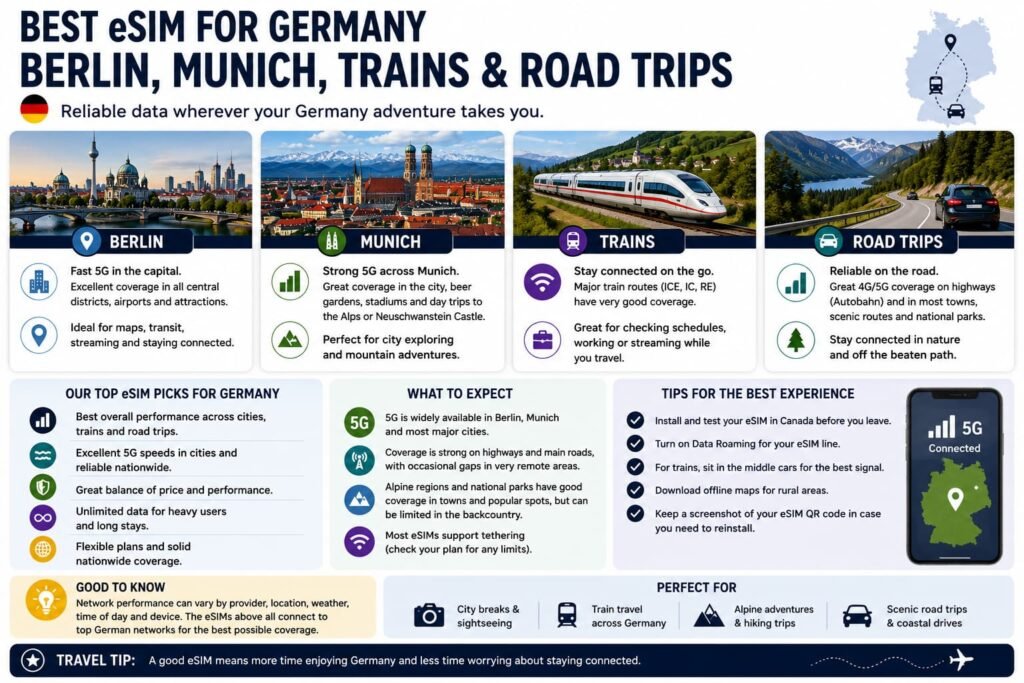
Berlin, Hamburg, Munich, Frankfurt and Cologne
Germany’s largest cities are the easiest environments for a travel eSIM. All three major networks have broad urban service, and 4G or 5G should normally be available across central tourist areas.
That matched my experience during the business trip. Frankfurt, Munich and Berlin were the easiest places to get strong results across several providers, although the speed difference between eSIMs was still noticeable.
The provider choice in these cities can focus more heavily on price, allowance, hotspot rules and app usability. Indoor reception can still change in older buildings, underground stations, hotels and crowded event venues.
ICE and Regional Trains
An eSIM for ICE trains uses the same external mobile networks as other cellular service. Reception can change as the train moves through tunnels, rural stretches and areas with fewer towers. High speed, station congestion and the train carriage can also affect performance.
I saw more variation on train routes than I did while testing in the centres of Frankfurt, Munich and Berlin. That does not automatically make one provider unsuitable, but it makes network access and reconnection behaviour more important than a single city-centre speed test.
The onboard Wi-Fi relies partly on mobile connectivity, so switching from cellular data to train Wi-Fi does not always solve a weak route segment.
For a rail-heavy itinerary, a plan with clearly disclosed network access is easier to evaluate than one that simply promises nationwide coverage. Nomad and Roamless identify both O2 and Vodafone, while Vodafone Travel says it can use all three major German networks.
Download Deutsche Bahn tickets before boarding and save any platform, accommodation or transfer details you cannot afford to lose during a temporary signal gap.
Autobahn and Rural Routes
Coverage along major roads is generally strong, but weaker stretches can still appear between towns or through difficult terrain. This matters when navigation, charging stations, accommodation check-in or roadside assistance depends on a working connection.
Drivers should save important stops, the rental company’s contact details and roadside-assistance information before leaving a city. A larger data allowance does not improve coverage if the selected German network has no usable signal on that stretch.
Black Forest and Bavarian Alps
Popular towns and major tourist routes in the Black Forest and Bavarian Alps generally have mobile service. Deep valleys, remote trails and mountain areas can still produce weak or unavailable reception.
Check an operator coverage map for the exact accommodation or hiking area when mobile access is important. Offline maps and saved trail information remain sensible backup measures in places where terrain can block every available network.
How Much Data Do You Need in Germany?
Data needs depend more on phone habits than the destination itself.
3 GB for Light Use
Three gigabytes can work for a one-week trip when the phone is mainly used for maps, messaging, train tickets, restaurant searches, occasional email and light browsing.
Hotel Wi-Fi will need to handle most streaming, large uploads and software updates.
5 GB to 10 GB for Most Trips
This is the most practical range for many travellers spending one or two weeks in Germany.
It provides room for daily navigation, social media, translation, transit apps, attraction research and occasional video without paying for a very large plan. Ubigi, Nomad, Saily and Jetpac all have options in this range.
15 GB to 20 GB for Heavier Use
Consider this range if you expect frequent social-media uploads, regular short videos, several hours away from Wi-Fi each day, occasional laptop hotspot use or a longer itinerary.
Larger or Unlimited Plans
A larger fixed allowance or unlimited-style plan makes more sense for remote work, frequent video calls, daily streaming or hotspot sharing.
Compare the daily high-speed allowance, reduced speed, hotspot policy and total validity. A transparent 30 GB or 50 GB package can sometimes be more useful than an unlimited plan with a restrictive fair-use structure.
Travel eSIM or Local German SIM?
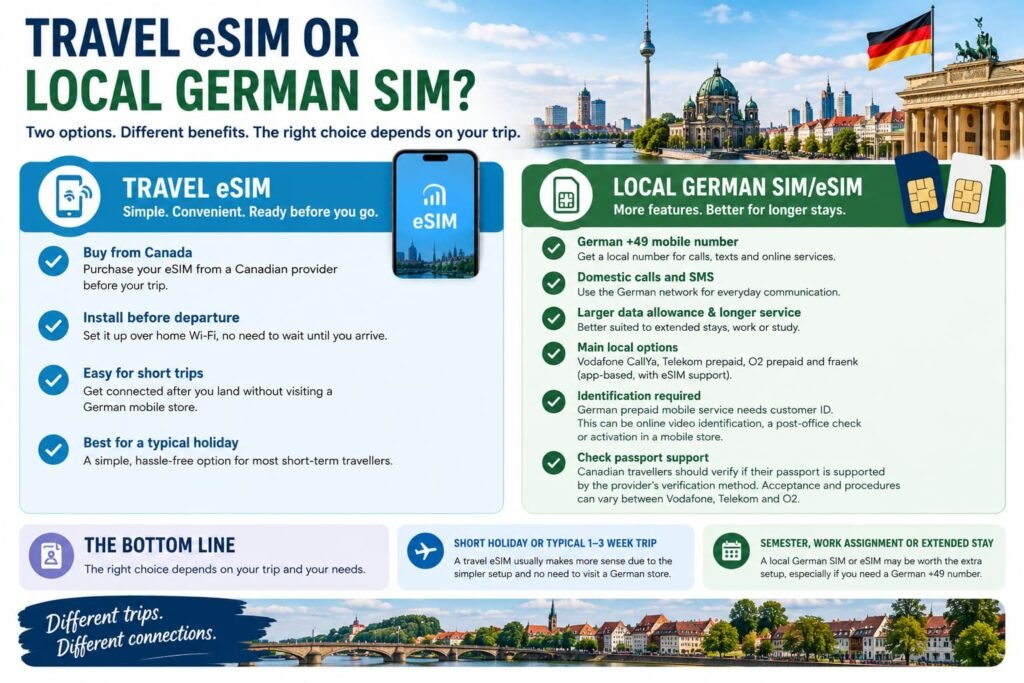
A travel eSIM is usually easier for a short visit. It can be purchased from Canada, installed over home Wi-Fi and activated after arrival without visiting a German mobile store.
A local German SIM or eSIM becomes more interesting when you need:
- A German mobile number
- Conventional domestic calls and SMS
- A larger local allowance
- Service for several months
- A +49 number for local registrations or appointments
Vodafone CallYa, Telekom prepaid and O2 prepaid are the main local options. App-based services such as fraenk also support eSIM, although payment methods, recurring billing and account requirements can make them less convenient for short-term visitors.
Germany requires identification for prepaid mobile activation. The exact process varies by provider and may involve online video identification, a post-office check or activation in a mobile store.
Canadian travellers should verify whether their passport is supported by the selected online method before purchasing. It would be too broad to say that Canadian passports never work, but document acceptance and activation procedures are not identical across Vodafone, Telekom and O2.
For a short holiday, the convenience of a travel eSIM normally outweighs the benefit of a German number. For a semester, work assignment or extended family stay, a German prepaid eSIM or monthly service may justify the additional setup.
Can You Get a Germany eSIM With a Phone Number?
Most travel eSIMs for Germany are data-only. They provide internet access but do not assign a conventional German mobile number.
That still allows calls through WhatsApp, FaceTime, Signal, Facebook Messenger, Microsoft Teams, Google Meet and other internet calling apps.
Some providers offer separate calling features, but the distinction matters. Saily can add a US phone number with a separate call and text plan. Jetpac provides outgoing calls through voice packs, while Roamless supports app-based calls and optional Roamless Numbers.
None of those features should automatically be described as a Germany eSIM with a phone number from Germany. A local prepaid eSIM from Vodafone, Telekom or O2 is the more appropriate direction when you specifically need a +49 number for conventional calls, SMS or local verification.
Germany eSIM vs Canadian Roaming
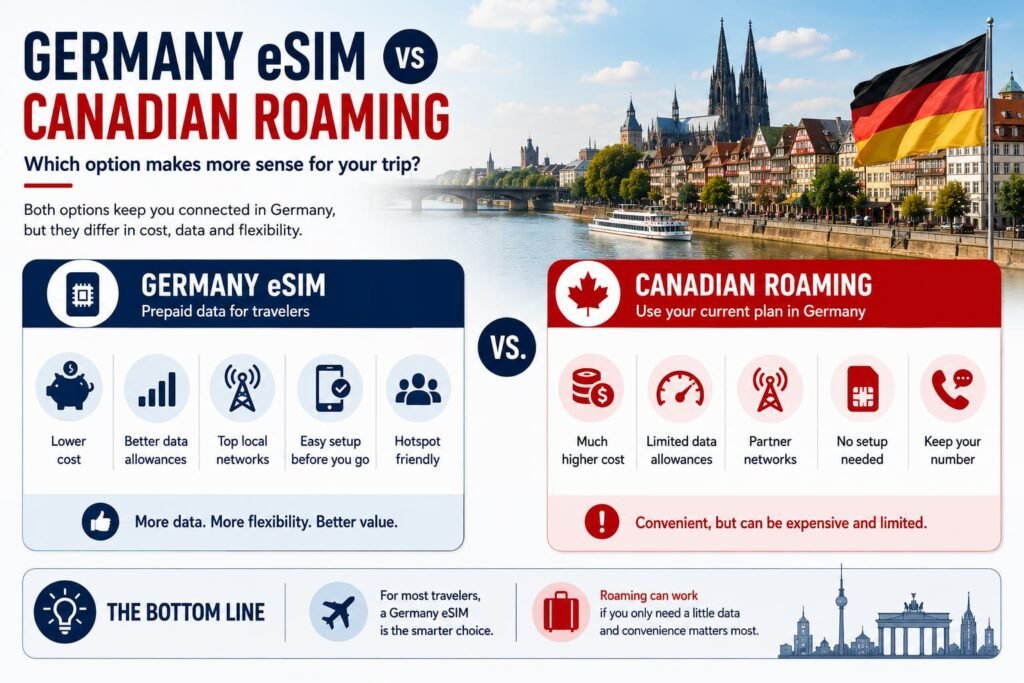
Canadian roaming usually costs more than a travel eSIM, but it provides something different. Your regular number, calls, texts and eligible home-plan data continue working without managing a separate data line.
Bell Roaming in Germany
Bell currently charges C$16 per day for international Roam Better use. Germany is also covered by Bell’s Europe Travel Passes:
| Bell Europe pass | Current price |
|---|---|
| 7 days | C$70 |
| 14 days | C$75 |
| 30 days | C$90 |
These passes use data from the eligible Canadian plan and include unlimited talk and text within the destination and back to Canada. They are available with most monthly and eligible small-business plans.
The pass begins as soon as it is added and expires at 11:59 p.m. Eastern Time on the final day, so Bell advises adding it on the day the trip begins.
Rogers Roaming in Germany
Rogers currently charges C$18 per day to use Roam Like Home in Germany. Its international Travel Passes offer a lower average daily cost on longer trips:
| Rogers international pass | Current price |
|---|---|
| 14 days | C$100 |
| 30 days | C$120 |
The passes cover eligible Roam Like Home destinations and use the talk, text and data included in the customer’s Canadian plan. Availability still depends on the account and rate plan.
TELUS Easy Roam in Germany
Germany is included among TELUS Easy Roam destinations. The current international daily charge is C$18 and includes eligible home-plan data, unlimited incoming and outgoing texts, calls within Germany and calls back to Canada.
TELUS also currently offers Europe passes that are much more competitive than paying the daily charge throughout a longer trip:
| TELUS Europe pass | Current price |
|---|---|
| 14 days | C$50 |
| 30 days | C$60 |
The Europe passes activate after arrival and use the data from the existing TELUS plan with eligible talk and text. The 14-day pass must be used within 30 days of being added, while the 30-day version must be used within 45 days.
Some TELUS 5G+ Complete Explore plans already include Germany among their international destinations. Customers with one of those plans should check their included allowance before purchasing either a pass or travel eSIM.
Freedom Mobile Roaming in Germany
Germany is included among Freedom Mobile’s Roam Beyond destinations. Current eligible monthly plans include a defined amount of roaming data plus unlimited talk and text across more than 120 destinations without a daily fee.
The included data allowance depends on the exact Freedom plan. Customers on an older or ineligible plan can compare a 30-day Roam Beyond pass, which can provide additional roaming data plus unlimited local and back-to-Canada calling and global texting.
Once the included or pass data is exhausted, pay-per-use data charges may apply. Freedom customers should check the Germany allowance in My Account rather than assuming their entire Canadian data bucket is available abroad.
Which Option Makes More Sense?
A travel eSIM is generally the better value when you mainly need maps, messaging, tickets, browsing and app-based calls.
Canadian roaming becomes more attractive when conventional calls matter, you want your Canadian number to work normally, your plan already includes Germany or a competitive Europe pass fits the trip.
The current TELUS Europe passes and some Freedom Roam Beyond plans narrow the cost difference considerably. Bell and Rogers passes remain convenient but generally cost more than a modest travel eSIM.
Use the Canadian Roaming Savings Calculator to compare the cost using your carrier, trip length, number of travellers and expected data use.
For a broader explanation of the trade-offs, see Travel eSIM vs International Roaming for Canadians.
How to Keep Your Canadian Number With a Germany eSIM
Many recent phones can keep a Canadian SIM or eSIM active while using a separate Germany eSIM for mobile data.
A careful dual-SIM setup looks like this:
- Install the Germany eSIM while connected to reliable Wi-Fi.
- Label the Canadian line
Primary. - Label the new line
Germany Data. - Set
Germany Dataas the mobile-data line after arrival. - Turn on data roaming for the travel eSIM if the provider requires it.
- Turn off data roaming for the Canadian line.
- Disable automatic cellular-data switching.
- Confirm which line the phone will use before placing a conventional call.
- Check your carrier’s rules for calls, texts and voicemail.
Keeping the Canadian line enabled does not make every activity free. Answering or placing calls, sending messages, checking voicemail or allowing the line to use data can trigger roaming depending on the carrier.
TELUS currently states that receiving an incoming SMS does not activate Easy Roam, but that rule should not be generalized to every Canadian carrier. Test important two-factor authentication services before departure and save authenticator or backup-code options where available.
Install Your Germany eSIM Before Departure
Install the eSIM before leaving Canada while you have stable Wi-Fi and time to solve a problem. Installation and plan activation are not always the same event.
Before travelling:
- Use the eSIM Compatibility Checker to confirm the exact phone model.
- Make sure the device is carrier-unlocked.
- Read the provider’s activation instructions.
- Install the profile without turning on the Germany plan too early.
- Save the QR code, manual activation details and support contact.
- Turn off automatic app updates and cloud backups if the allowance is small.
Do not delete an eSIM simply because it does not connect immediately. Some profiles cannot be installed again using the original QR code.
Try airplane mode, restart the phone, confirm that the travel line is enabled, check the mobile-data selection and verify whether data roaming is required. The eSIM troubleshooting guide covers additional steps.
For device-specific help, see How to Activate eSIM on iPhone or Activate eSIM on Samsung Galaxy and other Android phones.
Germany eSIM FAQs
Are unlimited Germany eSIM plans really unlimited?
Unlimited Germany eSIM plans usually come with some form of fair-use or high-speed data policy, so “unlimited” does not always mean unlimited full-speed data.
The exact rule depends on the provider. Some plans give you a defined amount of high-speed data each day and then reduce the connection until the next reset. Others use broader traffic-management rules rather than publishing one fixed daily threshold.
That is why I compare the high-speed allowance, reduced speed and hotspot policy before choosing an unlimited Germany eSIM. For heavy phone use, an unlimited plan can still be convenient, but a large fixed-data package may sometimes give you more predictable performance.
Which German mobile network should travellers choose?
Deutsche Telekom currently reports the broadest 5G surface coverage in Germany. Vodafone and O2 Germany also have extensive national networks and can be suitable for city travel and many established tourist routes.
The best choice depends on where you are travelling. My testing was strongest in major cities, while rail routes showed more variation. Travellers visiting rural areas, mountain regions or smaller towns should pay closer attention to the German networks available through the eSIM.
Does a Germany eSIM work on ICE trains and in rural areas?
A Germany eSIM works on ICE trains whenever its partner network has a usable signal, but continuous service should not be expected. High train speeds, tunnels, rural stretches and crowded stations can all affect reception.
I noticed more variation during train travel than while testing in Frankfurt, Munich and Berlin. Save Deutsche Bahn tickets and important transfer details before boarding, especially on longer routes.
Are unlimited Germany eSIM plans really unlimited?
Unlimited Germany eSIM plans can still have fair-use or high-speed data limits. Some providers give you a set amount of full-speed data each day and then reduce the connection until the next reset, while others use broader traffic-management rules.
Check the daily high-speed allowance, reduced speed and hotspot policy before buying. A large fixed-data package can sometimes provide more predictable performance than an unlimited plan.
Can I get a Germany eSIM with a local phone number?
Most international travel eSIMs for Germany are data-only and do not include a German +49 number.
Saily can offer a US number through a separate call and text plan, while Jetpac and Roamless provide different app-based calling features. If you specifically need a German number for conventional calls, SMS or local verification, a domestic prepaid eSIM from Vodafone, Telekom or O2 is usually the better option.
Do Canadian travellers need ID for a German prepaid SIM or eSIM?
German prepaid mobile service requires customer identification. Depending on the provider, activation may involve online video identification, a post-office check or in-store verification.
Canadian passport acceptance can vary between providers and verification systems. International travel eSIMs generally do not require travellers to complete the same German prepaid registration process.
Can I use one eSIM in Germany and other European countries?
A Europe regional eSIM can cover Germany and the other countries on your itinerary, provided each destination is included in the plan. A Germany-only eSIM may stop working once you cross the border.
Check the complete country list before buying, particularly if your trip includes Switzerland, which is outside the EU and EEA roaming framework even though many travel eSIM providers include it in their Europe plans.
How do I keep my Canadian number while using a Germany eSIM?
A dual-SIM phone lets you keep your Canadian number active while using the Germany eSIM for mobile data. Set the Germany eSIM as your data line, turn off data roaming on the Canadian line, and disable automatic cellular-data switching so the phone does not fall back to your Canadian plan.
Your Canadian line can still receive texts and remain available for calls or verification codes, but certain activity may trigger roaming charges. Before travelling, check your carrier’s rules for calls, outgoing texts, voicemail and background data so you know what can activate roaming.
Related eSIM Guides
Start Here
Compare Germany eSIM Providers
- Nomad eSIM Review
- Ubigi eSIM Review
- Saily eSIM Review
- Holafly eSIM Review
- Roamless eSIM Review
- Vodafone Travel eSIM Review
Related European Destinations
- Best eSIM for France From Canada
- Best eSIM for Italy From Canada
- Best eSIM for Portugal From Canada
- Best eSIM for UK From Canada
Setup Help
Final Thoughts
Nomad remains my strongest overall starting point for Germany because it combines useful plan choices, O2 and Vodafone access and strong real-world performance. Ubigi delivered one of my fastest results and remains an excellent fixed-data value, while Roamless also performed very well and offers a flexible model that works particularly well for backup or repeat travel.
Vodafone Travel produced the strongest result during my three-week Germany test at approximately 185 Mbps download with very low latency, and its current high-data pricing makes it particularly interesting for heavier use.
Jetpac also performed strongly and remains one of the better choices for hotspot sharing. Saily, Holafly and Airalo were slower during my testing, but all still provided enough speed for normal travel tasks. That is why I would not rank Germany eSIMs using speed alone.
Match the plan to the places you will actually visit. A city break is relatively easy to cover, while ICE routes, rural roads and mountain regions make the underlying German network more important. My three-week business trip reinforced that difference: the strongest city result was not always the most important thing once I started moving between locations.
Canadians should also check whether a TELUS Europe pass, Bell or Rogers roaming package, or Freedom Roam Beyond allowance changes the value comparison.
Install the eSIM before leaving Canada and verify the final price, network, activation policy and hotspot rules at checkout. A little preparation before departure will usually matter more than chasing a small difference in cost per gigabyte.