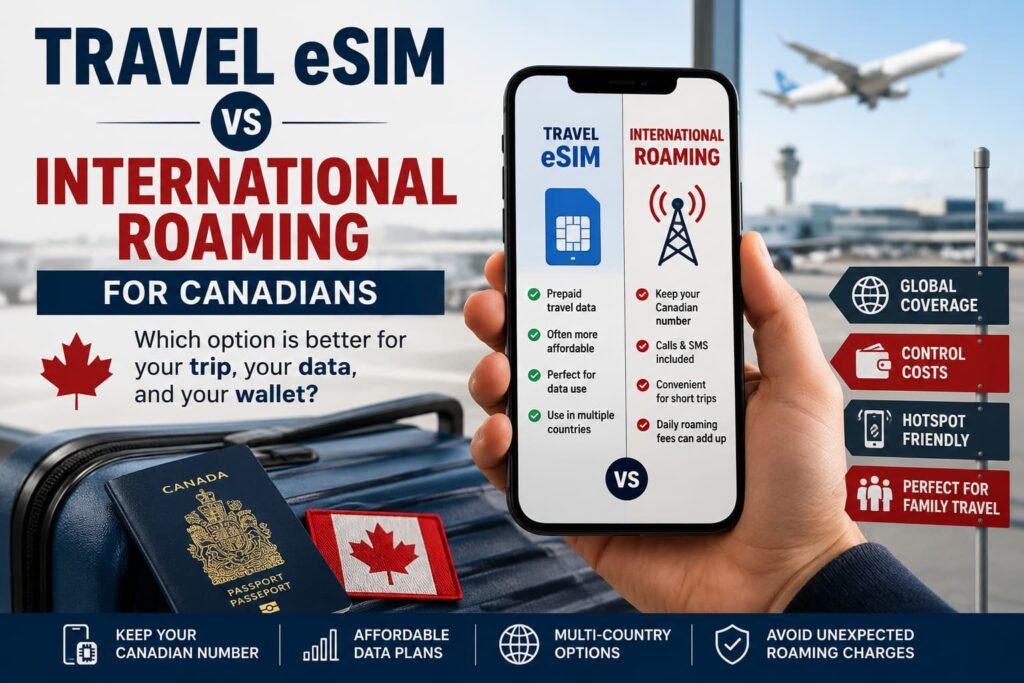
If you are travelling outside Canada, one of the biggest mobile decisions is whether to use international roaming through your Canadian carrier or install a travel eSIM before you leave.
Both options can work. The better choice depends on your destination, trip length, data use, number of travellers, and whether you need your Canadian phone number active while you are away.
International roaming is convenient because your regular Canadian line keeps working in supported destinations. A travel eSIM is usually better when you mainly need affordable mobile data, want a separate prepaid data bucket, or want to avoid daily roaming charges adding up across several days.
This guide explains travel eSIM vs international roaming for Canadians, when each option makes sense, when a hybrid setup is best, and how to avoid common roaming mistakes before your trip.
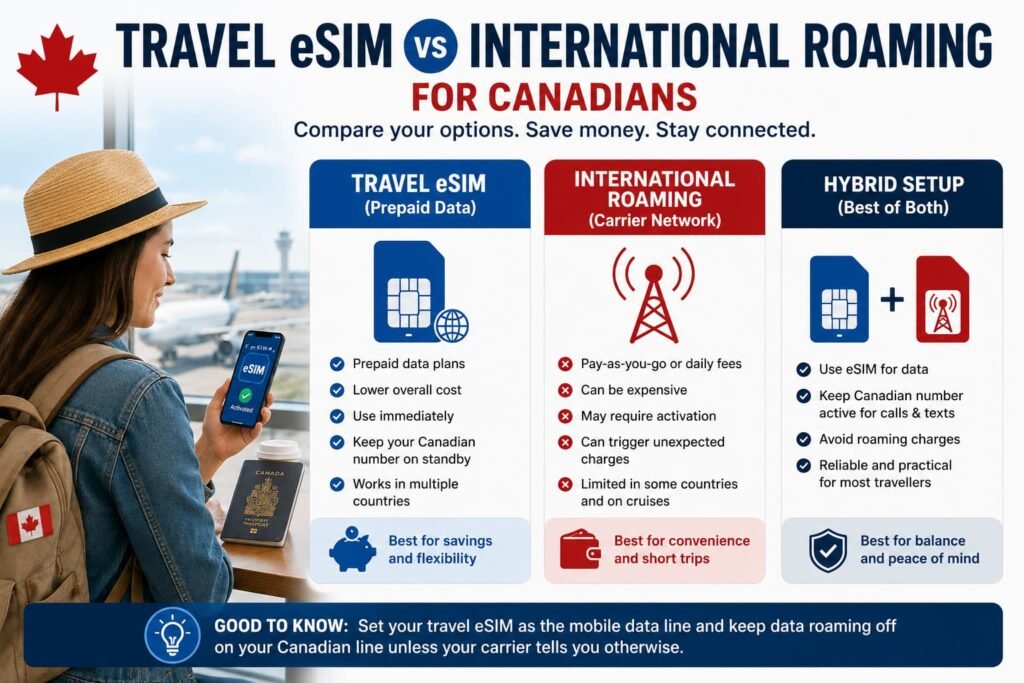
For most Canadians travelling outside Canada, a travel eSIM is usually better when the main need is affordable mobile data for maps, messaging apps, browsing, rideshares, hotel bookings, hotspot use, or multi-country travel, while international roaming is usually better for very short trips, business travel, or situations where your Canadian number needs to stay active for calls, texts, voicemail, or verification codes. Many travellers get the best result with a hybrid setup: keep the Canadian line available for important texts or calls, then use the travel eSIM for mobile data.
Best Option by Travel Situation
Different trips need different mobile setups. A one-day U.S. visit, a family vacation, a remote-work trip, and a traveller who needs bank verification texts all have different roaming risks and data needs.
| Travel Situation | Better Starting Point | Why |
|---|---|---|
| One-day U.S. trip | International roaming | Convenience may be worth more than setup time. |
| Weekend business trip | Roaming or hybrid setup | Your Canadian number may matter for calls and work access. |
| One-week vacation | Travel eSIM | Daily roaming fees can add up across several days. |
| Family vacation | Travel eSIMs or hybrid setup | Roaming charges can multiply per line. |
| Europe or multi-country trip | Regional travel eSIM | One prepaid plan can often cover several countries. |
| Needs bank codes abroad | Hybrid setup | Keep the Canadian line reachable while the eSIM handles data. |
Travel eSIM vs International Roaming: The Main Difference
International roaming uses your Canadian carrier line outside Canada. Your phone connects to a partner network in the destination country, and your Canadian provider bills you based on its roaming rules, daily roaming feature, travel pass, add-on, or pay-per-use pricing.
A travel eSIM is different. It is a separate digital SIM profile that gives your phone prepaid mobile data for a specific country, region, or global plan. You usually install it before your trip, then choose it as your mobile data line when travelling.
The simple difference is this: roaming keeps everything on your Canadian carrier, while a travel eSIM gives you a separate data connection for the trip.
| Option | Best For | Main Advantage | Main Caution |
|---|---|---|---|
| International roaming | Short trips and Canadian number access | Convenient and keeps your regular line active | Daily fees and usage rules can add up. |
| Travel eSIM | Longer trips and mobile data | Separate prepaid data bucket | Many plans are data-only. |
| Travel pass | Medium-length trips with carrier support | More predictable than pay-per-use roaming | Often still uses your Canadian data bucket. |
| Hybrid setup | Travellers needing Canadian SMS plus cheaper data | Keeps number access while eSIM handles data | Requires correct phone settings. |
| Local SIM | Long stays in one country | May include a local number and local rates | Requires buying and setting up service abroad. |
When International Roaming Makes Sense
International roaming can be the right choice when convenience matters more than savings.
It is useful when your trip is short, your data use is light, or you need your Canadian number active for calls, incoming texts, banking codes, work messages, voicemail, or emergency contact.
Roaming may make sense for:
- One-day or two-day U.S. trips.
- Short business trips.
- Airport layovers.
- Travellers who need regular calls and SMS.
- Employer-paid travel.
- People who do not want to manage dual SIM settings.
- Trips where your plan already includes the destination.
For example, if you are crossing the border for one day and only need occasional maps and texts, roaming may be simple enough. But the same setup can become expensive if the trip lasts one or two weeks, especially if several family members each trigger a daily roaming fee.
When a Travel eSIM Is Better
A travel eSIM is usually better when mobile data is the main thing you need.
It gives you a separate prepaid data plan for your destination, so you can use maps, hotel apps, rideshare apps, WhatsApp, iMessage, FaceTime, Messenger, email, browsing, and travel apps without relying only on your Canadian carrier’s roaming setup.
A travel eSIM is especially useful for:
- Europe trips.
- U.S. vacations longer than a few days.
- Mexico and Caribbean resort trips.
- Family travel.
- Multi-country travel.
- Cruise port days.
- Remote work.
- Hotspot and laptop tethering.
- Social media-heavy trips.
- Backpacking or long-term travel.
- Travellers who want predictable prepaid pricing.
For many Canadians, a travel eSIM is not just about saving money. It is about control. You choose the data amount, validity period, destination, and provider before the trip starts.
International Roaming Costs Can Add Up Quickly
Many Canadian roaming options charge per day, per line, or per travel pass. That can be fine for a quick trip, but the total can grow quickly when the trip gets longer or multiple people are travelling.
A one-line weekend trip may be manageable. A family vacation with three or four phones can look very different.
| Travel Situation | Roaming Risk | Why It Matters |
|---|---|---|
| One-day U.S. trip | Lower | Convenience may be worth it. |
| One-week U.S. vacation | Medium | Daily fees can add up. |
| Two-week Europe trip | High | International daily fees can become expensive. |
| Family vacation | High | Charges may apply per line. |
| Remote work trip | High | Hotspot and video calls use data quickly. |
| Multi-country trip | High | Roaming rules may vary by destination. |
| Cruise travel | Very high | Ship and in-flight networks are different from normal roaming. |
Before deciding, use the free Canadian Roaming Savings Calculator to compare your estimated Canadian roaming cost against travel eSIM pricing based on your carrier, destination, trip length, number of travellers, and expected data use.
Why the CRTC Roaming Cap Does Not Mean Roaming Is Always Cheap
Canadian wireless rules include protections around roaming charges, but that does not mean every roaming setup is automatically cheap or risk-free.
The CRTC’s international roaming guidance says service providers cannot charge more than $100 for roaming per billing cycle unless you explicitly agree to pay more. The provider must also notify you when you are roaming internationally.
That protection can help reduce bill shock, but it does not replace trip planning. You still need to check what triggers roaming on your specific carrier, whether the fee applies per line, whether calls and texts are included, whether your trip crosses a billing cycle, and whether you have already consented to additional charges.
The detailed Wireless Code also includes amended wording around data roaming caps and daily fixed-rate roaming options that comes into force on April 13, 2027. Because roaming rules, consent prompts, and carrier plan wording can change, check your carrier’s current travel page before you leave Canada.
Last checked: June 2026.
Travel eSIMs Are Usually Data-Only
One of the biggest things Canadians need to understand is that many travel eSIMs are data-only.
That means a travel eSIM can give you internet access abroad, but it may not give you a traditional phone number for regular voice calls or SMS.
You can still use internet-based apps over the travel eSIM connection, including:
- WhatsApp.
- FaceTime.
- iMessage.
- Messenger.
- Signal.
- Telegram.
- Skype.
- Google Meet.
- Email.
- Banking and travel apps.
If you need your Canadian number for SMS verification or regular phone calls, use a hybrid setup instead of relying only on a data-only travel eSIM.
The Hybrid Setup: Best of Both Options
For many Canadians, the strongest travel setup is not roaming or eSIM. It is both.
A hybrid setup means your Canadian line stays available for important texts or calls, while the travel eSIM handles mobile data.
This is useful if you need:
- Bank verification texts.
- Credit card alerts.
- Email login codes.
- Work account access.
- Family emergency contact.
- Your Canadian number available abroad.
- Affordable mobile data for apps and maps.
The key is to configure the phone correctly. Set the travel eSIM as your mobile data line, turn off data roaming on your Canadian line, and disable automatic data switching.
This lets the travel eSIM handle maps, browsing, messaging apps, hotel bookings, and rideshares while your Canadian line stays available only for the things you actually need.
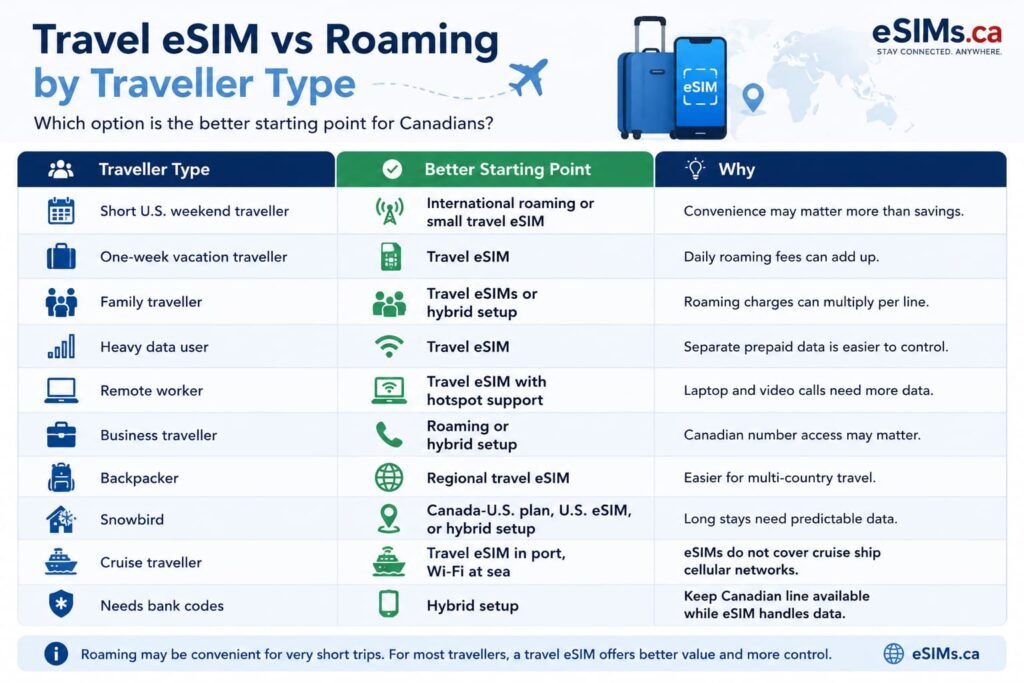
Travel eSIM vs Roaming by Traveller Type
| Traveller Type | Better Starting Point | Why |
|---|---|---|
| Short U.S. weekend traveller | International roaming or small travel eSIM | Convenience may matter more than savings. |
| One-week vacation traveller | Travel eSIM | Daily roaming fees can add up. |
| Family traveller | Travel eSIMs or hybrid setup | Roaming charges can multiply per line. |
| Heavy data user | Travel eSIM | Separate prepaid data is easier to control. |
| Remote worker | Travel eSIM with hotspot support | Laptop and video calls need more data. |
| Business traveller | Roaming or hybrid setup | Canadian number access may matter. |
| Backpacker | Regional travel eSIM | Easier for multi-country travel. |
| Snowbird | Canada-U.S. plan, U.S. eSIM, or hybrid setup | Long stays need predictable data. |
| Cruise traveller | Travel eSIM in port, Wi-Fi at sea | eSIMs do not cover cruise ship cellular networks. |
| Needs bank codes | Hybrid setup | Keep Canadian line available while eSIM handles data. |
Travel eSIM vs Roaming by Destination
| Destination Type | Best Starting Point | Why |
|---|---|---|
| United States | Compare roaming, Canada-U.S. plan, and USA eSIM | Short trips may favour roaming, longer trips often favour eSIM. |
| Europe | Regional Europe eSIM | Multi-country data is usually easier with one regional plan. |
| Mexico | Mexico eSIM or North America plan | Resort trips and airport transfers need reliable data. |
| Caribbean | Destination eSIM or regional option | Island coverage varies, so check before buying. |
| Asia | Regional or country-specific eSIM | Maps, translation, rail, and ride apps can use a lot of data. |
| Latin America | Country or regional eSIM | Roaming can vary widely by destination. |
| Cruises | Ship Wi-Fi at sea, eSIM in port | Travel eSIMs work on land-based networks, not ship satellite systems. |
| Multi-country travel | Regional or global eSIM | Easier than managing several roaming rules. |
Canadian Carrier Roaming vs Travel eSIMs
Each Canadian carrier handles international travel differently. Some use daily roaming, some offer travel passes, some focus on prepaid add-ons, and some have included roaming on select plans.
That is why a single answer does not work for every Canadian traveller.
| Carrier Type | Examples | Main Travel Issue |
|---|---|---|
| Daily roaming carriers | Rogers, Bell, TELUS, Fido, Koodo, Virgin Plus | Daily fees can add up on longer trips. |
| Prepaid and budget carriers | Public Mobile, Chatr, Lucky Mobile, PC Mobile | Roaming may be limited or unavailable outside certain destinations. |
| Included roaming plans | Freedom Mobile, some Canada-U.S. plans | Destination and data allowance matter. |
| Regional carriers | SaskTel, Eastlink, Videotron, Fizz | Travel packs, pass rules, or coverage areas need checking. |
If you already know your Canadian carrier, use the detailed carrier comparison guides in the related section below before deciding.
How Much Data Do You Need for International Travel?
Most travellers underestimate how much data they use while travelling.
Maps, rideshare apps, restaurant searches, hotel apps, airline apps, messaging, and email may not use much data individually, but they add up throughout the day. Hotspot use, video calls, social media uploads, cloud backups, and streaming use much more.
| Travel Style | Suggested Data Range | Good For |
|---|---|---|
| Light traveller | 1 GB to 3 GB per week | Maps, messaging, email, quick searches. |
| Regular traveller | 5 GB to 10 GB per week | Maps, social media, browsing, travel apps. |
| Heavy user | 10 GB to 20 GB per week | Video calls, social uploads, daily navigation. |
| Remote worker | 20 GB+ or unlimited-style plan | Hotspot, laptop work, video meetings. |
| Family hotspot user | Larger plan with hotspot support | Sharing data with multiple devices. |
If your trip is longer than a week, or if you plan to use hotspot, choose more data than the minimum. Running out of data abroad can be frustrating, especially if your hotel booking, ride, or boarding pass depends on internet access.
Once you know your destination, trip length, and rough data range, use the eSIM Plan Comparison Tool to compare travel eSIM plans by country, data amount, validity, approximate CAD pricing, and hotspot support.
How to Set Up a Travel eSIM Before Leaving Canada
Install your travel eSIM before you leave Canada when possible. This gives you time to confirm the eSIM profile is installed, read the provider’s activation rules, and fix any setup issues before the trip.
Before buying, use the eSIM Compatibility Checker to confirm that your phone supports eSIM and that your model is suitable for travel eSIM use.
On iPhone, install the travel eSIM, label your Canadian line as Primary, label the eSIM as Travel Data, then select the travel eSIM under Settings > Cellular > Cellular Data. Turn off Allow Cellular Data Switching if you do not want your phone falling back to Canadian roaming data. Apple’s Dual SIM with eSIM support guide explains how to choose which line uses cellular data and how data switching works.
For detailed setup help, follow the How to Activate eSIM on iPhone in Canada guide before travelling.
On Android, the menu depends on your phone. Samsung Galaxy users usually start at Settings > Connections > SIM Manager. Google Pixel users usually start at Settings > Network & Internet > SIMs. Motorola and other Android users should look for SIMs, Mobile Network, or SIM Manager. Samsung Canada’s Galaxy eSIM support page and Google’s Pixel eSIM setup instructions are useful official references if your phone menus look different.
For full Android setup help, use the Activate eSIM on Android Canada guide before your trip.
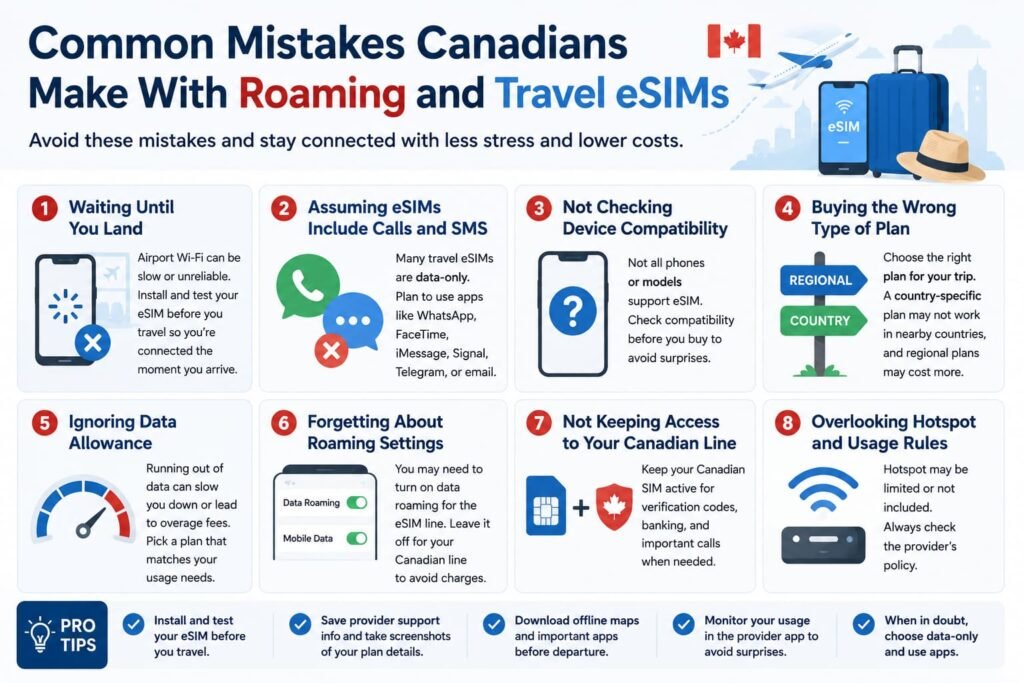
Common Mistakes Canadians Make With Roaming and Travel eSIMs
The biggest mistake is waiting until you land to figure everything out. If your phone has no data, the airport Wi-Fi is unreliable, or your email login asks for a verification code, installing an eSIM after arrival can become stressful.
Another mistake is assuming a travel eSIM includes regular calls and SMS. Many travel eSIMs are data-only, so you should plan to use apps like WhatsApp, FaceTime, iMessage, Messenger, Signal, Telegram, or email for communication.
A third mistake is leaving automatic data switching on. If your travel eSIM signal drops and the phone switches back to your Canadian line, you may accidentally trigger roaming.
Cruise travel is another common issue. Travel eSIMs generally work on land-based mobile networks, not cruise ship satellite cellular systems. Use Airplane Mode while at sea and only turn mobile data back on when you are connected to land-based networks in port.
Also be careful near the Canada-U.S. border. The CRTC warns that phones can accidentally connect to a U.S. network close to the border. If you are not travelling but are near the border, manually selecting your Canadian network or turning off data roaming can reduce the risk of accidental roaming.
Roaming charges can be triggered by more than heavy browsing. A short call, background data, automatic line switching, cruise ship cellular networks, or several family phones using roaming on the same trip can change the total quickly. If you are using a hybrid setup, set the travel eSIM as the mobile data line and keep data roaming off on your Canadian line unless your carrier tells you otherwise.
Frequently Asked Questions About Travel eSIM vs International Roaming for Canadians
Is a travel eSIM cheaper than international roaming for Canadians?
A travel eSIM is often cheaper than international roaming for longer trips, family travel, Europe travel, hotspot use, and data-heavy travel. Roaming can be convenient, but daily fees can add up quickly when several days or multiple lines are involved.
For very short trips, roaming may still be simple enough if you need your Canadian number active. The best way to compare is to estimate your carrier, destination, trip length, number of travellers, and expected data use before you leave Canada.
Can I keep my Canadian number active while using a travel eSIM?
Most modern dual SIM phones let you keep your Canadian number active while using a travel eSIM for mobile data. This is one of the best setups for Canadians who need bank verification texts, work messages, or important calls while travelling.
The important part is setup. Set the travel eSIM as your mobile data line, turn off data roaming for your Canadian line, and disable automatic data switching so your phone does not accidentally fall back to Canadian roaming data.
Does a travel eSIM replace my Canadian phone plan?
A travel eSIM does not usually replace your Canadian phone plan. It adds a separate data plan to your phone for travel.
Your Canadian SIM or eSIM can stay installed, while the travel eSIM handles mobile data abroad. This lets you keep your Canadian number available while using a separate prepaid data bucket for travel apps and internet access.
Do travel eSIMs include phone calls and SMS?
Many travel eSIMs are data-only, which means they do not include traditional phone calls or SMS. They give your phone internet access in the destination country or region.
You can still use apps like WhatsApp, FaceTime, iMessage, Messenger, Signal, Telegram, Skype, and email over the travel eSIM data connection. If you need regular calls or SMS, check the provider details carefully before buying.
Is roaming better than a travel eSIM for short trips?
Roaming can be better for very short trips if convenience matters more than savings. A one-day U.S. visit, quick business trip, or short layover may be easier with your Canadian carrier’s roaming feature.
For trips longer than a few days, the math often changes. A travel eSIM can give you more predictable prepaid data and may help avoid daily roaming charges building up across the trip.
Should data roaming be on or off when using a travel eSIM?
For a hybrid setup, data roaming should usually be off on your Canadian line and mobile data should be assigned to the travel eSIM. This helps prevent your phone from using your Canadian carrier for travel data.
For the travel eSIM line itself, follow your travel eSIM provider’s instructions. Some providers require data roaming to be on for the travel eSIM line because the plan connects through partner networks in the destination. The key is to check the setting line by line, not just the phone’s global mobile data toggle.
What is the best setup for bank verification texts while travelling?
The best setup is usually a hybrid setup. Keep your Canadian line active for incoming SMS, but use the travel eSIM for mobile data.
Before leaving Canada, also set up backup verification methods such as authenticator apps, backup codes, email verification, trusted devices, or app-based login approvals. SMS can be delayed or unavailable depending on your carrier, destination, and roaming setup.
Can I use a travel eSIM for hotspot or remote work?
Many travel eSIMs support hotspot, but the rules depend on the provider and plan. Some plans allow hotspot freely, while unlimited-style plans may have hotspot limits, fair-use rules, or speed restrictions.
If you need hotspot for a laptop, remote work, video calls, or sharing data with family, check the hotspot rules before buying. Choose a larger data package than you would for basic maps and messaging.
Do travel eSIMs work on cruises?
Travel eSIMs usually work on land-based mobile networks, not cruise ship satellite cellular systems. If you are at sea, your phone may connect to maritime networks that are separate from normal roaming or eSIM coverage.
The safer setup is to use Airplane Mode while at sea, use ship Wi-Fi if needed, and turn your travel eSIM back on only when you are in port or connected to supported land-based networks.
Should families use roaming or travel eSIMs?
Families should compare carefully because roaming costs can multiply per line. If four phones trigger daily roaming, the total can become expensive quickly.
Travel eSIMs can give each compatible phone its own prepaid data plan, which makes family travel easier to control. Some families also keep one Canadian line active for important calls or texts while everyone else uses travel eSIMs for data.
What should I check before buying a travel eSIM?
Before buying a travel eSIM, confirm that your phone supports eSIM, your phone is unlocked, the plan covers your destination, the data amount fits your trip, and hotspot is allowed if you need it.
You should also check when the plan validity starts, whether top-ups are available, whether the eSIM is data-only, and whether the provider supports the countries on your itinerary.
Related eSIM Travel Guides
Start Here
- Best eSIM for International Travel
- eSIM Providers by Country
- Canadian Roaming Savings Calculator
- eSIM Compatibility Checker
- eSIM Plan Comparison Tool
Compare Canadian Roaming Options
- Rogers Roam Like Home vs Travel eSIMs
- Bell Roam Better vs Travel eSIMs
- TELUS Easy Roam vs Travel eSIMs
- Fido Roam vs Travel eSIMs
- Public Mobile Roaming vs Travel eSIMs
Setup and Provider Help
- How to Activate eSIM on iPhone in Canada
- Activate eSIM on Android Canada
- How to Fix eSIM Not Working in Canada
- Airalo eSIM Review
- Nomad eSIM Review
- Holafly eSIM Review
Final Thoughts
Travel eSIM vs international roaming for Canadians comes down to convenience, cost control, data use, destination, number of travellers, and whether you need your Canadian number active while abroad.
International roaming is useful for short trips and travellers who need their regular Canadian line for calls, texts, and simple setup. But daily roaming fees, per-line charges, data bucket limits, and long-trip costs can add up quickly.
A travel eSIM is usually better when your main priority is mobile data. It gives you a separate prepaid data bucket for maps, rideshares, messaging apps, hotel bookings, browsing, and hotspot use.
For many Canadians, the best setup is hybrid: keep the Canadian line available for important texts or calls, then use the travel eSIM for mobile data.
Before travelling, compare your roaming estimate, check phone compatibility, choose the right data amount, install the eSIM before departure, and make sure your phone settings are ready.