I spent two weeks in Greece on a business trip, testing six eSIM services in Athens and Thessaloniki and during the outbound and return train journeys between the two cities, each of which lasted approximately five hours and 15 minutes.
The test group consisted of five international travel eSIM services: Sim Local, Ubigi, Orange Travel, Nomad and Airalo, plus a local Vodafone Greece eSIM. Including the local option provided a useful performance reference, but Vodafone Greece is a different type of purchase from an eSIM that can be arranged before departure.
Testing was conducted using my iPhone 17 business phone and Samsung Galaxy S25 personal phone. This added real-world cross-device context, but it was not a controlled iPhone-versus-Samsung experiment, and the results should not be interpreted as device performance comparisons.

My Recommendation After Testing Six eSIMs in Greece
Sim Local is the option I would choose for most trips focused on Greece. Its city results were consistently strong, it recorded connections through both Vodafone and Nova during my testing, and its plan structure suits travellers who want a meaningful data allowance without buying a local Greek service.
Ubigi stood out when I compared fixed-data pricing. It was not quite as fast as Sim Local in my measurements, but its 10GB Greece plan offers a good balance for navigation, messaging, restaurant searches and moderate everyday use.
Orange Travel solves a different problem. Its measured speeds were lower, but selected plans include calls, SMS and a number. I would look at it when conventional phone service matters more than maximum download performance.
Nomad sat comfortably in the middle as a flexible alternative. Airalo also worked and offers a familiar marketplace and app, although it did not stand out in the measured city results.
Vodafone Greece delivered the strongest measurements in both Athens and Thessaloniki. I would consider it if I specifically wanted local Greek service and did not mind completing the local purchase or identification process.
How I Tested the eSIMs in Greece
These results come from real use during a two-week business trip, rather than laboratory testing. Measurements were recorded separately in Athens and Thessaloniki so that different city results were not blended into an artificial Greece-wide average.
For the performance checks, I used Ookla Speedtest and Opensignal to measure download speed, upload speed and latency. I also used field-test diagnostics and CellMapper to identify the Greek networks connected during testing and review available radio-signal information. The published results focus on the measurements preserved in my testing records rather than every diagnostic collected during the trip.
Testing was carried out using my iPhone 17 business phone and Samsung Galaxy S25 personal phone. This gave me real-world experience across iPhone and Samsung hardware, but it was not a controlled device-comparison test, and the records do not establish that every provider was tested on both phones.
I also used the eSIMs while commuting and moving around Athens and Thessaloniki rather than relying only on one stationary location. The published speed results remain separate city snapshots and should not be treated as continuous driving averages or Greece-wide performance guarantees.
I also tested all six eSIM services during the train journeys between Athens and Thessaloniki, covering roughly 10 and a half hours of travel in total across the outbound and return trips. This gave me additional real-world evidence of how the connections behaved while moving through different coverage areas at speed. I did not collect a complete route-wide speed series for every provider, so I treat this as real-world transit testing rather than a controlled railway-coverage benchmark.
Greece eSIM test results
| Provider | Greek network or networks recorded | Thessaloniki | Athens |
|---|---|---|---|
| Vodafone Greece – local eSIM | Vodafone Greece | 380 Mbps Download, 60 Mbps upload, 20 ms latency | 430 Mbps Download, 90 Mbps upload, 35 ms latency |
| Sim Local | Vodafone, Nova | 320 Mbps Download, 55 Mbps upload, 25 ms latency | 380 Mbps Download, 80+ Mbps upload, 45 ms latency |
| Ubigi | Cosmote, Vodafone | 270 Mbps Download, 55 Mbps upload, 40 ms latency | 340 Mbps Download, 72 Mbps upload, 65 ms latency |
| Nomad | Nova, Vodafone | 200 Mbps Download, 35 Mbps upload, 55 ms latency | 245 Mbps Download, 60 Mbps upload, 75 ms latency |
| Airalo | Cosmote, Vodafone | 160 Mbps Download, 30 Mbps upload, 55 ms latency | 210 Mbps Download, 48 Mbps upload, 85 ms latency |
| Orange Travel | Vodafone, Nova | 120 Mbps Download, 40 Mbps upload, 50 ms latency | 175 Mbps Download, 65 Mbps upload, 80 ms latency |
These are individual city measurements, not provider averages or guarantees. Mobile performance can change with the precise location, network congestion, signal conditions, plan routing and other factors.
Greece eSIM Prices Compared
These current plan examples show the different price and product structures available.
| Provider | Plan example | Listed price | CAD |
|---|---|---|---|
| Airalo | Greece plan starting price | US$4 | C$5.54 |
| Ubigi | 10GB for 30 days | US$12 | C$16.61 |
| Nomad | 10GB for 30 days | €15.50 | C$24.92 |
| Sim Local | 20GB for 30 days | US$21.50 | C$29.76 |
| Orange Travel | Europe plan with 20GB, calls and SMS for 14 days | US$29.99 | C$41.51 |
Prices checked September 6, 2026. CAD conversions are included for Canadian readers; checkout prices and promotions can change.
The cheapest plan is not automatically the best value. Compare the data allowance, validity period, included countries, hotspot rules and whether you need calls or SMS. The eSIM Plan Comparison Tool can help narrow the choice for your trip length and expected usage.
Sim Local: My Preferred Travel eSIM Overall
Sim Local was the international travel eSIM I came away preferring after the Greece trip.
It reached 320 Mbps Download in Thessaloniki and 380 Mbps in Athens, with latency of 25 ms and 45 ms respectively. Those results placed it ahead of the other international travel eSIMs I tested in both cities.
Vodafone and Nova were recorded in the test evidence, so more than one Greek network appeared during my use. That is useful factual context, although these measurements do not establish that having multiple recorded networks necessarily improved intercity performance.
The 20GB-for-30-days plan is a practical fit for a longer holiday or business trip. It provides considerably more room than a small starter plan for maps, messaging, uploads, video calls and hotspot use.
Sim Local makes the most sense for someone who wants:
- Strong tested performance in Athens and Thessaloniki
- A substantial fixed-data allowance
- An international travel eSIM that can be arranged before arrival
- A straightforward alternative to buying a local Greek service
At the checked price of US$21.50, or approximately C$29.76, it was not the least expensive option. I would still choose it for most Greece-only trips because the overall combination of plan size and measured city performance was convincing.
View Sim Local’s Greece plans.
Ubigi: Strong Fixed-Data Value
Ubigi was the value option that stood out most to me.
Its 10GB Greece plan was listed at US$12, or approximately C$16.61, for 30 days. That allowance should be enough for many one- or two-week trips if most heavy downloads and video streaming happen over Wi-Fi.
Performance was also strong. I measured 270 Mbps Download in Thessaloniki and 340 Mbps in Athens. Upload speeds were 55 Mbps and 72 Mbps, while latency measured 40 ms and 65 ms.
Cosmote and Vodafone both appeared in the testing records. As with the other providers, network availability can depend on the plan and current roaming arrangements, so check the plan details before purchasing.
I would choose Ubigi over Sim Local when the lower price and a 10GB allowance suit the trip better than having 20GB. It is especially attractive for travellers who mainly need Google Maps, messaging, email, bookings and occasional social-media use.
Read the complete Ubigi eSIM review or view the 10GB Greece plan.
Orange Travel: The Most Useful Tested Option for Calls and SMS
Orange Travel did not lead the speed results, but I would not dismiss it for that reason. It addresses a requirement that most travel eSIMs do not: selected plans include conventional calls, SMS and a phone number.
I measured 120 Mbps Download in Thessaloniki and 175 Mbps in Athens. Upload speeds were 40 Mbps and 65 Mbps, with latency of 50 ms and 80 ms. Those results were sufficient for ordinary travel use, including navigation, messaging, browsing and video calls under suitable signal conditions.
Vodafone and Nova were recorded during the testing. Orange Travel also remained stable during my approximately five-hour-and-15-minute Athens–Thessaloniki train journey. Because I did not record a series of speed tests along the route, I treat that as a useful real-world observation rather than a route-performance benchmark.
The checked Europe plan included 20GB for 14 days plus calls and SMS for US$29.99, or approximately C$41.51. That costs more than a data-only plan, but the added phone-service features can justify the difference when you need to contact hotels, restaurants, tour operators or business contacts through conventional calling.
Some Orange Travel offers that provide a phone number may require identity registration within 30 days. Review the activation and registration conditions for the specific plan you select.
I would choose Orange Travel when calls, SMS and number options matter more than obtaining the fastest measured download result.
Read the Orange Travel eSIM review or check current Greece offers.
Nomad: A Flexible Middle-Ground Option
Nomad occupied the middle of the tested group.
It measured 200 Mbps Download in Thessaloniki and 245 Mbps in Athens, with upload speeds of 35 Mbps and 60 Mbps. Latency was 55 ms in Thessaloniki and 75 ms in Athens. Nova and Vodafone appeared in the testing evidence.
Those results did not match Sim Local or Ubigi, but they were still suitable for normal travel tasks. Nomad’s broader appeal is its range of data sizes and validity periods, which can make it easier to buy something that matches a short visit or a specific expected data allowance.
The checked 10GB-for-30-days example cost €15.50, or approximately C$24.92. Ubigi offered a lower checked price for the same headline allowance and validity period, so Nomad was not my first fixed-data value choice for this trip.
I would still consider it when its current plan menu fits the itinerary better or when an existing Nomad user prefers to keep everything in the same app.
Read the Nomad eSIM review or compare its current Greece plans.
Airalo: Familiar and Workable, but Not a Performance Standout
Airalo is one of the most familiar eSIM marketplaces, and its app makes it easy to browse destination and regional plans. It worked during my Greece testing, but it did not stand out against the stronger measured results from Sim Local, Ubigi or Nomad.
I recorded 160 Mbps Download in Thessaloniki and 210 Mbps in Athens. Upload speeds were 30 Mbps and 48 Mbps, with latency of 55 ms and 85 ms. Cosmote and Vodafone appeared in the testing records.
Those figures are still more than adequate for common travel needs. My conclusion is not that Airalo was unusable, it simply gave me less reason to choose it based on this particular set of city measurements.
Its low starting price can be useful for a light-data trip or as a small backup plan. Check the exact allowance and validity period, since a low entry price may correspond to a relatively small package.
I would look at Airalo when familiarity, app experience or a small starter plan matters more than leading the tested performance group.
Read the Airalo eSIM review or view current Greece plans.
Vodafone Greece: The Strongest Measured Local Service
Vodafone Greece produced the strongest city results in the test group: 380 Mbps Download in Thessaloniki and 430 Mbps in Athens. Upload speeds measured 60 Mbps and 90 Mbps, with latency of 20 ms and 35 ms.
Those results make Vodafone Greece a valuable local benchmark, but it should not be treated as the same product category as the five international travel eSIM services.
A local Greek eSIM may appeal if you want domestic service, local support or a local product rather than a travel-data package. The tradeoff is that purchase and activation may involve identification requirements and a process completed through the Greek operator.
By contrast, an international travel eSIM is normally easier to arrange before departure and can be installed while you still have reliable home internet access.
I would consider Vodafone Greece when maximum measured city performance and local service are the priorities. For travellers who want the simpler pre-trip purchase experience, Sim Local remains my preferred international option.
Check Vodafone Greece’s tourist prepaid SIM and eSIM information.
Other Greece eSIMs I Did Not Test
Holafly and SimOptions are established alternatives, but I did not test either service during this Greece trip. They should therefore be considered from their current plan terms rather than compared against the first-hand speed results above.
Holafly is commonly considered by travellers interested in an unlimited-data-style plan. Review its fair-use, hotspot and validity conditions carefully because “unlimited” does not always mean unrestricted high-speed usage or unlimited tethering.
SimOptions operates as a marketplace with offers from different providers. Plan features can vary considerably, particularly for calls, SMS, phone numbers and regional coverage.
For more detail, read the Holafly eSIM review and SimOptions eSIM review.

Which Mobile Networks Do Greece eSIMs Use?
Greece’s major mobile network operators include Cosmote, Vodafone and Nova. A travel eSIM does not usually operate its own radio network. Instead, it connects through one or more local networks under the provider’s current roaming arrangements.
During my testing:
- Sim Local recorded Vodafone and Nova
- Ubigi recorded Cosmote and Vodafone
- Nomad recorded Nova and Vodafone
- Airalo recorded Cosmote and Vodafone
- Orange Travel recorded Vodafone and Nova
- The local Vodafone Greece eSIM used Vodafone Greece
A longer list of supported networks is not, by itself, proof that one eSIM will be faster or more reliable throughout the country. Routing, congestion, plan restrictions, signal conditions and the exact location can all influence performance.
My measurements show what happened in Athens and Thessaloniki during this trip. They do not establish nationwide results or guarantee the same speeds for another traveller.
What About the Greek Islands and Ferries?
I did not conduct first-hand tests on the Greek islands or aboard ferries, so I would not use the city results to promise identical performance in those settings.
Coverage can vary by island, coastal terrain, distance from mobile infrastructure and the route taken. Service may weaken when a ferry moves away from land, regardless of the travel eSIM provider.
For an island itinerary, I would prioritize:
- Access to an established Greek mobile network
- A plan with enough validity for the full trip
- Offline maps and saved booking details
- Downloaded ferry tickets and accommodation information
- A backup plan for essential communication
Download key information before boarding rather than assuming continuous offshore service. When comparing plans, focus on the listed Greek network access and current terms instead of interpreting Athens or Thessaloniki measurements as island evidence.
Greece-Only eSIM or Europe Regional Plan?
A Greece-only plan is usually the cleaner choice when the entire trip takes place within Greece. You can compare its price and allowance without paying for coverage you may never use.
A Europe regional eSIM becomes more useful when Greece is one stop in a broader itinerary. If you are visiting Italy, France, Spain or several other supported European destinations, one regional plan may avoid installing and managing separate country eSIMs.
Compare:
- Total data
- Validity period
- Included countries
- Supported networks
- Calls and SMS
- Hotspot restrictions
- Price for the full itinerary
Regional plans do not automatically provide identical networks or performance in every included country. Confirm the destination list rather than relying only on the word “Europe.”
See the best eSIMs for Europe travel from Canada for broader itineraries.
Do You Need One eSIM for Greece and Turkey?
Do not assume that every European regional plan includes Turkey. Some do, while others treat it separately.
For a combined Greece-and-Turkey trip, check both countries in the plan’s official coverage list before paying. A regional plan covering both may be more convenient than switching eSIMs at the border, but two country-specific plans can still be less expensive or provide better allowances.
Also compare validity carefully. The plan should remain active for the entire itinerary, not merely the days spent in Greece.
Do You Need Calls, SMS or a Greek Phone Number?
Most travel eSIMs are data-only. Messaging and calling through WhatsApp, FaceTime, Signal, Teams or similar apps will work over mobile data, but that is different from receiving conventional cellular calls or SMS on the travel eSIM.
A data-only plan is sufficient for many travellers. It becomes less convenient when you need to call a business that does not use messaging apps, receive a conventional text on the travel line or provide a reachable local-style number.
Among the services I tested, Orange Travel was the clearest option for plans with calls, SMS and number features. Vodafone Greece may also make sense if you specifically want local Greek service and are comfortable with the purchase requirements.
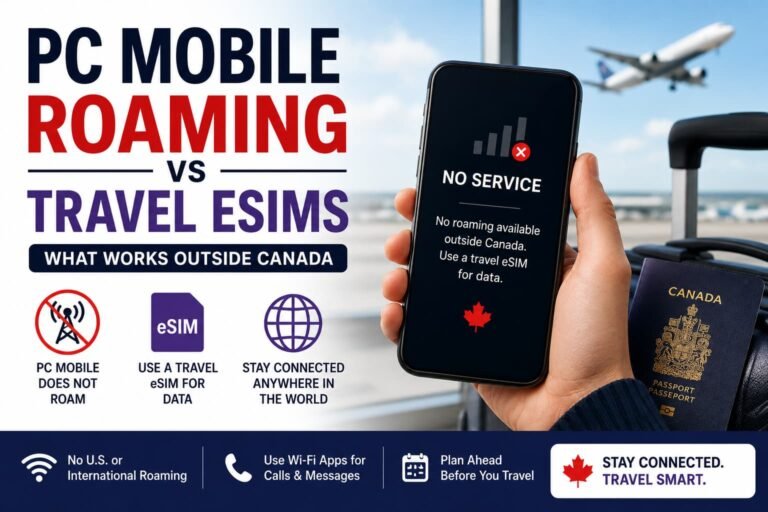
Dual-SIM phones can often keep a Canadian line enabled for incoming texts while using the travel eSIM for data. Before doing this, review your carrier’s roaming rules and disable data switching if you want to reduce the risk of unintended roaming charges.
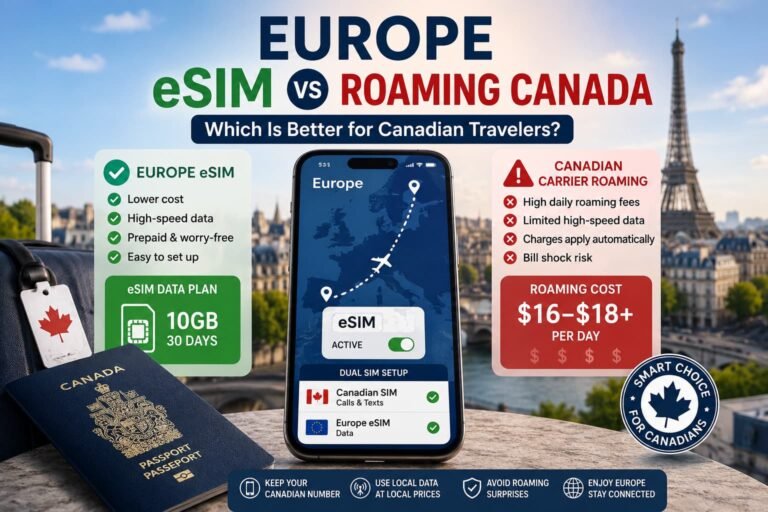
Should Canadians Use Rogers, Bell, TELUS or Freedom Roaming Instead?
Carrier roaming can genuinely compete with a travel eSIM when a regional pass is available, your plan already includes Greece, or keeping your Canadian number and conventional calling is worth paying more for.
| Canadian carrier | Current Greece decision context |
|---|---|
| Rogers | Rogers lists an international Travel Pass at C$100 for 14 days or C$120 for 30 days, using the talk, text and data from an eligible home plan in supported destinations. That is more expensive than the tested travel eSIM examples, but it keeps the Canadian number and avoids changing the data line. |
| Bell | Bell lists a Europe Travel Pass at C$75 for 14 days or C$90 for 30 days. It uses data from the eligible home plan and includes talk and text within the destination and back to Canada. For a two-week trip, the pass can be more competitive than paying a daily international roaming fee. |
| TELUS | TELUS lists Europe Easy Roam passes at C$50 for 14 days and C$60 for 30 days, using data from the existing plan with talk and text in eligible destinations. Eligible 5G+ Complete Explore plans may already include service in selected international destinations, so check the plan before purchasing anything extra. |
| Freedom Mobile | Freedom says eligible monthly plans include roaming data plus talk and text in more than 120 destinations without daily roaming fees. Customers without enough included roaming data can consider a 30-day Roam Beyond pass. Confirm that Greece and the required allowance are included in the specific plan or pass. |
Daily roaming remains convenient for a short stop or an emergency-use day, but the total can become difficult to justify over a one- or two-week Greece trip. A travel eSIM is usually cheaper when you mainly need data and are comfortable using internet-based calling.
Carrier roaming may be worth the premium when you need your normal Canadian number for business, conventional calls, authentication messages or uninterrupted access to the home plan. It may also be competitive if your current plan already includes Greece or if a discounted regional pass covers the entire trip.
Use the Canadian Roaming Savings Calculator to compare the total cost, and read Travel eSIM vs International Roaming before deciding.
Carrier prices, eligible plans and included destinations can change. Confirm the current Greece terms in your account before departure.
A Practical Data Allowance for Athens, Islands and a Two-Week Trip
The same data ranges remain useful in Greece, but the right allowance depends on how you travel.
3GB to 5GB
This can work for a shorter or Wi-Fi-heavy trip focused on Google Maps in Athens or Thessaloniki, messaging, restaurant searches, accommodation details, ferry schedules and occasional menu or sign translation.
Download offline maps and ferry documents before leaving Wi-Fi. Photo and video uploads can consume a small plan quickly.
Around 10GB
Ten gigabytes is a comfortable target for many one- or two-week holidays. It leaves more room for regular navigation, island transport searches, attraction bookings, social media and occasional video calls.
Ubigi’s checked 10GB plan is a strong value example for this usage level.
20GB or more
I would look at 20GB or more for a two-week business trip, frequent photo or video uploads, regular video meetings or hotspot use with a laptop.
Sim Local’s checked 20GB plan fits this category and gives more breathing room when mobile data is doing real work rather than only supporting sightseeing.
Unlimited-style plans
An unlimited-style plan can be appealing for heavy use, but check the fair-use and tethering rules. The word “unlimited” may still come with speed-management or hotspot restrictions.
For any allowance, downloading large app updates, cloud libraries and streaming media over hotel Wi-Fi will make the mobile plan last longer.
Can You Use Hotspot With a Greece eSIM?
Hotspot support depends on the provider and specific plan. Many fixed-data travel eSIMs permit tethering, but an unlimited-style offer may restrict it or apply a separate hotspot allowance.
Check the current plan terms if you expect to connect a laptop during a business trip or share data with another traveller. Hotspot use especially for video meetings, cloud backups or large downloads can consume data much faster than navigation and messaging.

How to Install a Greece eSIM
First, confirm that your phone supports eSIM and is carrier-unlocked. The eSIM Compatibility Checker can help with the device check.
Then:
- Buy the plan while you have reliable internet access.
- Follow the provider’s app or QR-code installation instructions.
- Label the line clearly, such as “Greece data.”
- Keep your Canadian SIM selected for your normal number if needed.
- Select the Greece eSIM for mobile data.
- Turn on data roaming for the travel eSIM if the provider requires it.
- Turn off cellular data switching if you do not want the phone to fall back to the Canadian line.
- Wait until the provider’s stated activation point before using the plan.
Install the eSIM before leaving Canada when possible, but do not activate it prematurely if the plan’s validity begins upon installation rather than its first connection in Greece.
Keep the installation details until the eSIM is working. Some QR codes cannot be reused after deletion.
Frequently Asked Questions
Should I buy a travel eSIM or a local Greek eSIM?
A travel eSIM is usually the easier choice for a short visit because you can buy and install it before leaving Canada. You can connect after landing without finding a mobile store or completing a local purchase.
A local Vodafone Greece eSIM may make more sense if you want service directly from a Greek operator, need a local product or place greater importance on the strongest city performance from my testing. The local Vodafone eSIM reached 430 Mbps Download in Athens and 380 Mbps in Thessaloniki, but those measurements do not guarantee the same results elsewhere in Greece.
For most visitors, I would choose the convenience of a travel eSIM. I would consider local Greek service when its identification, activation and purchase requirements are worth the additional effort.
Does It Matter Which Greek Mobile Network My eSIM Uses?
Cosmote, Vodafone and Nova are the main Greek mobile networks. I would not choose a Greece travel eSIM solely because it lists the greatest number of networks, since actual performance can also depend on roaming arrangements, network congestion, plan routing and your location.
During my testing, Cosmote appeared with Ubigi and Airalo, while Vodafone and Nova appeared across several services. Sim Local produced the strongest results among the international travel eSIMs, even though the local Vodafone Greece service recorded the highest city speeds overall.
The practical approach is to confirm which Greek mobile networks are supported by the specific plan you are buying. Network access can differ between plans from the same provider and may change over time.
When should I install and activate an eSIM for Greece?
I would buy and install the eSIM before departure while connected to reliable Wi-Fi. This gives you time to confirm that the profile appears correctly on your phone and avoids trying to scan a QR code or troubleshoot installation after landing.
Installation and activation are not always the same event. Some plans begin when the eSIM first connects to a supported Greek network, while others may start when installed or activated in the provider’s app. Check the rule for your specific plan before adding it.
After arriving in Greece, select the travel eSIM as your mobile-data line and enable data roaming for that line if required. Keep automatic cellular-data switching disabled if you do not want the phone to fall back to your Canadian carrier.
How much eSIM data do I need for 10 days or two weeks in Greece?
Around 10GB should suit many visitors using Google Maps in Athens or Thessaloniki, checking ferry schedules, translating menus, messaging, searching for restaurants and accommodation, and occasionally uploading photos.
A lighter traveller who relies heavily on hotel Wi-Fi may manage with 3GB to 5GB. I would choose 20GB or more for a two-week business trip, regular video calls, frequent photo or video uploads, or hotspot use with a laptop.
Download offline maps, ferry tickets and important booking details before travelling between cities or islands. Streaming, cloud backups, app updates and hotspot use will consume data much faster than navigation and messaging.
Can I use the same eSIM in Greece and Turkey?
You can use one eSIM for Greece and Turkey only when both countries are explicitly included in the plan. Do not assume that every Europe eSIM includes Turkey, because some providers sell it as a separate destination.
For a combined itinerary, compare a regional Greece and Turkey eSIM against two country-specific plans. One regional profile is more convenient because you do not need to install or switch plans at the border. Separate plans may offer better pricing, more data or different local-network access.
Check the complete country list, validity period and activation rules before buying. The plan must remain active for the entire trip, including any time spent travelling between the two countries.
Do visitors need a Greek phone number for hotels, ferries or restaurants?
Most visitors can manage without a Greek phone number. Hotel communication, ferry tickets, restaurant searches and tour bookings are often handled online, by email or through apps such as WhatsApp.
A conventional number becomes more useful when you need to call a smaller hotel, restaurant, rental agency, tour operator or business that does not rely on app-based communication. Most Greece travel eSIMs are data-only, so they will not provide regular cellular calls or SMS.
Orange Travel is the tested option I would examine when calls, SMS and number features matter. A local Vodafone Greece eSIM may also be appropriate if you specifically want Greek mobile service and are comfortable with the local purchase requirements.
Can I keep my Canadian number while using a Greece eSIM?
Yes, on a compatible dual-SIM phone you can normally keep your Canadian line enabled while using the Greece eSIM for mobile data. This lets contacts continue reaching your regular number and may help with authentication messages.
Set the Greece eSIM as the mobile-data line and turn off cellular-data switching so the phone does not automatically use Rogers, Bell, TELUS or Freedom data. Review your carrier’s rules before answering calls, making calls or sending SMS, because those activities may trigger roaming charges even when the travel eSIM handles data.
For routine communication, I would use WhatsApp, FaceTime, Signal or another data-based service. If uninterrupted conventional calling through your Canadian number is essential, a carrier travel pass may be the simpler option.
Will a Greece eSIM work on the islands and during ferry trips?
A Greece eSIM can connect on the islands when a supported Greek mobile network has coverage, but performance will vary by island, terrain, port and exact location. Connectivity may also weaken after a ferry moves away from coastal mobile infrastructure.
My first-hand measurements came from Athens and Thessaloniki, not Santorini, Mykonos, Crete or other islands. They should not be treated as evidence that the same speeds will be available throughout an island itinerary.
Before boarding a ferry, download tickets, accommodation details, offline maps and any information needed on arrival. Choose a plan connected to an established Greek network, but keep realistic expectations for offshore sections of the journey.
Related Guides
More European eSIM Guides
- Best eSIM for Europe Travel From Canada
- Best eSIM for Italy
- Best eSIM for Spain
- Best eSIM for Portugal
- Best eSIM for France
- Best eSIM for Germany
- Best eSIM for UK Travel From Canada
Roaming and Phone-Compatibility Help
Final Thoughts
After testing five international travel eSIM services and one local Greek eSIM, Sim Local is the option I would choose for most Greece trips. It combined strong measured results in Athens and Thessaloniki with a practical 20GB allowance that suits a longer holiday or business visit.
Ubigi is the more attractive choice when 10GB is enough and fixed-data value matters. Orange Travel deserves consideration when calls, SMS and number options are more important than leading the speed table. Nomad is a flexible middle-ground alternative, while Airalo remains workable for travellers who prefer its familiar marketplace.
Vodafone Greece delivered the strongest city measurements, but it belongs in a separate local-service decision. It makes sense when you want a Greek operator and accept the local purchase requirements; it does not replace the convenience of arranging an international travel eSIM before departure.
Whichever option you choose, match the plan to your itinerary, data use and need for conventional phone service. I would not choose from the speed table alone. The better option is the one whose price, allowance and features actually match your trip.