This Roamless eSIM review looks at a travel eSIM that works differently from the usual country-by-country plan. Instead of installing a new eSIM for every trip, Roamless gives you one reusable global eSIM that works with non-expiring pay-as-you-go credits and optional fixed data plans.
That flexibility can be genuinely useful for Canadians who travel several times a year, cross borders regularly, or want backup data ready without purchasing another plan before every departure. It does not automatically make Roamless the least expensive option, especially when streaming, tethering a laptop, or using several gigabytes every day.
The real decision comes down to how you travel. Roamless is strongest when you value a reusable balance and light-to-moderate data use. A larger fixed bundle or unlimited-style plan may be easier to budget when your trip is longer or your data needs are heavy.
Roamless is a strong choice for Canadians who want one reusable travel eSIM, take several short trips, or prefer paying only for the data they use. Its non-expiring purchased credits reduce wasted value between trips, but travellers expecting heavy streaming or frequent hotspot use should compare the complete cost of a fixed plan with other travel eSIM providers.
What Is Roamless?
Roamless is an international mobile-connectivity provider built around a single global eSIM. You install the eSIM on a compatible device and leave it available for future trips, turning the line on when travelling and off when it is not needed.
The same eSIM supports two main data-payment options:
- Roamless FLEX credits: A pay-as-you-go balance deducted according to your data use and the destination rate.
- Roamless FIX plans: Prepaid data packages that include a defined allowance for an eligible country, region, or wider coverage area.
Roamless says its global eSIM provides service across more than 200 supported destinations. Purchased FLEX credits do not expire, while FIX plans follow a separate activation and validity period.
That reusable model is Roamless’s clearest advantage over providers that require travellers to purchase and install a separate plan or profile for each trip.
Who Roamless Suits Best
Roamless is most useful when you travel repeatedly but do not consume a large, predictable amount of mobile data on every trip.
| Traveller type | Roamless fit | Why |
|---|---|---|
| Occasional traveller | Strong | Purchased FLEX credits remain available for a later trip |
| Frequent traveller | Strong | One global eSIM can remain installed between destinations |
| Multi-country traveller | Strong | FLEX can work across supported destinations without buying a separate bundle for each short stop |
| Light data user | Strong | You pay according to actual usage instead of purchasing an oversized package |
| Backup-data user | Strong | A small balance can remain ready for delays, stopovers, or primary-plan failures |
| Business traveller | Good | In-app calling can help with hotels, airlines, restaurants, and local businesses |
| Heavy streamer | Weaker | High pay-as-you-go consumption may cost more than a larger fixed bundle |
| Remote worker | Depends | A FIX plan may be more predictable for hotspot use and video meetings |
| Family with several devices | Depends | Each device requires its own Roamless account and eSIM |
| Traveller needing native calls and SMS | Weaker | Roamless communication features operate through its app rather than the phone’s native carrier service |
For a traveller taking weekend trips to the United States, occasional European vacations, and a few international stopovers, Roamless can reduce repeated setup and unused data. Someone spending a month abroad while tethering a laptop will need to compare fixed-plan costs much more carefully.
The account structure also matters for families. Roamless currently allows one eSIM per account, so each additional phone or tablet needs a separate account rather than sharing one account balance across several installed eSIMs.
How Roamless Pay-As-You-Go Credits Work
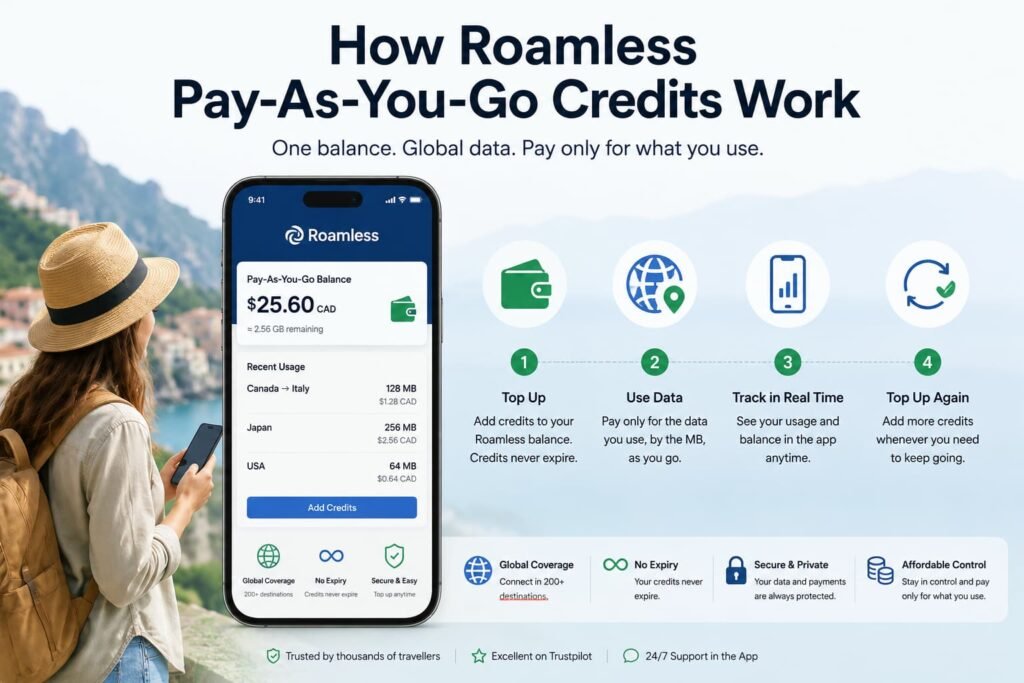
Roamless FLEX works like a prepaid travel wallet. You add credits to your account, and the balance is deducted as your phone uses mobile data.
The rate is destination-specific. The same balance may provide more usable data in one country and less in another because the local price per gigabyte changes.
Purchased FLEX credits do not expire. Any unused balance remains in the account for future data use, eligible in-app calls, or supported app-based messaging services. Promotional rewards and bonus data may follow separate expiry conditions, so they should not be treated as identical to purchased credits.
FLEX works well for practical travel tasks such as:
- Maps and navigation
- Rideshare and public-transit apps
- Messaging
- Restaurant and hotel searches
- Flight updates
- Occasional browsing
You do not need to select a destination manually before using FLEX. When the Roamless eSIM, mobile data, and the required roaming setting are enabled, the applicable destination rate is deducted automatically.
FLEX becomes less predictable when background activity is high. Automatic photo backups, app updates, cloud syncing, video streaming, and laptop tethering can consume data quickly even when you are not actively watching the balance.
How Roamless Fixed Data Plans Work
Roamless FIX plans provide a defined data allowance for travellers who want a prepaid bundle rather than paying for every megabyte used.
These plans work through the same installed Roamless eSIM. You do not have to add another eSIM profile when moving between FLEX and an eligible FIX plan.
According to the official Roamless data-plan guidance, FIX plans:
- Are data-only and cannot be used to pay for Roamless in-app calls.
- Work through the same global Roamless eSIM.
- Begin their validity period after the first kilobyte of eligible data use.
- Can remain unactivated for up to 18 months after purchase.
- Remain valid for 30 days after activation.
- Can operate alongside FLEX credits on the same eSIM.
The ability to purchase a plan before leaving Canada without immediately starting its validity period is useful. You can complete the installation while connected to reliable home Wi-Fi and allow the plan to activate when eligible data use begins at the destination.
What happens when a fixed plan runs out?
Roamless automatically prioritizes eligible rewards, then an eligible FIX plan, and finally FLEX credits. If the fixed allowance expires or is fully consumed, available FLEX credits can become the fallback data source.
This can prevent an abrupt loss of connectivity when you still need directions, transportation, or access to a boarding pass.
The trade-off is that your FLEX balance may begin decreasing without a separate manual switch. Check your usage in the app rather than assuming the original bundle remains active.
Roamless FLEX vs FIX Plans
| Feature | Roamless FLEX | Roamless FIX |
|---|---|---|
| Payment model | Pay according to actual usage | Pay upfront for a defined allowance |
| Expiry | Purchased credits do not expire | Valid for 30 days after activation |
| Destination use | Works across supported FLEX destinations | Limited to the destinations included in the plan |
| Best for | Light use, short trips, stopovers, and backup data | Predictable daily use and larger data needs |
| In-app calls | Uses available FLEX credits | FIX data cannot pay for calls |
| Automatic use | Starts when no higher-priority eligible balance is active | Used before FLEX when eligible |
| Leftover value | Purchased balance remains available | Unused data expires with the plan |
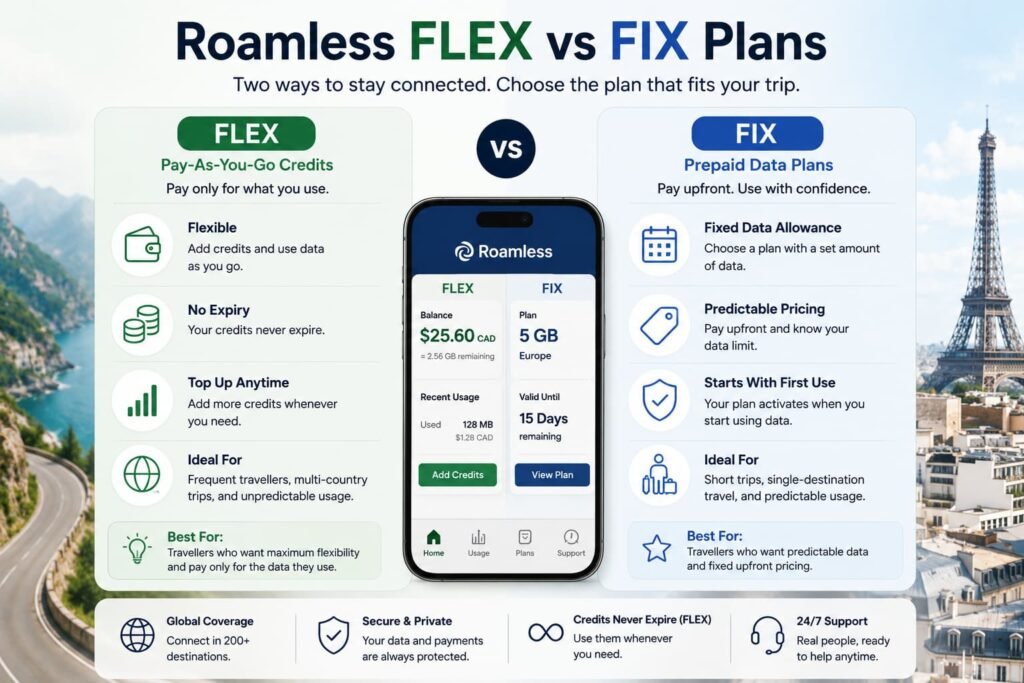
FLEX offers more flexibility between trips, while FIX usually provides a clearer data allowance for one defined journey. The stronger option depends on the destination rate, trip duration, expected usage, and how much time you will spend away from Wi-Fi.
Roamless Pricing Explained
Roamless pricing cannot be summarized with one universal cost per gigabyte because FLEX rates and available FIX plans vary by destination.
| Pricing option | How you pay | Best suited to |
|---|---|---|
| FLEX credits | Usage deducted from a prepaid balance | Short trips, light use, stopovers, and backup data |
| Country FIX plan | Set data allowance for one destination | Predictable use in one country |
| Regional FIX plan | One allowance across included destinations | Multi-country trips with moderate or heavy use |
| Wider-coverage plan | Data across a broader destination list | Complex itineraries where every destination is included |
| Roamless Number | Separate monthly or annual subscription | Travellers wanting an app-based second number |
FLEX may save money when you rely heavily on Wi-Fi and only need mobile data intermittently. A FIX plan can provide a more predictable effective cost per gigabyte when you expect daily navigation, social-media uploads, hotspot use, or longer periods away from Wi-Fi.
Roamless displays prices in US dollars, and the final cost differs significantly by destination. Compare the complete price for the amount of data you expect to use rather than relying on a provider’s lowest advertised rate.
Before choosing, use the eSIM Plan Comparison Tool to compare destination coverage, allowance, approximate Canadian-dollar pricing, validity, and hotspot support across providers.
Important:
Roamless may change its prices, plan sizes, destination coverage, network partners, validity terms, hotspot rules, communication features, and promotions. The information in this review was verified when the article was prepared, but you should confirm the current details in the Roamless app or on the official website before purchasing.
Roamless Coverage and Network Access
Roamless advertises mobile-data access across more than 200 supported destinations. Available networks, speeds, and connection types vary by location, so check the specific country or regional listing rather than assuming the same carrier or 5G access everywhere.
Roamless does not operate its own physical mobile network. Like other travel eSIM providers, it connects through partner networks in each destination.
Your actual connection can depend on:
- Local partner coverage
- Phone compatibility
- Regional phone model
- Carrier-lock status
- Network congestion
- Signal conditions
- Available 4G, LTE, or 5G access
- Automatic or manual network selection
Broad country coverage does not guarantee identical speed in every city, airport, resort, highway, or rural area.
The eSIM Providers by Country guide can help you compare Roamless with providers offering different country and regional options.
Roamless App and Installation Experience
The Roamless mobile app is used to create an account, install the eSIM, purchase FLEX credits or FIX plans, monitor balances, make eligible calls, and manage Roamless Numbers.
The main practical benefit is that installation should normally be a one-time task on the same phone. Once the Roamless eSIM is added, it can remain available for future supported trips.
Before purchasing, check your phone with the eSIM Compatibility Checker. A device may support eSIM generally but still have regional-model, carrier-lock, or active-SIM limitations.
Can the Roamless eSIM be moved to a new phone?
Roamless allows users to reinstall the eSIM on a replacement device without losing associated credits, plans, or rewards.
Roamless specifically advises users not to rely on Apple’s built-in Transfer eSIM command. Its documented process is to delete the Roamless profile from the old phone and reinstall it manually on the new device through the Roamless account.
Do not delete the profile until you have access to the Roamless account, reliable Wi-Fi, and the current reinstallation instructions.
Setting Up Roamless on an iPhone
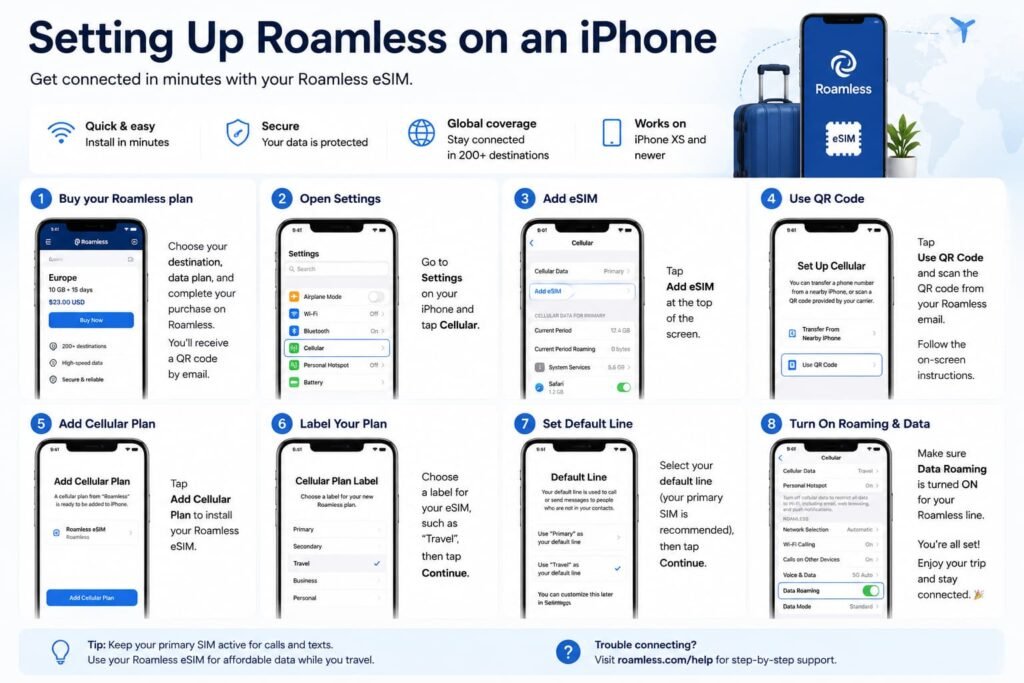
Install the Roamless eSIM while connected to reliable Wi-Fi, then give the line a clear label such as Roamless Travel. Before departure, confirm that your regular Canadian line remains assigned to calls and messages.
After arriving:
- Turn on the Roamless line.
- Select Roamless for cellular data.
- Enable data roaming on the Roamless line when required by its current instructions.
- Keep data roaming disabled on the Canadian line unless your Canadian plan includes the destination.
- Disable cellular-data switching when you do not want the iPhone to fall back to the Canadian line.
Menu wording can change between iOS releases. The iPhone eSIM activation guide for Canada explains the broader installation and dual-SIM setup process.
Setting Up Roamless on Android
Android menu names vary by manufacturer. Samsung commonly uses SIM Manager, while Google Pixel and other Android phones may place the controls under Network & Internet, Connections, Mobile Network, or SIMs.
The general arrangement is:
- Enable the Roamless eSIM.
- Select it as the preferred mobile-data line.
- Leave the Canadian SIM assigned to calls and SMS when needed.
- Prevent automatic data switching to the Canadian line.
- Enable data roaming on the Roamless line when instructed.
- Apply any current network-selection or APN instructions provided by Roamless.
Refer to the Android eSIM setup guide for Canada for broader device preparation and settings guidance.
Calls, Text Messages, and Roamless Numbers
The Roamless eSIM itself is a data-only service. It does not automatically include a native telephone number, conventional carrier calling, or SMS through the phone’s regular dialler and messaging apps.
Roamless offers separate app-based communication features.
Outgoing in-app calls
You can place calls to regular telephone numbers through the Roamless app. The call uses an internet connection and deducts the per-minute charge from your FLEX credits.
The internet connection can come from:
- The Roamless eSIM
- Wi-Fi
- Another active SIM
- A personal hotspot
Roamless says its in-app calling feature can dial numbers in more than 200 destinations. A FLEX balance and internet connection are required, and calls are placed from the Roamless app rather than the phone’s normal dialler.
This can be useful for reaching a hotel, airline, restaurant, tour operator, or other business that does not use WhatsApp or another internet-messaging service.
Roamless Numbers
Roamless Numbers is an optional subscription service that provides an app-based telephone number for supported calling and SMS functions.
A Roamless Number:
- Can be purchased with a monthly or annual subscription.
- Receives calls and SMS within the Roamless app.
- Requires an internet connection for real-time app access.
- Operates independently from the Roamless data eSIM.
- Does not replace your regular Canadian carrier number.
- Uses FLEX credits for outgoing calls and sent SMS.
- Does not charge FLEX credits for receiving eligible calls or SMS.
If the phone is temporarily offline, an SMS sent to a Roamless Number may be delivered after internet connectivity returns.
This feature may help someone who needs a second app-based number, but it should not be treated as a guaranteed solution for bank verification or account recovery. Some institutions and online platforms reject VoIP or app-based numbers.
What Happens to Your Canadian Phone Number?
Your Rogers, Bell, TELUS, Freedom Mobile, or other Canadian number remains attached to your original Canadian SIM or eSIM. Installing Roamless does not transfer, replace, or duplicate that number.
You can keep the Canadian line enabled for incoming texts and calls while using Roamless for mobile data, provided your phone supports the required dual-SIM arrangement.
This setup can help when you need:
- Bank verification texts
- Airline updates
- Account security codes
- Calls to your regular Canadian number
- iMessage associated with the original line
- RCS associated with the Canadian number
The safest setup is usually to assign Roamless as the mobile-data line and turn data roaming off on the Canadian line. Carrier policies differ, so confirm how your provider treats incoming calls, outgoing messages, Wi-Fi Calling, and roaming triggers before leaving Canada.
Does Roamless Support Hotspot and Tethering?
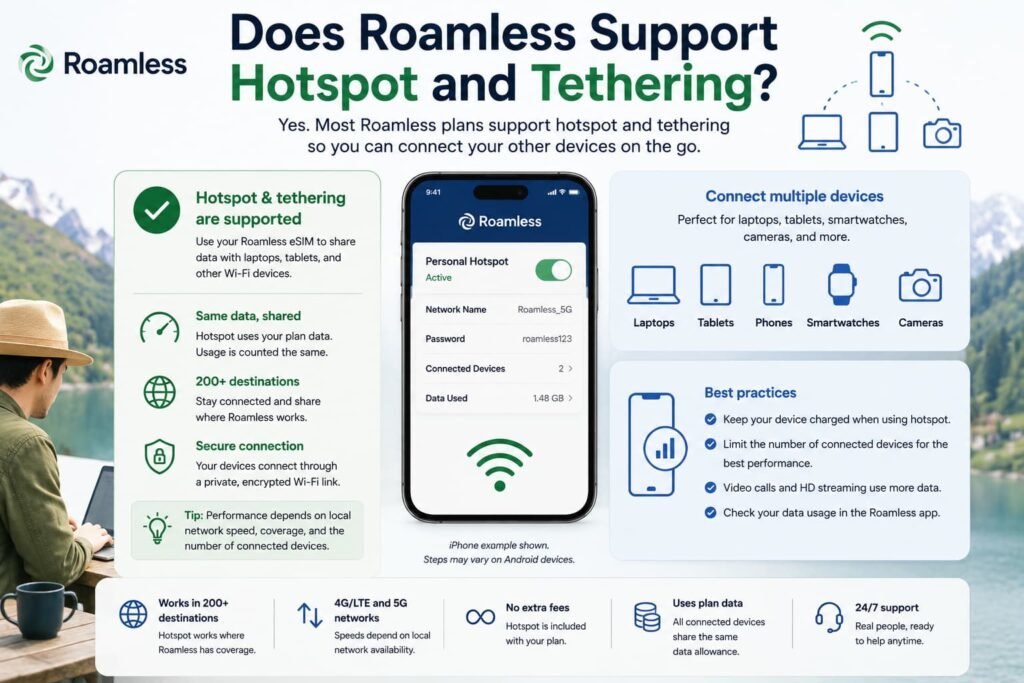
Roamless lists hotspot and tethering support for its service, although the destination and plan details should still be checked before relying on one plan for work or several devices. Individual destination pages display the available tethering conditions for that location.
The more important question is not only whether hotspot is permitted, but whether the selected payment model makes financial sense.
A connected laptop can consume data quickly through:
- Cloud backups
- Software updates
- Video meetings
- High-resolution streaming
- Large file uploads
- Automatic photo syncing
FLEX may be suitable for occasional email, light browsing, or emergency laptop access. A FIX plan is generally easier to monitor when tethering will be used every day.
Remember that hotspot sharing does not overcome the one-eSIM-per-account rule. You can share one phone’s connection temporarily, but installing Roamless separately on several family devices requires individual accounts.
Where Roamless Works Well in Real Travel Situations
Short trips to the United States
Canadians making weekend shopping trips, attending an event, or taking a short road trip may not need a full data package. FLEX lets the traveller use a small amount of data and retain the remaining purchased balance afterward.
It is also useful for someone who crosses the border several times a year and does not want to purchase another short-validity plan before every visit.
Multi-country trips in Europe
Roamless becomes more attractive when an itinerary crosses several supported countries. A reusable FLEX balance may cover a brief stopover or short stay where buying another country plan would create unnecessary leftover data.
Travellers expecting heavier use across the region should compare a Roamless regional FIX plan with the options covered in the Best eSIM for Europe from Canada guide.
Emergency and backup data
Keeping a small non-expiring FLEX balance provides a practical backup when:
- Airport Wi-Fi is unreliable.
- A primary travel plan fails.
- A fixed bundle expires.
- A flight disruption creates an unexpected stopover.
- You need maps or transportation immediately after landing.
Backup use is one of the strongest reasons to keep the Roamless eSIM installed after returning home.
Longer stays and remote work
Roamless can still work for longer trips, but FLEX is not automatically the best choice. Compare FIX plans when daily use includes video calls, streaming, large uploads, or laptop tethering.
For remote work, a predictable allowance, supported networks, and hotspot terms often matter more than keeping unused credit indefinitely.
Roamless Strengths
One reusable global eSIM
The profile can remain installed between trips instead of being replaced for each destination.
Non-expiring purchased credits
Unused FLEX credits remain available for future data, eligible in-app calls, and supported app communication.
Flexible payment choices
Light users can rely on FLEX, while travellers with larger needs can purchase a FIX plan through the same eSIM.
Automatic balance management
Eligible rewards and FIX plans are used before FLEX credits, helping preserve the non-expiring balance until other applicable data has been consumed.
Multi-country convenience
FLEX reduces the need to buy a separate bundle for every short stop or transit destination.
App-based calling
Outgoing calls to regular phone numbers can be useful when messaging apps are not accepted.
Optional second-number service
Roamless Numbers adds app-based incoming calls and SMS for users who need a separate number.
Hotspot support
Tethering is supported, although travellers still need to monitor how quickly connected devices consume data.
Manual device reinstallation
The Roamless eSIM can be moved to a replacement phone through Roamless’s documented reinstallation process without losing the associated account balance.
Roamless Limitations
FLEX rates vary by destination
One balance does not represent the same amount of data everywhere.
Heavy use may cost more
Streaming, large uploads, and daily tethering can make a larger fixed or unlimited-style plan more economical.
FIX-plan data expires
The 30-day validity begins after activation, and unused data does not carry forward after the plan expires.
Calls and SMS are app-based
The communication features do not behave like native carrier service attached directly to the data eSIM.
Roamless Numbers require connectivity
Incoming app calls cannot ring without an internet connection, and offline SMS waits until the app reconnects.
VoIP verification is uncertain
Banks, payment services, and online platforms may reject app-based numbers.
Automatic FLEX fallback consumes the balance
Continued connectivity is helpful, but it can consume purchased credits after a FIX plan ends.
One eSIM per account
Families or travellers using several devices need separate Roamless accounts for separate installed eSIMs.
Performance depends on local partners
Coverage in a supported country does not guarantee the same speed, latency, or network experience everywhere.
Roamless Alternatives
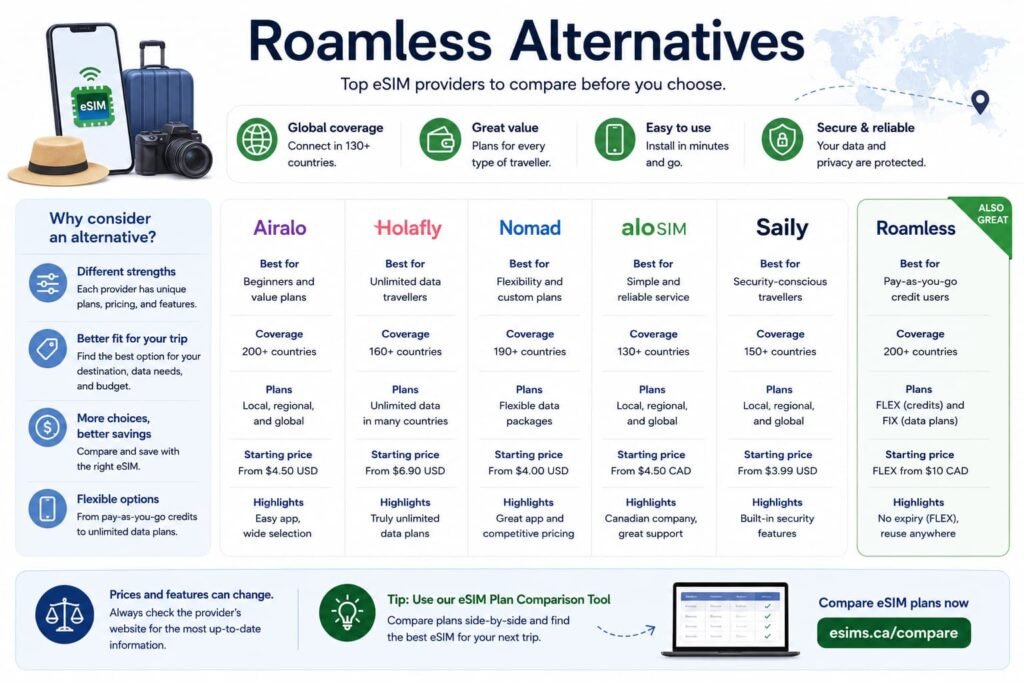
Roamless has a distinct payment model, but another provider may suit a different travel pattern.
| Travel priority | Provider to compare | Why |
|---|---|---|
| Large or unlimited-style data | Holafly | Focuses on heavier data use in many destinations |
| Familiar country and regional bundles | Airalo | Offers a broad catalogue of conventional prepaid plans |
| Flexible fixed data sizes | Nomad | Provides varied country and regional bundles |
| Long-validity backup data | Keepgo | Built around long-lasting balances and top-ups |
| Security-oriented app features | Saily | Offers a beginner-friendly experience with extra security tools |
A direct Roamless-versus-Airalo or Roamless-versus-Nomad article should own the side-by-side comparison intent. This review remains focused on whether Roamless itself is a practical choice.
Is Roamless eSIM Worth It for Canadians?
Roamless is worth considering when flexibility matters more than finding the lowest-cost bundle for one specific trip.
Its strongest fit is a Canadian traveller who takes more than one trip, uses light-to-moderate data, and wants one eSIM that can remain installed with purchased credits that do not disappear after a short validity period.
The decision changes when data use becomes heavy. A traveller streaming every night, running video meetings, or tethering a laptop should compare Roamless FIX plans with larger bundles and unlimited-style options rather than relying automatically on FLEX.
Roamless is also useful as a backup connection. Even when another provider supplies the main trip plan, keeping a small FLEX balance available can help during an unexpected stopover, trip extension, or primary-plan failure.
For a broader provider comparison, review the Best eSIM for International Travel before deciding.
Frequently Asked Questions About Roamless
How long do Roamless credits last?
Purchased Roamless FLEX credits do not expire. The remaining balance stays in your account and can be used during a future trip in another supported destination.
Promotional rewards and bonus data may have separate validity periods. Check the reward details rather than assuming every free or promotional credit lasts indefinitely.
What is the difference between Roamless FLEX and a FIX data plan?
Roamless FLEX uses a pay-as-you-go balance that is deducted according to the destination rate and your actual consumption. Purchased credits do not expire and can be used across supported destinations.
A FIX plan provides a predetermined data allowance for an eligible destination or coverage area. It may offer more predictable value for heavier use, but it expires 30 days after activation and unused data does not carry forward.
Does Roamless provide a phone number for calls and text messages?
The data eSIM itself does not include a conventional mobile number. Roamless Numbers is a separate subscription service that provides an app-based number for supported calls and SMS.
Calls and messages are handled inside the Roamless app rather than the phone’s regular dialler and messaging applications.
What happens to my Canadian phone number while using Roamless?
Your Canadian number remains connected to the original carrier SIM or eSIM. Roamless does not replace or transfer that number.
A compatible dual-SIM phone can keep the Canadian line active for calls and verification texts while Roamless handles mobile data. Turn off data roaming on the Canadian line unless your carrier plan specifically includes the destination.
Can I use one Roamless account on several phones?
One Roamless account currently supports one associated eSIM. Installing Roamless on additional phones or tablets requires separate accounts for those devices.
One phone can still share its data through hotspot when tethering is supported, but that is different from installing the Roamless eSIM directly on several devices.
How much data does Roamless use when tethering a laptop?
Roamless supplies the connection, but the amount consumed depends on the laptop’s activity.
Email and light browsing may use relatively little data, while cloud backups, operating-system updates, streaming, and video meetings can consume several gigabytes. Disable automatic updates and syncing before tethering through a pay-as-you-go balance.
When should I choose Roamless FLEX instead of a fixed plan?
FLEX is best suited to short trips, light use, stopovers, backup connectivity, and travellers who want unused purchased credits to remain available.
A FIX plan is usually easier to budget when you expect regular daily use, large uploads, streaming, or repeated hotspot sessions. Compare the full trip cost instead of choosing FLEX solely because it has no expiry.
Who should avoid relying on Roamless FLEX for travel?
FLEX is a weaker fit for heavy streamers, remote workers with frequent video meetings, families sharing one hotspot, and anyone who wants a single prepaid price without monitoring consumption.
Those travellers may still use Roamless, but a FIX bundle or another provider with a larger allowance may provide better cost predictability.
Does Roamless Work in Canada for Tourists?
Roamless includes Canada among its supported destinations, allowing international travellers to use eligible FLEX credits or a Canada FIX plan for mobile data during their visit. Available networks, data rates, and connection speeds may vary, so travellers should check the current Canada details in the Roamless app before purchasing.
Roamless may suit visitors who want one reusable eSIM for Canada and other destinations, but it is not automatically the best value for every trip. The stronger option depends on the length of the stay, expected data use, whether the itinerary also includes the United States, and how Roamless compares with Canada-specific travel eSIMs or local prepaid service.
Related eSIM Guides
Compare Travel Options
- Compare Travel eSIM Providers
- eSIM Providers by Country
- Best eSIM for International Travel
- eSIM Plan Comparison Tool
Review Other Travel eSIM Providers
Prepare and Troubleshoot Your Phone
- eSIM Compatibility Checker
- Activate eSIM on iPhone in Canada
- Activate eSIM on Android in Canada
- How to Fix eSIM Not Working in Canada
Final Thoughts
This Roamless eSIM review comes down to one main advantage: Roamless gives travellers a reusable global eSIM with purchased FLEX credits that remain available between trips.
That makes it especially practical for Canadians who travel several times, use data selectively, cross multiple borders, or want an emergency connection ready without buying another short-validity package.
Roamless is less compelling when mobile-data use is consistently high. Heavy streamers, remote workers, and families sharing hotspot should compare FIX plans and larger bundles before relying on pay-as-you-go data.
The strongest setup may be a combination: use a FIX plan for the main portion of a data-heavy trip and keep FLEX credits available for stopovers, unexpected extensions, or future travel.