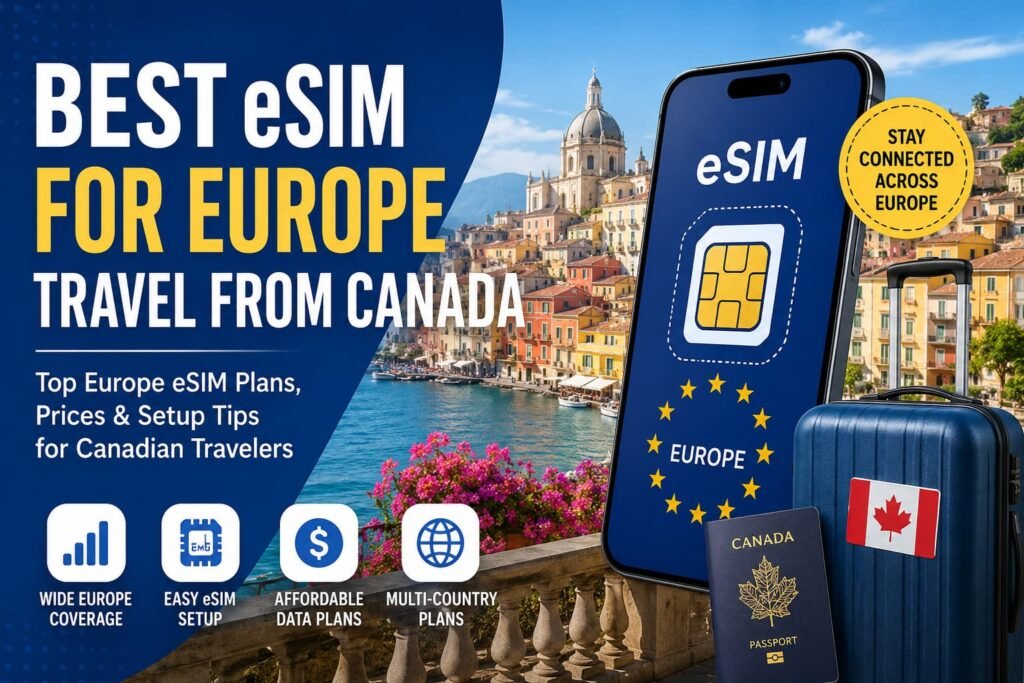
If you are travelling from Canada to Europe, choosing the best eSIM for Europe travel from Canada can make your trip much easier, especially if you are visiting more than one country.
Europe travel is different from a quick one-country trip. Many Canadians visit France, Italy, Spain, Portugal, Greece, the United Kingdom, Germany, the Netherlands, Ireland, Switzerland, Austria, or several countries in one itinerary. That means your mobile data setup needs to work across borders without making you switch SIM cards every few days.
A Europe travel eSIM gives you a separate prepaid data plan for your trip. You can install it before leaving Canada, use it for maps, hotel apps, train tickets, rideshares, restaurant searches, translation apps, messaging, and browsing, then keep your Canadian line available only if you need calls, texts, or verification codes.
This guide compares the best Europe eSIM options for Canadian travelers, when a regional Europe eSIM makes sense, how it compares with Canadian carrier roaming, and what to check before you leave Canada.
Quick Answer: Best eSIM for Europe Travel From Canada
For most Canadian travelers, Airalo is one of the best starting points for Europe travel because it offers simple regional Europe eSIM plans, easy setup, and useful coverage for multi-country trips. It is a strong fit for regular travelers who want prepaid data without dealing with daily roaming fees.
That said, the best eSIM for Europe travel from Canada depends on your trip style. Nomad is a strong alternative if you want flexible plan sizes and straightforward app-based setup. Saily is a good choice if you want a beginner-friendly app with added security features. Holafly is better suited for travelers who want unlimited-style data and do not want to monitor usage as closely.
For a short Europe trip where convenience matters most, Canadian carrier roaming may still be useful if you need your Canadian number active and do not mind the daily fee. For longer trips, family travel, multi-country itineraries, hotspot use, or data-heavy travel, a Europe travel eSIM is usually worth comparing before you leave Canada.
Best Europe eSIM Options for Canadian Travelers
The best Europe eSIM depends on where you are going, how many countries you are visiting, how much data you need, and whether you care more about price, unlimited-style data, app simplicity, or long-validity coverage.
| Provider | Best For | Main Strength | Main Caution |
|---|---|---|---|
| Airalo | Most Canadian travelers visiting Europe | Simple regional Europe eSIM plans and easy setup | Mostly data-focused, so check calls and SMS before buying |
| Nomad | Flexible plan sizes and city travel | Good plan variety and straightforward app-based setup | Some plans may require careful activation timing |
| Saily | Beginner-friendly Europe trips | Simple app experience with security-focused features | Data-only, so calls and texts usually use apps |
| Holafly | Heavy data users | Unlimited-style Europe data options | Usually costs more than smaller fixed-data plans |
| aloSIM | Simple travel data and Canadian-company angle | Easy app-based data setup | Check current Europe plan details before buying |
| Ubigi | Stable data and connected-device travelers | Useful for data-focused users and some connected devices | Plan options can vary by country and device |
| Jetpac | Budget-focused travelers | Often useful for short trips and simple data needs | Check coverage, validity, and hotspot rules before buying |
| Airhub | Deal shoppers | Marketplace-style pricing and plan variety | Plan details can vary by network partner |
For current plan details, compare live Europe options on the official Airalo Europe eSIM, Nomad Europe eSIM, Saily Europe eSIM, and Holafly Europe eSIM pages before buying.
aloSIM is also worth checking if you prefer a simple travel data setup and like using a Canadian-based eSIM company. Just compare its current Europe plan details before buying, because pricing, data amounts, included countries, hotspot rules, and coverage options can change.
How We Score Europe eSIM Providers for Canadian Travelers
To make these recommendations more useful, the provider rankings are based on overall fit for Canadian travelers, not just the cheapest plan.
A cheap Europe eSIM can still be the wrong choice if it has limited country coverage, confusing activation rules, weak hotspot support, short validity, poor support, or plan details that do not match how Canadians actually travel through Europe.
For this guide, each provider is scored using these factors:
| Scoring Factor | Weight | Why It Matters |
|---|---|---|
| Europe coverage and country support | 25% | A Europe eSIM should work across the countries Canadians commonly visit, including France, Italy, Spain, Portugal, the United Kingdom, Greece, Germany, Ireland, Switzerland, and the Netherlands. |
| Ease of setup before leaving Canada | 20% | The provider should be easy to install over Wi-Fi before departure, with clear app or QR code setup. |
| Plan flexibility and data options | 20% | Travelers need options for short trips, longer vacations, family travel, hotspot use, rail travel, and multi-country itineraries. |
| Value compared with Canadian roaming | 15% | A good travel eSIM should make sense compared with Canadian daily roaming fees, especially for longer trips or multiple travelers. |
| Best-fit use case clarity | 10% | Each provider should have a clear purpose, such as budget travel, unlimited-style data, simple setup, Canadian-company preference, or multi-country flexibility. |
| Limitations and fine print | 10% | The score considers possible issues such as data-only plans, hotspot restrictions, fair-use limits, activation timing, customer support, and country exclusions. |
Europe eSIM Price Snapshot for Canadian Travelers
Last checked: May 2026
Pricing is one of the biggest confidence indicators when choosing a Europe travel eSIM. The examples below are not meant to be a permanent price guarantee. They are a current planning snapshot based on publicly listed provider pages and plan examples available at the time of writing.
Always confirm the final price, included countries, validity period, hotspot rules, activation timing, and billing currency on the provider’s official page before buying. Many travel eSIM providers bill in USD or EUR, so Canadian travelers may also see foreign transaction fees depending on the credit card used.
| Provider | Verified Europe Plan Examples | Pricing Signal | Best Fit |
|---|---|---|---|
| MobiMatter | Marketplace examples include Europe plans such as 10 GB / 30-day options and larger regional bundles, depending on the network partner | Often one of the strongest low-cost marketplace options by data amount | Deal hunters and flexible travelers |
| Ubigi | Example: Europe 10 GB / 30 days listed at US$15 | Strong mid-size fixed-data value | Travelers who want stable fixed data |
| Saily | Examples include 1 GB / 7 days at US$4.99, 3 GB / 30 days at US$12.49, 10 GB / 30 days at US$35.99, and larger 50 GB or unlimited-style options | Good plan variety with beginner-friendly app features | First-time eSIM users |
| aloSIM | Europe prepaid packages start at 1 GB for US$5, with larger fixed-data options also available | Simple entry pricing and Canadian-company angle | Canadians who prefer a straightforward option |
| Holafly | Unlimited Europe eSIM plans are sold by trip length | Strong for unlimited-style data, but usually higher cost than fixed-data plans | Heavy data users |
| Nomad | Europe regional plans commonly include smaller, mid-size, and larger fixed-data options | Good balance of price, app simplicity, and plan variety | Flexible Europe travelers |
| Airalo | Europe regional plans commonly include fixed-data options such as smaller, mid-size, and larger plans | Strong all-around reliability and regional coverage | Most Canadian travelers starting their search |
| Keepgo | No-expiry prepaid data bundles are available, with annual top-up style use cases | Better long-term value if you travel repeatedly | Frequent travelers and backup data users |
| Airhub | Europe packages vary and may include different data, voice, or SMS combinations | Useful for plan variety, but details need careful checking | Travelers who want more than data-only options |
| GigSky | Europe and specialty travel plans are available, including premium travel use cases | Better as a premium or specialty option than a budget pick | Cruise, flight, or premium coverage users |
For most Canadian travelers, the best value depends on trip length and data habits. A 10 GB fixed-data plan may be enough for maps, train tickets, restaurant searches, messaging, and light social media. A heavier user, remote worker, or family sharing hotspot may need 20 GB or more, or an unlimited-style plan.
The cheapest plan is not always the best plan. Check whether the plan includes every country on your itinerary, especially if your trip includes the United Kingdom, Switzerland, Türkiye, Ireland, or smaller destinations outside the core European Union travel route.
Price matters, but it should not be the only factor. A cheaper plan may be fine for a short city break, while a stronger regional plan may be better for multi-country train travel, family trips, or remote work. That is why the scorecard below balances price with setup, coverage, plan flexibility, and real travel use.
Europe eSIM Provider Scorecard for Canadian Travelers
These are editorial fit scores, not lab-tested speed scores or guaranteed performance ratings. They are meant to help Canadian travelers compare providers based on practical travel needs, current plan structure, setup simplicity, regional usefulness, and known limitations.
| Provider | Best Use Case | Why It Scores Well | Fit Score |
|---|---|---|---|
| Airalo | Best starting point for most Canadian travelers | Strong regional Europe options, simple setup, practical prepaid data plans, and a good fit for multi-country trips | 9.3/10 |
| Nomad | Best flexible alternative | Good plan variety, straightforward app setup, and useful options for city travel, short trips, and regular Europe vacations | 9.1/10 |
| Saily | Best beginner-friendly setup | Simple app experience, security-focused features, and easy setup for travelers who want less technical friction | 8.9/10 |
| Holafly | Best for unlimited-style data | Strong fit for travelers who want heavy data use without monitoring every GB, especially for longer trips | 8.8/10 |
| MobiMatter | Best low-cost marketplace option | Strong low-cost Europe plan examples and broad marketplace selection, but support and plan details can vary by network partner | 8.6/10 |
| aloSIM | Best simple Canadian-company option | Easy app-based data setup and a good fit for Canadians who prefer a straightforward travel eSIM option | 8.5/10 |
| Ubigi | Best for stable data-focused use | Useful for travelers who want consistent data performance and supported-device flexibility | 8.4/10 |
| Jetpac | Best budget/simple-trip option | Good fit for shorter trips, deal-focused travelers, and simple Europe data needs | 8.2/10 |
| Airhub | Best marketplace-style option | Useful for deal shoppers who want plan variety, but plan details can vary by network partner | 8.0/10 |
Airalo scores highest as the best starting point because it fits the widest range of Canadian travelers visiting Europe. Nomad, Saily, Holafly, and MobiMatter are strong alternatives depending on whether you care more about flexible plan sizes, beginner-friendly setup, unlimited-style data, or low-cost marketplace pricing.
These scores are not meant to say one provider is perfect for every trip. They are meant to help you narrow down the best place to start based on how most Canadians travel in Europe.
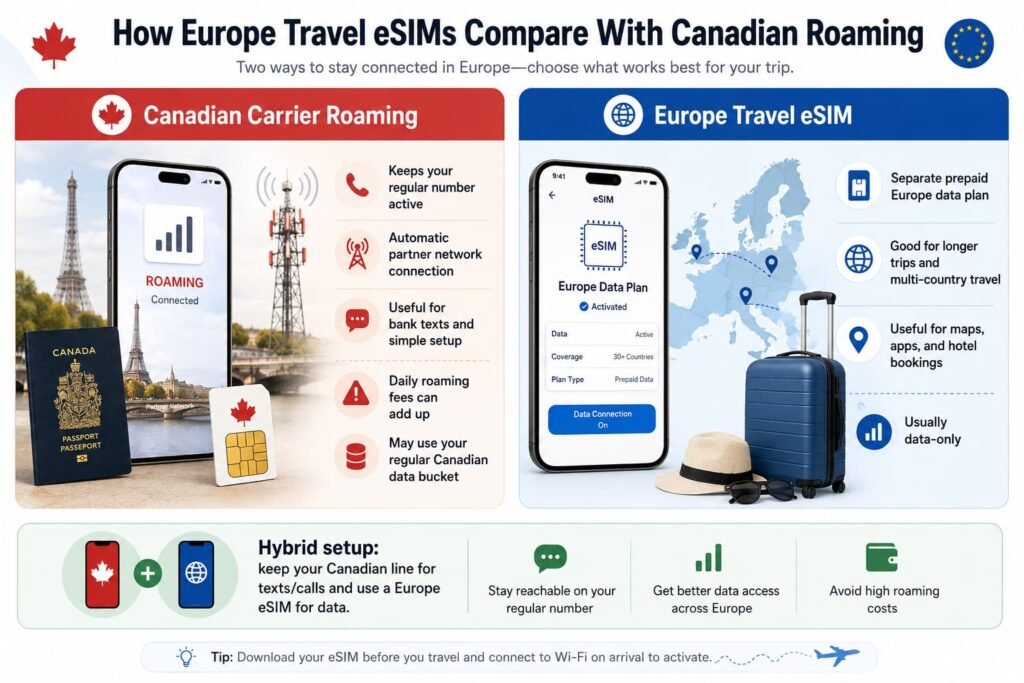
How Europe Travel eSIMs Compare With Canadian Roaming
Canadian carrier roaming is convenient because your regular phone number stays active and your device can connect to supported partner networks automatically. That can be useful if you want a simple setup, need bank verification texts, or do not want to manage another SIM profile.
The tradeoff is cost. Daily roaming fees can add up quickly in Europe, especially when the trip lasts more than a few days or several family members are travelling together. Some Canadian roaming options also use your regular Canadian data bucket, which means your maps, train apps, photo uploads, restaurant searches, and hotel bookings can use the same data plan you rely on at home.
A Europe travel eSIM works differently. It gives you a separate prepaid data plan for Europe. You install it before your trip, choose it as your mobile data line, and use it for internet access while keeping your Canadian line available only if needed.
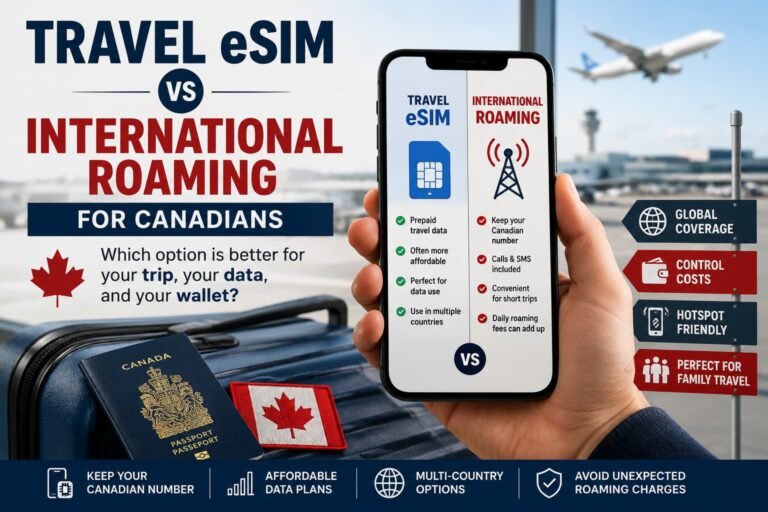
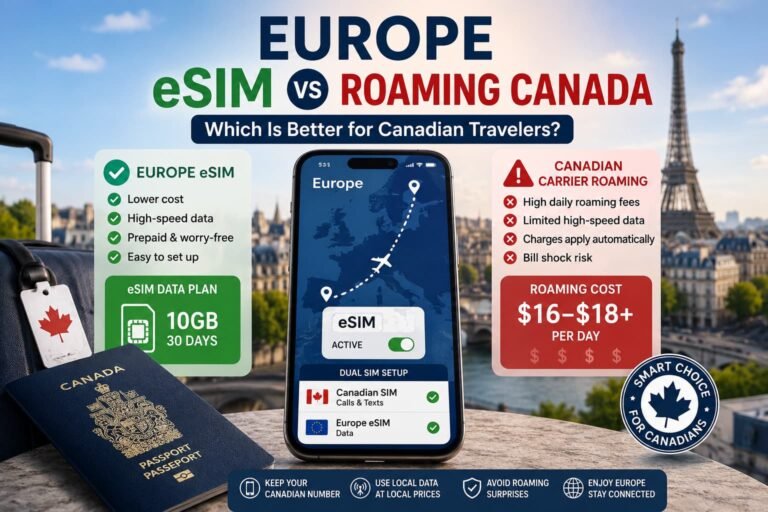
This is only a quick comparison. For a detailed look at current Canadian carrier options, travel passes, dual-SIM use and settings that help prevent accidental charges, see my Europe eSIM vs Roaming Canada guide.
To compare the estimated cost for your own trip, use the free Canadian Roaming Savings Calculator. It lets you calculate the difference based on your destination, trip length, number of travellers and expected data use.
| Option | Best For | Watch Out For |
|---|---|---|
| Canadian carrier roaming | Short trips, convenience, keeping your Canadian number active | Daily fees, per-line charges, and possible regular data bucket usage |
| Europe travel eSIM | Data control, longer trips, city travel, rail travel, family trips | Usually data-only, so regular calls and SMS may still need your Canadian line |
| Hybrid setup | Canadians who need their number active but want separate Europe data | Requires the correct dual SIM and roaming settings |
When a Europe Travel eSIM Makes the Most Sense
A Europe travel eSIM is usually worth comparing when your trip is longer than a weekend, includes several countries, or requires steady mobile data throughout the day.
It is especially useful for Canadian travelers who need mobile data for:
- Google Maps or Apple Maps
- Train tickets and transit apps
- Airline and hotel apps
- Rideshare apps
- Restaurant searches and reservations
- Translation apps
- Messaging apps like WhatsApp, iMessage, Messenger, Signal, or Telegram
- Email and browsing
- Museum, attraction, and event tickets
- Social media uploads
- Hotspot or laptop tethering
- Remote work or video calls
For many Canadians, the strongest setup is a hybrid setup: keep your Canadian line active only if you need incoming texts or important calls, then use the Europe travel eSIM for mobile data.
When Canadian Roaming May Still Be Better
A Europe travel eSIM is not always necessary.
Canadian carrier roaming may still be better if your trip is very short, your employer pays the roaming bill, your data use is light, or you need your Canadian number working normally for calls and texts.
Roaming can also be convenient for a quick business trip, a short layover, or a weekend visit where setup simplicity matters more than saving money.
The key is knowing the full cost before you leave Canada. If your carrier charges a daily roaming fee per line, a short trip can stay manageable. A 10-day Europe trip with two, three, or four phones can become expensive very quickly.
Best Europe eSIM by Traveler Type
Different Europe trips need different data setups. Use this table as a starting point before choosing a plan.
| Traveler Type | Best Starting Point | Why It Matters |
|---|---|---|
| One-country traveler | Country-specific or Europe regional eSIM | A single-country plan may be enough, but a regional plan gives flexibility |
| Multi-country traveler | Europe regional eSIM | One plan can work across several countries without switching profiles |
| Family trip | Travel eSIMs for each compatible phone | Per-line roaming fees can multiply quickly |
| Backpacker | Regional Europe eSIM with enough data | Hostels, train routes, maps, and messaging need steady data |
| Remote worker | High-data or unlimited-style Europe eSIM | Hotspot and video calls can drain data quickly |
| Budget traveler | Smaller prepaid Europe eSIM | Keeps mobile data separate from roaming |
| Needs Canadian SMS | Hybrid setup | Keeps Canadian line available while the eSIM handles data |
| Rail traveler | Regional Europe eSIM | Useful when crossing borders by train or bus |
Best Europe eSIM for Multi-Country Trips
A regional Europe eSIM is usually the easiest choice if your trip includes more than one country.
This is common for Canadians visiting routes like London, Paris, Amsterdam, and Brussels, or Italy, France, Spain, and Portugal. Instead of buying a separate country plan for every stop, a Europe regional eSIM can keep your data working as you move between supported countries.
Before buying, always check the included country list. Europe eSIM plans do not always cover every destination the same way. Some include the United Kingdom, Switzerland, Ireland, or Türkiye, while others may treat those countries differently.
If your itinerary includes smaller islands, remote areas, border regions, or non-EU destinations, read the plan details carefully before buying.
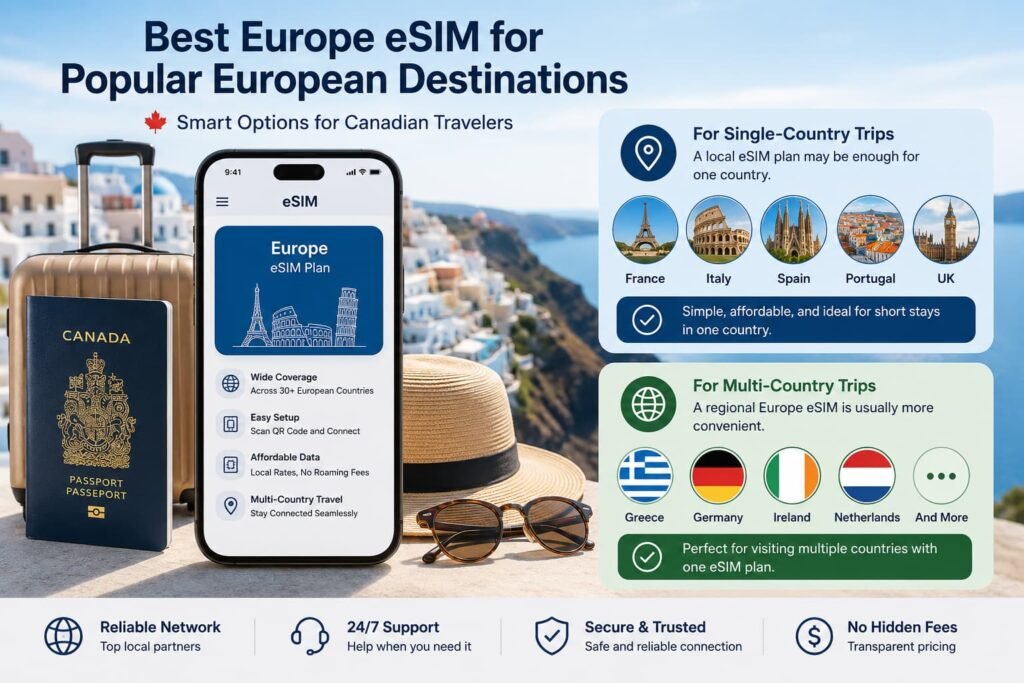
Best Europe eSIM for Popular European Destinations
Many Canadians travel to Europe for destinations such as France, Italy, Portugal, the United Kingdom, Spain, Greece, Germany, Ireland and the Netherlands.
For a single-country trip, a country-specific eSIM may provide better value than a regional plan:
- Best eSIM for Italy From Canada
- Best eSIM for France From Canada
- Best eSIM for Portugal From Canada
- Best eSIM for Spain From Canada
- Best eSIM for UK From Canada
If your itinerary includes several European countries, a regional Europe eSIM is usually more convenient because you can keep using the same data plan as you cross supported borders.
Before buying, check the included countries, data allowance, validity period, hotspot rules and activation timing. A regional plan is only useful if it covers every destination on your itinerary.
Europe eSIM vs Country-Specific eSIM
A Europe eSIM and a country-specific eSIM can both work well, but they solve different problems.
A country-specific eSIM is usually best when your trip stays in one place. If you are spending two weeks in France, Italy, Portugal, Spain, or the United Kingdom, a local plan may give you enough data without paying for broader regional coverage.
A Europe regional eSIM is usually better when your itinerary crosses borders. If you are visiting France and Italy, Spain and Portugal, or several countries by train, a regional plan helps you avoid switching profiles during the trip.
For most Canadian travelers taking a classic multi-country Europe vacation, a Europe regional eSIM is the safer starting point.
How Much Data Do Canadians Need for Europe Travel?
Your data needs depend on how you use your phone. Europe travel can use more data than people expect because maps, transit apps, translation tools, train tickets, hotel apps, and photo uploads are used constantly.
| Travel Style | Suggested Data Range | Good For |
|---|---|---|
| Light user | 1 GB to 3 GB per week | Messaging, quick searches, maps, email |
| Regular traveler | 5 GB to 10 GB per week | Maps, transit apps, restaurant searches, browsing, social media |
| Heavy user | 10 GB to 20 GB per week | Photo uploads, video calls, frequent navigation, content sharing |
| Remote worker | 20 GB+ or unlimited-style plan | Hotspot, laptop work, video meetings, cloud tools |
| Family hotspot user | Larger plan with hotspot support | Sharing data with tablets, kids, or laptops |
A smaller plan is fine if you mostly use hotel Wi-Fi. A larger plan is better if you are moving between cities, using maps all day, uploading photos, using hotspot, or travelling with family.
Best Setup for Keeping Your Canadian Number Active in Europe
Many Canadian travelers still need their regular phone number while in Europe. That might be for bank verification texts, work messages, family calls, two-factor authentication, or account login codes.
In that case, use a hybrid setup.
Keep your Canadian line active for incoming SMS or important calls, but set the Europe travel eSIM as the mobile data line. Then turn off data roaming for your Canadian line and disable automatic data switching.
This helps your phone use the travel eSIM for data while reducing the risk that your Canadian line quietly triggers roaming data in the background.
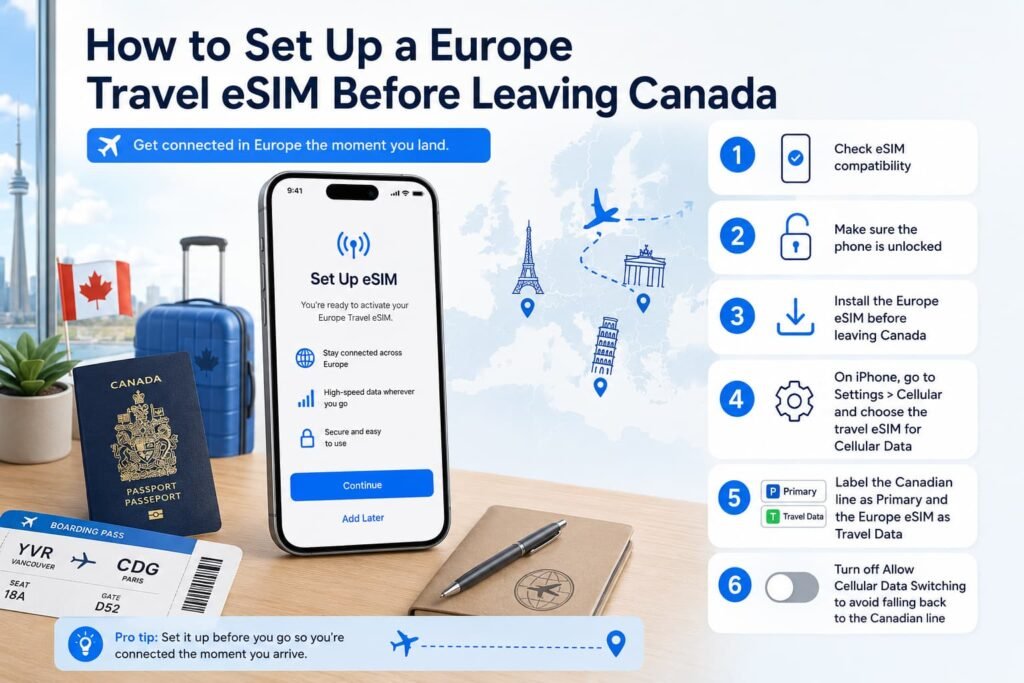
How to Set Up a Europe Travel eSIM Before Leaving Canada
Install your Europe travel eSIM before leaving Canada when possible. This is much easier than trying to set it up after landing at a busy airport, train station, hotel lobby, or border crossing with weak Wi-Fi.
Before buying any eSIM, use the eSIM Compatibility Checker to confirm that your phone supports eSIM. Also make sure your device is unlocked if you plan to use a travel eSIM from a provider that is not your regular carrier.
On iPhone, install the eSIM, label your Canadian line as Primary, label the Europe eSIM as Travel Data, then go to Settings > Cellular and choose the travel eSIM for Cellular Data. Turn off Allow Cellular Data Switching if you do not want the phone to fall back to your Canadian line.
For detailed setup help, follow the How to Activate eSIM on iPhone in Canada guide before your trip.
On Android, the menu depends on your phone brand. Samsung Galaxy users usually start at Settings > Connections > SIM Manager. Google Pixel users usually start at Settings > Network & Internet > SIMs. Motorola and other Android users should look for SIMs, Mobile Network, or SIM Manager.
For full Android setup help, use the Activate eSIM on Android Canada guide before travelling.
Common Europe eSIM Mistakes to Avoid
The biggest mistake is buying a Europe eSIM without checking the included countries. Europe plans can vary, and not every plan covers the same destinations.
Another common mistake is waiting until you arrive to install your eSIM. If airport Wi-Fi is slow, your email login asks for a verification code, or your Canadian line does not connect properly, setup can become stressful.
Do not buy the smallest plan automatically. Europe travel often involves maps, transit apps, translation tools, photo uploads, and train or hotel apps. A cheap 1 GB plan can disappear quickly if your phone updates apps, syncs photos, or uses navigation all day.
Also check whether your travel eSIM is data-only. Most travel eSIMs do not replace your Canadian phone number for regular SMS or voice calls. You can still use WhatsApp, iMessage, FaceTime, Messenger, Signal, Telegram, email, and other internet-based apps over the eSIM data connection.
Finally, do not leave automatic data switching on if you are trying to avoid Canadian roaming. If your phone switches back to your Canadian line for data, you may trigger roaming even though you bought a travel eSIM.
Frequently Asked Questions About the Best eSIM for Europe Travel From Canada
What is the best eSIM for Europe travel from Canada?
The best eSIM for Europe travel from Canada depends on your trip length, destination list, data needs, and whether you want fixed data or unlimited-style data. Airalo is a strong starting point for most Canadian travelers because it offers regional Europe plans that are useful for multi-country trips.
Nomad, Saily, Holafly, MobiMatter, aloSIM, Ubigi, Jetpac, and Airhub are also worth comparing depending on whether you want flexible plan sizes, simple setup, unlimited-style data, low-cost marketplace pricing, security features, or marketplace-style plan variety.
Is a Europe travel eSIM cheaper than Canadian roaming?
A Europe travel eSIM is often cheaper than Canadian roaming for longer trips, family travel, and data-heavy travel. Canadian roaming can be convenient, but daily fees can add up quickly when several lines are travelling or when the trip lasts more than a few days.
For very short trips, roaming may still be simple enough if you need your Canadian number active. Before deciding, compare your carrier, trip length, number of travelers, and data use with the Canadian Roaming Savings Calculator.
How do I avoid Rogers, Bell, or TELUS roaming fees while using a Europe eSIM?
To reduce the risk of Canadian roaming fees, set your Europe eSIM as the mobile data line, turn off data roaming on your Canadian SIM, and disable automatic cellular data switching. Keep your Canadian line active only if you need incoming texts, verification codes, or important calls.
Before travelling, use the Canadian Roaming Savings Calculator to estimate your carrier roaming cost and compare it with a Europe travel eSIM. For now, the calculator is the best place to check whether roaming or a travel eSIM may cost less for your trip.
Will using a Europe eSIM change my Canadian phone number on WhatsApp or iMessage?
Using a Europe eSIM for mobile data does not automatically change your WhatsApp number or iMessage identity. Apps like WhatsApp and iMessage can continue using your Canadian number while your Europe eSIM handles the data connection.
The main thing is to keep your phone settings organized. Label your Canadian line as Primary, label your Europe eSIM as Travel Data, and make sure mobile data is assigned to the Europe eSIM once you arrive.
Should I buy a Europe eSIM or a country-specific eSIM?
A Europe eSIM is usually better if your trip includes multiple countries. It keeps your setup simpler and helps you avoid switching plans as you cross borders.
A country-specific eSIM may be better if your entire trip is in one country. If you are staying only in France, Italy, Portugal, Spain, Greece, or the United Kingdom, compare both options before buying because a local plan may be enough.
Can I keep my Canadian number active while using a Europe eSIM?
Most modern dual SIM phones let you keep your Canadian line active while using a Europe travel eSIM for mobile data. This is helpful if you need bank verification texts, work messages, family calls, or account login codes while travelling.
The key is to set the Europe eSIM as the mobile data line and turn off data roaming for your Canadian line. You should also turn off automatic data switching so your phone does not quietly switch back to Canadian roaming data.
Do Europe travel eSIMs include calls and texts?
Many Europe travel eSIMs are data-only. That means they give you mobile internet but not a regular European phone number for traditional calls and SMS.
You can still use internet-based apps such as WhatsApp, FaceTime, iMessage, Messenger, Signal, Telegram, Skype, Google Meet, and email over the eSIM data connection. If regular calls and texts are important, check the plan details carefully before buying.
When should I install my Europe travel eSIM?
Install your Europe travel eSIM before leaving Canada whenever possible. You can usually install the profile before the trip, then activate it or turn it on according to the provider’s instructions.
This helps avoid airport Wi-Fi issues, email login problems, QR code access problems, and setup stress after landing. Always read the provider’s activation rules because some plans start immediately after installation, while others start when the eSIM connects in the destination.
Does a Europe travel eSIM work for hotspot?
Many Europe travel eSIMs support hotspot, but the rules depend on the provider and plan. Some fixed-data plans allow hotspot without much issue, while unlimited-style plans may have hotspot limits, speed rules, or fair-use restrictions.
If you plan to work remotely, connect a laptop, share data with family, or use a tablet during the trip, check hotspot support before buying. Hotspot use can drain data quickly, so choose more data than you think you need.
Can I use one Europe eSIM across multiple countries?
A regional Europe eSIM can often be used across multiple supported countries, but you need to check the country list before buying. Europe plans can vary by provider, and some may include different combinations of EU and non-EU destinations.
This is especially important if your trip includes the United Kingdom, Switzerland, Türkiye, Ireland, or smaller island destinations. Do not assume every Europe eSIM covers every European stop on your itinerary.
What should Canadians check before buying a Europe eSIM?
Before buying a Europe eSIM, confirm that your phone supports eSIM, your device is unlocked, the plan covers every country on your itinerary, hotspot is allowed if you need it, and the data amount matches your trip.
You should also check whether the plan is data-only, when the validity period starts, whether top-ups are available, and whether the provider supports the specific countries or regions you are visiting.
More eSIM Travel Guides for Canadian Travelers
Start Here
- Best eSIM for International Travel
- Best eSIM for USA Travel for Canadians
- eSIM Providers by Country
- Canadian Roaming Savings Calculator
- eSIM Compatibility Checker
Explore Europe Destinations
- Best eSIM for Italy From Canada
- Best eSIM for France From Canada
- Best eSIM for Portugal From Canada
- Best eSIM for Spain From Canada
- Best eSIM for UK From Canada
- Europe eSIM vs Roaming Canada
Setup Help
- How to Activate eSIM on iPhone in Canada
- Activate eSIM on Android Canada
- How to Fix eSIM Not Working in Canada
Provider Reviews
Final Thoughts
The best eSIM for Europe travel from Canada depends on how you travel.
For a short Europe trip, Canadian roaming may still be convenient if you need your regular number and do not mind the daily fee. For longer Europe trips, family vacations, multi-country itineraries, rail travel, hotspot use, or remote work, a Europe travel eSIM is usually worth comparing before you leave Canada.
A travel eSIM gives you a separate prepaid data bucket, which can make Europe travel easier to budget. It also helps you avoid draining your regular Canadian data plan while using maps, transit apps, hotel apps, messaging, translation tools, and browsing abroad.
For many Canadians, the best setup is simple: keep your Canadian line available only if you need texts or important calls, then use a Europe travel eSIM for mobile data.
Before buying, check your phone compatibility, compare your carrier roaming cost, confirm the countries included, choose enough data for the trip, and install your eSIM before leaving Canada.