If you’re trying to figure out the best eSIM for France from Canada, you’ve got more choices than ever. The challenge isn’t finding a France eSIM. It’s figuring out which option actually makes the most sense for your trip.
For some Canadians, a prepaid travel eSIM will be the easiest and cheapest choice. Others may be better off with a Europe-wide eSIM, while longer trips can make Bell or TELUS’s newer Europe roaming passes more competitive than many travellers expect. If you want to keep your Canadian number active or need a French phone number during your stay, that changes the decision again.
The good news is that you don’t have to guess. This guide compares the best eSIMs for France from Canada, explains when Canadian roaming is worth considering, and helps you choose the right setup for your itinerary.
What Is the Best eSIM for France From Canada?
If I were choosing an eSIM for a typical trip from Canada to France today, Ubigi would be my first place to look. Its France-specific plans offer excellent value, enough data for most holidays, and an easy setup before you leave Canada.
That doesn’t mean it’s automatically the best option for everyone.
If France is just one stop on a longer European itinerary, a regional Europe eSIM could save money and eliminate the need to switch plans between countries. Travellers who expect to use a lot of mobile data may prefer Holafly’s unlimited plans, while Canadians who want to keep using their existing mobile plan without changing anything should compare their carrier’s current Europe roaming options before buying an eSIM.
For most Canadians, though, a prepaid travel eSIM remains the best balance of price, convenience and flexibility for travelling in France.
What I’d Choose for Different France Trips
Ubigi is my first place to look for a France-only trip because its current France plans can offer unusually strong value without forcing you into an unlimited package.
Saily is a good fit if you want a straightforward app-based setup with several fixed-data sizes and automatic activation when you arrive.
Holafly makes more sense for heavy data use when you would rather pay more for unlimited data than keep checking how many gigabytes remain.
Nomad is worth comparing if you want flexible plan choices, hotspot support and access to multiple French networks on eligible plans.
If France is only one part of your itinerary, do not buy yet. A regional Europe eSIM may be a better choice than a France-only plan.
The Best eSIMs for France From Canada
There is no reason to recommend six nearly identical France plans just to make the list longer. These four options cover the main decisions most Canadian travellers will actually face.
| Provider | Example current plan | Validity | Official price | CAD | Best for |
|---|---|---|---|---|---|
| Ubigi | 10 GB | 7 days | US$8 | C$11.14 | Short France trips and value |
| Saily | 5 GB | 30 days | US$10.99 | C$15.30 | Light to moderate use |
| Saily | 10 GB | 30 days | US$16.99 | C$23.66 | Typical vacations |
| Holafly | Unlimited | 7 days | US$27.50 | C$38.30 | Heavy data use |
Prices can change, so I would still check the provider before buying. The important comparison is not whether one plan is a few dollars cheaper today. It is whether the data amount, validity and countries covered match the trip you are actually taking.
Ubigi: My First Pick for a France-Only Trip
Ubigi stands out because its France-specific plans can be aggressively priced without requiring a large data commitment.
A current example is 10 GB for seven days at US$8. The plan supports hotspot sharing and uses Ubigi’s Smartstart system, which starts the plan when it connects at the destination rather than simply consuming the validity period while you are still in Canada.
Ten gigabytes is enough for a lot of normal travel use. Maps, messaging, restaurant searches, transit apps, email and moderate social media use should not come close to consuming that amount for many travellers during a one-week holiday.
That combination makes Ubigi especially competitive for a typical France-only trip.
The limitation is that the best France-specific deal may no longer be the best deal once your itinerary crosses borders. If you are adding Italy, Spain, Belgium or another European country, compare the France package against Ubigi’s regional plans and competing Europe eSIMs before buying.
You can also read my complete Ubigi eSIM Review if you want a closer look at how the provider works beyond France.
Saily: A Simple Choice for Fixed Data
Saily’s France plans currently run from small 1 GB packages through larger fixed-data and unlimited options, so it is easy to match the amount of data to the trip instead of paying for more than you expect to use.
For example, 5 GB is currently US$10.99 and 10 GB is US$16.99, with both valid for 30 days.
The setup is app-led. You install the eSIM, enable roaming for the Saily line and the plan can activate automatically when you reach France. Hotspot use is supported, and Saily currently lists 3G, 4G/LTE and 5G connectivity depending on the local network.
I like Saily most for someone who wants the process to feel uncomplicated. Pick a data amount, install the eSIM before travelling and let the phone connect when you arrive.
Saily is also worth considering if France becomes part of a wider itinerary because it offers regional Europe plans. See my Saily eSIM Review for the broader strengths and limitations.
Holafly: Better for Travellers Who Do Not Want to Track Data
There are trips where I would rather not think about whether I have 2.7 GB or 1.9 GB left. That is the main argument for Holafly’s France eSIM.
Holafly currently sells unlimited-data France packages based on the number of days you need. A seven-day plan is US$27.50, while longer stays are priced according to duration.
It costs considerably more than the fixed-data examples above, but that is not automatically poor value. Someone uploading photos and videos throughout the day, using navigation constantly or simply wanting predictable unlimited mobile data may prefer paying more upfront.
There are two limitations worth knowing.
First, unlimited data does not mean unrestricted hotspot use. The current France product permits up to 1 GB of hotspot sharing per day.
Second, Holafly notes that fair-use restrictions can temporarily affect speeds in some situations. Unlimited should therefore be read as freedom from a fixed gigabyte allowance, not a promise of permanently unrestricted maximum-speed use.
For lighter travellers, I would save the money and use a fixed-data plan. For heavy users, Holafly becomes much easier to justify.
My Holafly eSIM Review goes deeper into that trade-off.
Nomad: Flexible Plans and Multiple French Networks
Nomad’s France eSIM is another option I would check before buying, particularly if its available plan sizes line up better with your trip than Ubigi or Saily.
Nomad currently lists access to Bouygues, Free Mobile, Orange and SFR for France, although exact network availability can depend on the plan. Having access to more than one network can be useful when travelling outside major cities because the strongest signal may change by location.
Hotspot use is supported, and Nomad offers both fixed-data and unlimited-style options. Eligible plans can also be extended with add-on data instead of requiring a completely new setup.
Installation can be done before leaving Canada, but Nomad advises checking the specific activation instructions because some plans differ. Its current France guidance generally allows the plan to be purchased and installed in advance and then started when it connects at the destination.
See my Nomad eSIM Review if you want to compare its broader plan model before choosing.
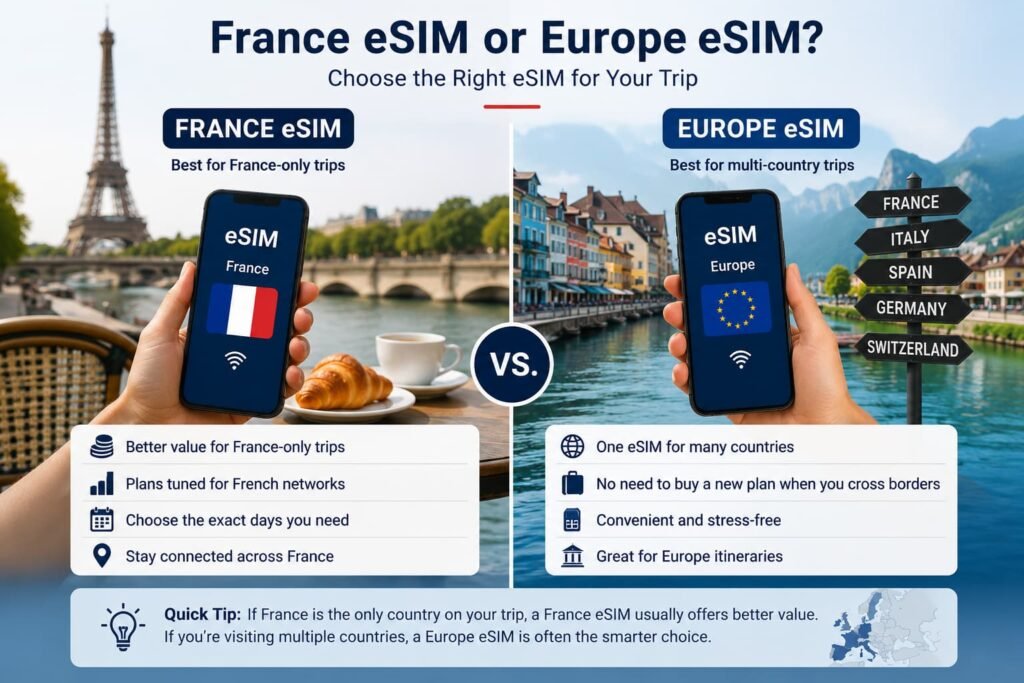
Should You Buy a France eSIM or a Europe eSIM?
This decision matters almost as much as choosing the provider.
If you are flying to Paris, spending ten days in France and returning to Canada, a France-only plan deserves to be compared first. There is little benefit in paying for thirty or forty countries you never enter if the local plan gives you more data for less.
The calculation changes quickly once France becomes the first stop rather than the whole trip.
A France, Belgium and Netherlands itinerary is a good example. So is Paris followed by Barcelona or Rome. Instead of buying separate country plans or wondering whether your France package continues across the border, one Europe regional eSIM can keep the same data line working throughout the trip.
If Spain is one of your main stops, my Best eSIM for Spain guide compares Spain-specific plans, tested performance, local prepaid options and Canadian roaming.
My rule is simple:
| Your itinerary | What I would compare first |
|---|---|
| France only | France-specific eSIM |
| France + one nearby country | Compare France plans against a regional Europe plan |
| Several European countries | Regional Europe eSIM |
| Frequent Europe travel | Longer-validity or reusable regional plan |
If you are travelling beyond France, use my Best eSIM for Europe Travel From Canada guide before buying. A France plan that looks cheaper on the first screen may not be the better purchase once the full itinerary is considered.
How Much Data Do You Need in France?
Many travellers overbuy data because unlimited sounds safer. Others underestimate how quickly maps, videos and hotspot use can add up.
For a normal vacation, this is a reasonable starting point:
| Travel style | Suggested data |
|---|---|
| Maps, WhatsApp, email and occasional browsing | 3–5 GB per week |
| Normal maps, social media, browsing and photo sharing | 5–10 GB per week |
| Frequent video, reels and heavier social use | 10–20 GB per week |
| Laptop hotspot, remote work or extensive video | 20 GB+ or unlimited |
Hotel and apartment Wi-Fi can reduce your mobile-data needs, but I would not build a trip around having Wi-Fi available every time you need directions, a train ticket or a rideshare app.
In Paris and other major French cities, mobile data becomes particularly useful because transport, navigation, restaurant bookings and tickets often end up on the phone throughout the day.
For road trips, I would leave a little more headroom. Navigation does not usually consume huge amounts of data, but searching routes, attractions, accommodation and restaurants while moving around can make usage less predictable.
When a Local French SIM or eSIM Makes More Sense
A travel eSIM is usually the easiest answer for a short Canadian vacation, but it is not always the best one.
Most travel eSIMs are built around mobile data. That is perfect if you use WhatsApp, FaceTime, Messenger or another internet-based service for calls and messages.
A local French service becomes more attractive when you want:
- a French phone number
- conventional local calling and SMS
- a longer stay
- large domestic data allowances
- service that behaves more like a normal French mobile plan
Orange Holiday is designed specifically for visitors. Orange sells the eSIM online, while physical versions are also available through Orange stores and selected airport and train-station retailers. Current Holiday options can include data, calls and SMS rather than functioning as data-only travel products.
Free Mobile is another interesting option for longer stays. Free offers visitor access to local service, including eSIM activation and a French phone number.
The trade-off is convenience. A travel eSIM can usually be bought in Canada in minutes, installed before departure and left dormant until arrival. Local French service may involve more plan terms, local activation procedures or a product designed around staying longer than a typical one-week holiday.
For most short trips, I would still use a travel eSIM. If I needed a French number or were staying for several weeks, I would compare the local options much more seriously.
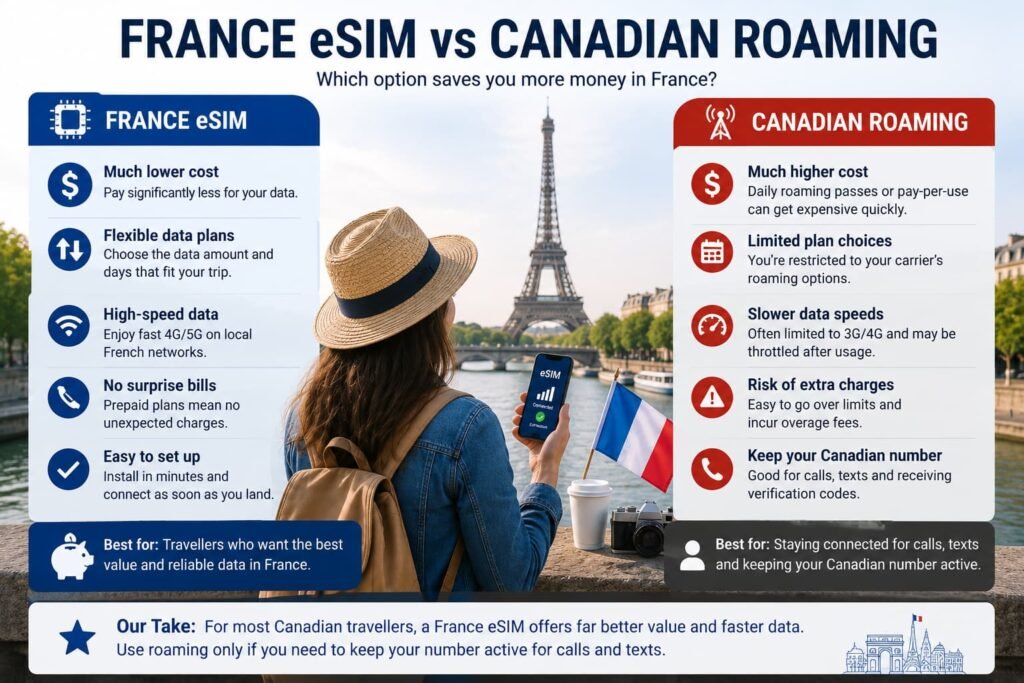
France eSIM vs Canadian Roaming
This comparison is less obvious than it used to be.
Paying a Canadian carrier’s international daily roaming rate can still become expensive quickly, but Bell and TELUS now offer European travel passes that dramatically change the numbers for longer trips.
| Option | Current example | Best reason to use it |
|---|---|---|
| TELUS Europe Easy Roam Pass | C$50 / 14 days | Very convenient if eligible |
| TELUS Europe Easy Roam Pass | C$60 / 30 days | Strong longer-trip value |
| Bell Europe Travel Pass | C$75 / 14 days | Keep Canadian plan/number working normally |
| Bell Europe Travel Pass | C$90 / 30 days | Convenience on a longer Europe trip |
| Bell Roam Better | C$16/day | Short trips or occasional roaming days |
| TELUS Easy Roam international | C$18/day | Short or occasional use |
| Travel eSIM | Often much less for data-only service | Control data cost separately |
These carrier passes are important because they weaken the old blanket advice that a travel eSIM is always cheaper.
A TELUS customer who can get 30 days of European roaming for C$60 may decide the convenience is worth more than saving another C$30 or C$40. You keep using your Canadian phone number, existing plan data, calls and texts without changing your normal communication habits.
On the other hand, someone who only needs data could still spend far less with a travel eSIM. The gap gets even larger when two, three or four family members would otherwise each need their own Canadian roaming arrangement.
Rogers also offers Roam Like Home Travel Pass options for longer international trips, so Rogers customers should check the current France/Europe offer in MyRogers rather than assuming the standard daily roaming rate is their only choice.
Freedom Mobile is different again. Its current Roam Beyond plans and passes cover a large group of international destinations without the same daily-roaming model used by the larger carriers. Check whether your current Freedom plan or available Roam Beyond option already covers France before buying another service.
If you use Fido, Koodo, Virgin Plus or another Canadian carrier, check its current Europe roaming or travel-pass options before buying a France eSIM. While the names and pricing may differ, the same decision applies: paying more for the convenience of using your Canadian plan or saving money with a dedicated travel eSIM.
The easiest way to compare your actual trip length is with the Canadian Roaming Savings Calculator.
The Hybrid Setup I Prefer for Many France Trips
There is no requirement to choose between “use my Canadian SIM” and “replace it with a travel eSIM.”
With a dual-SIM phone, you can keep both.
The travel eSIM handles mobile data in France while the Canadian SIM remains installed for your regular phone number. That can be useful for bank verification texts, account security codes or people who still need to reach your Canadian number.
The important part is configuring the lines deliberately.
Set the France eSIM as the line used for mobile data. Enable data roaming on the travel eSIM when the provider requires it.
Then decide what you want the Canadian line to do.
If you do not intend to use Canadian carrier roaming, disable data roaming on that line and avoid allowing the phone to switch mobile data back to it automatically. Calls and other activity on the Canadian line may still produce roaming charges depending on your carrier and plan, so keeping a SIM turned on is not the same thing as having free service abroad.
If you bought a Canadian Europe roaming pass specifically because you want the Canadian line to work normally, the setup is different. In that case you may not need a separate travel eSIM at all.
What Mobile Coverage Is Really Like Around France
France has four major mobile-network operators: Orange, SFR, Bouygues Telecom and Free Mobile.
That gives travel eSIM providers several possible network partners, but the network available to you depends on the provider and exact plan you purchased.
In Paris, Lyon, Marseille, Nice and other large cities, I would be more concerned about choosing the right data allowance and plan than obsessing over one network name.
Coverage becomes a more meaningful question when the itinerary moves into:
- rural villages
- wine regions
- long motorway drives
- mountain areas
- remote hiking routes
- extended rail travel
Mobile service can also fluctuate while a high-speed train is moving between coverage areas. That does not necessarily mean the eSIM itself is bad.
France’s telecom regulator ARCEP operates Mon réseau mobile, which lets you compare mobile coverage and quality by network. If you are spending significant time in a remote part of France, I would check the location there instead of relying on a generic “nationwide coverage” marketing claim.
Multiple-network support can also become more useful on this type of trip. Nomad, for example, currently lists Bouygues, Free Mobile, Orange and SFR networks for its France product, while Holafly also lists multiple French networks.
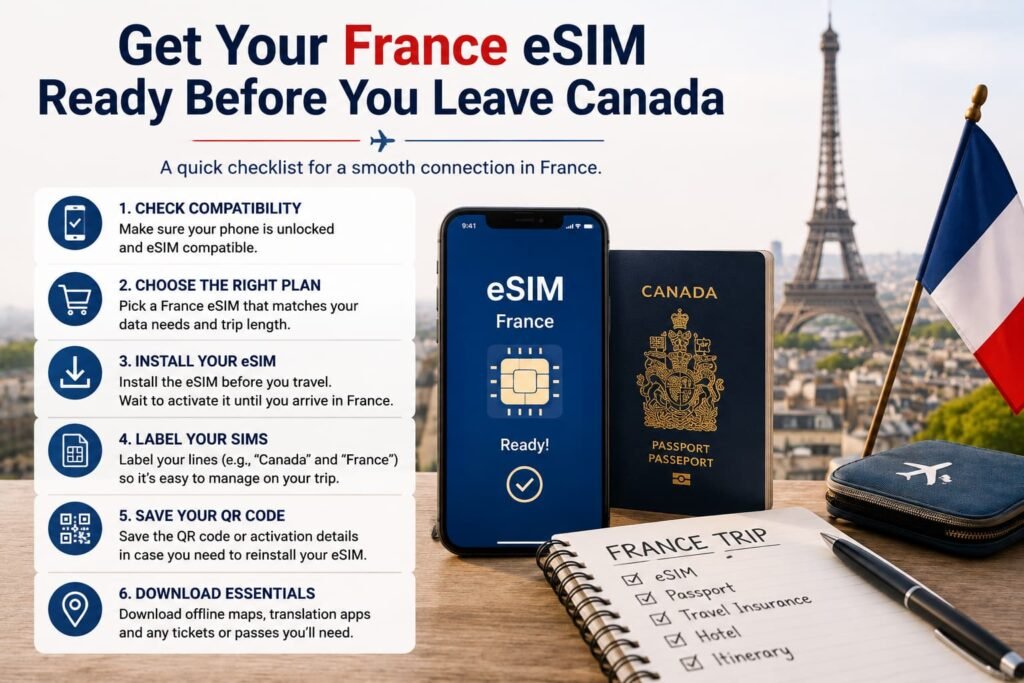
Get Your France eSIM Ready Before You Leave Canada
Do the setup while you still have reliable home internet rather than figuring it out after a long flight.
First, make sure the phone is unlocked and supports eSIM. You can use the eSIM Compatibility Checker if you are unsure.
Then:
- Buy the plan that matches the entire itinerary. Do not buy France-only data before remembering that you are spending four days in Spain afterward.
- Install the eSIM before departure when the provider permits it. Installation and plan activation are not always the same thing.
- Label the lines clearly. Names such as “Canada” and “France Data” are much easier to understand after landing than “Primary” and “Secondary.”
- Save the provider’s app, account details or QR information. Do not assume airport Wi-Fi will be perfect if something needs to be rechecked.
- Choose the correct mobile-data line after arrival.
- Enable data roaming on the travel eSIM when required.
- Disable unwanted Canadian-line data roaming and automatic data switching.
- Download important information offline.
I would keep offline copies of hotel details, train or airline tickets and at least part of the map for the area I am visiting. Mobile coverage in France is generally good enough that a traveller should not be planning for constant disconnection, but essential documents are too important to depend entirely on one phone connection.
For a broader comparison of available plans before buying, use the eSIM Plan Comparison Tool.
Frequently Asked Questions
Which France eSIM is best for a one-week trip?
For a typical one-week France-only holiday, Ubigi is the first option I would compare because its current France-specific fixed-data pricing is particularly competitive. A 10 GB plan should also be enough for many travellers using maps, messaging, restaurant searches, transit apps and moderate social media.
Saily is a strong alternative if you prefer its app-led setup, while Holafly makes more sense if you expect heavy data use and do not want to monitor a fixed allowance.
How much mobile data do I need for a week in France?
Around 5–10 GB is a comfortable range for many travellers using maps, messaging, web browsing, transit apps and normal social media during a one-week trip. Light users can manage with less, while frequent video uploads, streaming or laptop hotspot use can push consumption much higher.
Unlimited data is convenient, but it is not automatically necessary for a normal holiday.
Can I keep my Canadian phone number while using a France eSIM?
A dual-SIM phone can normally keep the Canadian SIM available while a France eSIM handles mobile data. This is useful when you want access to your usual number or verification texts.
You still need to understand your Canadian carrier’s roaming rules. Keeping the line switched on does not automatically mean calls, texts or other activity are free.
When is a local French SIM or eSIM better than a travel eSIM?
Local French service becomes more interesting when you need a French phone number, conventional local calls and SMS, a very large domestic data allowance or service for a longer stay. Orange Holiday and Free Mobile are examples worth comparing.
For a short trip where mobile data is the main requirement, a prepaid travel eSIM is usually easier.
Should I buy a France eSIM or a Europe eSIM?
A France-specific eSIM usually makes the most sense when France is the entire trip and the local plan offers better data value. A Europe eSIM becomes more useful when you are visiting several countries because the same data line can continue working as you cross borders.
Always check the country list. “Europe” does not guarantee that every regional plan covers exactly the same destinations.
Can I get a French phone number with an eSIM?
Local French eSIM services can include a French number. Free Mobile is one example, while Orange Holiday products can include calling and SMS features.
Do not assume that every travel eSIM provides a French number. Many are primarily data services even though calls through WhatsApp, FaceTime and similar apps work over the data connection.
Is Canadian carrier roaming worth using in France?
It can be. TELUS currently offers Europe passes at C$50 for 14 days and C$60 for 30 days, while Bell currently offers C$75 for 14 days and C$90 for 30 days. Those longer-duration options are far more competitive than repeatedly paying a daily international roaming charge.
A travel eSIM can still cost much less when you mainly need data, but carrier roaming may be worth the extra cost when keeping your Canadian number and plan working normally is the priority.
Will my France eSIM work outside Paris?
A France eSIM is intended to provide service beyond Paris, but actual coverage depends on the local network used by your particular plan and your location. Major cities are the easy part. Rural areas, mountains, long rail routes and remote roads are where network differences become more relevant.
If you are heading somewhere unusually remote, check the French network used by the plan and compare coverage through ARCEP’s Mon réseau mobile tool.
Related eSIM Canada Guides
Planning a European Trip
- Best eSIM for Europe Travel From Canada
- Best eSIM for Spain
- Europe eSIM vs Roaming Canada
- Best eSIM for UK From Canada
Compare Travel eSIM Providers
Check Your Setup and Costs
Final Thoughts
For a normal France-only vacation, I would start by comparing Ubigi and Saily. Both let you buy the data before leaving Canada without committing to an expensive roaming arrangement, and the current fixed-data pricing is difficult to ignore.
Holafly becomes the more comfortable choice when unlimited mobile data matters more than keeping the price down. Nomad deserves a look when its available plan sizes or multiple-network options fit the itinerary better.
But France is also a good example of why “buy an eSIM to avoid roaming” is no longer enough advice.
A Canadian traveller visiting several European countries may be better served by one regional Europe eSIM. Someone who needs a French phone number may prefer Orange or Free. And a TELUS or Bell customer with access to one of the newer Europe passes may reasonably decide that keeping the Canadian line working normally is worth paying a little more.
Choose the setup around the trip, not the label on the plan.