Most travel eSIM providers focus almost entirely on mobile data.
Jetpac tries to make the overall travel experience more convenient.
Instead of behaving purely like a telecom product, Jetpac positions itself more like a travel utility ecosystem designed to reduce travel friction during international trips.
Along with affordable international data plans, Jetpac also includes travel-focused extras like airport lounge access offers and traveler-oriented perks that help it stand out from many standard eSIM providers.
That approach gives Jetpac a very different feel compared to infrastructure-focused providers like Keepgo or premium enterprise-focused options like GigSky.
Instead of targeting power users or long-term digital nomads, Jetpac focuses more on affordable travel convenience for everyday travelers.
In this Jetpac eSIM review, you’ll see how Jetpac performs in real-world travel, how pricing compares to competitors like Airalo and Saily, and whether the travel perks actually make it worth using.
Jetpac eSIM Review: What You Need to Know
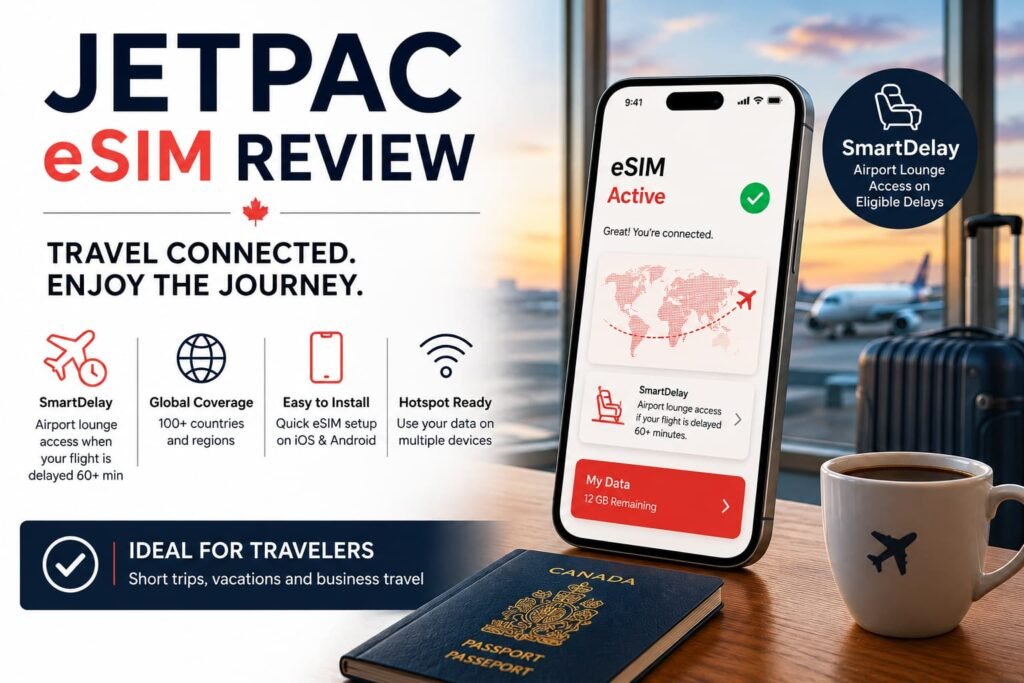
Jetpac is a global travel eSIM provider focused on affordable international data and travel convenience.
The service is designed primarily for:
- vacation travel
- short-term international trips
- casual travelers
- budget-conscious users
- travelers wanting simple app-based setup
Unlike providers focused heavily on infrastructure or long-term rollover systems, Jetpac focuses more on creating a smoother overall travel experience.
One of the biggest differentiators is its travel perk positioning.
Jetpac’s SmartDelay system is one of the more unique features in the eSIM space.
In supported regions, travelers can register flights inside the app before departure. If a qualifying delay occurs, Jetpac automatically issues airport lounge access vouchers through partner lounge networks.
That creates a very different experience compared to standard travel eSIM providers that only focus on selling data buckets.
Depending on the region and promotions available, Jetpac may include benefits such as:
- airport lounge access offers
- travel-related app perks
- traveler rewards and discounts
- simplified global plan management
The setup process is straightforward:
- buy a plan
- install the eSIM through a QR code or app
- activate the line
- connect to local partner networks
Jetpac is designed to feel approachable for travelers who want something easy to manage without dealing with complicated roaming systems or enterprise-style infrastructure.
You can explore Jetpac plans, supported destinations, SmartDelay airport lounge perks, and current travel offers directly on the official Jetpac website.
Is Jetpac eSIM Worth It for Travel?
Jetpac can absolutely be worth it for travelers who care more about convenience, pricing, and simplicity than advanced infrastructure features.
Its biggest advantage is accessibility.
Instead of focusing heavily on telecom complexity or premium business travel infrastructure, Jetpac focuses on making travel connectivity easy and affordable.
Jetpac is a good fit for:
- vacation travelers
- casual international trips
- budget-conscious users
- travelers wanting airport lounge perks
- travelers wanting simple setup
- users looking for affordable global data
It may not be the best option if:
- you need long-term rollover connectivity
- maximum speed consistency matters most
- you travel constantly throughout the year
- you need enterprise-grade low latency performance
- unlimited data is the main priority
The biggest strength with Jetpac is convenience-focused travel usability.
The biggest downside is that it does not offer the same level of infrastructure depth or long-term flexibility as providers like Keepgo or Ubigi.
Jetpac eSIM Pros and Cons
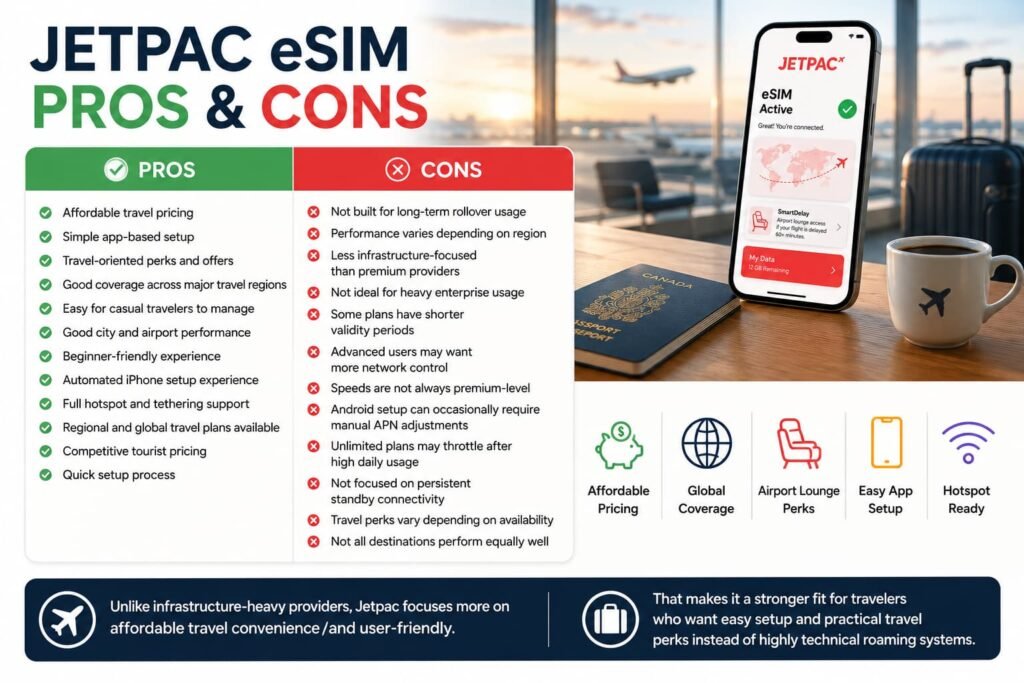
| Pros | Cons |
|---|---|
| Affordable travel pricing | Not built for long-term rollover usage |
| Simple app-based setup | Performance varies depending on region |
| Travel-oriented perks and offers | Less infrastructure-focused than premium providers |
| Good coverage across major travel regions | Not ideal for heavy enterprise usage |
| Easy for casual travelers to manage | Some plans have shorter validity periods |
| Good city and airport performance | Advanced users may want more network control |
| Beginner-friendly experience | Speeds are not always premium-level |
| Automated iPhone setup experience | Android setup can occasionally require manual APN adjustments |
| Full hotspot and tethering support | Unlimited plans may throttle after high daily usage |
| Regional and global travel plans available | Not focused on persistent standby connectivity |
| Competitive tourist pricing | Travel perks vary depending on availability |
| Quick setup process | Not all destinations perform equally well |
Unlike infrastructure-heavy providers, Jetpac focuses more on affordable travel convenience and user-friendly international connectivity.
That makes it a stronger fit for travelers who want easy setup and practical travel perks instead of highly technical roaming systems.
What Makes Jetpac Different
Jetpac stands out because it focuses on the overall travel experience instead of only selling data plans.
Most eSIM providers compete mainly on:
- data pricing
- coverage
- speed
- validity periods
Jetpac adds another layer by positioning itself around traveler convenience and reducing travel disruption.
Instead of focusing purely on telecom infrastructure, the platform behaves more like a traveler-focused membership utility backed by international connectivity.
That includes:
- SmartDelay airport lounge protection
- travel disruption perks
- airport lounge related perks
- app-based travel tools
- affordable regional pricing
- beginner-friendly onboarding
- simpler travel management
The service feels less like a telecom infrastructure platform and more like a travel-oriented convenience app.
That distinction matters.
Providers like Keepgo or Flexiroam often feel more infrastructure-oriented and technical.
Jetpac feels much more casual and traveler-friendly.
That makes it particularly appealing for:
- younger travelers
- vacation travel
- first-time eSIM users
- short international trips
- travelers wanting fast setup with minimal complexity
Jetpac Coverage and Supported Countries
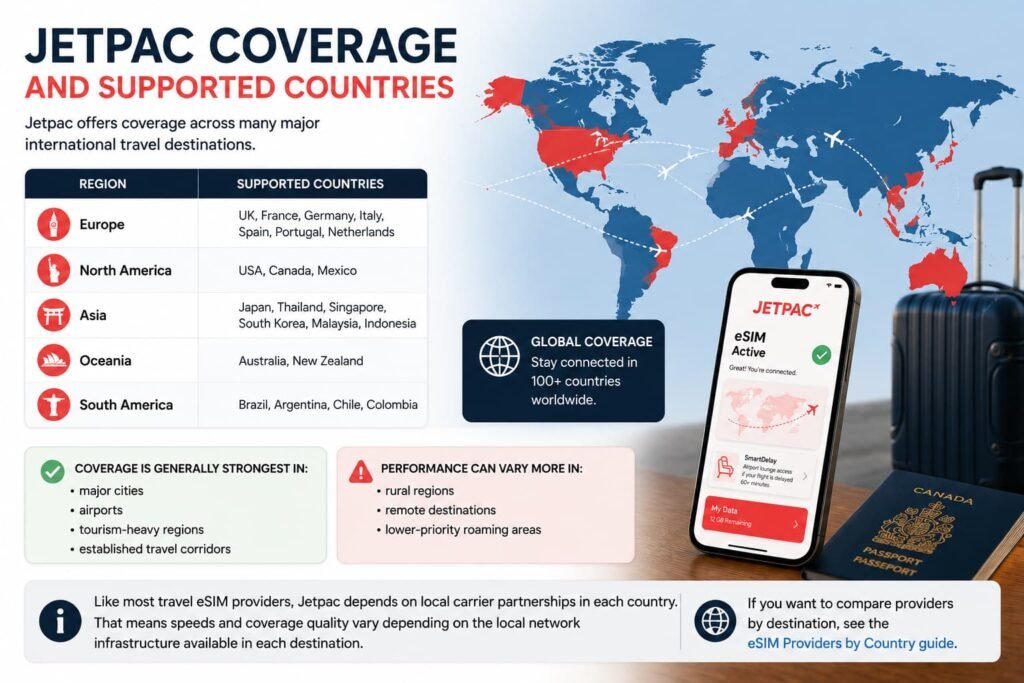
Jetpac offers coverage across many major international travel destinations.
Coverage includes:
| Region | Supported Countries |
|---|---|
| Europe | UK, France, Germany, Italy, Spain, Portugal, Netherlands |
| North America | USA, Canada, Mexico |
| Asia | Japan, Thailand, Singapore, South Korea, Malaysia, Indonesia |
| Oceania | Australia, New Zealand |
| South America | Brazil, Argentina, Chile, Colombia |
Coverage is generally strongest in:
- major cities
- airports
- tourism-heavy regions
- established travel corridors
Performance can vary more in:
- rural regions
- remote destinations
- lower-priority roaming areas
Like most travel eSIM providers, Jetpac depends on local carrier partnerships in each country.
That means speeds and coverage quality vary depending on the local network infrastructure available in each destination.
If you want to compare providers by destination, see the eSIM Providers by Country guide.
Jetpac Pricing and Plan Costs
Jetpac focuses heavily on affordable tourist-friendly pricing.
Compared to premium providers like GigSky or infrastructure-focused providers like Keepgo, Jetpac usually targets lower-cost travel plans designed for shorter trips.
Example pricing by region:
| Destination | Data | Duration | Price (USD) |
|---|---|---|---|
| USA | 5GB | 30 Days | $8–$15 |
| Canada | 5GB | 30 Days | $9–$16 |
| Europe Regional | 10GB | 30 Days | $15–$28 |
| Japan | 5GB | 30 Days | $8–$18 |
| Thailand | 5GB | 30 Days | $7–$16 |
| Singapore | 5GB | 30 Days | $8–$18 |
| Global Plan | 10GB | 30 Days | $30–$55 |
Typical pricing tiers:
- 1GB: around $1–$5
- 5GB: around $8–$18
- 10GB: around $15–$35
- regional plans are often competitively priced for tourism-focused travel
Compared to Airalo and Saily, Jetpac pricing is generally competitive.
One important detail is that Jetpac’s fixed data bucket plans are often a better value than its unlimited plans.
Some unlimited plans include daily high-speed usage limits before speeds are reduced for the remainder of the day.
For heavier users, larger fixed-bucket plans often provide more consistent real-world performance.
Where Jetpac tries to differentiate itself is through convenience and travel-oriented perks rather than purely competing on raw gigabyte pricing.
Jetpac Speeds and Real World Performance
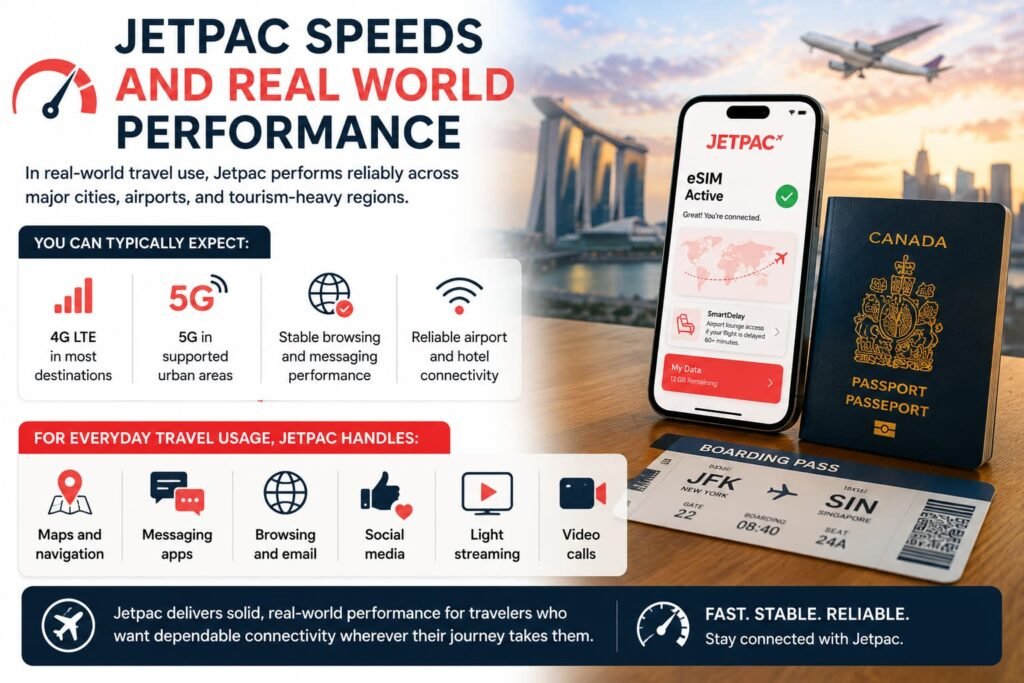
In real-world travel use, Jetpac performs reliably across major cities, airports, and tourism-heavy regions.
You can typically expect:
- 4G LTE in most destinations
- 5G in supported urban areas
- stable browsing and messaging performance
- reliable airport and hotel connectivity
For everyday travel usage, Jetpac handles:
- maps and navigation
- messaging apps
- browsing and email
- social media
- light streaming
- video calls
Typical speeds vary depending on the local carrier partnership in each destination.
In many countries, users report speeds ranging from around 20 Mbps to 60 Mbps, which is more than enough for standard vacation travel.
Jetpac performs best in:
- Southeast Asia
- North America
- Western Europe
- large cities
- tourism-heavy destinations
- airports
- major international travel hubs
Travelers in parts of Asia-Pacific occasionally report higher latency on some regional profiles because traffic may route through distant regional gateways depending on the roaming configuration.
In real-world use, this usually affects response time more than raw download speed.
Where performance becomes less predictable:
- rural travel
- congested local networks
- remote destinations
- lower-priority roaming agreements
Compared to providers like Ubigi or GigSky, Jetpac focuses more on convenience and affordability than premium low-latency performance.
Compared to Keepgo or Flexiroam, Jetpac is designed more for casual travel simplicity than long-term roaming infrastructure.
That distinction is important because Jetpac is built primarily for easy tourist connectivity instead of advanced travel networking.
Jetpac vs Other eSIM Providers
Jetpac vs Airalo
Jetpac and Airalo differ mainly in travel perks versus pure budget simplicity.
Airalo focuses heavily on affordable straightforward tourist plans.
Jetpac focuses more on combining affordable pricing with traveler-oriented convenience perks.
If your priority is ultra-simple low-cost travel data, Airalo is usually the better option. You can compare that in the Airalo eSIM review.
If you want additional travel-oriented perks alongside affordable data, Jetpac becomes more appealing.
Quick take: Airalo for straightforward budget pricing, Jetpac for travel-focused convenience.
Jetpac vs Nomad
Jetpac and Nomad differ mainly in travel perks versus regional flexibility.
Nomad focuses more on structured regional plans and flexible data options for travelers moving across multiple countries.
Jetpac focuses more on affordable tourist-friendly data with added travel convenience features.
If regional plan structure matters most, Nomad is usually the better option. You can compare that in the Nomad eSIM review.
If travel perks and simple vacation-focused usability matter more, Jetpac becomes more appealing.
Quick take: Nomad for regional flexibility, Jetpac for travel perks and convenience.
Jetpac vs Holafly
Jetpac and Holafly differ mainly in pricing structure and usage style.
Holafly focuses heavily on unlimited data plans.
Jetpac focuses more on affordable metered travel plans with added travel perks.
If unlimited streaming and heavy daily usage matter most, Holafly is usually the better choice. I explain that further in the Holafly eSIM review.
If affordable pricing and casual travel flexibility matter more, Jetpac is often the stronger option.
Quick take: Holafly for unlimited data, Jetpac for affordable travel convenience.
Jetpac vs Saily
Jetpac and Saily differ mainly in travel perks versus streamlined simplicity.
Saily focuses heavily on beginner-friendly app simplicity.
Jetpac adds a more travel-oriented experience with perks and convenience features.
If simplicity alone matters most, Saily is often easier to use. You can compare that in the Saily eSIM review.
If you want additional travel-oriented features beyond just data, Jetpac becomes more attractive.
Quick take: Saily for simplicity, Jetpac for travel perks and convenience.
Jetpac vs aloSIM
Jetpac and aloSIM differ mainly in traveler convenience versus predictable simplicity.
aloSIM focuses heavily on clean setup and predictable travel pricing.
Jetpac focuses more on traveler-oriented perks and convenience.
If you want a highly predictable travel eSIM experience, aloSIM is often the stronger choice. I explain that further in the aloSIM eSIM review.
If travel extras and convenience features matter more, Jetpac becomes more appealing.
Quick take: aloSIM for predictable simplicity, Jetpac for travel-focused convenience.
Jetpac vs Ubigi
Jetpac and Ubigi differ mainly in convenience versus premium infrastructure.
Ubigi focuses heavily on stable low-latency performance and premium network consistency.
Jetpac focuses more on casual travel convenience and affordable pricing.
If premium speed consistency matters most, Ubigi is usually stronger. You can compare that in the Ubigi eSIM review.
If affordable tourist-friendly travel usability matters more, Jetpac is often the better fit.
Quick take: Ubigi for premium infrastructure, Jetpac for casual travel convenience.
Jetpac vs GigSky
Jetpac and GigSky differ mainly in value positioning versus premium business travel.
GigSky focuses heavily on premium global connectivity.
Jetpac focuses more on affordable travel usability.
If premium global performance matters most, GigSky is usually stronger. I explain that further in the GigSky eSIM review.
If affordable pricing and traveler-friendly simplicity matter more, Jetpac is usually more practical.
Quick take: GigSky for premium performance, Jetpac for value-focused travel.
Jetpac vs Flexiroam
Jetpac and Flexiroam differ mainly in travel simplicity versus roaming continuity.
Flexiroam focuses heavily on long-term roaming continuity across regions.
Jetpac focuses more on simple short-term travel usability.
If long-term roaming flexibility matters most, Flexiroam is often the better option. You can compare that in the Flexiroam eSIM review.
If simple affordable tourist connectivity matters more, Jetpac is often easier to manage.
Quick take: Flexiroam for roaming continuity, Jetpac for easy tourist travel.
Jetpac vs Keepgo
Jetpac and Keepgo differ mainly in travel convenience versus long-term persistence.
Keepgo focuses heavily on rollover data and standby global connectivity.
Jetpac focuses more on affordable short-term travel convenience and reducing travel friction during vacation trips.
If long-validity rollover connectivity matters most, Keepgo is usually stronger. I explain that further in the Keepgo eSIM review.
If simple affordable vacation travel matters more, Jetpac is often the better fit.
Quick take: Keepgo for long-term persistence, Jetpac for casual travel convenience.
Jetpac vs Airhub
Jetpac and Airhub differ mainly in convenience versus marketplace flexibility.
Airhub focuses heavily on comparing multiple provider structures and marketplace pricing.
Jetpac focuses more on simplified traveler usability.
If comparing multiple pricing options matters most, Airhub is often the better choice. You can compare that in the Airhub eSIM review.
If simple travel-oriented convenience matters more, Jetpac is easier to use.
Quick take: Airhub for marketplace flexibility, Jetpac for traveler-friendly simplicity.
Jetpac vs Yesim
Jetpac and Yesim differ mainly in convenience positioning and app structure.
Yesim focuses heavily on adaptable app-based travel plans.
Jetpac focuses more on affordable tourist convenience and travel perks.
If adaptable app-based flexibility matters most, Yesim is often stronger. I explain that further in the Yesim eSIM review.
If affordable vacation-focused travel usability matters more, Jetpac becomes more appealing.
Quick take: Yesim for flexible travel plans, Jetpac for budget-friendly convenience.
Best Use Cases for Jetpac
Jetpac works best for travelers who prioritize simplicity, affordability, and convenience.
It is especially useful for:
- vacation travel
- short international trips
- budget-conscious travelers
- airport-heavy travel
- younger travelers
- first-time eSIM users
- travelers wanting simple setup
- users interested in travel-related perks
Jetpac is less ideal for:
- enterprise business travel
- advanced network users
- long-term standby connectivity
- heavy unlimited-data usage
- infrastructure-focused travel setups
Alternatives to Jetpac
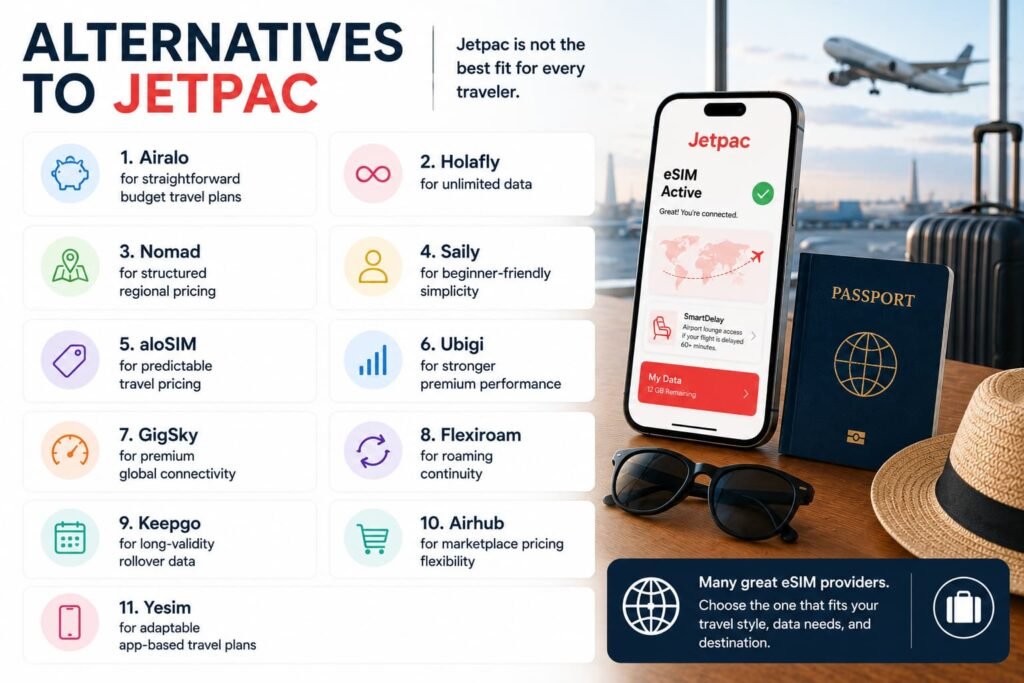
Jetpac is not the best fit for every traveler.
- Airalo for straightforward budget travel plans
- Holafly for unlimited data
- Nomad for structured regional pricing
- Saily for beginner-friendly simplicity
- aloSIM for predictable travel pricing
- Ubigi for stronger premium performance
- GigSky for premium global connectivity
- Flexiroam for roaming continuity
- Keepgo for long-validity rollover data
- Airhub for marketplace pricing flexibility
- Yesim for adaptable app-based travel plans
Related Guides
If you are still comparing providers or preparing your setup, these guides will help:
- Airalo eSIM review
- Holafly eSIM review
- Nomad eSIM review
- Ubigi eSIM review
- GigSky eSIM review
- Flexiroam eSIM review
- Keepgo eSIM review
- Saily eSIM review
- aloSIM eSIM review
- Airhub eSIM review
- Yesim eSIM review
- Best eSIM for International Travel
- eSIM Providers by Country
- How to Activate eSIM on iPhone in Canada
- Activate eSIM on Android Canada
Final Thoughts
Jetpac approaches travel connectivity differently than many infrastructure-focused eSIM providers.
Instead of concentrating heavily on enterprise networking, rollover systems, or advanced roaming management, Jetpac focuses more on making international travel easier and more convenient.
That includes:
- airport lounge delay protection
- affordable pricing
- easy setup
- traveler-oriented perks
- practical global connectivity
For casual travelers and vacation travel, that simplicity can be extremely appealing.
Jetpac will not be the best fit for everyone.
If your priority is premium low-latency performance, providers like Ubigi or GigSky are stronger options.
If long-term rollover connectivity matters more, Keepgo is usually the better choice.
But if you want affordable travel data, simple setup, airport-oriented travel perks, and a more traveler-friendly experience overall, Jetpac offers a very practical balance between convenience and value.
More than most providers in this category, Jetpac feels designed around improving the overall travel experience instead of simply selling mobile data.