I tested BNESIM eSIM during a trip to Spain to see whether its flexible plan system is genuinely useful for Canadian travellers or simply more complicated than the alternatives. Unlike many travel eSIM providers that focus on fixed packages expiring after a week or a month, BNESIM also offers non-expiring data that can remain available between trips.
That flexibility can appeal to Canadians who travel several times a year, cross multiple countries or want backup mobile data ready on their phone. BNESIM also offers regional and global plans, scheduled activation, app-based top-ups and recurring packages for people who need data more regularly.
During my test, activation was straightforward and the connection remained reliable throughout the trip. Mobile data was consistently fast in Spanish cities and busy tourist areas, with responsive navigation, smooth browsing, reliable messaging and no noticeable problems during video calls or streaming. Performance will still depend on the local partner network, congestion and signal conditions, but my overall experience in Spain was very positive.
The trade-off is complexity. Plan availability, validity, renewal terms, coverage and pricing can vary considerably by destination. BNESIM also sells separate voice and virtual-number services, making it important to understand what comes with the travel data eSIM and what requires another product.
This BNESIM review combines my hands-on experience in Spain with verified research into the provider’s plans, pricing, installation, app features, coverage approach and support policies.
My BNESIM eSIM Verdict
Based on my testing and research, BNESIM is a strong option for repeat travellers who value flexibility more than absolute simplicity. The eSIM activated without difficulty in Spain, stayed connected while I travelled between cities and delivered consistently good performance for maps, messaging, browsing, social media, streaming and video calls.
Its non-expiring plans can work well as backup data or across several shorter trips, while fixed-validity packages may offer better immediate value for a single holiday. My main concern is not reliability but the amount of attention required when choosing a plan. Expiry, renewal, coverage and pricing can differ from one package to another.
BNESIM is best suited to travellers comfortable comparing several plan types and managing service through an app. Someone who wants one obvious package, a native travel phone number or a simple unlimited-data option may prefer a more straightforward provider.
What Is BNESIM?
BNESIM is an international connectivity provider selling travel eSIM data plans for individual countries, regions and broader groups of destinations.
Through the official BNESIM website, travellers can search by destination and choose from available expiring or non-expiring packages. Depending on the country, BNESIM may offer several data allowances and plan types rather than one standardized worldwide catalogue.
BNESIM also operates a mobile app for purchasing plans, installing eSIM profiles, checking data consumption and adding more data. Separate services may include internet-based calling and virtual phone numbers, but these should not be confused with native calls and SMS on a standard travel data eSIM.
What stands out is the amount of choice. Travellers may be able to buy a plan for one trip, keep unused data for later or select a recurring package. The downside is that the exact plan details matter more than they do with a provider built around one simple package type.
Who Is BNESIM Best For?
BNESIM makes the most sense for Canadians who travel several times a year, want backup data already installed or prefer to retain unused data between trips. Regional and global options may also suit multi-country itineraries when the included destinations line up with the route.
Light data users may find particular value in the non-expiring format because they are less likely to lose a large unused balance at the end of a short validity period. Travellers who are comfortable managing plans and top-ups through an app should also find the system manageable.
A simpler provider may be preferable for someone taking one short holiday, needing traditional cellular calls and SMS, or wanting one clearly defined plan with minimal setup decisions. Recurring packages also require attention from anyone likely to forget a cancellation date.
BNESIM is not automatically the best choice simply because some data packages do not expire. The real value depends on travel frequency, expected data use, destination coverage and the premium charged for retaining unused data.
BNESIM eSIM Plan Types Explained
BNESIM’s terminology and available options can vary across its storefront. The most important distinctions are expiry, renewal and geographic coverage.
| Plan style | Typical validity | Renewal | Best suited to |
|---|---|---|---|
| Non-expiring plan | No fixed expiry on purchased data | Normally no automatic renewal | Repeat trips, backup data and light use |
| Fixed-validity plan | Often 30 days | No renewal when sold as a one-time package | A single holiday or defined travel period |
| Weekly or monthly plan | Fixed billing period | May renew automatically | Frequent or ongoing travel |
| Regional or global plan | Depends on the selected package | Depends on the plan type | Multi-country trips |
Non-Expiring BNESIM Data
BNESIM’s non-expiring packages are its most distinctive option. Purchased data remains available rather than disappearing at the end of a short validity window.
The format works particularly well for someone taking several trips during the year, using only a modest amount of data each time or wanting emergency connectivity available after landing. It may also reduce the need to install a new eSIM for every journey.
Non-expiring data is not always the least expensive way to buy a specific allowance. Part of the price reflects the flexibility to retain what remains. A fixed 30-day package may provide better short-term value when most of the allowance will be used during one trip.
Geographic restrictions still matter. Data bought for one country does not automatically become a worldwide balance simply because it has no expiry date.
Fixed-Validity Plans
BNESIM also sells packages with a defined validity period. The official global storefront, for example, displays 30-day packages alongside non-expiring alternatives.
These plans are generally easier to evaluate when the destination, trip length and expected data use are already known. Someone planning a two-week holiday and expecting to use most of the allowance may gain little from paying extra to preserve unused data.
Recurring Plans
Some BNESIM packages renew weekly or monthly. These may present a lower initial price in exchange for automatic renewal.
Recurring data can suit frequent travellers, international workers or people spending an extended period abroad. It can also lead to another charge after the trip if the renewal date is overlooked.
The checkout screen should make the billing cycle, next payment date, cancellation process and rollover rules clear. Deleting the eSIM profile from a phone should never be treated as a substitute for cancelling a paid subscription through the account or app.
Regional and Global Plans
Regional plans can simplify trips crossing several countries, such as a European rail itinerary. A broader global package may be convenient when destinations span more than one region.
The wider option is not always the best value. Country-specific plans often cost less, so the included destination list should drive the choice rather than the name of the package.
Coverage lists can also change. Every country on the itinerary should appear on the current plan page before payment.
BNESIM Pricing and Value
BNESIM pricing varies substantially by destination, allowance, validity and plan type. The examples below illustrate the differences rather than representing the entire catalogue.
Representative BNESIM Prices
| Destination or package | Data | Validity | Price shown | Approximate CAD |
|---|---|---|---|---|
| Europe regional plan | 5 GB | 30 days | €7.06 | C$11.42 |
| Global plan | 1 GB | 30 days | €14.99 | C$24.25 |
| Global non-expiring plan | 1 GB | No expiration | €18.99 | C$30.72 |
| United States non-expiring plan | 5 GB | No expiration | €5.99 | C$9.69 |
Prices and conversions last checked: August 6, 2026. BNESIM displayed these prices in euros on the official pages reviewed. Canadian-dollar amounts use an indicative exchange rate of approximately €1 = C$1.6179 and are rounded to the nearest cent. Checkout currency, taxes, promotions, card-conversion charges and the final amount billed may differ.
The global example demonstrates the central trade-off. At the time checked, 1 GB with 30-day validity cost €14.99, or approximately C$24.25. The equivalent non-expiring package cost €18.99, or approximately C$30.72. The non-expiring option cost about C$6.47 more, but the remaining data was not tied to a 30-day trip.
The United States example also shows why BNESIM cannot be judged by a single global price. Its 5 GB non-expiring package was listed at €5.99, approximately C$9.69, which was considerably less expensive than the broader global packages reviewed.
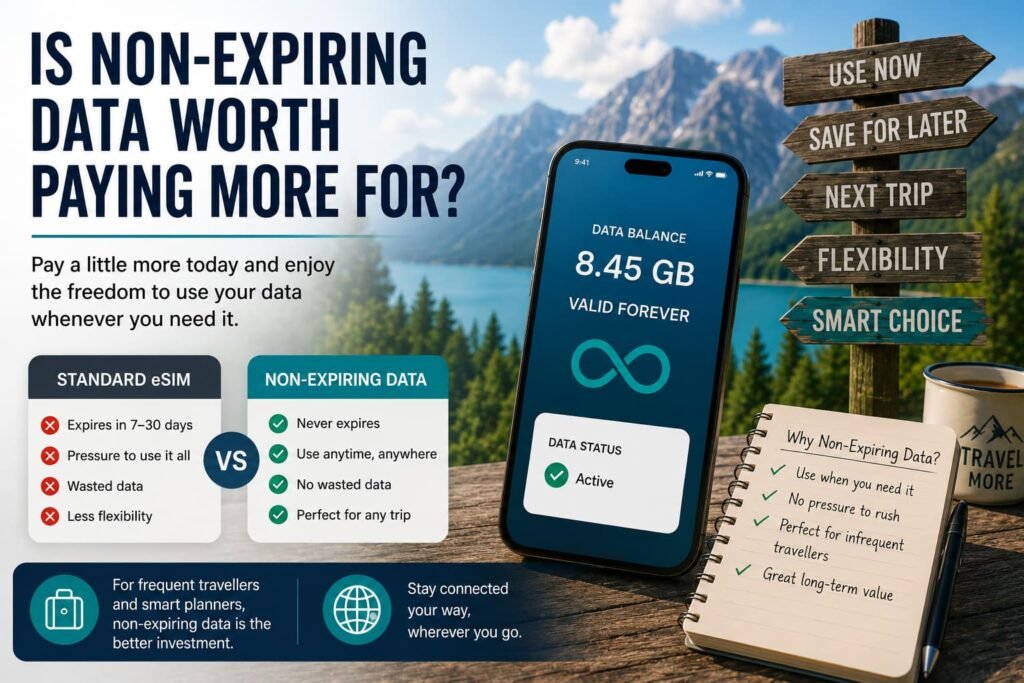
Is Non-Expiring Data Worth Paying More For?
The premium makes sense when the remaining allowance will realistically be used on a later trip.
Frequent travellers, light data users and people who value emergency connectivity may benefit from keeping a small balance ready. The advantage becomes less convincing for a single holiday, a large immediate data requirement or a country the traveller is unlikely to revisit.
The important comparison is not simply the advertised price per gigabyte. It is the cost of the data that will actually be used.
The eSIM Plan Comparison Tool can help compare BNESIM’s current value with other travel providers before choosing a package.
My BNESIM Experience in Spain
I used BNESIM eSIM while travelling through Spain and found the overall experience reliable from activation onward. The eSIM connected without any setup problems and stayed usable throughout the trip.
For everyday travel, the connection handled navigation, messaging, browsing, social media, streaming and video calls without difficulty. Performance can vary by location, local partner network and signal strength, but my overall experience in Spain was very positive.
Download Speeds and Everyday Use
Mobile data felt consistently fast in cities and popular tourist areas. Web pages loaded quickly, Google Maps responded without noticeable delay and everyday apps worked normally.
Streaming and video calls were also smooth during my test. I did not encounter the kind of persistent buffering or slow page loading that can make a travel eSIM frustrating to use.
Exact speeds will vary by location, partner network, congestion and signal strength. My experience in Spain should not be treated as a guarantee for every destination, but performance was excellent for the tasks I relied on most.
Latency
Latency was low enough that I did not notice any practical delay while browsing, using WhatsApp or navigating with GPS.
Travel eSIMs can sometimes route data through another country, which may increase ping times even when download speeds look strong. That did not create a noticeable problem during ordinary use in Spain.
Connection Stability
The connection remained stable while I moved between different cities. I was able to continue using maps, messaging and mobile browsing without repeatedly changing network settings or restarting the phone.
Speeds can still drop in crowded tourist areas, inside buildings or where local cellular coverage is weaker. Those limitations apply to any roaming-based travel eSIM and do not necessarily indicate a problem with BNESIM itself.
Reliability and Support Considerations
BNESIM activated correctly and stayed connected throughout my trip. I did not need to contact support to restore service.
Public user feedback is more mixed than my own experience. Many travellers report reliable connections in several countries, while others describe activation difficulties or slower support responses. That is another reason to install the eSIM before leaving Canada and keep the purchase information available in case help is required.
Based on my Spain test, BNESIM handled navigation, messaging, social media, streaming and video calls without difficulty.
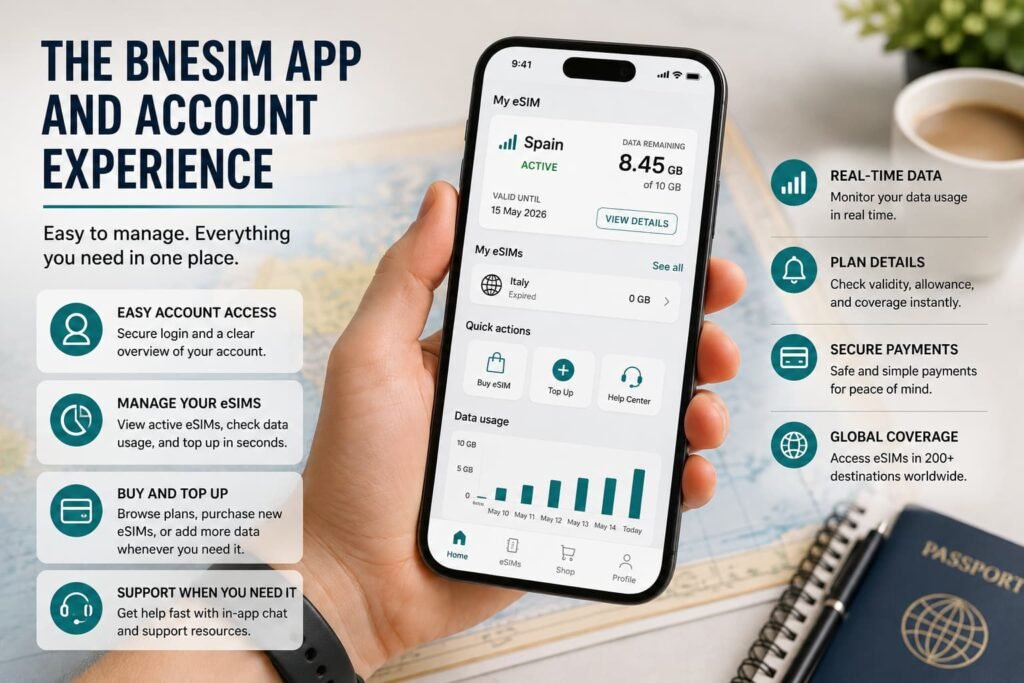
The BNESIM App and Account Experience
The BNESIM app is central to managing the service. It can be used to purchase plans, view installed eSIMs, monitor remaining data and add another package when needed.
Scheduled activation is useful for buying before leaving Canada without intentionally beginning a short-validity plan too early. Purchase time, scheduled start date and first connection to a supported network are not necessarily the same event, so the confirmation screen deserves a careful read.
The app also manages products beyond travel data. Internet-based calls and virtual phone numbers may appear alongside eSIM packages, but those services do not mean that a normal travel data plan includes traditional cellular calling or an SMS-capable number.
Official BNESIM apps are available through the Apple App Store and Google Play.
Before You Install
BNESIM is easier to set up while reliable internet and familiar support options are still available. Installing the eSIM before leaving Canada also gives you time to resolve compatibility or account issues without relying on airport Wi-Fi.
Start by confirming that the exact phone model supports eSIM. Devices with similar names can have different capabilities depending on their country of sale, carrier configuration or model number. The eSIM Compatibility Checker can help with the initial check.
The phone must also be carrier-unlocked. Canadian phones sold in recent years are generally unlocked, but used, imported and replacement devices are still worth verifying.
Use dependable Wi-Fi during installation and keep the purchase email accessible on another screen when possible. BNESIM may provide app-based installation, a QR code or manual activation information. A QR code displayed on the same phone is difficult to scan, so opening it on a laptop, tablet or second phone is usually more convenient.
Once the eSIM is installed, label it clearly as BNESIM or Travel Data. Keep the Canadian line for calls and messages when needed, but leave Canadian-line data roaming off to reduce the risk of accidental roaming charges.
Do not delete the BNESIM profile simply because the first connection attempt fails. Travel eSIM profiles are not always reusable after removal, and deleting one does not necessarily cancel a recurring plan. BNESIM provides current setup information through its official installation guide.
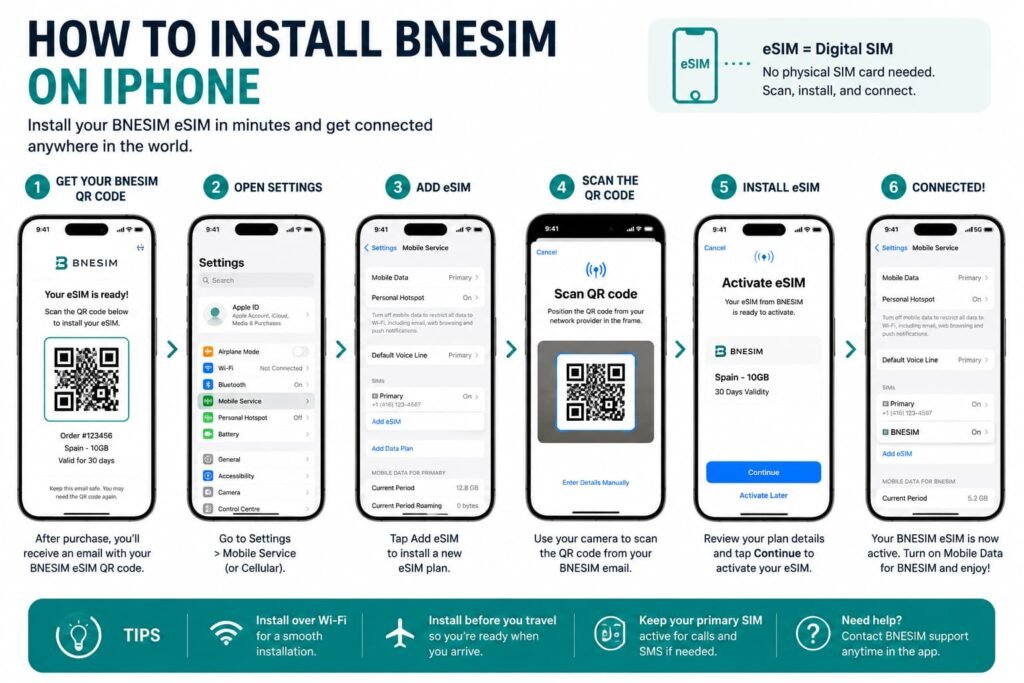
How to Install BNESIM on iPhone
BNESIM can be added to a compatible iPhone through the provider’s app, a QR code or manual activation details. App installation is generally the cleanest option when it appears in the BNESIM account.
The current iPhone settings path is Settings > Cellular or Mobile Service > Add eSIM.
When using the app, open My eSIMs, select the purchased profile and follow the installation prompt. Approve the iPhone request to add a cellular plan, then label the new line BNESIM or Travel Data.
For QR-code installation:
- Open Settings > Cellular or Mobile Service > Add eSIM.
- Choose Use QR Code and scan the code supplied by BNESIM.
- Follow the prompts to add and label the plan.
Keep the Canadian number as the default line for calls and messages when it is still needed. BNESIM should become the mobile-data line only when the plan is ready to use.
Leave Allow Cellular Data Switching disabled unless you intentionally want the iPhone to move between lines. Otherwise, a weak BNESIM signal could cause the phone to use Canadian mobile data abroad.
For a complete walkthrough of Apple’s menus and dual-SIM settings, see How to Activate eSIM on iPhone in Canada.
How to Install BNESIM on Samsung Galaxy
Samsung places eSIM controls in SIM manager, although the wording may differ slightly by One UI version.
The usual path is Settings > Connections > SIM manager > Add eSIM.
From there, scan the BNESIM QR code or approve the direct-installation prompt from the app. Give the profile a recognizable label, then return to SIM manager to choose it for mobile data when the trip begins.
Roaming may need to be enabled for the BNESIM line because the service connects through partner networks abroad. That setting should apply only to BNESIM. Keep roaming disabled on the Canadian line unless Canadian carrier roaming is being used intentionally.
Samsung devices sold in different regions can have different eSIM capabilities, even within the same product family. The exact model number matters more than the general Galaxy name.
For more detailed Samsung instructions, use How to Activate eSIM on Samsung Galaxy in Canada.
How to Install BNESIM on Google Pixel
Google Pixel phones generally place eSIM setup under the Network and Internet menu.
The current path is Settings > Network & internet > SIMs > Add SIM > Set up an eSIM.
Scan the BNESIM QR code and follow the prompts to download the profile. If a QR code is unavailable, Pixel phones usually provide a manual-entry option for the SM-DP+ address and activation code supplied by BNESIM.
After installation, label the plan and select it as the preferred mobile-data SIM when service is required. Data roaming may need to be enabled for the BNESIM profile, while roaming should remain off for the Canadian line.
Google occasionally adjusts menu wording between Android versions, but the eSIM controls remain within the SIM or mobile-network settings.
See How to Activate eSIM on Google Pixel in Canada for a fuller Pixel walkthrough.
How to Install BNESIM on Motorola
Motorola follows a mostly standard Android setup process, although menu labels vary between models and software versions.
Look for Settings > Network & internet > SIMs or Mobile network > Add SIM > Set up an eSIM.
Some devices use the wording Download a SIM instead. Select that option, scan the BNESIM QR code and approve the profile download. Once installed, label the plan and choose it for mobile data.
Motorola models sold in different regions do not always share the same eSIM support. Checking the exact model before buying is especially important with imported devices.
When travelling, enable roaming for BNESIM if the provider’s instructions require it. Leave roaming disabled on the Canadian line unless you have deliberately chosen to use your carrier’s roaming service.
For model-specific help, read How to Activate eSIM on Motorola Phones in Canada.
How to Install BNESIM on Other Android Phones
OnePlus, Xiaomi, OPPO, Nothing, Sony, ASUS and other Android manufacturers use different labels for the same basic process.
The eSIM option is usually found under Settings > Network & internet, Mobile network or SIM manager > Add SIM or Add eSIM.
Follow the BNESIM app prompt or scan the supplied QR code, then label the profile clearly. BNESIM should be selected for mobile data when the plan is in use, with roaming enabled for the travel line if required.
Keep the Canadian SIM available for calls or verification texts when needed, but disable its data roaming. Automatic data switching should also remain off unless you understand how that manufacturer handles weak signals and fallback data.
If the profile does not appear after installation, restart the phone before changing APN or network settings. BNESIM’s Android documentation notes that menu paths vary and that account-specific APN information may sometimes be required.
For broader Android guidance, see How to Activate eSIM on Android in Canada.
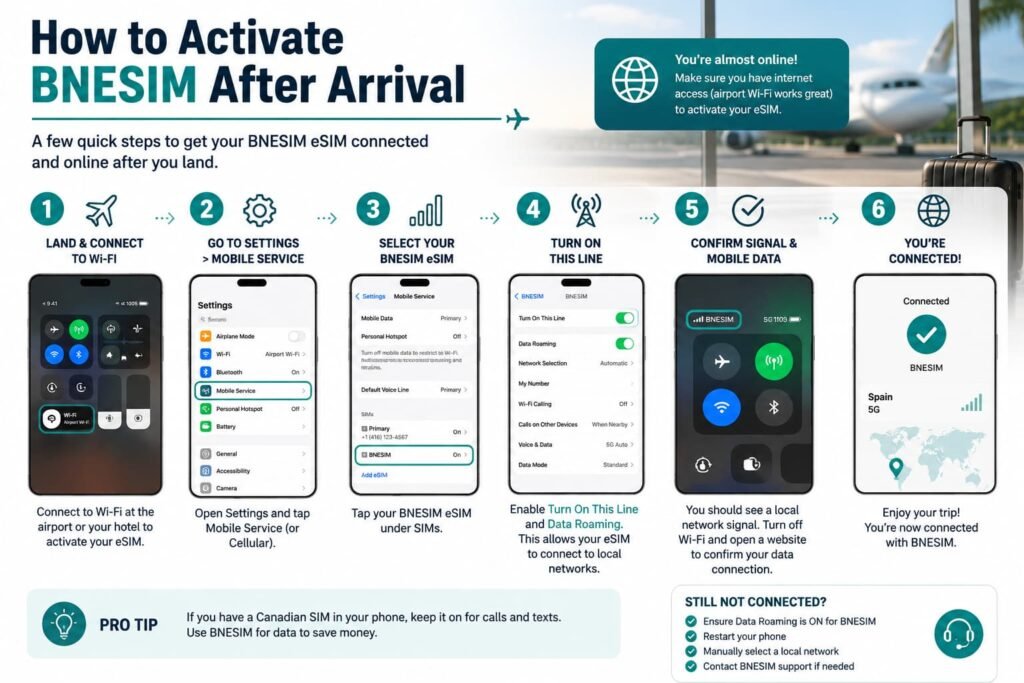
How to Activate BNESIM After Arrival
Installing the profile before departure does not necessarily mean the phone will connect immediately. Activation depends on the selected plan, any scheduled start date and access to a supported partner network.
After landing, open the phone’s SIM settings and make sure the BNESIM line is enabled. Select it for mobile data, turn on data roaming for that line when required and verify that Canadian-line roaming remains off.
If service does not appear within a few minutes:
- Turn Airplane mode on for about ten seconds, then turn it off.
- Confirm that the BNESIM package has started and that the correct line is selected for data.
- Review the APN information in the BNESIM account.
- Restart the phone and allow automatic network selection to try again.
A lightweight task such as loading a webpage or opening a map is a better first test than starting a large download.
Automatic data switching should stay disabled unless fallback to the Canadian SIM is intentional. Otherwise, the phone may use the Canadian line when the BNESIM signal is weak and trigger roaming charges.
Support should be contacted before the eSIM is deleted. Screenshots of the SIM settings, plan status and any error message will make troubleshooting easier.
Does BNESIM Support Calls and SMS?
A standard BNESIM travel eSIM should be treated as data-only unless the exact plan says otherwise.
The connection can support WhatsApp, FaceTime, Signal, Messenger, email and other internet-based calling or messaging services. It does not normally replace a Canadian mobile number or include traditional carrier calls and SMS.
BNESIM also sells virtual-number and internet-calling products. Those are separate services with their own features and pricing.
Receiving Canadian Verification Messages
A compatible dual-SIM phone can keep the Canadian line active while BNESIM handles mobile data. This may allow calls and verification texts to continue reaching the Canadian number, subject to the carrier’s roaming rules.
Receiving an SMS abroad is often free with Canadian carriers, but answering calls, placing calls, sending messages or using Canadian mobile data can trigger charges.
A cautious dual-SIM arrangement uses the Canadian SIM for calls and SMS, BNESIM for data, Canadian-line roaming off and automatic data switching disabled.
Does BNESIM Support Hotspot and Tethering?
Hotspot availability should be verified for the exact package rather than assumed across every BNESIM plan.
For laptop work, family sharing or extended tethering, review:
- tethering support for the selected package
- any separate hotspot allowance
- fair-use or speed-reduction rules
- reliability of the local partner network
- likely data consumption from computers and tablets
Even when hotspot works technically, a modest allowance can disappear quickly through operating-system updates, cloud backups, video meetings or streaming.
BNESIM Coverage and Network Performance
BNESIM works through partner mobile networks rather than operating its own towers in every destination.
Performance therefore depends on the country, selected plan, local network, signal conditions, congestion and international data routing. Access to 4G or 5G may also vary between packages and locations.
My experience in Spain was consistently reliable, including while moving between cities. Pages loaded quickly, navigation remained responsive and the connection was stable enough for video calls and streaming.
That result cannot establish how every BNESIM plan will perform elsewhere. The exact destination page should take priority over broad claims about worldwide coverage.
Review the included countries, available plan sizes, validity, activation timing and any fair-use restrictions before paying. Unlimited-style plans deserve particular attention because high-speed allowances and reduced-speed conditions can differ.
Top-Ups and Reusing the eSIM
One advantage of an app-managed eSIM is the possibility of keeping the profile and adding more data instead of installing a new eSIM for every trip.
The usual process is to open the BNESIM app, select the existing eSIM, choose the required destination or package and complete the purchase. The account should show which balance or plan will be used.
Reusing an installed profile can be convenient, but compatibility between the existing eSIM and the new destination still needs to be established. Not every package can necessarily be added to every previously installed profile.
Keeping the line labelled clearly also reduces the chance of deleting it while removing older travel plans.
BNESIM Refunds and Support
BNESIM directs refund requests through live chat or email on its official refund help page.
The provider says approved refund requests are processed within 24 hours, although the time required for the money to appear depends on the bank or payment method.
That processing timeline does not make every purchase refundable. Eligibility may depend on installation, activation, data use, promotional terms, automatic renewal and whether support had an opportunity to investigate the problem.
I did not need to contact support during my Spain test because the eSIM activated correctly and remained connected. Other customer experiences can vary, so installing before departure is still the safer approach.
Contacting support promptly is important when a problem occurs. Include the order information, phone model, destination, screenshots and a concise record of the troubleshooting already attempted.
Repeatedly reinstalling, deleting or changing the eSIM while waiting for assistance can make diagnosis more difficult and may affect whether the original profile remains usable.
BNESIM Strengths
Non-Expiring Data Is Genuinely Different
Many travel eSIM packages expire after 7, 15 or 30 days. BNESIM gives travellers the option to preserve unused data when a non-expiring plan is available.
Reliable Everyday Performance
During my trip to Spain, BNESIM handled navigation, messaging, browsing, social media, streaming and video calls without noticeable difficulty.
Stable Connection While Travelling
The eSIM remained connected as I moved between cities, and I did not need to repeatedly adjust network settings or restart the phone.
Several Plan Styles
Country, regional, global, expiring and non-expiring packages provide more flexibility than a provider built around one format.
Useful for Repeat Travel
Travellers returning to the same country or covered region may gain more practical value from retained data than from repeatedly buying short-validity packages.
App-Based Management
Purchasing, checking consumption and adding data through one account can be easier than managing unrelated QR codes for every trip.
Scheduled Activation
Planning the activation date can reduce the risk of starting a fixed-validity package too early.
BNESIM Limitations
The Product Range Can Feel Complicated
Flexibility creates more decisions. Validity, coverage, renewal and price all need to be compared rather than choosing only a data allowance.
Recurring Plans Require Attention
A lower weekly or monthly price may come with automatic renewal. The next billing date matters as much as the initial payment.
Travel Data Is Primarily Data-Only
The standard eSIM does not replace a Canadian voice line or automatically include native calls and SMS.
Value Varies by Destination
A competitively priced package for the United States does not mean BNESIM will offer the same value in Europe, Asia or on a global plan.
Performance Depends on the Local Network
My connection in Spain was excellent, but speeds and latency can vary in crowded areas, inside buildings or where the partner network has weaker coverage.
Public Feature Information Is Not Always Uniform
Coverage totals, hotspot rules, unlimited-plan conditions and product terminology may differ across BNESIM pages. The details shown for the exact package at checkout should take priority over broader marketing statements.
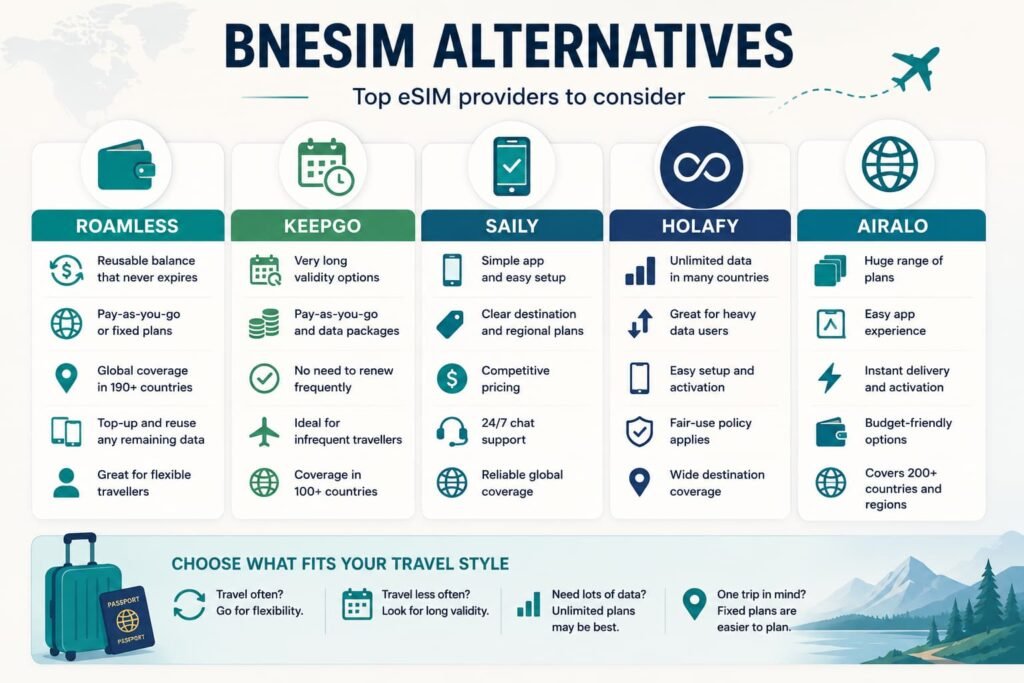
BNESIM Alternatives
Roamless
Roamless is the closest alternative for travellers interested in retaining value between trips. Its FLEX model uses a reusable balance for pay-as-you-go data, while FIX packages cover more traditional trip-based needs.
Roamless may feel simpler for someone who wants one global balance rather than several BNESIM plan structures.
Keepgo
Keepgo is worth considering when long validity and repeat travel are the main priorities.
The meaningful comparison includes supported countries, renewal requirements and cost per gigabyte. Long validity has limited value when the package does not cover the places a traveller expects to visit.
Saily
Saily offers a more straightforward app-led experience centred on destination and regional data packages.
It may suit someone who prefers a simpler buying process and does not need non-expiring data.
Holafly
Holafly is more relevant to travellers looking for high-data or unlimited-style destination packages.
It may work better for heavier mobile-data use, although destination-specific hotspot allowances and fair-use terms still matter.
Airalo
Airalo offers a large catalogue of country, regional and global packages with a familiar fixed-plan structure.
That format can be easier to understand for one defined trip, while BNESIM provides more flexibility for data kept between journeys.
Frequently Asked Questions
Is BNESIM legit?
BNESIM is a legitimate international eSIM provider with active travel data plans, official iOS and Android apps, and established support channels. During my trip to Spain, the eSIM activated without difficulty and remained stable as I travelled between cities, which gave me confidence in the service for everyday travel use.
That said, legitimacy and value are separate questions. Coverage, pricing, validity and renewal terms vary by plan, so the exact package still needs to be reviewed carefully before purchase.
Who is BNESIM best for?
BNESIM is best suited to frequent travellers, light data users and anyone who likes having backup connectivity ready between trips. Its non-expiring plans are particularly useful for people who may not use a full allowance during one holiday and would rather keep the remaining data for later.
It also suits travellers who are comfortable comparing several plan types and managing service through an app. For a single short trip, a simpler fixed-validity provider may be easier to evaluate and may offer better immediate value.
How does BNESIM non-expiring data work?
BNESIM’s non-expiring plans let you keep any unused data instead of losing it after a fixed period such as 7 or 30 days. The remaining balance stays available for future use, provided you continue using it within the countries and coverage area included with that specific plan.
The main benefit is flexibility. Someone who uses only part of the allowance on one trip can save the rest for a later journey rather than buying a new package immediately. The trade-off is that non-expiring plans may cost more than comparable fixed-validity options, so they offer the best value when you are likely to use the remaining data later.
What happens to unused BNESIM data?
What happens to your remaining data depends on the type of BNESIM plan you purchase. With a non-expiring plan, any unused data stays available for future trips instead of expiring after a set number of days.
If you choose a fixed-validity or recurring plan, different expiry or renewal rules apply. Before purchasing, check the specific plan details so you know whether unused data carries over, expires at the end of the validity period or is affected by automatic renewal.
When does a BNESIM plan activate?
The activation date depends on the specific BNESIM plan you purchase. Some plans can be scheduled to start on a future date, while others begin when the eSIM first connects to a supported mobile network at your destination.
To avoid activating your plan earlier than intended, install the eSIM before leaving Canada but review the activation terms for your chosen package. The purchase confirmation and BNESIM app will show when your plan is scheduled to begin or what event triggers activation.
Can I keep my Canadian number while using BNESIM?
A compatible Dual SIM phone lets you keep your Canadian number active while using BNESIM for mobile data. This allows you to continue receiving calls and verification texts on your Canadian line while the BNESIM eSIM handles your internet connection abroad.
To help avoid unexpected roaming charges, set BNESIM as your mobile data line and keep data roaming turned off on your Canadian SIM unless you intentionally plan to use your Canadian carrier’s roaming service.
Does BNESIM support hotspot?
Hotspot support is available on many BNESIM plans, but it should not be assumed for every destination or package. Before purchasing, review the plan details to confirm whether tethering is supported and whether any separate hotspot limits or fair-use policies apply.
If you regularly connect a laptop, tablet or other devices while travelling, it’s also worth considering your expected data usage. Even when hotspot is supported, smaller data allowances can be used up quickly through video calls, cloud backups or software updates.
Is a non-expiring plan worth paying more for?
A non-expiring BNESIM plan can be worth the extra cost if you travel regularly or rarely use an entire data allowance during a single trip. Instead of losing unused data after a set validity period, you can keep the remaining balance for future travel, making it a practical option for frequent travellers.
For a one-time holiday where you expect to use most of your data, a fixed-validity plan will often provide better overall value. The right choice depends on how often you travel, how much data you typically use and whether you’ll realistically benefit from keeping unused data for another trip.
What should I do if BNESIM does not connect?
Make sure the BNESIM line is turned on and selected for mobile data, with data roaming enabled for the travel eSIM when required. If the connection still does not appear, toggle Airplane mode, restart the phone and review the APN details shown in the BNESIM app or account.
Contact BNESIM support before deleting the eSIM profile. Removing it too early can make troubleshooting harder and may prevent the same profile from being reinstalled.
How do BNESIM refunds work?
Refund requests must be submitted through BNESIM’s customer support team and are assessed according to the provider’s refund policy. Eligibility depends on factors such as whether the eSIM has been activated, how much data has been used and the specific terms of the plan you purchased.
If you experience a problem, contact BNESIM support as soon as possible and provide your order details, device information and any screenshots that may help with troubleshooting. Resolving the issue before deleting the eSIM profile can also improve the chances of a successful support outcome.
Related Guides
Compare Travel eSIM Options
- Best eSIM for International Travel
- Compare Plans With the eSIM Plan Comparison Tool
- Browse eSIM Providers by Country
Read More Provider Reviews
Set Up Your Travel eSIM
- Check Whether Your Phone Supports eSIM
- How to Activate eSIM on iPhone in Canada
- How to Activate eSIM on Samsung Galaxy in Canada
- How to Activate eSIM on Google Pixel
- How to Activate eSIM on Motorola
- Activate eSIM on Other Android Phones
Fix Common Problems
- How to Fix eSIM Not Working
- How to Reinstall or Reactivate an eSIM
- How to Transfer eSIM Between Phones
Final Thoughts
This BNESIM review comes down to one trade-off: flexibility versus simplicity.
After testing BNESIM in Spain and reviewing its current plan structure, I found the service dependable for the everyday tasks most travellers care about. Activation was straightforward, the connection remained stable while moving between cities and performance was strong enough for maps, messaging, browsing, streaming and video calls.
The non-expiring option can make genuine sense for Canadians who travel repeatedly, use data lightly or want a backup connection ready for a future trip. Fixed-validity and regional packages provide more conventional choices when preserving data is unnecessary.
My main reservation is that there is no single BNESIM rule covering every destination and package. Price, expiry, renewal, coverage and features must be reviewed at the individual-plan level.
Based on my experience, BNESIM is strongest for travellers willing to spend a little more time choosing and managing the right package. Someone who wants one obvious option for a short holiday may be happier with a simpler fixed-plan provider.