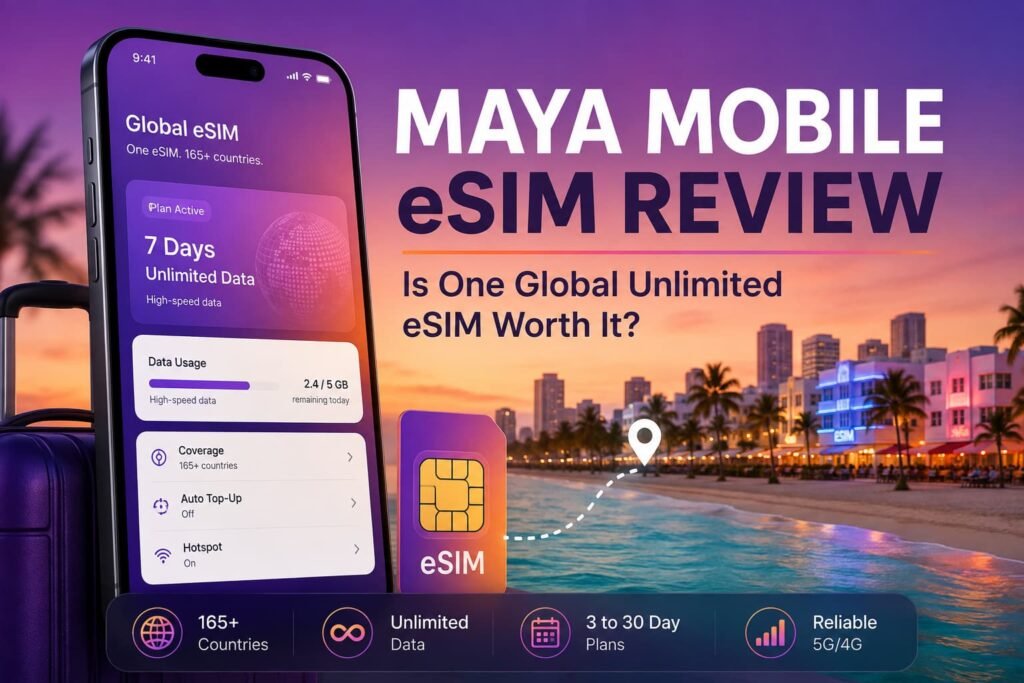
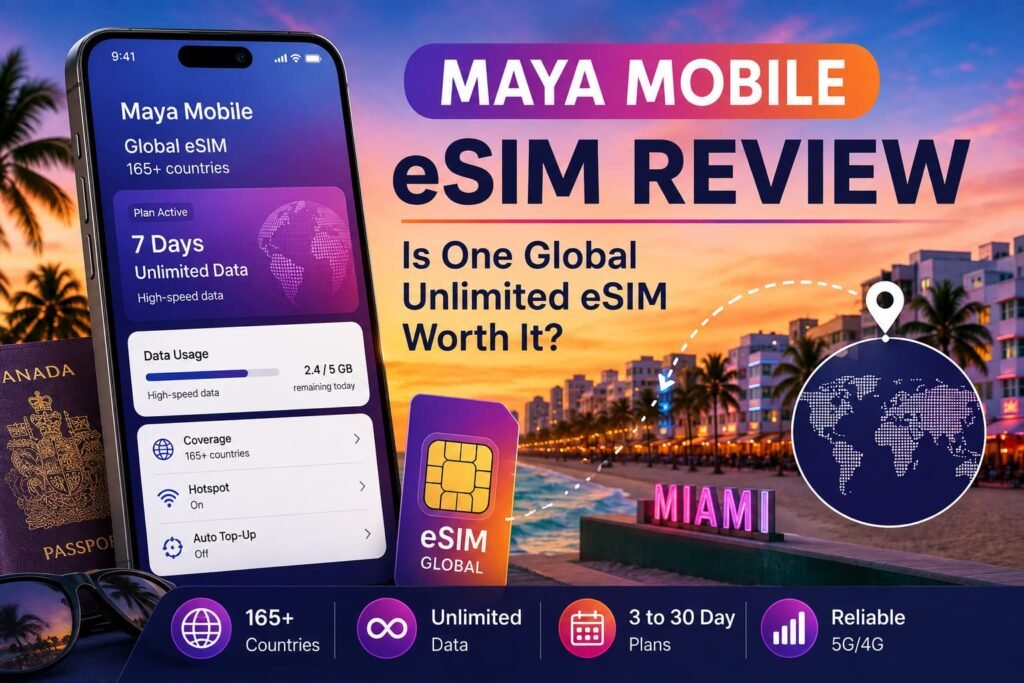
I bought Maya Mobile before leaving Toronto Pearson, installed the eSIM by QR code, and used it throughout a recent trip to Miami. That hands-on test is what shapes this Maya Mobile eSIM review, because the current Maya product is quite different from the version still described in many older reviews.
Once I landed in Florida, the eSIM activated and my phone connected through both T-Mobile and Verizon 5G during the trip. I had reliable service around South Beach and while moving around downtown Miami, used the hotspot with my laptop, streamed plenty of video, and generally found the experience smooth.
What stood out most was how little I had to manage.
Maya now revolves around one reusable global eSIM and four time-based plans covering more than 165 countries. Instead of choosing between multiple data allowances and destination packages, the main question is how many days you need service.
There is a trade-off.
After heavy video streaming during the day, I noticed slower speeds later that evening. Maya’s current Terms and Conditions explain why that matters: its unlimited plans include a daily high-speed allowance, after which data continues at standard speed until the allowance resets.
Overall, I came away liking Maya. I would use it again, particularly for a busy or multi-country trip. But I would not automatically choose it for every vacation, because travellers who use only a little data can still save money with a smaller fixed-data plan.
Verdict: My Take on the New Maya Mobile eSIM
Maya makes the most sense to me as a convenience-first global travel eSIM.
I purchased the plan before leaving Canada, installed the profile, arrived in Florida, and used it. There was very little plan management after that.
For a frequent traveller, that is the appeal.
You install one profile and keep it. When another trip comes up, you choose a 3-, 7-, 14-, or 30-day plan and use the same travel eSIM again.
For a one-week vacation where I expected to use only a couple of gigabytes, I would still compare cheaper fixed-data plans before buying Maya.
For a trip where I expected heavier use and wanted one less thing to monitor, Maya would be much higher on my list.
The limitation I would take most seriously is the daily high-speed allowance. I noticed the effect after a heavy day of streaming in Miami, so this is not something I would treat as fine print.
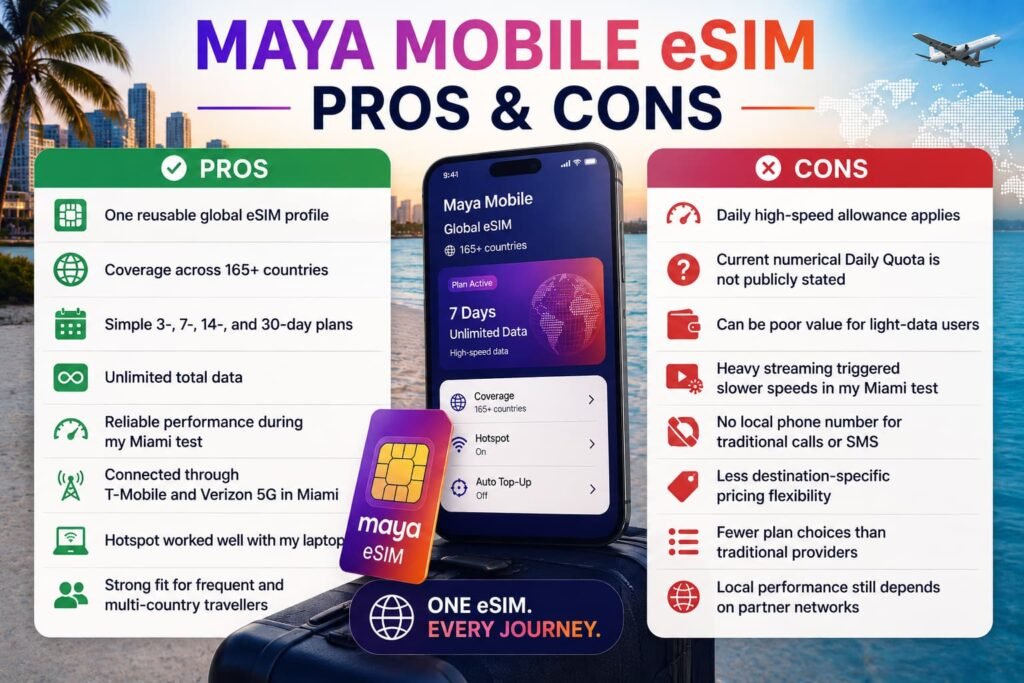
Maya Mobile eSIM Pros and Cons
| Pros | Cons |
|---|---|
| One reusable global eSIM profile | Daily high-speed allowance applies |
| Coverage across 165+ countries | Current numerical Daily Quota is not publicly stated |
| Simple 3-, 7-, 14-, and 30-day plans | Can be poor value for light-data users |
| Unlimited total data | Heavy streaming triggered slower speeds in my Miami test |
| Reliable performance during my Miami test | No local phone number for traditional calls or SMS |
| Connected through T-Mobile and Verizon 5G in Miami | Less destination-specific pricing flexibility |
| Hotspot worked well with my laptop | Fewer plan choices than traditional providers |
| Strong fit for frequent and multi-country travellers | Local performance still depends on partner networks |
Maya Has Removed Most of the Plan Shopping
Maya Mobile used to work more like a conventional travel eSIM provider. That matters because older reviews may still describe country-specific plans, regional packages, fixed data buckets, and a different buying experience.
The current service is much simpler.
Maya now centres its offering around one reusable global eSIM. Install the profile once, choose how long you need data, and leave the eSIM on your phone for the next trip.
The basic process is straightforward:
- Buy your plan before travelling.
- Install Maya on an unlocked, eSIM-compatible device.
- Enable the travel eSIM when you arrive.
- Use the same profile across supported destinations.
- Leave Maya installed after the plan expires.
- Add another plan when you travel again.
That is almost the opposite of an eSIM marketplace.
With a marketplace such as MobiMatter or SimOptions, more choice is part of the attraction. You compare plans, suppliers, coverage, and pricing to find the best fit.
Maya’s appeal is having less to compare.
Neither model is automatically better.
If you are happy spending time comparing plans to save money, Maya’s limited choice can work against you. If you would rather get the eSIM decision over with quickly, the current model is refreshingly easy to understand.
The Real Choice Is Trip Length, Not Gigabytes
Maya currently sells four core Global plans through its official website:
| Duration | Coverage | Data Model | USD | CAD |
|---|---|---|---|---|
| 3 days | 165+ countries | Unlimited total data | US$9.99 | C$13.94 |
| 7 days | 165+ countries | Unlimited total data | US$19.99 | C$27.90 |
| 14 days | 165+ countries | Unlimited total data | US$27.99 | C$39.06 |
| 30 days | 165+ countries | Unlimited total data | US$49.99 | C$69.76 |
The 3-day plan is an easy fit for a weekend or short business trip. Seven days works for a typical one-week vacation, while the 14- and 30-day options become more attractive for longer travel and multi-country itineraries.
I like that the price does not change simply because you cross into another supported country.
If you are travelling from Toronto to London, then Paris, and later Rome, you do not have to decide whether to buy three local plans or guess whether a regional package will cover the entire itinerary.
But easy pricing is not automatically the lowest pricing.
If I were going back to Miami for three or four days and expected to use only navigation, rideshare apps, WhatsApp, email, and occasional browsing, I would compare a smaller U.S. data package before paying for unlimited global access.
The eSIM Plan Comparison Tool is useful for that decision.
What “Unlimited Data” Actually Meant During My Trip
This is the most important limitation to understand.
Maya sells its core Global plans as unlimited data. Its current Terms say each plan includes a daily high-speed data allowance, which Maya calls the Daily Quota.
While the allowance remains available, Maya says service can run at up to 4G LTE or 5G where supported by the local network.
Once the allowance is consumed, your connection does not stop. Data continues at standard speed until the daily high-speed allowance resets.
I saw the practical side of that during my Miami test.
I streamed a substantial amount of video during the day along with normal travel use. Later that evening, I noticed that the connection had slowed.
I did not run a controlled measurement of the reduced speed, and I do not know exactly how much data I consumed before the slowdown happened.
Maya also does not currently publish a numerical Daily Quota for the new global product that I can verify, so I would not attach an arbitrary 3 GB, 5 GB, or other number to my experience.
What I can say is simpler: after heavy usage, I noticed a slowdown, and Maya’s current Terms describe a daily high-speed allowance followed by standard-speed data.
For everyday travel, that may never become an issue.
Maps, rideshare apps, WhatsApp, email, restaurant searches, hotel bookings, social media, and ordinary browsing are very different from spending hours streaming high-resolution video or moving large files.
Heavy users should pay more attention.
If you want Maya mainly for all-day laptop tethering, large cloud uploads, constant video calls, or heavy streaming, I would buy it knowing that unlimited total data does not necessarily mean unlimited maximum-speed data.
That is the most important practical lesson I took from using it.
One eSIM Across More Than 165 Countries
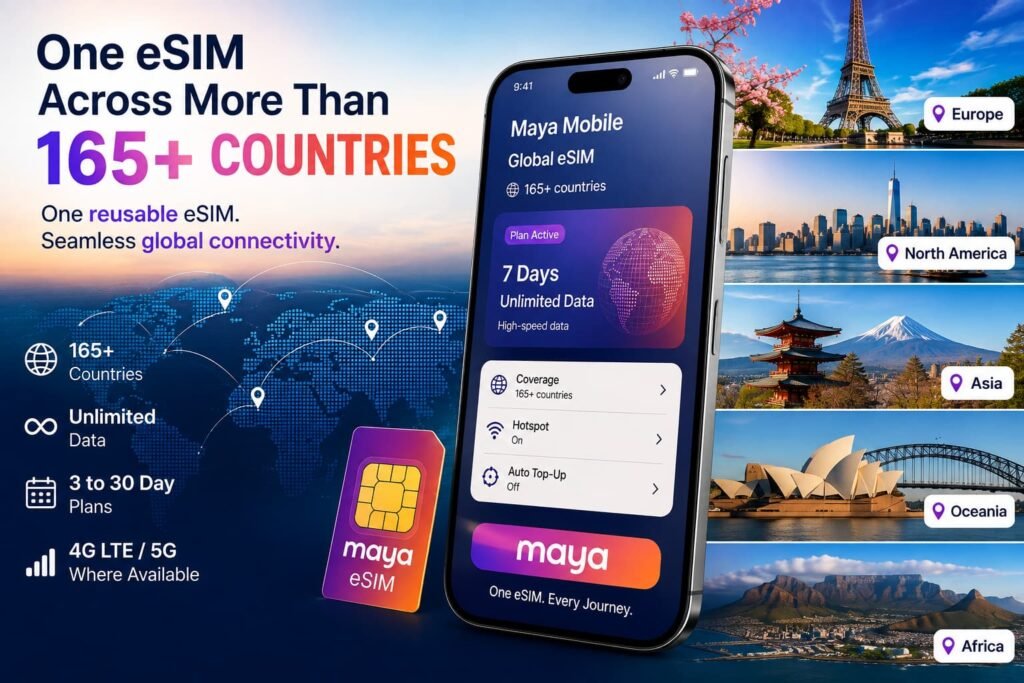
Maya’s current Global coverage extends across more than 165 countries.
The number is useful, but the real advantage is that the same installed profile is designed to follow you between supported destinations.
| Region | Representative Supported Destinations |
|---|---|
| North America | Canada, United States, Mexico |
| Europe | United Kingdom, France, Germany, Spain, Italy |
| Asia | Japan, South Korea, Thailand, China |
| Oceania | Australia, New Zealand |
| Latin America & Caribbean | Multiple supported destinations |
| Middle East & Africa | Multiple supported destinations |
During my Miami trip, my phone connected through T-Mobile and Verizon 5G.
Coverage was reliable around South Beach and while I was moving around downtown Miami. For the navigation, browsing, streaming, messaging, and work I needed to do, the connection was dependable.
That gives me confidence in how Maya performed on that trip.
It does not prove Maya will perform identically in London, Tokyo, rural Mexico, or every other supported destination.
Like other travel eSIM providers, Maya relies on local carrier partners. Signal, congestion, roaming priority, available 5G, and network quality can all change by country and location.
The global model becomes much more valuable when your itinerary crosses borders.
If your entire vacation is centred on one country and local carrier choice matters more than convenience, I would still compare the options in eSIM Providers by Country before deciding.
When Maya’s Simplicity Is Worth Paying For
The more complicated the trip becomes, the easier Maya is to justify.
A Canadian traveller going from Toronto to London, Paris, and Rome is a stronger Maya candidate than someone taking a quiet three-day trip to one U.S. city.
You can keep the same profile installed, and an itinerary change is less likely to force another eSIM purchase.
Frequent travellers also get more from the reusable setup.
The data plan does not remain active forever. The eSIM profile is what stays on your phone, ready for another plan later.
That distinction matters.
Repeated eSIM installation is not a serious problem, but after enough trips it becomes another small task I would rather avoid.
Maya also worked well for the way I used data in Miami. I streamed video, used navigation throughout the day, and tethered my laptop without worrying about how many gigabytes remained in a fixed bundle.
The daily high-speed allowance is the compromise.
For someone trying an eSIM for the first time, I also like how few plan decisions Maya asks you to make. You still need an unlocked and compatible phone, which you can check with the eSIM Compatibility Checker, but the buying process itself is easy to follow.
When I Would Buy a Fixed-Data Plan Instead
Maya worked well for me in Miami, but that does not make it my automatic choice for every future trip.
The main reason is simple: light users can pay for data they do not need.
Maya does not give you a cheaper 1 GB or 3 GB version of the same Global plan.
If I knew I would use only a couple of gigabytes over one short trip, I would rather compare a fixed package and keep the difference in my pocket.
Providers such as Airalo, Nomad, aloSIM, Saily, Jetpac, and Ubigi all give travellers more ways to match a plan to a specific destination or expected amount of data.
That takes more comparison.
It can also produce a better price.
Maya makes the most sense when the convenience is part of what you are paying for.
Using Maya With Your Canadian SIM
My setup for Miami was straightforward.
I purchased Maya online before leaving Toronto Pearson and installed it using the QR code. I prefer doing this before departure because I would rather solve a setup issue at home than after landing without dependable mobile data.
The eSIM activated once I arrived in Florida.
Maya also provides current iPhone and Android apps, and its official installation instructions cover automatic, QR-code, and manual setup methods depending on the device.
Keeping your Canadian number
Maya is primarily a data eSIM.
My plan did not provide a local U.S. number for conventional calls or SMS.
I kept my regular Canadian line available for my existing number while using Maya for travel data. Internet-based services such as WhatsApp, FaceTime, Signal, Teams, and similar apps can use the Maya connection.
For Canadians, the important part is controlling which line handles data.
If you do not want to trigger your Canadian carrier’s daily roaming charge, make sure Maya is selected for mobile data and review the roaming settings on the Canadian line.
I preferred using Maya in Miami to paying my Canadian carrier a daily roaming fee. That is one of the main reasons I use travel eSIMs in the first place.
Hotspot worked well with my laptop
Maya supports hotspot and tethering, and I used that feature during the trip.
My laptop stayed usable enough for me to get work done while travelling, which was far more convenient than depending entirely on public or hotel Wi-Fi.
I would still keep the high-speed allowance in mind.
Laptop traffic can climb quickly through cloud syncing, video meetings, app updates, downloads, and streaming. My successful hotspot test does not turn Maya into an unlimited full-speed home-internet replacement.
Auto Top-Up is optional
Maya also offers Auto Top-Up.
If you enable it, the same plan duration can be purchased again when the active plan ends. Under Maya’s current Terms, Auto Top-Up is optional rather than a mandatory subscription.
I prefer that arrangement.
Travellers who want continuity can enable it, while everyone else keeps control over the next purchase.
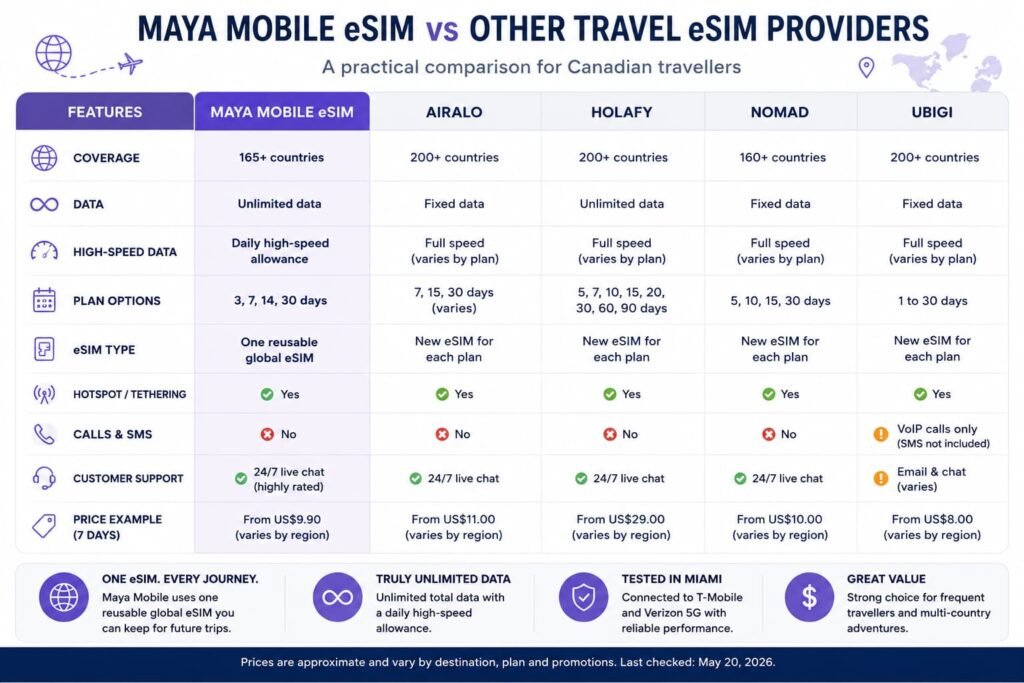
Maya Mobile eSIM vs Other Travel eSIM Providers
There are now enough different eSIM business models that comparing providers by feature count does not tell you very much.
The useful question is which buying model fits your trip better than Maya’s?
| Provider | Better than Maya when… | Maya is better when… |
|---|---|---|
| Saily | You want more destination and regional plan choice, plus built-in privacy and security tools. | You want the buying decision reduced mainly to trip length and expect heavier use across several destinations. |
| Airalo | Smaller fixed-data packages, destination pricing, and tighter cost control matter more. | You want unlimited total data, fewer plan decisions, and simple multi-country use. |
| Roamless | Your usage is light or unpredictable and paying according to actual consumption suits you better. | You expect heavier daily use and prefer budgeting by number of travel days instead of watching consumption. |
| Ubigi | You want more destination, regional, or data-allowance choices and a reusable profile you can top up for different trips. | You prefer Maya’s much narrower global unlimited-by-duration model instead of comparing allowances. |
| Eskimo | Keeping paid fixed data available across future trips or transferring unused data matters more than unlimited use on one trip. | You want unlimited total data for a defined number of travel days and do not want to manage a remaining balance. |
| aloSIM | A smaller prepaid country or regional package better matches your expected usage. | You would rather avoid shopping for a new destination-specific allowance each trip. |
| Holafly | Your trip centres on one destination or region and you prefer a destination-focused unlimited product. | Your itinerary crosses several countries and one consistent global product is more convenient. |
| Jetpac | Competitive fixed-data or regional packages, travel perks, and more plan choice matter more than simplicity. | You want one very simple global unlimited model without comparing multiple data-pack options. |
Several of these providers now support reusable eSIM profiles themselves, so that feature alone does not make Maya unique.
The difference is the combination: Maya keeps its current core offer unusually narrow by pairing one global profile with four time-based unlimited plans.
Maya Mobile vs Airalo
Airalo gives you far more ways to tune the purchase.
Its current catalogue includes local, regional, and global eSIM options with different data allowances, including some unlimited packages. That makes Airalo useful when I know exactly where I am going and how much data I expect to use.
For a simple U.S. trip where I need only a few gigabytes, I would check Airalo first.
For a multi-country trip where I expect heavier usage and do not want to keep choosing plans, Maya is easier.
The difference is precision versus simplicity.
Maya Mobile vs Holafly
Holafly is one of the closest alternatives when unlimited data is the priority.
Its traditional travel product is organized around destinations and regions, so you can choose an unlimited plan built around a particular trip.
Maya takes a more standardized approach.
If I were spending my entire holiday in one country and found a Holafly plan that fit the exact duration and destination well, I would compare it closely with Maya.
If I were moving between several countries and wanted the same basic product everywhere, I would lean toward Maya.
Maya Mobile vs Roamless
Roamless gives me almost the opposite way to budget travel data.
Its single global eSIM can use pay-as-you-go credits that are deducted according to actual consumption, alongside separate fixed data plans.
That makes Roamless very appealing for light or unpredictable use.
Maya is easier when I know I will be using mobile data heavily every day and would rather buy a block of time.
My Miami usage is a good example. I was streaming, navigating, staying connected through the day, and tethering a laptop. I liked not watching a remaining GB balance.
If I were travelling lightly and relying mostly on Wi-Fi, I would probably prefer the pay-for-what-I-use approach.
Maya Mobile vs Eskimo
Eskimo is the comparison I would make if the trip problem were leftover value, not unlimited use.
Its fixed data model is designed so paid data can remain available for future travel rather than expiring at the end of a typical short validity window. Eskimo also offers transferable fixed data and separate unlimited day-pass options.
That can be a better fit if you travel often but use modest amounts of data on each trip.
Maya is easier when I know the current trip will involve heavier data use and I would rather pay for 7, 14, or 30 days than think about how much data remains.
So the choice comes down to what you want to preserve:
Eskimo preserves unused data value. Maya simplifies the active trip.
Frequently Asked Questions
Is Maya Mobile eSIM worth it?
For frequent travellers, multi-country trips, or heavier data use, Maya’s simple global plan can be worth paying for because it removes a lot of repeated plan shopping.
I would be less likely to choose it for a short trip where I knew a few gigabytes would be enough. In that situation, compare fixed-data alternatives with the eSIM Plan Comparison Tool before paying for unlimited access.
What does Maya Mobile mean by unlimited data?
What does Maya Mobile mean by unlimited data?
The useful way to read Maya’s offer is unlimited total data with a daily high-speed allowance.
Its Terms say that after the high-speed allowance is used, service continues at standard speed until the allowance resets. Maya does not currently publish a numerical Daily Quota for the new global product that I can verify.
What happens after heavy data use on Maya Mobile?
During my Miami test, I noticed a clear slowdown later in the day after substantial video streaming.
I did not measure the reduced speed or determine exactly how much data triggered it. Maya’s current Terms do, however, describe a daily high-speed allowance followed by standard-speed data, so heavy streamers and laptop users should factor that into the decision.
How reusable is the Maya Mobile eSIM between trips?
You can leave the Maya profile installed after one plan expires and add another plan when you travel again.
That makes the setup more useful for frequent travellers because you are not treating the travel eSIM as disposable after every vacation. The plan itself still expires; it is the eSIM profile that remains available for future use.
Where does Maya Mobile work in North America?
Canada, the United States, and Mexico are included in Maya’s current Global coverage.
I personally used Maya after travelling from Toronto to Miami and had reliable connectivity around South Beach and downtown Miami, with my phone connecting through T-Mobile and Verizon 5G during the trip.
For normal everyday use while you are home in Canada, your domestic Canadian plan will usually make more sense than paying for a travel eSIM.
What was Maya Mobile hotspot performance like in real use?
I tethered my laptop to Maya during the Miami trip and was able to get work done without relying entirely on hotel or public Wi-Fi.
The hotspot itself worked well for me. The bigger consideration is data intensity: laptop traffic can use the daily high-speed allowance more quickly, especially with video meetings, cloud syncing, downloads, and streaming.
What should you know about calls, texts, and phone numbers with Maya?
My Maya plan did not provide a local U.S. number for ordinary cellular calls or SMS.
I used Maya for mobile data while keeping my Canadian line available for my usual number. Apps such as WhatsApp, FaceTime, Signal, and Teams can use the Maya connection, but that is different from receiving a local phone number with the travel eSIM.
When does a Maya Mobile plan actually start?
My plan did not begin simply because I purchased and installed it in Toronto.
I bought Maya before leaving Pearson, installed the profile by QR code, and the eSIM activated after I arrived in Florida and enabled it. That makes pre-trip installation practical because you can finish the setup while you still have a dependable internet connection.
How does Maya compare with Airalo, Holafly, and Roamless?
I would choose Airalo when a smaller destination-specific package gives me better value, Holafly when a destination-focused unlimited plan fits one trip particularly well, and Roamless when light or irregular usage makes pay-as-you-go more attractive.
Maya is the option I would favour when I expect heavier use, want one simple global product, and do not want to keep thinking about gigabytes.
Related eSIM Canada Guides
Explore Other Ways to Stay Connected
- Nomad eSIM Review — A useful next read if you want flexible fixed-data and regional options instead of Maya’s unlimited-by-duration model.
- Saily eSIM Review — Compare Maya’s stripped-down plan choice with an app-led provider offering destination plans and additional security features.
- Jetpac eSIM Review — Worth reading if competitive data packages and traveller perks matter more than having the simplest possible plan structure.
- Flexiroam eSIM Review — A different take on persistent international connectivity for frequent and longer-term travellers.
- MobiMatter eSIM Review — See the opposite buying philosophy, where marketplace choice and price comparison are the main advantages.
- Roamless eSIM Review — Compare Maya’s time-based unlimited model with reusable pay-as-you-go data.
Plan Your Next Trip
Use the eSIM Plan Comparison Tool when you want to compare actual plan structures and Canadian-dollar costs before buying.
You can also browse eSIM Providers by Country when your trip is centred on one destination and you want to compare the providers available there.
Final Thoughts
I would use Maya Mobile again.
What impressed me most in Miami was how little attention the service required once I arrived. It activated in Florida, coverage was reliable where I travelled, and the hotspot was good enough for me to work from my laptop.
I also preferred paying for Maya instead of triggering my Canadian carrier’s daily roaming charge.
The limitation I would watch is the daily high-speed allowance. After substantial streaming, I noticed slower speeds later in the day, so I would never describe the service as unlimited maximum-speed data.
For someone taking a short trip and using only a couple of gigabytes, I would probably buy a smaller fixed-data plan.
For frequent travellers, multi-country itineraries, or people who expect heavier everyday data use, Maya makes much more sense.
Compared with the other eSIM models I use, Maya sits firmly at the simplicity end of the market. Other providers give me more ways to optimize price, preserve unused data, or pay according to actual consumption. Maya asks me to make fewer decisions.
That is its strongest argument.
I would recommend Maya when convenience and heavier use matter more than squeezing the lowest possible price out of one destination. I would choose something else when my data needs were small enough that unlimited service would mostly go unused.