Most travel eSIM providers sell their own plans.
Mobimatter works differently.
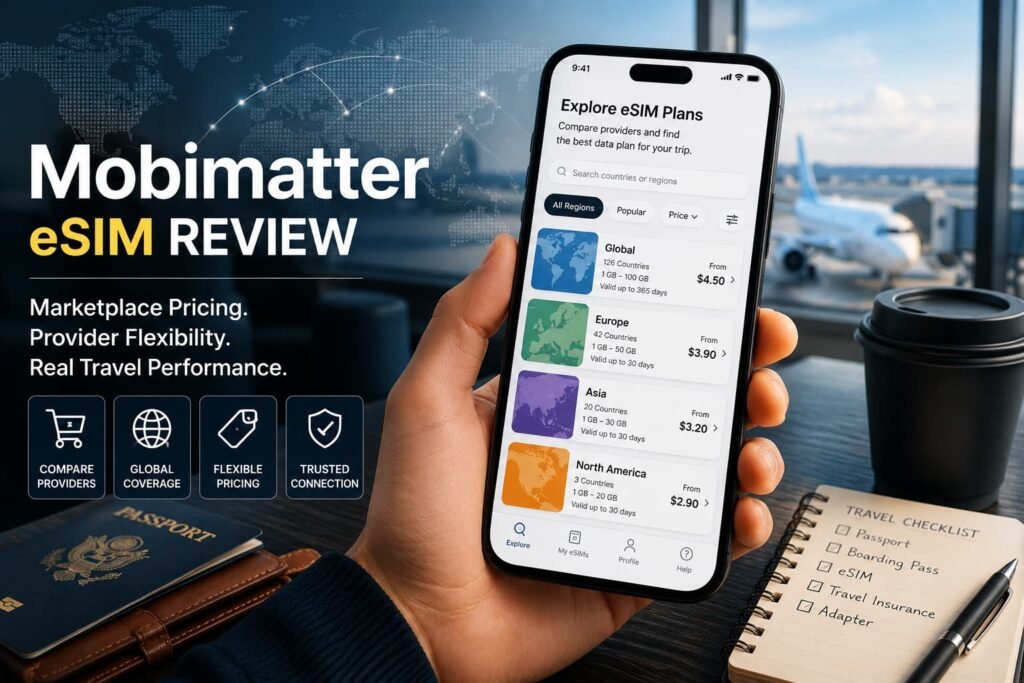
Instead of operating like a traditional eSIM provider, Mobimatter behaves more like a global marketplace where travelers can compare plans from multiple eSIM brands and carrier partners in one place.
That changes the experience completely.
In some countries, Mobimatter can offer significantly lower pricing than providers like Holafly, GigSky, or Ubigi because it aggregates plans from different suppliers rather than relying on one fixed pricing structure.
At the same time, that flexibility also creates more variation.
Some plans are excellent.
Some feel less polished.
Some focus heavily on low pricing.
Others prioritize stronger regional coverage or larger data allowances.
Compared to simpler providers like Saily or aloSIM, Mobimatter requires more comparison before buying.
But for travelers willing to spend a few extra minutes evaluating plans, the pricing flexibility can be extremely attractive.
In this Mobimatter eSIM review, you will see how the platform works, how pricing compares across different regions, what kind of real-world performance to expect, and whether Mobimatter is actually worth using for international travel.
Mobimatter eSIM Review: What You Need to Know
Mobimatter is built around comparison flexibility.
Instead of offering one standardized global eSIM experience, Mobimatter aggregates plans from multiple providers and carrier partners through a marketplace-style platform.
That means travelers can browse:
- country-specific plans
- regional plans
- global plans
- budget-focused providers
- premium carrier-backed options
- short-term and long-term travel plans
This marketplace structure creates more variation than most standard eSIM providers.
In practice, that means:
- more pricing options
- wider variation between plans
- different network partnerships depending on provider
- varying levels of performance consistency
- stronger opportunities to find lower-cost plans
Compared to providers like Airalo or Nomad, Mobimatter feels less curated and more marketplace-driven.
Traditional providers usually operate through more standardized roaming infrastructure and routing systems.
Marketplace platforms like Mobimatter aggregate plans from multiple suppliers, which creates broader pricing flexibility but also more variation between plans.
Compared to Airhub, Mobimatter usually feels slightly more structured and easier to compare.
That distinction becomes important because marketplace-style eSIM platforms introduce much more variability than traditional single-provider ecosystems.
The platform is especially appealing for:
- experienced travelers
- budget-conscious users
- travelers comparing multiple destinations
- users comfortable evaluating plan differences
- travelers wanting access to multiple provider ecosystems
For travelers who simply want the easiest setup possible, providers like Saily or aloSIM may feel more approachable.
For travelers who care more about pricing flexibility and plan variety, Mobimatter becomes much more attractive.
You can explore available plans, supported destinations, and provider options directly on the official Mobimatter website.
Is Mobimatter eSIM Worth It for Travel?
Mobimatter can absolutely be worth it if pricing flexibility matters more than having a highly simplified experience.
Its biggest strength is access.
Instead of being locked into one provider’s pricing structure, travelers can compare multiple providers and carrier combinations inside one platform.
Mobimatter is a good fit for:
- travelers comparing multiple pricing options
- users comfortable browsing different providers
- regional travel with flexible data needs
- travelers looking for lower-cost plans
- experienced eSIM users
- travelers wanting marketplace flexibility
It may not be the best option if:
- the simplest setup is the priority
- predictable pricing matters most
- maximum network consistency is required
- premium infrastructure matters more than price
- unlimited data is the primary goal
If you want the simplest possible setup with less comparison work, Saily will probably feel easier to manage.
If stable routing and more consistent premium performance matter more than finding the cheapest plan, Ubigi is usually the stronger option.
Travelers looking for unlimited data will likely find Holafly more appealing, especially for heavier daily usage.
Airhub is probably the closest alternative to Mobimatter overall, although Mobimatter usually feels more organized and easier to compare when browsing multiple providers.
What makes Mobimatter attractive is the amount of flexibility it gives travelers.
You can compare different suppliers, pricing structures, regional plans, and carrier combinations inside one marketplace instead of being locked into a single provider ecosystem.
The tradeoff is consistency.
Because plans come from different suppliers and roaming partners, the overall experience can vary more than providers with tightly controlled infrastructure and support systems.
What Mobimatter Is and How It Works
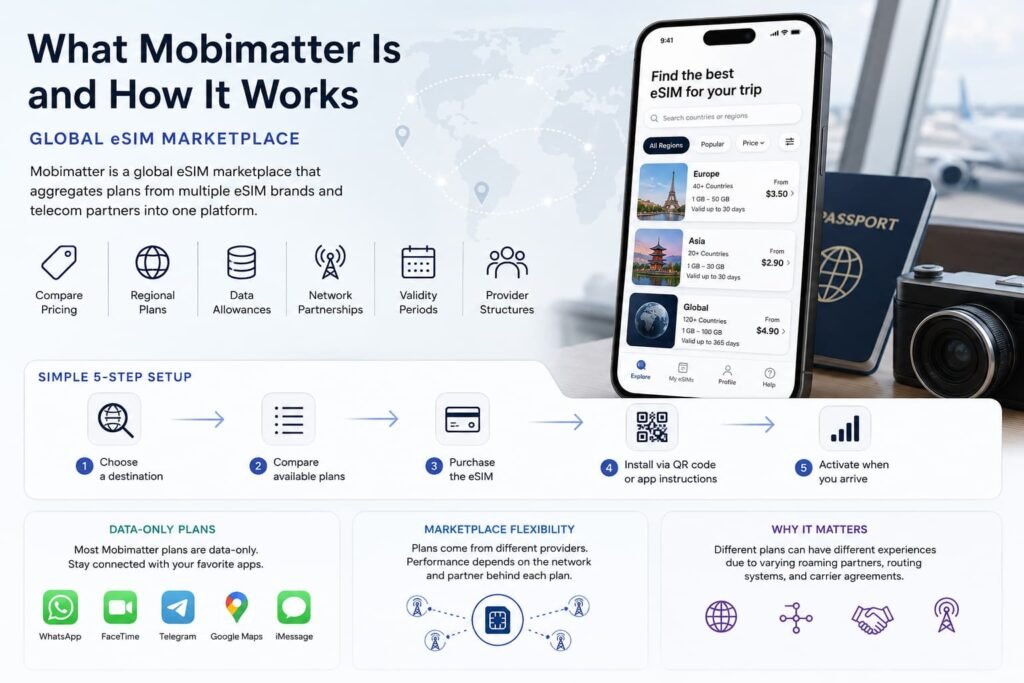
Mobimatter is a global eSIM marketplace platform headquartered in Dubai, United Arab Emirates.
Instead of operating as a single eSIM provider, Mobimatter aggregates plans from multiple eSIM brands and telecom partners into one marketplace.
That means travelers can compare:
- pricing
- regional plans
- data allowances
- network partnerships
- validity periods
- provider structures
inside one app or website.
The setup process is similar to most eSIM providers:
- choose a destination
- compare available plans
- purchase the eSIM
- install via QR code or app instructions
- activate when you arrive
Like most travel eSIM platforms, most Mobimatter plans are data-only.
Apps like:
- FaceTime
- Telegram
- Google Maps
- iMessage
continue working normally.
Because Mobimatter aggregates plans from different providers, the overall experience depends heavily on which specific plan and provider you choose.
Two plans purchased inside the same marketplace can sometimes behave very differently because they may rely on completely different roaming partners, routing systems, and carrier agreements behind the scenes.
That is one of the biggest differences compared to providers like Ubigi or GigSky that control their own infrastructure more tightly.
What Makes Mobimatter Different
Mobimatter stands out because it behaves more like an eSIM marketplace engine than a traditional telecom-style provider.
Most eSIM providers focus on:
- selling their own plans
- maintaining one ecosystem
- controlling one pricing structure
Mobimatter focuses more on:
- plan comparison
- provider aggregation
- pricing competition
- regional flexibility
- marketplace-style discovery
That marketplace approach creates several advantages.
Travelers can often:
- access wholesale-style regional pricing
- compare multiple supplier ecosystems
- find lower cost-per-GB pricing than premium providers
- find cheaper pricing
- compare multiple providers quickly
- discover regional plans that are harder to find elsewhere
- access provider combinations not available on single-provider platforms
One reason pricing can sometimes be dramatically cheaper than premium providers is because marketplace suppliers compete directly against each other inside the platform.
Instead of maintaining one tightly controlled infrastructure stack, multiple wholesalers and roaming suppliers compete for visibility through marketplace pricing.
Mobimatter also frequently features plans from:
- Sparks
- eSIMGo
- 3 Hong Kong
- and other regional telecom partners
That creates a much broader provider ecosystem than most standalone eSIM companies.
Airhub operates in a similar space, but Mobimatter usually feels more structured and easier to navigate when comparing multiple plans and suppliers.
Compared to simpler providers like Saily, Mobimatter gives travelers far more control over pricing, provider selection, and regional plan options, although it also requires a bit more comparison work before buying.
It also approaches travel connectivity very differently from premium providers like GigSky or Ubigi.
Those providers focus more on infrastructure consistency, controlled routing, and predictable performance across regions.
Mobimatter focuses more on marketplace flexibility, pricing competition, and giving travelers access to multiple supplier ecosystems inside one platform.
That makes it especially appealing for experienced travelers who prefer optimizing plans and pricing instead of relying on one tightly controlled provider experience.
That creates a much broader ecosystem than many standalone providers.
Mobimatter Coverage and Supported Countries
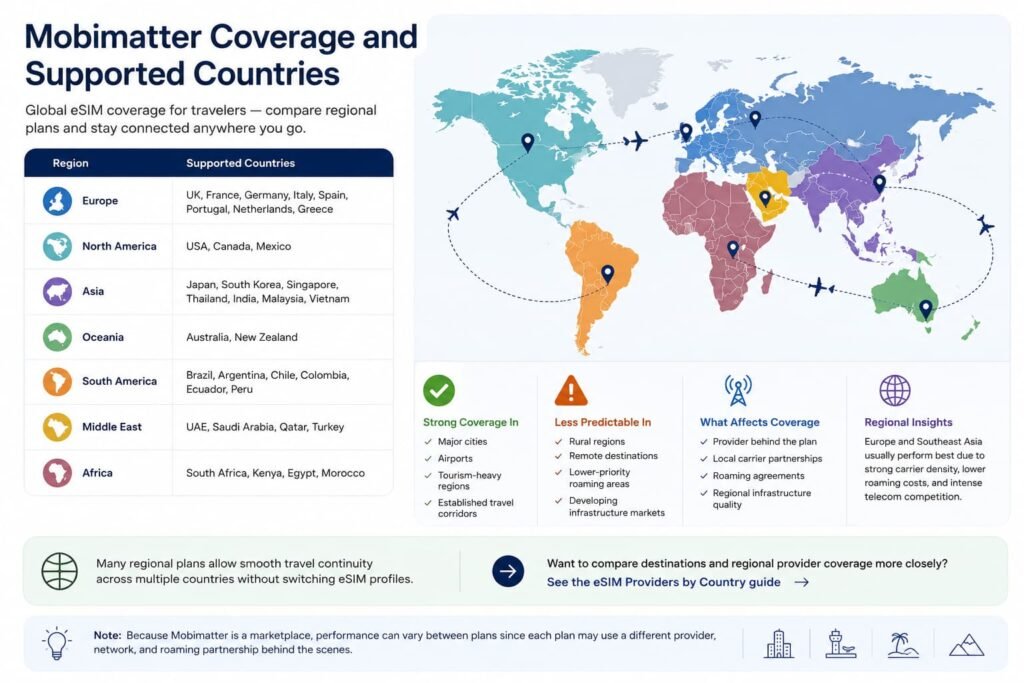
Mobimatter coverage includes most major international travel destinations.
| Region | Supported Countries |
|---|---|
| Europe | UK, France, Germany, Italy, Spain, Portugal, Netherlands, Greece |
| North America | USA, Canada, Mexico |
| Asia | Japan, South Korea, Singapore, Thailand, India, Malaysia, Vietnam |
| Oceania | Australia, New Zealand |
| South America | Brazil, Argentina, Chile, Colombia, Ecuador, Peru |
| Middle East | UAE, Saudi Arabia, Qatar, Turkey |
| Africa | South Africa, Kenya, Egypt, Morocco |
Coverage quality depends heavily on:
- the provider behind the plan
- local carrier partnerships
- roaming agreements
- regional infrastructure quality
Performance is usually strongest in:
- major cities
- airports
- tourism-heavy regions
- established travel corridors
Coverage can become less predictable in:
- rural regions
- remote destinations
- lower-priority roaming areas
- developing infrastructure markets
Europe and Southeast Asia usually perform particularly well due to stronger carrier density, lower wholesale roaming costs, and intense telecom competition.
That regional competition is one of the reasons marketplace platforms often provide extremely aggressive pricing in those areas.
Some regional plans also allow smoother travel continuity across multiple countries without switching eSIM profiles.
If you want to compare destinations and regional provider coverage more closely, see the eSIM Providers by Country guide.
Mobimatter Pricing and Plan Costs
Pricing flexibility is one of the main reasons travelers use Mobimatter.
Because the platform aggregates plans from multiple providers, pricing can vary significantly depending on:
- destination
- provider
- local carrier agreements
- regional competition
- promotions available at the time
In many destinations, Mobimatter can offer lower pricing than premium providers.
In some regions, it can even undercut providers like Airalo or Nomad on larger plans.
Example pricing by destination:
| Destination | Data | Duration | Price (USD) |
|---|---|---|---|
| USA | 10GB | 30 Days | ~$10–$18 |
| Canada | 10GB | 30 Days | ~$14–$24 |
| Mexico | 5GB | 30 Days | ~$10–$16 |
| Japan | 10GB | 30 Days | ~$12–$22 |
| Thailand | 5GB | 30 Days | ~$8–$16 |
| South Korea | 10GB | 30 Days | ~$12–$22 |
| Europe Regional | 10GB | 30 Days | ~$14–$26 |
| India | 10GB | 30 Days | ~$9–$18 |
| Brazil | 5GB | 30 Days | ~$16–$28 |
| South Africa | 5GB | 30 Days | ~$14–$24 |
| Global Plan | 10GB | 30 Days | ~$28–$55 |
Typical pricing tiers:
- 1GB plans often range from around $2 to $6
- 5GB plans usually range from around $8 to $18
- 10GB plans commonly range from around $12 to $30
- regional plans vary depending on provider and coverage scope
One of Mobimatter’s biggest advantages is competitive regional pricing.
Travelers moving between countries can often find:
- larger regional bundles
- better cost-per-GB pricing
- lower pricing than traditional roaming
- flexible provider combinations
Premium providers like GigSky and Ubigi focus more on infrastructure consistency, stable routing, and predictable performance across regions.
Mobimatter takes a different approach by prioritizing pricing flexibility, provider variety, and marketplace-style comparison.
It also offers significantly more plan variation than simpler providers like aloSIM or Saily, giving travelers more control over regional pricing, carrier combinations, and data options.
That added flexibility can be extremely valuable for travelers willing to spend a little more time comparing plans before purchasing.
For the latest pricing and available plans, it is worth checking the official Mobimatter pricing page before purchasing.
Mobimatter Speeds and Real-World Performance
Mobimatter performance depends heavily on which provider and carrier partnership the selected plan uses.
That means real-world performance varies more than providers with tightly controlled infrastructure.
Some marketplace plans route data through regional gateways located in other countries before reaching the public internet.
In real-world travel use, this can occasionally introduce higher latency compared to premium providers with more localized routing systems.
In major cities and airports, performance is usually reliable enough for:
- maps and navigation
- messaging apps
- browsing and email
- video calls
- social media
- light streaming
You can typically expect:
- 4G LTE in most destinations
- 5G in supported urban areas
- stable performance in stronger city networks
- reasonable speeds for everyday travel use
Typical real-world speeds vary depending on the region, supplier, and roaming agreements behind the selected plan.
In many destinations, users report:
- around 20 Mbps to 60 Mbps in major cities
- stable browsing and messaging performance
- reliable connectivity in airports and tourism-heavy areas
Some plans perform extremely well.
Others may feel slower depending on:
- network prioritization policies
- lower-tier roaming agreements
- roaming agreements
- provider quality
- network routing
- congestion levels
Where performance becomes less predictable:
- rural travel
- lower-cost regional plans
- congested local networks
- remote destinations
Compared to Ubigi or GigSky, Mobimatter prioritizes pricing flexibility over infrastructure consistency.
Premium providers usually maintain more predictable routing paths and stronger control over roaming infrastructure.
Marketplace platforms trade some of that consistency in exchange for broader provider choice and lower pricing opportunities.
Compared to Airhub, Mobimatter often feels slightly more stable and organized because plan comparison is more structured.
That distinction matters because Mobimatter is designed primarily around marketplace accessibility rather than premium network management.
Mobimatter vs Other eSIM Providers
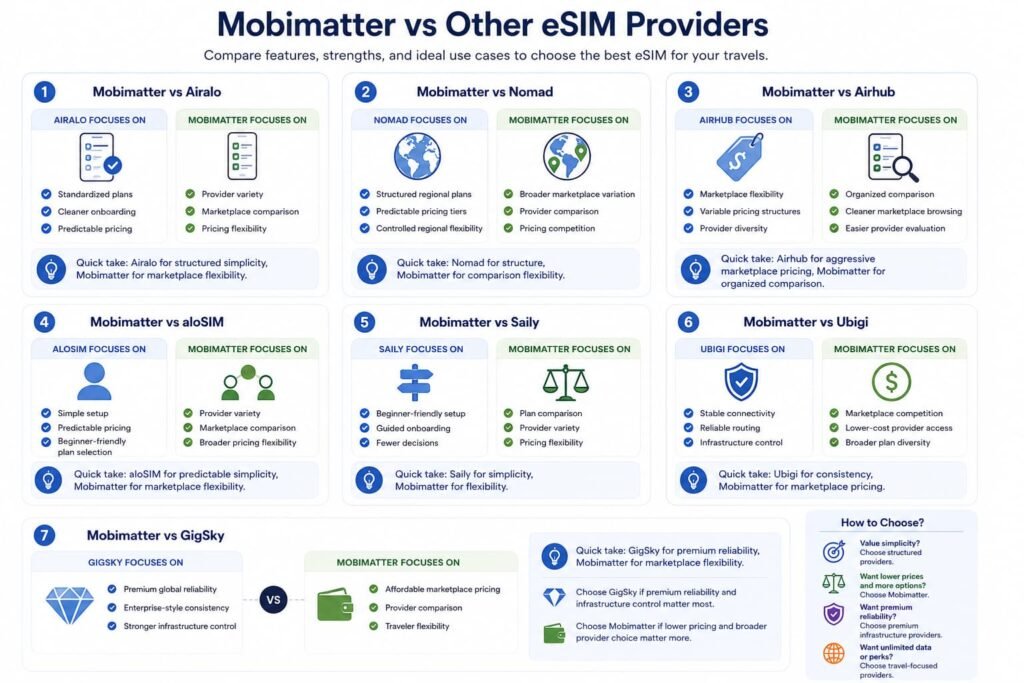
Mobimatter vs Airalo
Mobimatter and Airalo differ mainly in marketplace flexibility versus structured simplicity.
Airalo focuses on:
- standardized plans
- cleaner onboarding
- predictable pricing
Mobimatter focuses more on:
- provider variety
- marketplace comparison
- pricing flexibility
If predictable simplicity matters most, Airalo is usually the easier option. You can compare that in the Airalo eSIM review.
If comparing multiple providers and pricing structures matters more, Mobimatter becomes more attractive.
Quick take: Airalo for structured simplicity, Mobimatter for marketplace flexibility.
Mobimatter vs Nomad
Mobimatter and Nomad differ mainly in structure versus comparison freedom.
Nomad focuses heavily on:
- structured regional plans
- predictable pricing tiers
- controlled regional flexibility
Mobimatter focuses more on:
- broader marketplace variation
- provider comparison
- pricing competition
If cleaner regional organization matters most, Nomad is usually easier to manage. I explain that further in the Nomad eSIM review.
If broader marketplace flexibility matters more, Mobimatter becomes the stronger option.
Quick take: Nomad for structure, Mobimatter for comparison flexibility.
Mobimatter vs Airhub
Mobimatter and Airhub are very similar conceptually, but they differ in marketplace execution.
Airhub focuses more on:
- marketplace flexibility
- variable pricing structures
- provider diversity
Mobimatter focuses more on:
- organized comparison
- cleaner marketplace browsing
- easier provider evaluation
If aggressive pricing variation matters most, Airhub can sometimes offer stronger deals. You can compare that in the Airhub eSIM review.
If cleaner provider comparison matters more, Mobimatter often feels easier to use.
Quick take: Airhub for aggressive marketplace pricing, Mobimatter for organized comparison.
Mobimatter vs aloSIM
Mobimatter and aloSIM differ mainly in marketplace flexibility versus predictable simplicity.
aloSIM focuses on:
- simple setup
- predictable pricing
- beginner-friendly plan selection
Mobimatter focuses more on:
- provider variety
- marketplace comparison
- broader pricing flexibility
If you want a cleaner and more predictable setup, aloSIM is usually easier to manage. You can compare that in the aloSIM eSIM review.
If you want more provider choice and plan variation, Mobimatter becomes more useful.
Quick take: aloSIM for predictable simplicity, Mobimatter for marketplace flexibility.
Mobimatter vs Saily
Mobimatter and Saily differ mainly in complexity versus simplicity.
Saily focuses heavily on:
- beginner-friendly setup
- guided onboarding
- fewer decisions
Mobimatter focuses more on:
- plan comparison
- provider variety
- pricing flexibility
If simplicity matters most, Saily is usually easier to manage. I break that down further in the Saily eSIM review.
If comparing providers and optimizing pricing matters more, Mobimatter is the stronger option.
Quick take: Saily for simplicity, Mobimatter for flexibility.
Mobimatter vs Ubigi
Mobimatter and Ubigi differ mainly in pricing flexibility versus infrastructure consistency.
Ubigi focuses heavily on:
- stable connectivity
- reliable routing
- infrastructure control
Mobimatter focuses more on:
- marketplace competition
- lower-cost provider access
- broader plan diversity
If premium connection stability matters most, Ubigi is usually stronger. You can compare that in the Ubigi eSIM review.
If pricing flexibility matters more, Mobimatter becomes more attractive.
Quick take: Ubigi for consistency, Mobimatter for marketplace pricing.
Mobimatter vs GigSky
Mobimatter and GigSky target very different travelers.
GigSky focuses heavily on:
- premium global reliability
- enterprise-style consistency
- stronger infrastructure control
Mobimatter focuses more on:
- affordable marketplace pricing
- provider comparison
- traveler flexibility
If premium reliability matters most, GigSky is usually stronger. I explain that further in the GigSky eSIM review.
If lower pricing and broader provider choice matter more, Mobimatter is usually the better fit.
Quick take: GigSky for premium reliability, Mobimatter for marketplace flexibility.
Mobimatter vs Holafly
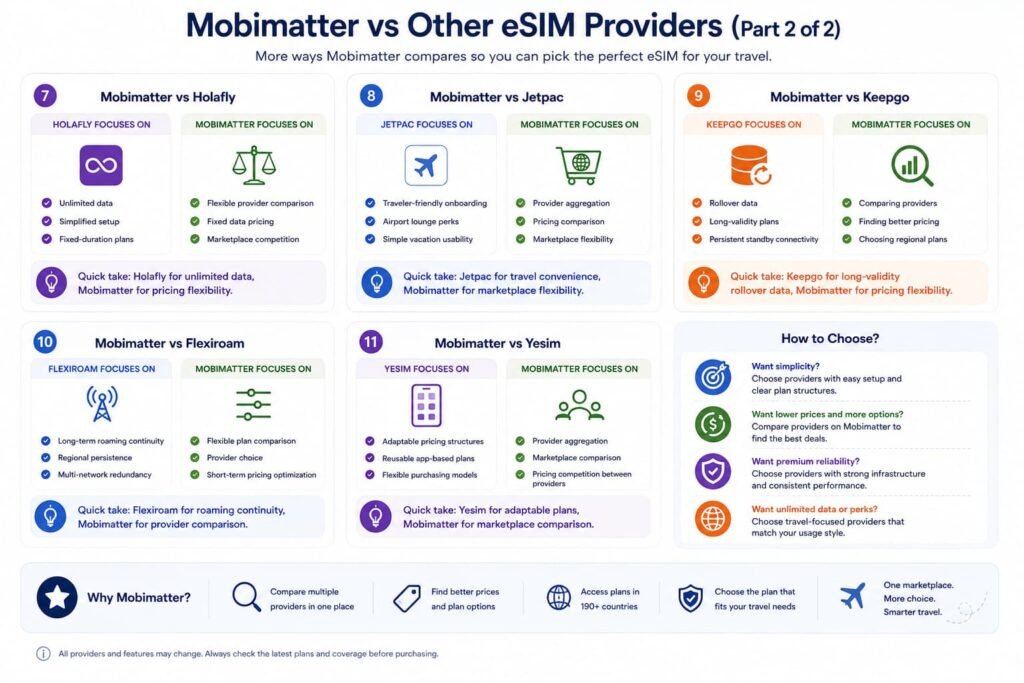
Mobimatter and Holafly differ mainly in pricing structure and usage style.
Holafly focuses heavily on:
- unlimited data
- simplified setup
- fixed-duration plans
Mobimatter focuses more on:
- flexible provider comparison
- fixed data pricing
- marketplace competition
If unlimited data matters most, Holafly is usually the better option. You can compare that in the Holafly eSIM review.
If pricing flexibility and provider comparison matter more, Mobimatter becomes more appealing.
Quick take: Holafly for unlimited data, Mobimatter for pricing flexibility.
Mobimatter vs Jetpac
Mobimatter and Jetpac differ mainly in marketplace flexibility versus travel convenience.
Jetpac focuses heavily on:
- traveler-friendly onboarding
- airport lounge perks
- simple vacation usability
Mobimatter focuses more on:
- provider aggregation
- pricing comparison
- marketplace flexibility
If traveler convenience and perks matter most, Jetpac is often the better option. I break that down further in the Jetpac eSIM review.
If comparing provider pricing matters more, Mobimatter is usually stronger.
Quick take: Jetpac for travel convenience, Mobimatter for marketplace flexibility.
Mobimatter vs Keepgo
Mobimatter and Keepgo differ mainly in marketplace pricing versus long-term data persistence.
Keepgo focuses on:
- rollover data
- long-validity plans
- persistent standby connectivity
Mobimatter focuses more on:
- comparing providers
- finding better marketplace pricing
- choosing between different regional plans
If keeping unused data active long term matters most, Keepgo is usually the better option. I explain that further in the Keepgo eSIM review.
If comparing supplier pricing and finding flexible regional deals matters more, Mobimatter is usually stronger.
Quick take: Keepgo for long-validity rollover data, Mobimatter for marketplace pricing flexibility.
Mobimatter vs Flexiroam
Mobimatter and Flexiroam differ mainly in marketplace comparison versus roaming continuity.
Flexiroam focuses heavily on:
- long-term roaming continuity
- regional persistence
- multi-network redundancy
Mobimatter focuses more on:
- flexible plan comparison
- provider choice
- short-term pricing optimization
If long-term roaming continuity matters most, Flexiroam is often the stronger option. You can compare that in the Flexiroam eSIM review.
If flexible pricing and provider comparison matter more, Mobimatter becomes more useful.
Quick take: Flexiroam for roaming continuity, Mobimatter for provider comparison.
Mobimatter vs Yesim
Mobimatter and Yesim differ mainly in marketplace structure versus flexible plan architecture.
Yesim focuses heavily on:
- adaptable pricing structures
- reusable app-based plans
- flexible purchasing models
Mobimatter focuses more on:
- provider aggregation
- marketplace comparison
- pricing competition between providers
If flexible plan architecture matters most, Yesim is often stronger. I explain that further in the Yesim eSIM review.
If comparing multiple providers inside one marketplace matters more, Mobimatter becomes more attractive.
Quick take: Yesim for adaptable plans, Mobimatter for marketplace comparison.
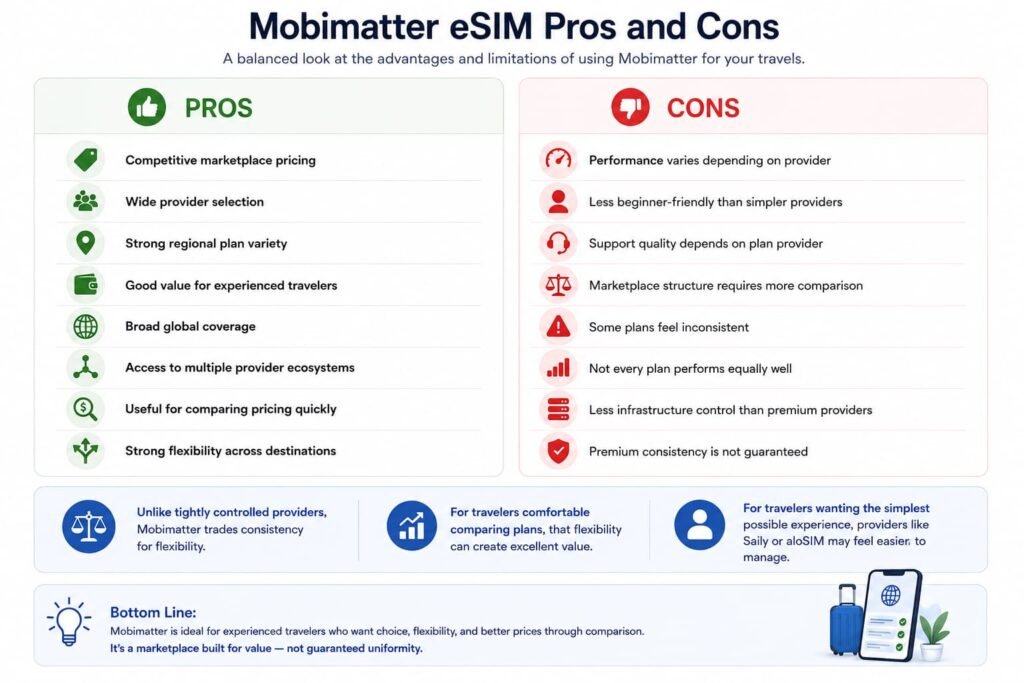
Mobimatter eSIM Pros and Cons
| Pros | Cons |
|---|---|
| Competitive marketplace pricing | Performance varies depending on provider |
| Wide provider selection | Less beginner-friendly than simpler providers |
| Strong regional plan variety | Support quality depends on plan provider |
| Good value for experienced travelers | Marketplace structure requires more comparison |
| Broad global coverage | Some plans feel inconsistent |
| Access to multiple provider ecosystems | Not every plan performs equally well |
| Useful for comparing pricing quickly | Less infrastructure control than premium providers |
| Strong flexibility across destinations | Premium consistency is not guaranteed |
Unlike tightly controlled providers, Mobimatter trades consistency for flexibility.
For travelers comfortable comparing plans, that flexibility can create excellent value.
For travelers wanting the simplest possible experience, providers like Saily or aloSIM may feel easier to manage.
Best Use Cases for Mobimatter
Mobimatter works best for:
- digital nomads
- experienced travelers
- travelers comfortable troubleshooting connectivity
- experienced eSIM users
- travelers comparing provider pricing
- regional travel with flexible data needs
- multi-country trips
- budget-conscious travelers
- travelers wanting marketplace flexibility
- users comfortable evaluating plans manually
Many experienced travelers use marketplace platforms strategically.
For example, some travelers pair a lower-cost marketplace eSIM for hotspot and high-volume data usage with a second premium eSIM for banking apps, navigation, or business calls.
That approach helps balance pricing flexibility with connection stability.
It is less ideal for:
- first-time eSIM users
- travelers wanting maximum simplicity
- users needing enterprise-grade consistency
- travelers wanting unlimited data without comparison
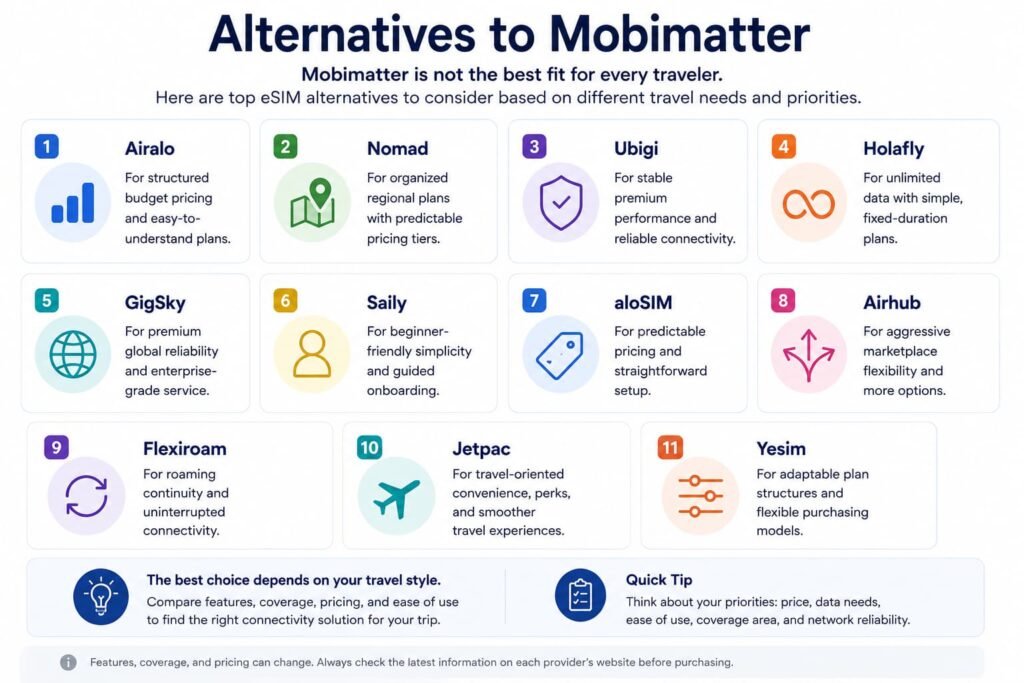
Alternatives to Mobimatter
Mobimatter is not the best fit for every traveler.
- Airalo for structured budget pricing
- Nomad for organized regional plans
- Ubigi for stable premium performance
- Holafly for unlimited data
- GigSky for premium global reliability
- Saily for beginner-friendly simplicity
- aloSIM for predictable pricing and setup
- Airhub for aggressive marketplace flexibility
- Flexiroam for roaming continuity
- Jetpac for travel-oriented convenience
- Yesim for adaptable plan structures
Related Guides
If you are still comparing providers or preparing your setup, these guides will help:
- Compare lower-cost travel plans in the Airalo eSIM review
- Explore structured regional pricing in the Nomad eSIM review
- See marketplace flexibility in the Airhub eSIM review
- Explore stable connectivity in the Ubigi eSIM review
- Compare premium global coverage in the GigSky eSIM review
- Learn how unlimited data works in the Holafly eSIM review
- Compare beginner-friendly simplicity in the Saily eSIM review
- Explore predictable setup and pricing in the aloSIM eSIM review
- Compare roaming continuity in the Flexiroam eSIM review
- Explore travel-oriented perks in the Jetpac eSIM review
- See flexible purchasing structures in the Yesim eSIM review
- Compare global coverage in eSIM Providers by Country
- Explore recommendations in Best eSIM for International Travel (2026 Guide)
- Follow setup instructions in How to Activate eSIM on iPhone Step-by-Step Guide
- Set up Android devices using How to Activate eSIM on Android Step-by-Step Guide
Final Thoughts
Mobimatter approaches international travel connectivity differently than most standard eSIM providers.
Instead of focusing on one tightly controlled provider ecosystem, it gives travelers access to a broader marketplace of plans, pricing structures, and regional carrier combinations.
That flexibility can create excellent value.
At the same time, it also creates more variation in performance, support, and overall experience compared to providers that operate with tighter infrastructure control.
For experienced travelers comfortable comparing plans, Mobimatter can be one of the most flexible and cost-effective eSIM platforms available.
For travelers wanting maximum simplicity or highly predictable premium performance, providers like Saily, aloSIM, Ubigi, or GigSky may feel easier to manage.
Overall, this Mobimatter eSIM review shows that the platform works very differently from traditional single-provider travel eSIM companies.
Mobimatter works best for travelers who value provider choice, marketplace flexibility, and pricing competition more than having one standardized experience.
More than most providers in this category, Mobimatter feels designed around helping travelers compare and optimize travel connectivity instead of simply selling one fixed eSIM ecosystem.