Arriving in China with working mobile data matters for far more than checking email. You may need your phone to find an airport transfer, translate an address, open a railway booking, call a ride or make a payment before you have had time to settle in.
I’ve travelled to China three times, including two work trips through Shenzhen and other parts of Guangdong Province, with additional time in Hong Kong and Macau. I also visited Beijing on a family vacation that included Universal Studios Beijing and historic sites such as the Forbidden City. During these trips, I tested several travel eSIMs and recorded real-world download speeds, upload speeds and latency.
That makes choosing the best eSIM for China from Canada different from choosing one for a simpler destination. Data allowance and price still matter, but so do traffic routing, access to familiar apps, coverage in Hong Kong or Macau and whether you need a local Chinese phone number.
Nomad delivered the most consistent overall performance in my testing, while Jetpac produced the highest raw speeds. Ubigi remains an appealing fixed-data option, although my results were more variable. Holafly is better suited to travellers who prioritize unlimited data over maximum speed. The right choice ultimately depends on your trip length, route and what you need your phone to do after arrival.
For a broader comparison before narrowing your choice by destination, see the Best eSIM for International Travel guide.

Which China eSIM Should You Buy Before You Fly?
Nomad is the strongest first comparison for a typical one- or two-week trip because its China selection combines useful fixed-data sizes, longer validity and disclosed access to China Unicom and China Telecom. Ubigi deserves an equally close look for a shorter trip, particularly when its 10GB plan valid for seven days fits the itinerary.
Jetpac becomes more attractive when you want a larger allowance, unrestricted hotspot sharing or an unlimited-style plan with a clearly published daily high-speed allowance. Holafly is simpler for travellers who would rather buy unlimited data by trip duration, although it costs more and its hotspot allowance is more restrictive.
Saily and Airalo remain credible alternatives if you already know their apps and prefer their plan systems. Keepgo serves a different purpose. Its Cassiopeia Asia-Pacific eSIM uses refillable data that Keepgo describes as having no expiry, making it more suitable for lighter use, backup connectivity or several regional trips than a conventional short-lived China package.
The shortlist is not based on brand recognition alone. China is one destination where two plans with similar amounts of data can produce meaningfully different experiences if their routing, regional coverage or fair-use rules differ.
China eSIM Providers Compared
| Provider | Current plan structure | Disclosed China network | Why compare it |
|---|---|---|---|
| Nomad | Fixed data and unlimited-style plans; hotspot supported | China Unicom and China Telecom | Balanced fixed-data choices and useful China plus regional plans |
| Ubigi | Fixed one-off plans; reusable eSIM; data sharing allowed | China Telecom on the verified plan page | Strong short-trip and light-use pricing |
| Saily | Fixed data and unlimited choices; hotspot supported | Local partner varies | Simple app, security features and a straightforward plan range |
| Jetpac | Fixed and unlimited choices; unlimited hotspot | Multi-network access | Larger allowances, transparent unlimited fair-use rules and useful backup features |
| Holafly | Unlimited data priced by trip duration | CMCC | Simple unlimited structure for heavier phone use |
| Airalo | Fixed data and unlimited choices | China Unicom | Familiar app and broad plan selection |
| Keepgo | Refillable fixed-data packs with a no-expiry balance; tethering supported | China Unicom on Keepgo’s current China listing | Reusable Asia-Pacific data for lighter use, backup connectivity or multiple trips |
| aloSIM | Fixed data | Product-specific | Worth discussing because its own support page says its China eSIM does not get around mainland internet restrictions |
Every provider should be checked again at checkout. Network partners, plan availability, promotions and fair-use rules can change, and a regional plan may have different terms from the provider’s China-only product.
Use the eSIM Plan Comparison Tool to compare current plan structures in Canadian dollars before purchasing.
How the China eSIMs Performed in My Tests
I tested multiple travel eSIMs across three trips that included Shenzhen and other parts of Guangdong Province, Hong Kong, Macau and Beijing. Two were work trips, while the third was a family vacation that included Universal Studios Beijing and the Forbidden City.
The figures below are approximate averages from my recorded tests in real travel conditions. Speeds can vary with location, congestion, device settings, the available local network and how each provider routes international traffic, but these results show the performance I experienced while travelling.
| Provider | Average download | Average upload | Average latency | What I observed |
|---|---|---|---|---|
| Nomad | 60 Mbps | 20 Mbps | About 160 ms | The most consistent overall performance. It recovered quickly after temporary signal loss, including when leaving subway tunnels. |
| Jetpac | 90 Mbps | 30 Mbps | About 140 ms | The highest download and upload speeds in my tests, making it the strongest option for heavier data use and hotspot sharing. |
| Saily | 45 Mbps | 15 Mbps | About 210 ms | Steady everyday performance without frequent connection drops. It handled navigation, translation, browsing and messaging reliably. |
| Airalo | 38 Mbps | 13 Mbps | About 195 ms | Stable rather than exceptionally fast. Performance was sufficient for navigation, translation, browsing and normal social media use. |
| aloSIM | 32 Mbps | 20 Mbps | About 200 ms | Similar everyday performance to Airalo, with a stronger recorded upload result in my tests. |
| Holafly | 30 Mbps | 15 Mbps | About 200 ms | Good general coverage during my time in Beijing, but lower peak speeds than Nomad, Jetpac and Saily. Its main appeal is unlimited data rather than maximum speed. |
| Ubigi | 30 Mbps | 14 Mbps | About 230 ms | The most variable connection in my testing. It worked well at times but was less predictable than Nomad or Jetpac. |
| Keepgo | 25 Mbps | 10 Mbps | About 280 ms | Adequate for messaging, maps and light browsing, but the higher latency made it less suitable for demanding use. Its refillable balance makes more sense as reusable backup data than as a high-performance primary connection. |
Nomad delivered the best balance of speed, stability and reconnection in my tests. Jetpac recorded the fastest raw speeds and is the more compelling choice when large downloads, streaming or hotspot use matter. Saily, Airalo and aloSIM provided practical everyday performance without leading the speed results.
Holafly should be judged mainly on the convenience of its unlimited plan structure. Ubigi remains competitively priced, but my connection was more variable. Keepgo was the slowest and had the highest latency, although its long-lasting refillable data remains useful for light use or backup connectivity.
These results describe the plans and conditions I tested. A provider may use different local partners, routing arrangements or fair-use rules across products, so check the current plan details before buying.
Why Mobile Data Works Differently in Mainland China
China blocks access to a range of websites, social networks, search engines and online services. The Government of Canada travel advisory for China also warns travellers not to expect internet privacy and notes that communications may be monitored.
A local mainland mobile connection and an international travel eSIM do not always route traffic in the same way. Some travel eSIMs carry data through an overseas roaming gateway before it reaches the wider internet. When that happens, familiar services may remain accessible over the eSIM even though the same services do not load over a local SIM or hotel Wi-Fi.
That does not justify a blanket promise that every travel eSIM will bypass the Great Firewall. Providers use different platforms, roaming partners and routes, and those arrangements can change. A plan should be evaluated using its current China-specific documentation rather than a generic claim about travel eSIM technology.
The term “built-in VPN” also needs care. Some providers add a genuine privacy or virtual-location feature. Others are describing overseas routing that may provide broader app access but is not the same thing as a conventional VPN service.
What Happens When Your Phone Switches to Wi-Fi?
A traveller may find that Google, WhatsApp or another familiar service works over mobile data but stops loading when the phone reconnects to locally filtered hotel, airport or railway Wi-Fi. The eSIM has not necessarily failed. The active connection has changed.
If access differs between connections, switch Wi-Fi off temporarily and test the travel eSIM again. It is also worth reviewing automatic Wi-Fi connections before leaving Canada so the phone does not silently move away from the connection you intended to use.
Important: Verify the VPN Claim
Do not buy a China eSIM solely because a marketing page says “VPN included” or “no VPN needed.” Confirm what the provider actually means, which product the claim applies to and whether the current China plan is documented to support the services you need. If you are considering a separate VPN, review current government travel advice and applicable rules rather than assuming it is a risk-free universal solution.
Best eSIM Providers for China
Nomad eSIM for China: Balanced Fixed Data and Regional Options
Nomad’s China eSIM is the best place to begin for many ordinary trips. Its current selection includes small fixed plans, larger 30-day options and unlimited-style products. Nomad also discloses China Unicom and China Telecom, which is more useful than a provider page that simply promises nationwide coverage without naming a network.
The fixed plans are the more natural fit for travellers who use their phones for maps, translation, messaging, email and occasional social media. They make the cost predictable without paying extra for unlimited data that may still be governed by a daily high-speed allowance.
Nomad also offers regional choices, including plans built around China, Japan and South Korea. That can be more practical than installing separate country plans when China is one stop in a wider itinerary. Check the precise country list because a regional label does not automatically include Hong Kong, Macau and Taiwan.
Hotspot use is supported, making Nomad a reasonable choice for a laptop or second device. Most China plans remain data-only, so internet calling and messaging apps are more relevant than conventional calls or a local number.
For more on the provider beyond this destination, read the Nomad eSIM Review.
Ubigi eSIM for China: Strong Short-Trip Fixed Data
Ubigi’s China plans are especially competitive when the trip fits one of its shorter fixed-data packages. At the time of checking, the destination page showed 10GB valid for seven days at US$14 and 25GB valid for 30 days at US$33. The validity period matters as much as the headline data allowance, particularly when comparing a short city trip with a longer multi-region itinerary.
Ubigi uses a reusable eSIM profile. Once it is installed, another destination plan can be added later without necessarily downloading a completely new profile. Data sharing is allowed on the verified China plan page, which helps if you need to connect a laptop or share data briefly with another device.
The current 10GB plan page identifies China Telecom. That network disclosure is helpful, but it should not be converted into an unsupported promise about speed in every city, train tunnel or rural area. Ubigi’s strength here is a clear fixed-data structure and competitive short-trip pricing.
See the Ubigi eSIM Review for a broader look at its reusable profile and international plan model.
Saily eSIM for China: Simple Setup and Security Features
Saily’s China eSIM offers fixed plans from light data through 20GB, along with an unlimited option. The app guides the user through installation, data roaming and activation, which can be reassuring if this is your first travel eSIM.
Saily also includes security-oriented features within its app. These may add value, but they should not be treated as proof that every website or app will always be accessible in China. The China product page and current support documentation should control that decision.
Hotspot use is supported. Saily advises travellers to install the app and eSIM before arrival because access to the app may be limited in China. Its China-only plan does not automatically include Hong Kong or Macau, so a regional product may be required for a wider itinerary.
The plan is primarily a mobile-data solution. Saily has introduced optional calling and number-related features in some markets, but that does not turn the standard China data plan into a mainland +86 service.
The Saily eSIM Review explains how its broader service differs from more flexible provider marketplaces.
Jetpac eSIM for China: Larger Allowances and Hotspot Flexibility
Jetpac’s China eSIM is worth comparing for heavier use. Its current range includes larger fixed-data packages and unlimited-style plans, and Jetpac permits unlimited hotspot sharing on the China product.
The word unlimited still requires qualification. Jetpac states that its unlimited plan provides the first 3GB at high speed during each 24-hour period, followed by service at up to 1 Mbps until the allowance resets. That can still work for messaging, navigation and light browsing, but it is not equivalent to continuous unrestricted high-speed data.
Eligible fixed-data packs of 3GB or more also include limited access to selected essential apps after the purchased data is depleted. That is useful as a safety net, but it should not replace buying enough data for the trip.
Jetpac sells optional in-app voice packs, while the normal China plan remains data-focused and does not provide a local Chinese number. Its practical advantages are the larger allowances, hotspot policy and clearly stated unlimited threshold.
Read the Jetpac eSIM Review for more on its overall plan model and travel perks.
Holafly eSIM for China: Duration-Based Unlimited Data
Holafly’s China eSIM is designed for travellers who would rather choose the number of days than estimate a fixed allowance. Current options run from short stays to a month, with unlimited mobile data throughout the purchased period.
This simplicity is the main reason to consider Holafly. It can make sense if the phone will handle frequent navigation, video calls, social media uploads or other heavier use and you do not want to monitor a remaining data balance.
There are still limits to understand. Holafly permits 1GB of hotspot sharing per day on the current China product. Its fair-use wording also says a network operator may temporarily reduce speed for no more than one day, with the restriction resetting the following day. That is different from a fixed monthly cap and should be described accurately.
The standard product is data-only and does not provide a mainland phone number. The verified China plan covers mainland China, while a separate regional product should be compared if Hong Kong or Macau is part of the trip.
See the Holafly eSIM Review for a broader evaluation of its unlimited-data approach.
Airalo eSIM for China: Familiar App and Plan Variety
Airalo’s China eSIM remains an easy provider to include because many travellers already know the app and may have an existing account or installed eSIM profile. Its current China range includes fixed data and unlimited choices using China Unicom.
Airalo makes the most sense when app familiarity and plan selection matter more than finding the lowest price for a particular allowance. The trade-off is that another provider may offer more data for the same money at a given moment.
The unlimited label should be checked at the product level before purchase. Do not infer the daily high-speed allowance from an Airalo plan sold for another country, because fair-use structures can differ by destination and product.
Airalo is also useful for travellers comparing a mainland-only plan with an Asia regional option. Read the country list carefully rather than assuming every regional product treats mainland China, Hong Kong, Macau and Taiwan as one coverage area.
For a broader look at its app, plans and international coverage, read the Airalo eSIM Review.
Keepgo eSIM for China: Reusable Asia-Pacific Data That Does Not Expire
Keepgo’s Cassiopeia eSIM is not a conventional China-only package. It is a refillable Asia-Pacific eSIM with data that Keepgo describes as having unlimited validity. The available refill sizes run from 100MB through 50GB, and the remaining balance can be retained for later use instead of expiring after seven or 30 days.
That makes Keepgo most interesting for a light-data traveller, someone who wants a long-lasting backup or a person expecting several trips within the supported Asia-Pacific region. It is less compelling for heavy short-term use when another provider offers a larger allowance at a lower upfront cost.
Keepgo’s current China collection lists Cassiopeia on China Unicom. The provider generally documents 4G/LTE service on supported networks, but it does not establish China-specific 5G availability for Cassiopeia. Actual speeds still depend on the device, location and local network conditions.
The product page identifies its privacy IP location as Hong Kong. That is useful routing information, but Keepgo does not explicitly guarantee that Cassiopeia will provide access to Google, Gmail, WhatsApp, Instagram, Facebook or YouTube in mainland China. A Hong Kong IP should not be treated as proof of unrestricted app access or as an included VPN.
Cassiopeia supports tethering, although Keepgo notes more broadly that hotspot performance can depend on the device and local network. It is data-only and does not include a phone number, conventional calls or SMS. Internet calling and messaging can still work through compatible apps when those apps are accessible over the active connection.
Installation is handled through a Keepgo account using a QR code or activation code. The device must be unlocked and eSIM-compatible, and data roaming normally needs to be enabled on the Keepgo line. Keepgo says the plan duration begins when the balance is first used and that purchased data remains valid without expiry.
The same regional product also appears in Keepgo’s current Macau coverage collection. Do not assume that the Hong Kong privacy IP itself confirms Hong Kong service. Check the live Cassiopeia country list for every destination immediately before buying.
Read the Keepgo eSIM Review for a broader evaluation of its refillable data, no-expiry model and suitability as a long-term backup.
aloSIM eSIM for China: An Important App-Access Limitation
aloSIM’s China eSIM is included for a different reason. aloSIM’s own support material says its China eSIM cannot get around the Great Firewall.
That does not make the product unusable. It may still provide mobile data for services available on a mainland connection. It does mean travellers who depend on Google, WhatsApp, Gmail or other restricted services should not assume aloSIM behaves like an internationally routed product that explicitly documents broader access.
aloSIM may include a complimentary Hushed number with eligible purchases, but that is not a mainland +86 number. This distinction reinforces the need to check what type of number, if any, a travel eSIM actually supplies.
If aloSIM is still on your shortlist, read my aloSIM eSIM Review before deciding.
China eSIM Provider Prices Compared
The table below compares selected China eSIM plans across fixed-data, unlimited and refillable options. It shows how prices and plan structures differ rather than listing every package each provider sells. Compare the data allowance, validity and current checkout price before choosing.
| Provider example | Price in USD | Approximate CAD | What it shows |
|---|---|---|---|
| Nomad 10GB, 30 days | US$17 current displayed promotion | About C$23.60 | Longer-validity fixed data |
| Ubigi 10GB, 7 days | US$14 | About C$19.50 | Short-trip fixed data |
| Saily 10GB, 30 days | US$26.99 | About C$37.50 | App-led fixed-data option |
| Jetpac 15GB, 30 days | US$21 current displayed promotion | About C$29.20 | Larger fixed allowance |
| Holafly unlimited, 10 days | US$36.50 | About C$50.70 | Duration-based unlimited data |
| Keepgo Cassiopeia refill | From US$2 on the current product page | From about C$2.80 | Refillable no-expiry data; the total depends on the allowance selected |
Prices were checked on August 15, 2026. Canadian conversions use approximately US$1 = C$1.39 and are rounded. Promotions, exchange rates and plan details can change, so confirm the checkout total and current terms before paying.
Keepgo’s starting price represents a very small refill rather than a full-trip allowance. Compare the actual amount of data you need because its main advantage is long validity and reuse, not necessarily the lowest price per gigabyte for one China trip.
How Much Data Do You Need in China?
Data use in China depends partly on how many daily tasks move through the phone. Maps, translation, mobile payments, ride-hailing, train information and messaging can turn a light-use traveller into a moderate user even without much video.
Around 3GB to 5GB can be enough for a short trip built around messaging, occasional navigation and light browsing, especially when large downloads and video are saved for trusted Wi-Fi. A one- or two-week itinerary with regular maps, translation, social media and payment apps is more comfortable with 10GB to 20GB.
Heavier users should compare 20GB or more against an unlimited-style product. This includes people making frequent video calls, uploading large photo libraries, tethering a laptop or relying on mobile data rather than hotel Wi-Fi.
Unlimited does not always mean unrestricted high-speed use. Compare the daily high-speed allowance, reduced speed, hotspot policy and reset period. A large fixed-data plan can be more useful than an unlimited plan if you need sustained speed for a laptop.
Mainland China Only or China Plus Hong Kong and Macau?
Mainland China, Hong Kong and Macau should be treated as separate coverage entries. A product called a China eSIM may cover only the mainland, while a provider’s regional package may include some combination of mainland China, Hong Kong, Macau, Taiwan, Japan or South Korea.
For a trip that begins in Shanghai and continues to Hong Kong, compare the regional product with buying separate plans. One regional eSIM is more convenient, but it is not automatically cheaper and may offer less data than a mainland-only plan.
Keepgo Cassiopeia is one example of a regional product rather than a China-only plan. Keepgo currently lists it for mainland China and in its Macau coverage collection, but the complete live coverage list should still be checked for every stop. Its Hong Kong privacy IP describes routing and does not by itself prove that Hong Kong is included as a destination.
Regional coverage can also affect routing and app access, but those outcomes must be verified for the actual product. Do not assume that every plan associated with Hong Kong uses the same gateway or supplies a Hong Kong phone number.
For travellers continuing elsewhere in Asia, the Best eSIM for Japan and Best eSIM for Thailand guides provide destination-specific comparisons.
Travel eSIM or Local Chinese SIM?
A travel eSIM is usually the easier choice for a short visit. It can be purchased before departure, installed without visiting a store and used alongside a Canadian line on a compatible dual-SIM phone. The main limitation is that most travel plans provide data without a mainland Chinese phone number.
A local Chinese SIM serves a different need. It may provide conventional local calls, texts and a +86 number, which can help with services that require or work better with local verification. Local service can also be economical for a longer stay.
The trade-offs are registration and internet filtering. Tourist eligibility and activation requirements can vary, and a local connection is subject to mainland internet controls. Passport identification may be required when purchasing local service.
Local eSIM availability also needs careful wording. Apple currently states that China Mobile, China Telecom and China Unicom support eSIM in mainland China for eligible China-market iPhones, with in-store activation and device restrictions. That does not mean every Canadian iPhone can activate a domestic Chinese carrier eSIM. It also does not prevent an unlocked eSIM-compatible Canadian phone from using an international travel eSIM.
The practical choice is straightforward: use a travel eSIM when convenient data and potentially broader app access matter most; investigate local service when a mainland number or a longer-term domestic connection is more important.
China eSIM vs Canadian Roaming
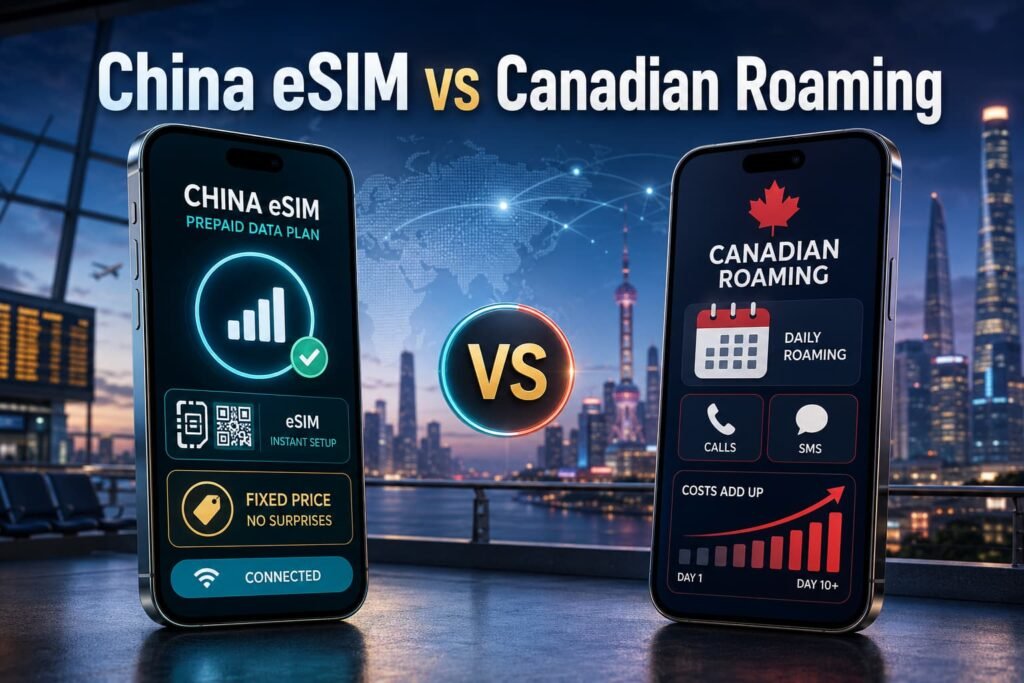
Canadian roaming is more competitive for China than a simple daily-fee warning would suggest. Some carriers now offer Asia or international travel passes, and Freedom includes China on eligible Roam Beyond plans.
| Canadian option | Current China-relevant structure | Main trade-off |
|---|---|---|
| TELUS | Asia Easy Roam 14-Day Pass at C$70 for eligible customers, using the home-plan data plus included talk and text | More expensive than many fixed-data eSIMs, but retains the regular number and mobile plan |
| Rogers | International passes at C$100 for 14 days or C$120 for 30 days across eligible destinations | Convenient for regular calling and SMS; confirm China and account eligibility in MyRogers |
| Bell | Asia Travel Pass at C$75 for 14 days or C$90 for 30 days; Roam Better is also available at C$16 per active day in eligible destinations | The Asia passes can be competitive for longer trips, but eligibility and activation timing must be checked |
| Freedom Mobile | China appears among eligible Roam Beyond destinations on qualifying plans and passes | The available allowance depends heavily on the customer’s exact plan or pass |
TELUS and Bell offer particularly relevant Asia passes. TELUS charges C$70 for 14 days, while Bell lists C$75 for 14 days and C$90 for 30 days. These options can compete with a premium unlimited eSIM while keeping Canadian calls, texts and the regular number available.
Rogers may make sense for a longer trip when its international pass is available on the account. Freedom customers should check whether their existing plan already includes China before purchasing a separate travel eSIM.
A travel eSIM still tends to be less expensive when the goal is prepaid mobile data and a fixed plan fits the trip. It also avoids using the Canadian plan’s roaming data. Carrier roaming becomes more attractive when conventional calls, SMS, voicemail and keeping the familiar number fully available are worth the additional cost.
Use the Canadian Roaming Savings Calculator after checking the current offer attached to your account. For the broader decision, read Travel eSIM vs International Roaming for Canadians.
Keeping Your Canadian Number While Using a China eSIM
Many recent phones can keep the Canadian line active while a travel eSIM handles mobile data. This is useful when you want to receive messages or calls on the regular number without sending all data through the Canadian carrier.
Set the China eSIM as the cellular-data line and turn data roaming off on the Canadian line unless you intentionally purchased roaming. Disable automatic cellular-data switching so the phone does not move data back to the Canadian line when the travel eSIM signal weakens.
Keeping the Canadian line active does not guarantee that every call or SMS is free. Carrier roaming rules still apply, and answering a call or sending a message may trigger charges or activate a daily feature. Review the carrier’s terms before departure.
For important accounts, store recovery codes or set up an authenticator where available. SMS can continue to work on a properly configured dual-SIM phone, but account access should not depend on a single delivery method while travelling.
Coverage in Major Cities, on High-Speed Rail and Beyond
China Mobile, China Unicom and China Telecom operate the main mainland networks. Travel eSIM providers generally connect through one or more of them, but the provider’s roaming agreement, traffic priority and routing can influence the experience.
Beijing, Shanghai, Guangzhou, Shenzhen, Chengdu and other large cities usually receive the strongest network investment. That does not guarantee identical indoor coverage in every hotel, station or large building.
High-speed rail routes can also produce brief interruptions in tunnels, mountain sections and less densely populated areas. A provider listing 5G does not mean the phone will stay on 5G for an entire journey. The device may move between 5G and 4G as coverage changes.
For a trip focused on remote areas, long overland routes or extensive tethering, prefer a provider that names its local network and supports manual network selection where possible. Download essential addresses, tickets and translation resources so a temporary connection gap does not stop the day.
Set Up Your Phone Before Leaving Canada
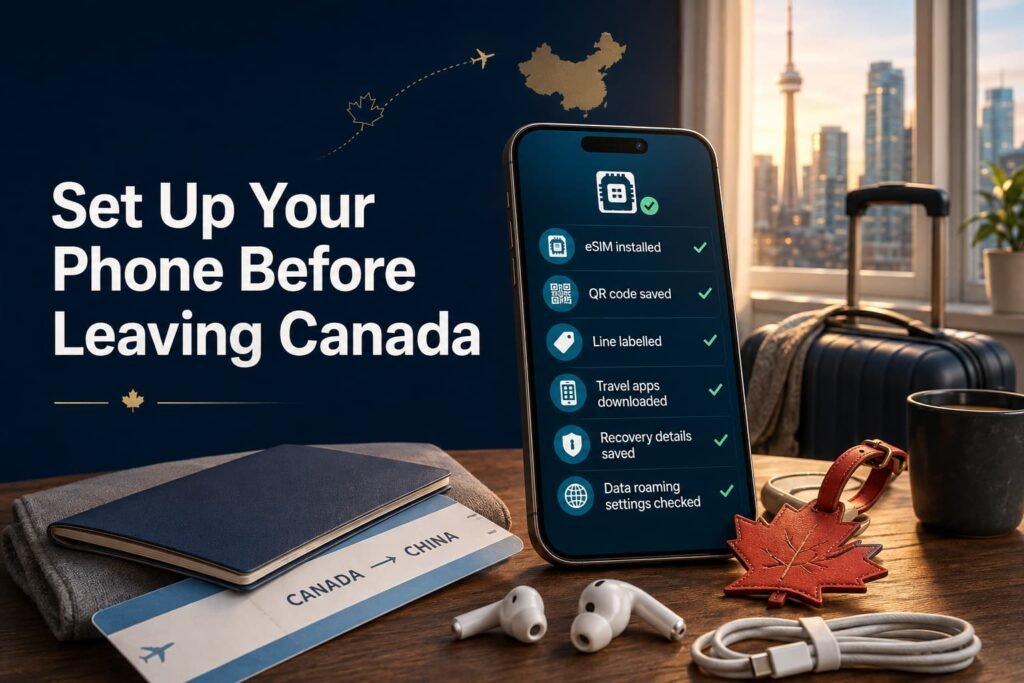
China is a poor destination for leaving every setup task until the airport arrival hall. Complete the important steps while you still have reliable home internet.
- Confirm that the phone is unlocked and supports eSIM. Use the eSIM Compatibility Checker if the exact model or regional variant is uncertain.
- Buy the plan from the provider’s official destination page and save the order details.
- Install the eSIM while connected to reliable Wi-Fi, but follow the provider’s instructions about activation. Installation and activation are not always the same event.
- Label the lines clearly, such as
CanadaandChina Data. - Keep the travel eSIM switched off until the provider says it is safe to enable it.
- Save the QR code, manual activation details and support instructions somewhere available offline.
- Download the apps and resources you expect to use, including Alipay or WeChat Pay, DiDi, the official 12306 railway app or website, offline translation and booking confirmations.
- Add an international card to the intended payment app and complete any identity checks before relying on it at arrival.
- Store account-recovery codes or configure an authenticator for important services.
- After landing, select the China eSIM for mobile data, enable data roaming on that line if the provider requires it and keep data roaming off on the Canadian line.
Foreign visitors can currently register for Alipay or WeChat using a foreign or Chinese mobile number and can link eligible international cards. That reduces the need for a mainland number for ordinary payments, although individual local services may still have their own verification requirements.
For device-specific help, use How to Activate eSIM on iPhone in Canada or Activate eSIM on Android Canada.
Before You Fly: Check the eSIM Setup.
You normally cannot test a destination eSIM’s Chinese network connection while you are still in Canada. What you can verify is that the profile installed correctly, the line appears in your phone settings, the provider app opens and the activation instructions are saved. Do not activate a validity-limited plan early unless the provider confirms that validity starts only when it first connects in China.
Common China eSIM Mistakes to Avoid
Treating Every China eSIM as Technically Identical
Two providers can use the same mainland network and still route traffic differently. Compare the actual China product, not just the local carrier name.
Activating the Plan Too Early
Some plans begin when they connect at the destination, while others can begin after installation or manual activation. Follow the exact provider instructions so a seven-day plan does not lose useful time before the flight.
Forgetting About Hong Kong or Macau
A mainland-only plan may stop working when the itinerary crosses into another coverage area. Verify each destination individually.
Leaving Automatic Data Switching Enabled
This can move cellular data back to the Canadian line and create roaming charges. Set the travel eSIM as the data line and disable automatic switching.
Depending on One App or One Login Method
Save tickets, addresses, translations and recovery information offline. Even a strong mobile setup can experience a temporary outage, app-verification problem or payment failure.
Frequently Asked Questions About China eSIMs
Which China eSIM works without a separate VPN?
Some internationally routed travel eSIMs may provide access to familiar services without a separate VPN because the data exits through an overseas roaming platform rather than a normal mainland internet connection. Nomad, Jetpac, Holafly and other providers make China-specific access claims in varying forms, but the wording and underlying product can change.
No provider should be treated as permanently guaranteed to bypass every restriction. Check the current China product page, confirm whether the statement applies to mobile data rather than an optional privacy feature and avoid assuming that one provider’s behaviour applies to every travel eSIM.
Keepgo states that Cassiopeia uses a Hong Kong privacy IP, but its current official product documentation does not guarantee access to services restricted on mainland connections. It should not be described as including a VPN or automatically bypassing the Great Firewall.
A separate VPN is a different service with its own technical, legal and privacy considerations. Travellers considering one should review current official travel advice and applicable rules rather than treating it as mandatory advice attached to every eSIM purchase.
Can I use WhatsApp, Google and Gmail with a travel eSIM in China?
These services may work over a travel eSIM that routes data internationally, even though they are restricted on ordinary mainland connections. The outcome is provider- and product-specific, so the safest approach is to choose a China eSIM whose current official documentation addresses app access directly.
The active connection matters. A service can work on the travel eSIM and stop loading when the phone reconnects to hotel or railway Wi-Fi. If that happens, switch Wi-Fi off and test the eSIM’s mobile data again before concluding that the plan has failed.
A foreign IP location alone is not a reliable guarantee. Keepgo documents Cassiopeia’s Hong Kong privacy IP but does not explicitly promise that Google, Gmail, WhatsApp or other restricted platforms will work in mainland China.
Access policies and routing can change. Download essential documents and alternative local apps before departure rather than relying on any single service for navigation, communication or payments.
Do I need a Chinese phone number for Alipay, WeChat, DiDi or 12306?
A mainland +86 number is no longer universally required for a visitor to use major payment platforms. Current Chinese government guidance says foreigners can register for Alipay and WeChat with foreign or Chinese mobile numbers and link eligible international bank cards. That makes a data-only travel eSIM workable for many ordinary payment situations.
The requirement can still vary by service and transaction. A delivery platform, merchant mini-program, ticketing workflow or identity check may work better with a local number. The official English 12306 service accepts foreign-passport registration, but the account should be created and verified before the day of travel.
Choose a local SIM when a Chinese number is central to the trip, not because every visitor automatically needs one.
Will a mainland China eSIM also work in Hong Kong and Macau?
Coverage depends on the precise plan. A mainland China product often stops at the mainland border, while a regional plan may include Hong Kong, Macau, Taiwan and other Asian destinations. The provider’s country list should be checked line by line before purchase.
Do not assume that a regional eSIM includes a Hong Kong number or uses a particular Hong Kong gateway. Coverage, phone-number entitlement and traffic routing are separate product features. Keepgo Cassiopeia, for example, uses a Hong Kong privacy IP and appears in Keepgo’s Macau coverage collection, but those facts should not be treated as confirmation of every destination in a wider itinerary.
For a multi-stop itinerary, compare the price and data allowance of one regional plan with separate destination plans. The regional choice is usually simpler, while separate plans may provide more data for the same cost.
Should I install my China eSIM before leaving Canada?
Installing the eSIM before departure is usually the safer approach because the phone is connected to reliable Wi-Fi and the provider app, email and support pages are easy to reach. Save the QR code and manual details offline in case the profile needs attention later.
Installation should not be confused with activation. Some plans start only when they connect to a supported network in China, while another product may start after manual activation or installation. Follow the provider’s instructions and keep a short-validity plan switched off until the correct time.
Keepgo says Cassiopeia’s no-expiry balance begins being used when the line first consumes data. Its separate 100MB trial has its own seven-day validity and installation deadline, so those trial rules should not be confused with purchased refill validity.
Before flying, confirm that the new line appears in the phone settings and that you know which line will handle data after arrival. The Chinese network connection itself normally cannot be tested from Canada.
Can I use a Canadian iPhone eSIM while travelling in China?
An unlocked Canadian iPhone that supports eSIM can generally use an international travel eSIM in mainland China. Apple explicitly notes that visitors can purchase prepaid data eSIMs from worldwide service providers. The exact phone model and regional variant should still be checked before purchase.
Mainland carrier eSIM activation is a separate issue. Apple currently limits domestic mainland eSIM activation to eligible China-market devices and requires activation through participating carrier stores.
Those restrictions do not mean a compatible Canadian phone loses its installed international travel eSIM when it enters China.
Imported devices and phones originally sold in mainland China or Hong Kong can have different SIM hardware. Check the model number with the eSIM Compatibility Checker instead of relying only on the phone’s marketing name.
Is a local Chinese SIM better than a travel eSIM?
A local Chinese SIM can be better for a long stay or when a mainland number is needed for calls, messages or local service verification. It may also provide strong domestic value, but purchase and activation can involve passport registration and a store visit.
A travel eSIM is normally easier for a short trip. It can be installed before departure, leaves the physical SIM slot untouched and may provide internationally routed data. The trade-off is that most plans are data-only and do not supply a +86 number.
The better choice therefore depends on the role of the phone. Choose the travel eSIM for convenient visitor data and choose local service when domestic calling, a Chinese number or a longer-term connection matters more.
More eSIM Travel Guides for Canadian Travellers
Start Here
- Best eSIM for International Travel
- eSIM Providers by Country
- Travel eSIM vs International Roaming for Canadians
- eSIM Plan Comparison Tool
- Canadian Roaming Savings Calculator
Compare Asia Travel Options
Set Up Your Phone
- eSIM Compatibility Checker
- How to Activate eSIM on iPhone in Canada
- Activate eSIM on Android Canada
- How to Fix eSIM Not Working in Canada
Compare Relevant Providers
Final Thoughts
The best eSIM for China is not simply the provider offering the largest number beside the lowest price. The plan has to fit the trip, connect through a useful mainland partner, handle hotspot use if you need it and give you a realistic understanding of app access.
Nomad is the strongest first comparison for a typical fixed-data trip. Ubigi is particularly competitive for seven-day travel, Jetpac is useful for larger allowances and hotspot flexibility, and Holafly is the simplest duration-based unlimited choice. Saily and Airalo provide familiar app-led alternatives, while Keepgo is most useful when reusable no-expiry data, backup connectivity or an Asia-Pacific plan matters more than the lowest short-trip price.
Complete the setup before leaving Canada. Install the profile at the right time, download the apps and offline resources you will need, check whether the itinerary includes Hong Kong or Macau and decide whether keeping your Canadian line active is worth the roaming implications.
That preparation matters more in China than choosing a provider from a generic ranking. A well-matched eSIM, realistic expectations and a few offline backups will make the phone far more useful from the moment you arrive.


