Japan is one of those destinations where the best eSIM for Japan from Canada depends less on the provider’s brand name and more on the trip you are actually taking. A week between Tokyo, Kyoto and Osaka is a different connectivity problem from a ski trip through Hokkaido, a month-long stay, or a Japan–South Korea itinerary.
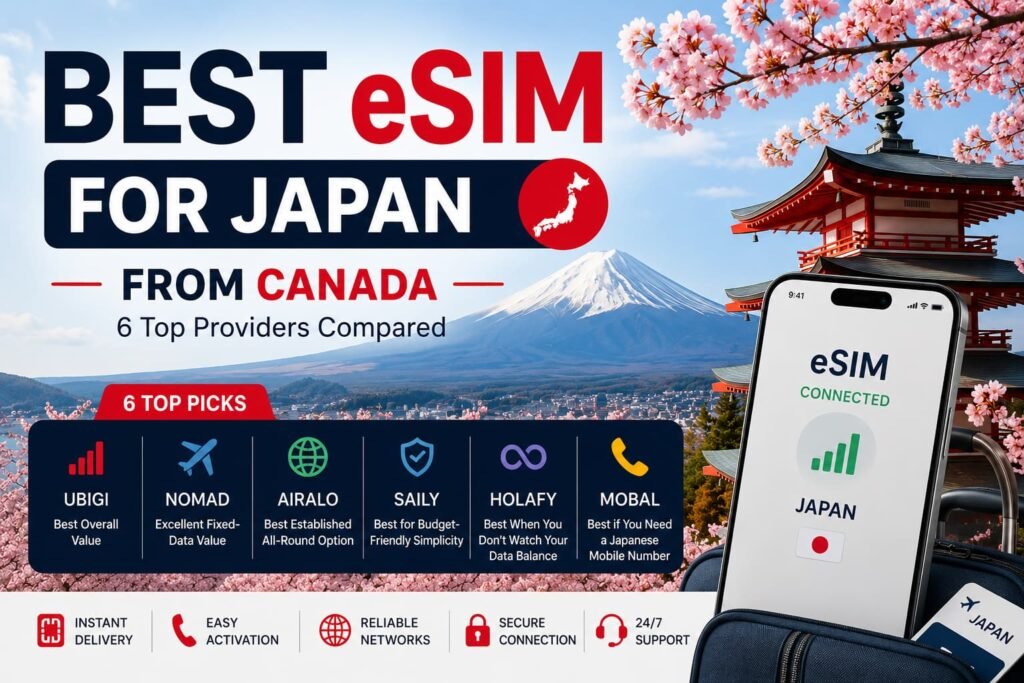
For most Canadian travellers, Ubigi and Nomad are the two places I would start for a straightforward Japan trip. Airalo, Saily and Holafly become more interesting when you care about a familiar app, lower entry pricing or unlimited-style data. Mobal belongs in a different category because it can provide something most tourist eSIMs do not: a genuine Japanese mobile number.
The important part is checking the specific plan you are buying. Network arrangements, hotspot rules, validity and activation conditions can vary, even between plans sold by the same provider.
My Top eSIM Picks for Japan
For most Canadians heading to Japan, Ubigi is the strongest place to start. Nomad is the closest alternative if you want a simple fixed-data plan at a competitive price, while Airalo makes sense if you already prefer its app and ecosystem.
Saily is a good fit for travellers looking for a lower-cost option, and Holafly is better suited to heavier data users who prefer unlimited-style plans over watching a fixed allowance. If your trip actually requires a Japanese mobile number, Mobal is the provider I would look at first.
Best eSIM for Japan From Canada: At a Glance
| Provider | Best For | Plan Style | Main Strength | Main Consideration |
|---|---|---|---|---|
| Ubigi | Most Japan-only trips | Fixed data + unlimited options | Competitive pricing and useful Japan network options | Check the network attached to the exact plan |
| Nomad | Fixed-data value | Fixed prepaid data | Strong pricing and hotspot support | Network depends on the plan |
| Airalo | Familiar app and broad plan choice | Fixed data + unlimited options | Established platform with plenty of choice | Compare the current Japan offer before buying |
| Saily | Budget-conscious travellers | Fixed data + unlimited options | Simple app and inexpensive entry plans | Optional phone-number service does not provide a Japanese number |
| Holafly | Heavy data users | Unlimited-style plans | Simple trip-length pricing without a fixed data bucket | Higher cost than many fixed-data plans |
| Mobal | Travellers who need a Japanese number | Voice, SMS and data | Genuine Japanese mobile number | Voice-capable plans involve additional activation steps |
There is no useful reason to give these providers artificial scores such as 9.2 versus 9.1. The differences that actually matter are much more practical: how much data you need, where you are travelling, whether you use hotspot, whether the trip extends beyond Japan and whether you need a phone number.
Ubigi eSIM for Japan: Best Overall for a Japan-Only Trip
Ubigi is the first provider I would check for a straightforward Japan-only holiday.
Its current Japan lineup includes a 10GB plan valid for 30 days at US$16.50, which makes it competitive for the kind of one-to-three-week trip many Canadians take to Japan. Ubigi also offers other fixed-data and unlimited options for travellers with different usage needs.
Ubigi currently works with NTT DOCOMO and KDDI in Japan. That gives you another useful factor to compare alongside price, data allowance and coverage for your particular route.
I would not interpret that as a promise that every Ubigi plan will automatically switch between networks or deliver the strongest reception everywhere. Mountain terrain, tunnels, buildings, local network conditions and the exact plan still matter.
For a typical itinerary through Tokyo, Kyoto, Osaka, Hiroshima and other major destinations, Ubigi offers a good balance between data allowance, price and simplicity.
It is primarily a data solution rather than a way to obtain a Japanese number, so most travellers will continue using LINE, WhatsApp, FaceTime, Signal or similar internet-based services for communication.
For a deeper look at the provider, see the Ubigi eSIM Review.
Nomad eSIM for Japan: Excellent Fixed-Data Value
Nomad is the closest fixed-data alternative to Ubigi.
Its current Japan eSIM plans include 10GB valid for 30 days at US$16 (about C$22.33), which keeps it very close to Ubigi on price.
The difference is small enough that I would not choose between Ubigi and Nomad based on price alone. Look instead at:
- the network listed for the plan
- validity
- hotspot support
- activation conditions
- top-up options
- whether you will travel outside Japan
Nomad also offers Asia-Pacific regional eSIM plans, which can make more sense if Japan is only one stop on a larger trip through Asia.
For someone who knows roughly how much data they need and wants a straightforward prepaid plan, Nomad is one of the strongest options to compare.
For a broader look at the provider, see the Nomad eSIM Review.
Airalo eSIM for Japan: Best Established All-Round Option
Airalo remains an easy provider to include on a Japan shortlist because it offers a mature app experience and a broad catalogue of travel eSIMs.
Its biggest advantage here is not that it automatically beats Ubigi or Nomad. It is familiarity.
If you have already used Airalo successfully elsewhere, keeping another trip inside the same app can be convenient. Airalo also offers different Japan plan styles, so you can choose according to your data needs rather than committing to one type of package.
Popularity alone is not a reason to buy, though. Japan has enough competition that it is worth comparing the current Airalo Japan eSIM plans against Ubigi, Nomad and Saily before paying.
Check the data allowance, validity, network details, hotspot conditions and any fair-use rules attached to the specific plan you choose.
For the broader pros and cons, read the Airalo eSIM Review
Saily eSim for Japan: Best for Budget-Friendly Simplicity
Saily is worth comparing when you want inexpensive travel data and a straightforward app experience.
Its Japan eSIM plans range from smaller fixed-data packages to larger and unlimited-style options. The app also includes extra privacy and security features, which gives Saily a slightly different angle from providers that focus only on selling data.
Those extras are not a reason to pay more if you do not need them, but they can be useful if you already prefer Saily’s simpler app-led approach.
Saily also offers phone-number functionality in some circumstances, but that should not be confused with getting a genuine Japanese mobile number. If a Japanese number is the requirement, Mobal is the more relevant comparison.
For a traveller who wants a lower-cost entry point without spending much time learning a new platform, Saily is a sensible option.
For the full provider breakdown, see the Saily eSIM Review.
Holafly eSIM for Japan: Best When You Do Not Want to Watch Your Data Balance
Holafly makes more sense when data volume matters more than finding the lowest possible price.
Its Japan eSIM plans are built around unlimited-style data sold by trip length rather than asking you to decide whether you need exactly 5GB, 10GB or 20GB.
That is a different purchase from a fixed 10GB plan.
If you expect to use maps throughout the day, upload lots of photos or video, stream on your phone, or simply dislike checking a remaining-data meter, paying more for an unlimited-style plan can be reasonable.
The part worth checking carefully is tethering. Unlimited mobile data should not automatically be interpreted as unlimited hotspot use, and plan conditions can change.
Holafly therefore works best as a convenience choice for heavier mobile-data users, not automatically as the cheapest Japan eSIM.
For more detail about its unlimited-data approach, see the Holafly eSIM Review.
Mobal eSIM for Japan: Best if You Need a Japanese Mobile Number
Mobal solves a different problem from the other providers in this guide.
Its voice-capable Japan eSIM plans can provide a genuine Japanese mobile number along with voice, SMS and data. That becomes more useful for longer stays, work, study or situations where a Japanese organisation specifically requires a domestic number.
For an ordinary sightseeing trip where most communication happens through LINE, WhatsApp, FaceTime and online reservations, I would not add the extra complexity just to have a local number.
The setup is also different from a typical tourist data eSIM. Mobal’s voice-capable eSIM requires an activation access code, with delivery or collection options depending on the order. That requirement applies to the relevant voice-capable products and should not be assumed to describe every Mobal data-only option.
When a Japanese number is genuinely necessary, though, Mobal fills a gap that most mainstream travel eSIM providers do not.
Current Japan eSIM Price Snapshot
Pricing changes, so use these as representative comparison points rather than permanent checkout prices.
| Provider | Example | Validity | USD | CAD |
|---|---|---|---|---|
| Ubigi | 10GB | 30 days | US$16.50 | C$23.03 |
| Nomad | 10GB | 30 days | US$16.00 | C$22.33 |
| Saily | Entry-level fixed data | Short trip | From US$3.99 | C$5.57 |
| Holafly | Unlimited-style | 10 days | US$36.50 | C$50.94 |
| Holafly | Unlimited-style | 30 days | US$73.90 | C$103.15 |
Nomad’s current official Japan page confirms the 10GB/30-day US$16 price used above.
CAD conversions can move with exchange rates, and providers can change prices or promotions without much notice.
For a broader comparison by destination, data allowance and budget, use the eSIM Plan Comparison Tool.
Which Japan eSIM Makes Sense for Different Trips?
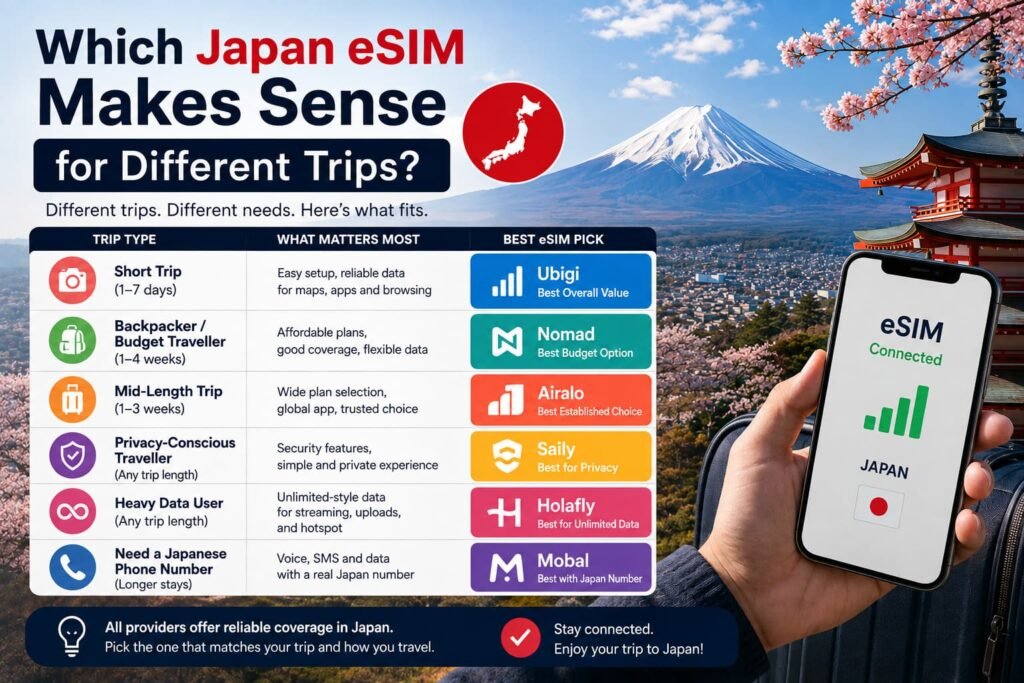
Tokyo, Kyoto and Osaka
For a straightforward city itinerary, I would compare Ubigi and Nomad first, then look at Airalo and Saily.
If 10GB is enough for the trip, Ubigi and Nomad are close enough in price that the decision should come down to the actual plan details rather than the headline difference.
For a city-focused holiday, there is also little reason to pay for unlimited data unless your usage is unusually heavy.
Two Weeks Across Several Parts of Japan
For a trip combining Tokyo, Kyoto, Hiroshima and another region or two, spend more time looking at the network details attached to the plan.
A provider documenting access to more than one Japanese carrier gives you another factor to consider, but it does not guarantee seamless switching or stronger coverage everywhere.
The better approach is to compare the actual plan against the route you expect to take.
Hokkaido, Niseko, Hakuba or Rural Travel
Coverage deserves more attention on a ski or rural trip than it does on a Tokyo-only vacation.
Japan’s mobile infrastructure is extensive, but mountains, tunnels and remote roads can still create dead zones or weaker reception.
Rather than choosing entirely from a provider ranking, check the underlying network information and coverage relevant to the locations that matter most.
A dollar or two of price difference matters much less here than buying a plan suited to the route.
Heavy Data Use
For streaming, large photo and video uploads, remote work or heavy social-media use, compare unlimited-style plans rather than automatically buying the largest fixed-data package you can find.
Holafly is the obvious unlimited-focused option in this shortlist, while other providers also offer higher-data or unlimited-style products.
Read the hotspot and fair-use conditions before buying. “Unlimited” should not automatically be interpreted as unrestricted high-speed use for every activity.
Japan Plus South Korea, China or Another Asian Destination
A Japan-only eSIM is normally the cleaner choice if Japan is the entire trip.
Once the itinerary becomes Japan plus South Korea, China, Singapore or another supported destination, a regional Asia eSIM may be easier than installing separate plans for each country.
Nomad and other providers in this guide sell regional products, so compare the multi-country option against separate destination plans before buying.
You Need a Japanese Number
Start with Mobal.
This is one situation where the provider offers a genuinely different product rather than simply another variation of prepaid travel data. Mobal’s current Japan eSIM offering specifically promotes real Japanese phone-number functionality.
How Much Data Do You Need in Japan?
Most travellers overestimate how much data maps and messaging consume but underestimate how quickly video and hotspot use can burn through a plan.
A practical starting point looks like this:
| Travel Style | Suggested Starting Range | Typical Use |
|---|---|---|
| Light | 3–5GB | Maps, messaging, transit apps, occasional browsing |
| Normal | 8–15GB | Maps, translation, social media, regular photo sharing |
| Heavy | 20GB+ | Frequent video, large uploads, heavier social use |
| Very heavy | Unlimited-style | Remote work, extensive streaming, constant high usage |
Around 10GB is a sensible starting point for many one-to-two-week trips if the phone is mainly handling maps, messaging, translation, browsing and moderate social-media use.
Video changes the equation quickly. So does tethering a laptop.
Hotel Wi-Fi matters too. Someone who streams mainly after returning to the hotel can use far less mobile data than someone relying on the eSIM as their main internet connection all day.
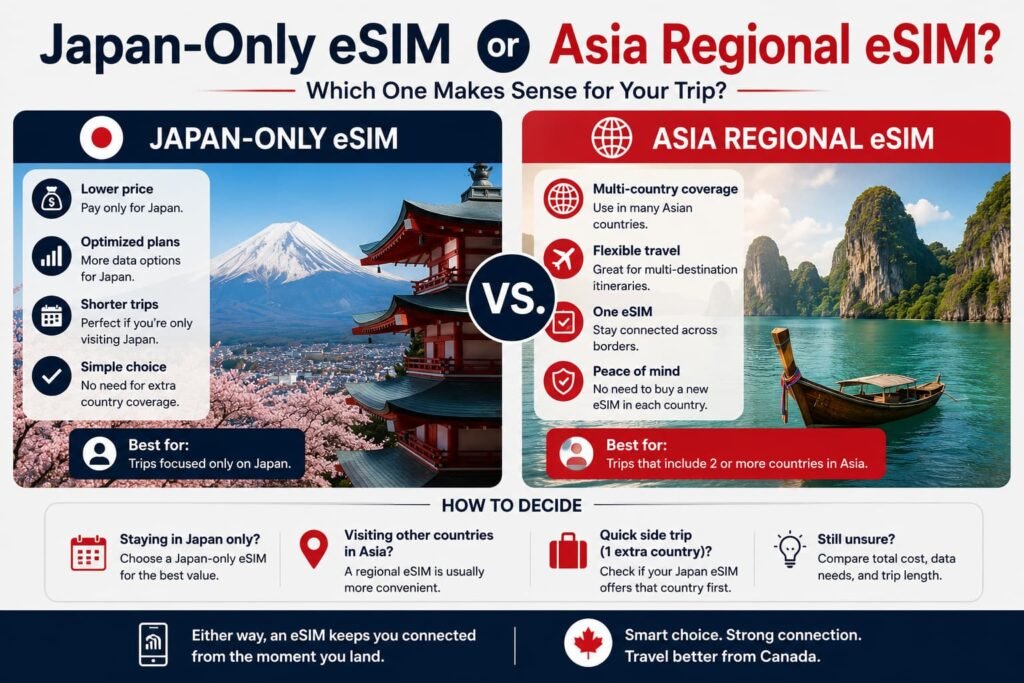
Japan-Only eSIM or Asia Regional eSIM?
Do not pay for regional coverage just because it sounds more flexible.
If you’re travelling only to Japan, a Japan-specific eSIM is usually the simpler and better-value choice because it covers everything you need without paying for additional countries.
A regional Asia eSIM starts making more sense when the same trip includes another supported country.
There is one useful exception: promotions or unusual provider pricing can occasionally put a multi-country plan surprisingly close to the Japan-only price.
Compare both before purchasing.
If Japan is part of a larger international trip, compare broader provider options in my Best eSIM for International Travel guide. If your itinerary also includes Thailand, see my Best eSIM for Thailand Travel From Canada guide before deciding whether a regional Asia plan is the better choice.
What to Check Before Buying a Japan eSIM
Check the Network on the Actual Plan
Japan’s major mobile networks include NTT DOCOMO, KDDI au and SoftBank.
Travel eSIM companies use agreements with underlying carriers, and those arrangements can vary between providers and plans.
Do not rely on an old comparison saying a provider simply “uses DOCOMO” or “uses SoftBank.” Open the current plan and check again before paying.
Check Hotspot Rules
Many fixed-data Japan eSIMs support tethering, but rules remain plan-specific.
This matters even more with unlimited-style products because hotspot allowances can differ from ordinary on-phone usage.
If you know you will tether a laptop or another traveller’s phone, confirm the rule before choosing the plan.
Check When the Plan Starts
Installation and activation are not always the same event.
Some providers let you install an eSIM before leaving Canada and start the plan only after it connects to a supported network in Japan.
Others use an activation window or different timing rules.
Follow the instructions for the actual plan rather than assuming every provider works the same way.
Decide Whether You Really Need Calls and SMS
Most tourists can use a data-only eSIM and communicate through LINE, FaceTime, WhatsApp and other internet-based services.
A Japanese mobile number is a separate buying requirement.
That is where Mobal becomes relevant.
When Canadian Carrier Roaming Still Makes Sense
A travel eSIM can cost substantially less than paying a Canadian international roaming fee every day, but price is not the only consideration.
Carrier roaming still makes sense in some situations:
- the trip is extremely short
- work is paying the bill
- you need your Canadian line functioning normally
- you do not want to manage another mobile-data line
- convenience matters more than minimizing the cost
For a longer Japan vacation, comparing a travel eSIM before accepting a daily roaming charge usually makes sense.
If you are still deciding whether to use a travel eSIM at all, see my Japan eSIM vs Roaming Canada comparison for a closer look at current Canadian carrier roaming options, travel passes, costs and when a hybrid setup makes sense.
The detailed roaming calculation belongs in a separate decision. Use the Canadian Roaming Savings Calculator to compare the cost for your own carrier, trip length and number of travellers.
Keep Your Canadian Number While Using Japan eSIM Data
A dual-SIM phone lets you keep your Canadian line available while selecting the Japan eSIM for mobile data.
That can be useful if you still need access to your normal number for important calls, texts or verification messages.
The important part is configuring the lines carefully.
Leaving your Canadian line switched on does not automatically make calls and texts free abroad. Depending on your carrier and how the line is used, roaming charges may still apply.
On an iPhone, a typical setup is:
- Keep the Canadian line clearly labelled, such as Primary.
- Label the Japan eSIM Travel or Japan.
- Select the Japan eSIM for cellular data.
- Enable data roaming on the travel line if the eSIM provider requires it.
- Turn off cellular data switching if you do not want the phone falling back to the Canadian line.
- Keep data roaming disabled on the Canadian line unless you intentionally plan to use carrier roaming.
Android phones support the same general idea, although menu names vary by manufacturer.
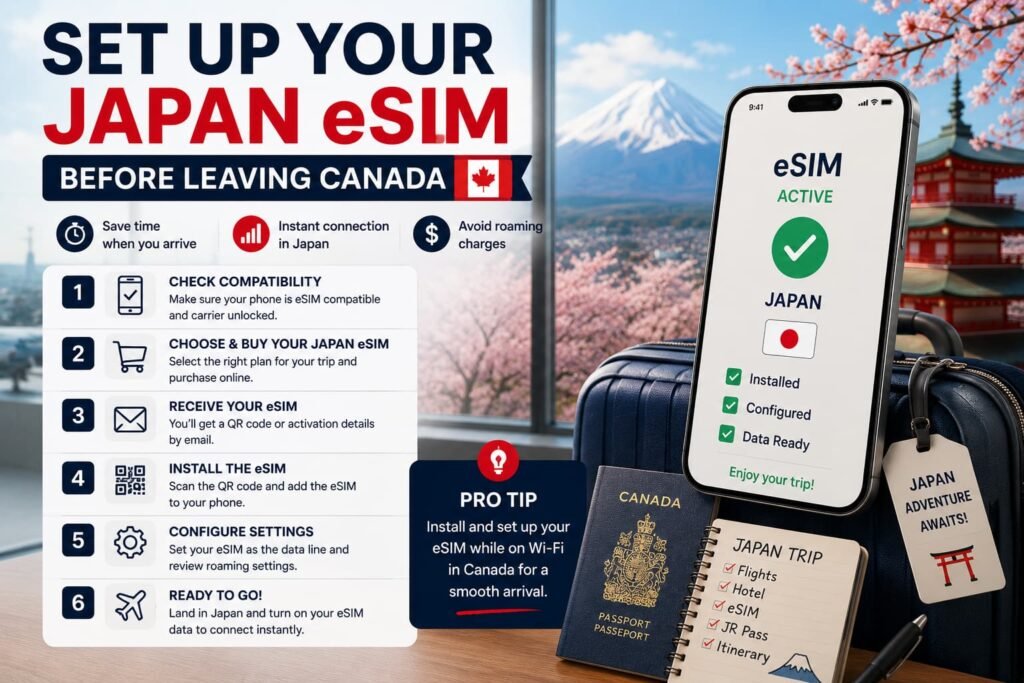
Set Up Your Japan eSIM Before Leaving Canada
Installing the eSIM while you still have dependable Wi-Fi is normally easier than doing the entire process after landing.
Start with the eSIM Compatibility Checker to confirm that your phone supports eSIM.
Then:
- Buy the plan.
- Install the eSIM according to the provider’s instructions.
- Give the travel line a clear name.
- Check whether activation happens immediately or after reaching Japan.
- Keep your Canadian line available only if you still need it.
- Select the Japan eSIM as the mobile-data line when it is time to connect.
- Follow the provider’s instructions for data roaming on the travel line.
For iPhone setup, see How to Activate eSIM on iPhone in Canada.
For Android, use Activate eSIM on Android Canada.
Common Japan eSIM Mistakes to Avoid
The biggest mistake is buying from a comparison table without opening the actual plan.
Networks change. Promotions change. Unlimited-plan policies change. Providers can also sell several Japan products with different conditions at the same time.
Another mistake is buying far more data than you realistically need. A 30-day unlimited plan can feel reassuring, but it is poor value if your normal usage would fit comfortably inside 10GB.
The opposite problem happens with hotspot use. A small data allowance can disappear quickly once you start tethering a laptop for meetings, uploads or streaming.
Finally, keep the Canadian and Japan lines clearly labelled. Buying a travel eSIM will not save you much if the phone accidentally routes mobile data through your Canadian line.
Frequently Asked Questions About Japan eSIMs
Which eSIM is best for Japan from Canada?
Ubigi is the strongest starting point for many Japan-only trips because it combines competitive pricing with a straightforward Japan offering. Nomad is very close for fixed-data value, while Airalo, Saily,
Holafly and Mobal become stronger choices for particular needs.
The final choice should reflect your route, data usage, hotspot requirements and whether you need a Japanese number.
How much eSIM data should I buy for two weeks in Japan?
Around 10GB is a sensible starting point for many two-week trips built around maps, messaging, translation, browsing and moderate social-media use.
Move toward 20GB or an unlimited-style plan if you stream frequently, upload large files, work remotely or use hotspot heavily.
Can I keep my Canadian number active with a Japan eSIM?
Most modern dual-SIM phones let you keep your Canadian number active while using a Japan eSIM for mobile data. This is useful if you still want to receive calls, text messages or two-factor authentication codes on your Canadian number while travelling.
Configure the two lines carefully, though. If your Canadian SIM remains active for calls, texts or mobile data, your carrier may still apply roaming charges depending on your plan and how you use the line.
If your goal is simply to keep your Canadian number reachable while using affordable mobile data in Japan, a dual-SIM setup with your Japan eSIM handling data is usually the best approach.
Do tourists need a Japanese phone number?
Most short-term visitors can get by without a Japanese phone number. A data-only eSIM is usually enough for maps, translation, messaging, email and internet-based calls through apps such as LINE,
WhatsApp and FaceTime.
A local number becomes more useful on longer stays or when a hotel, restaurant, employer, school or other Japanese service specifically asks for a domestic mobile number. In that situation, Mobal is worth considering because it offers voice-capable Japan eSIM options with a genuine Japanese number.
For a normal sightseeing trip, though, I would not choose a more complicated voice plan unless you know you actually need the number.
What should I choose for Hokkaido or a Japan ski trip?
For Hokkaido, Niseko, Hakuba or other mountain destinations, prioritize the network behind the specific eSIM plan over a small price difference. Coverage can be less consistent outside major cities, especially around ski resorts, mountain roads and more remote areas.
Check the coverage for the places on your itinerary before buying. A slightly cheaper plan is not better value if its network is a poor fit for where you will actually be travelling.
Can I use a Japan eSIM as a hotspot?
Many Japan eSIM plans support hotspot or tethering, making it easy to share your connection with a laptop, tablet or another device while travelling.
Always check the specific plan before buying, especially if you expect to use hotspot regularly. Some unlimited-style plans place separate limits on tethering, even when your phone’s own data is advertised as unlimited.
Should I buy a Japan-only eSIM or an Asia regional plan?
A Japan-only eSIM is usually the better choice if Japan is your only destination. It keeps the plan simple and avoids paying for coverage you will not use.
A regional Asia plan makes more sense when the same trip includes places such as South Korea, Singapore or another supported country. In that case, compare the regional plan against separate country eSIMs and choose whichever gives you the better mix of price, data and convenience.
Is an eSIM better than pocket Wi-Fi in Japan?
For most solo travellers with an eSIM-compatible phone, an eSIM is the more convenient choice.
There is no separate device to pick up, charge, carry around or return, and your phone stays connected whenever you have mobile coverage.
Pocket Wi-Fi can make more sense for a family or group that wants to share one connection, or when one or more phones do not support eSIM. Just remember that everyone depends on the person carrying the hotspot and on keeping that extra device charged.
When should I install my Japan eSIM?
Install your Japan eSIM before you leave Canada whenever possible. You’ll have reliable Wi-Fi, more time to complete the setup, and it’s easier to fix any issues before you travel.
Just remember that installing an eSIM is not always the same as activating it. Many providers let you install the eSIM in advance, but the plan does not start until it connects to a supported network in
Japan. Always follow the activation instructions for your specific provider.
Related eSIM Guides
Compare Japan Travel Options
- Japan eSIM vs Roaming Canada
- Best eSIM for International Travel
- Travel eSIM vs International Roaming for Canadians
- eSIM Providers by Country
Explore More Destination Guides
- Best eSIM for Thailand Travel From Canada
- Best eSIM for Italy From Canada
- Best eSIM for Portugal From Canada
- Best eSIM for Dominican Republic From Canada
Compare eSIM Providers
Plan Your Mobile Setup
- eSIM Plan Comparison Tool
- Canadian Roaming Savings Calculator
- eSIM Compatibility Checker
- How to Activate eSIM on iPhone in Canada
- Activate eSIM on Android Canada
Final Thoughts
For most Canadians travelling only to Japan, Ubigi and Nomad are the two providers I would compare first.
Ubigi is a strong overall starting point because its current Japan offering combines competitive fixed-data pricing with useful plan flexibility. Nomad is almost impossible to ignore at its current US$16 (about C$22.33) for 10 GB over 30 days, especially if you already know that a moderate fixed allowance is enough for your trip.
Airalo remains a sensible all-round alternative, Saily suits travellers looking for a lower-cost app-led option, and Holafly is worth considering when unlimited-style data matters more than getting the lowest possible price.
Mobal belongs in its own lane. Choose it because you genuinely need a Japanese phone number, not because every tourist needs voice service.
Before buying, check the exact plan rules for your itinerary, make sure the data allowance fits the way you travel, and install the eSIM while you still have reliable Wi-Fi in Canada. Those details matter more than whichever provider happens to sit at the top of a generic ranking.