If you are a Fido customer travelling outside Canada, the roaming decision is not just “Fido Roam or travel eSIM.”
You may need to compare three different options before leaving Canada: Fido Roam Daily, a Fido Roam Travel Pass, and a separate travel eSIM for mobile data.
Fido Roam is convenient because your Fido number stays active, your phone connects to a roaming partner network, and you can use your regular Canadian plan in many supported destinations.
But Fido is not always the cheapest option, especially if your trip is longer than a few days or you are travelling with multiple lines.
The key detail is that Fido Roam Daily and Fido Travel Passes usually use your regular Fido plan data. A travel eSIM gives you a separate travel data bucket.
This Fido Roam vs travel eSIMs guide explains how Fido roaming works, what it costs, when a Fido Travel Pass may make sense, and when a travel eSIM may be the better choice for Canadian travelers.
It also explains the difference between using a Fido eSIM as your regular Canadian line and using a separate travel eSIM for data abroad.
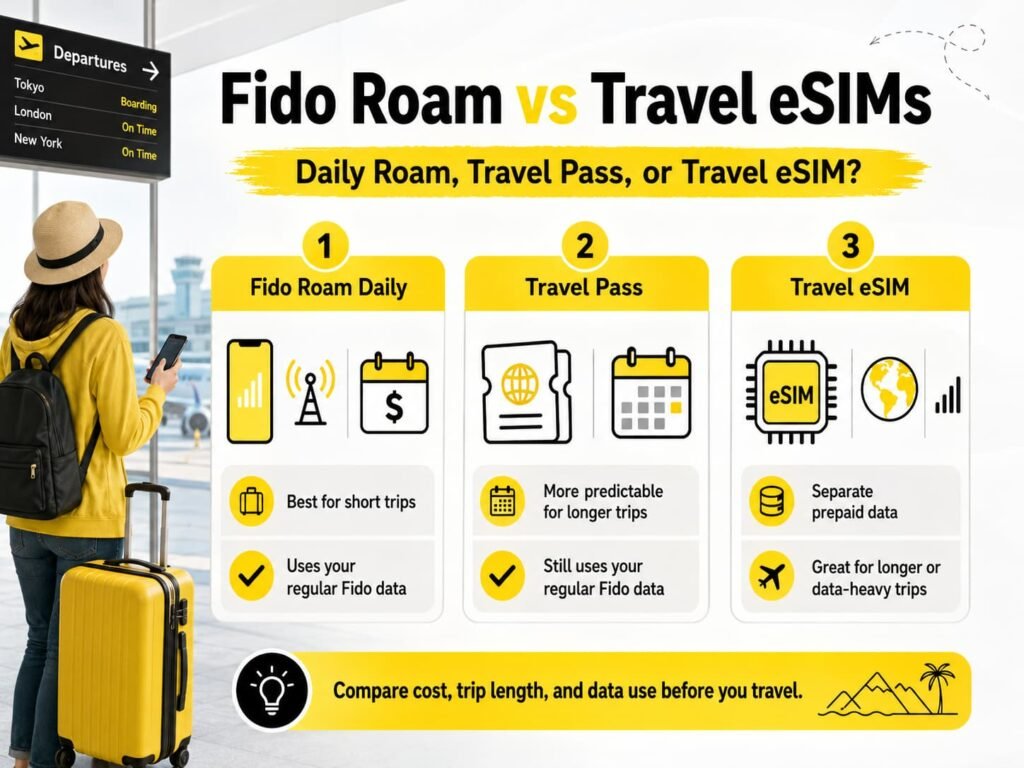
The Fido Travel Decision: Daily Roam, Travel Pass, or Travel eSIM?
Fido Roam is usually best for short trips when you want a simple setup and need your Canadian number active.
A Fido Travel Pass may be better for longer stays if you want to keep using your Fido plan without paying the daily rate every day.
A travel eSIM is usually better when you mainly need mobile data, want predictable upfront pricing, or are travelling for several days with family, hotspot use, or multiple devices.
| Travel Situation | Best Starting Point |
|---|---|
| 1 or 2-day U.S. trip | Fido Roam Daily may be simple enough |
| 7-day U.S. trip | Compare Fido Travel Pass vs travel eSIM |
| 10 to 14-day Europe trip | Travel eSIM or Fido Travel Pass |
| Family vacation | Travel eSIMs usually reduce per-line roaming costs |
| Heavy hotspot use | Travel eSIM is usually better for data control |
| Need your Fido number active | Fido Roam or hybrid setup |
| Cruise travel | Compare Fido cruise pass, cruise Wi-Fi, and eSIM in port |
| Multi-country trip | Regional travel eSIM is often worth comparing |
The biggest thing to remember is this:
Fido Roam and Fido Travel Passes usually use your existing Fido plan data.
A travel eSIM gives you a separate travel data bucket.
Before choosing one option, use our free Canadian Roaming Savings Calculator to compare Fido Roam Daily, available Fido Travel Passes, and travel eSIM pricing for your destination, trip length, number of travelers, and expected data use.
Why Fido Roam Is Not Just Rogers Roam Like Home
Fido is owned by Rogers, but Fido customers should not assume their travel decision is exactly the same as Rogers customers.
Fido has its own roaming page, its own Fido Roam Daily pricing, its own Travel Pass options, and its own plan eligibility rules.
The biggest difference for Fido customers is that Travel Passes can make longer trips more predictable, but they still use your regular Fido plan data.
That means the real Fido decision is not only daily roaming vs travel eSIM.
It is whether Fido Roam Daily, a Fido Travel Pass, or a separate travel eSIM gives you the better balance of price, data, and access to your Canadian number.
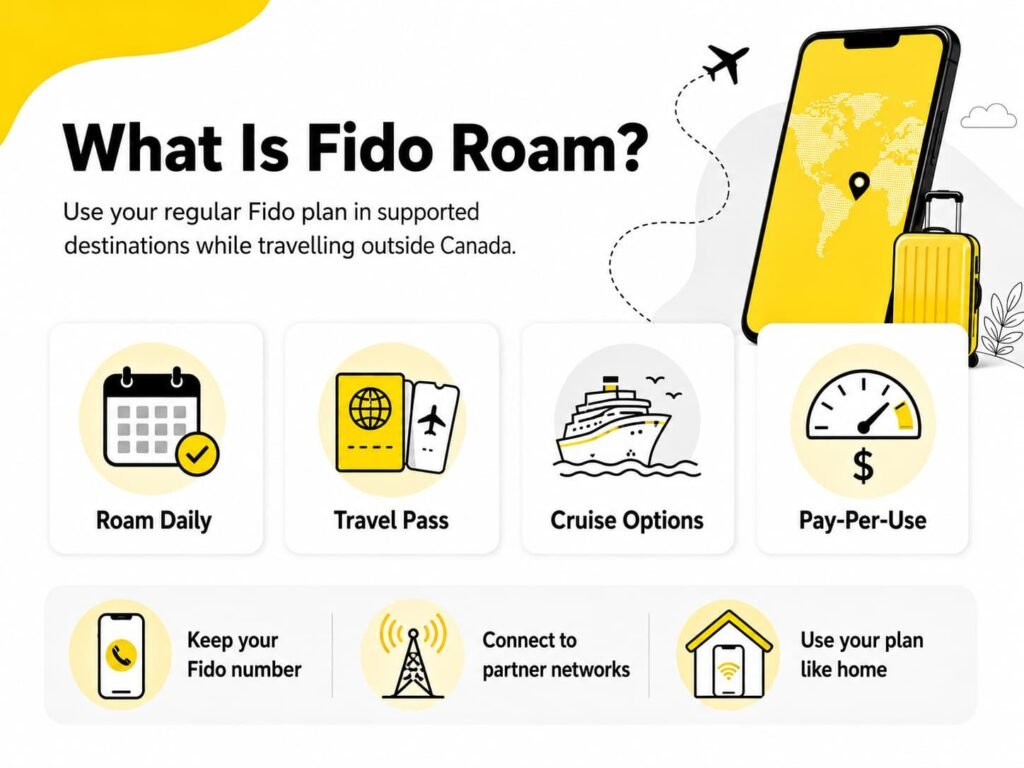
What Is Fido Roam?
Fido Roam is Fido’s roaming feature for eligible customers travelling outside Canada.
It lets you use your regular Fido plan while roaming in supported destinations instead of paying separate pay-per-use rates for every call, text, or megabyte of data.
Depending on the option you choose, Fido roaming can work through:
- Fido Roam Daily
- Fido Roam Travel Pass
- cruise roaming options
- pay-per-use roaming if Fido Roam is unavailable or not active
Fido Roam is designed for convenience.
You keep your Fido number, your phone connects to roaming partner networks, and you can use your plan similarly to how you use it at home.
Fido Roam is generally for eligible monthly postpaid plans. Basic talk-and-text plans and prepaid accounts may not have the same Fido Roam access, so prepaid customers should check available roaming add-ons before travelling.
For current pricing and destination support, check Fido’s official Travel and International Roaming page before travelling.
Fido Roam Daily: How the Daily Roaming Option Works
Fido Roam Daily is the simple pay-by-the-day option.
When you use your phone in an eligible roaming destination, Fido charges the daily roaming rate for that day.
The daily fee can be triggered by actions such as:
- using mobile data
- sending a text message
- making a phone call
- answering a phone call
- checking voicemail
- background app data
- Wi-Fi Assist or similar settings using mobile data
- apps syncing in the background
This is where many travelers get caught.
You do not always need to open an app for roaming to start. Your phone may use data in the background through email, cloud backups, app refresh, push notifications, weather widgets, maps, messaging apps, or system services.
If you plan to use a travel eSIM for data, turn off data roaming on your Fido line before you arrive.
Fido Roam Daily Pricing in 2026
Fido roaming pricing can change, so always confirm your exact destination and plan before travelling.
As of Fido’s current roaming information, common Fido Roam Daily pricing is:
| Destination Type | Fido Roam Daily Cost |
|---|---|
| United States | $16 CAD per day |
| International destinations | $18 CAD per day |
Fido Roam is available in more than 185 destinations, including many countries across Europe, Asia, the Caribbean, Mexico, Central and South America, Oceania, Africa, and select cruise ship networks.
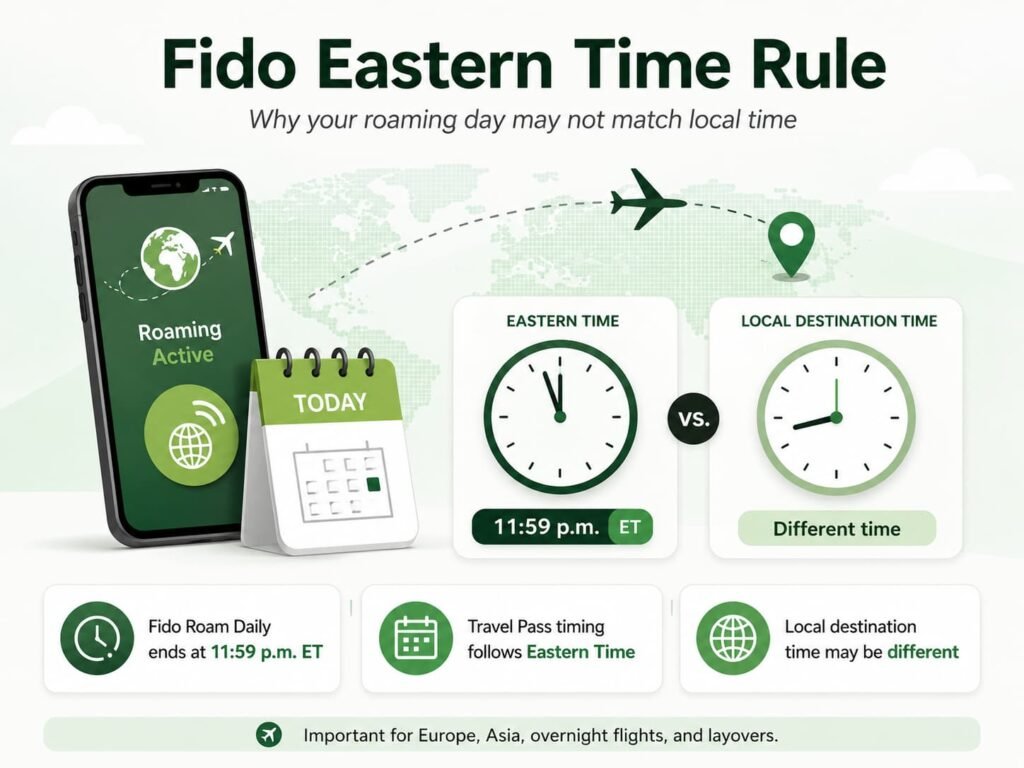
Fido says the daily rate applies until 11:59 p.m. Eastern Time of each calendar day.
That Eastern Time detail matters.
If you are travelling in Europe, Asia, or another time zone far from Canada, your roaming day may not line up with local midnight where you are standing.
This can make timing confusing during:
- overnight flights
- long layovers
- late arrivals
- early morning departures
- cross-border trips
- trips that move between the U.S. and another destination
For example, Fido states that if you use your device in the U.S. and another Fido Roam destination on the same calendar day, you can be billed both daily rates for that day.
That means a trip involving the U.S. and Europe on the same travel day may cost more than some travelers expect.
Fido also applies a billing-cycle protection cap for Fido Roam Daily. You are charged for a maximum of 20 days per monthly billing cycle per line. After that, additional eligible Fido Roam Daily use in the same billing cycle is not charged again, but your regular plan data, talk, and text limits still matter.
Does Fido Cap Roaming Charges After 20 Days?
Fido Roam Daily has a 20-day charge cap per monthly billing cycle per line.
That means if you use Fido Roam Daily every day during a long trip, Fido only charges the daily roaming fee for up to 20 days in that billing cycle.
Using the common daily rates, that means the cap can work out roughly like this:
| Fido Roam Daily Zone | Daily Rate | 20-Day Billing-Cycle Cap |
|---|---|---|
| United States | $16 CAD per day | About $320 CAD per line |
| International | $18 CAD per day | About $360 CAD per line |
This cap can help on longer trips, but it does not create a separate travel data bucket.
You still use your regular Fido plan data, talk, and text. If your trip crosses into a new billing cycle, the chargeable-day count may also restart in the new cycle.
For long trips, snowbird travel, family vacations, or multi-country itineraries, compare the 20-day cap against a Travel Pass and a travel eSIM before deciding.
Fido Roam Travel Passes: The Middle Option Between Daily Roaming and a Travel eSIM
Fido Roam Travel Pass is a set-duration roaming add-on.
Instead of paying the daily roaming rate each day, you choose a Travel Pass for a specific trip length or region.
Fido currently offers different travel pass options, including U.S., Europe, Caribbean and Mexico, Asia, Oceania, Africa, Central and South America, International, and cruise-related pass options.
Examples of current Fido Travel Pass pricing may include:
| Fido Travel Pass Type | Example Price |
|---|---|
| U.S. Travel Pass | $60 for 14 days or $70 for 30 days |
| Europe, Asia, Caribbean & Mexico passes | $70 for 14 days or $80 for 30 days |
| International Travel Pass | $100 for 14 days or $110 for 30 days |
Prices and pass options can change, so confirm the exact pass in Fido My Account before buying.
Travel Passes can be useful if:
- your trip is longer than a weekend
- you want a more predictable cost than daily roaming
- you still need your Fido number active
- you do not want to install a separate eSIM
- you want to use your Fido plan while travelling
But there is one very important detail.
Fido Travel Passes do not give you a separate travel data bucket.
They use the data, talk, and text included in your existing Fido plan.
That means your roaming use can still drain your Canadian Fido monthly data allowance.
You can buy a Travel Pass through the Fido website or the Fido My Account app under Manage Add-ons. For full pass rules, check Fido’s official Fido Roam Travel Pass FAQ.
Fido Roam Daily vs Fido Travel Pass vs Travel eSIM
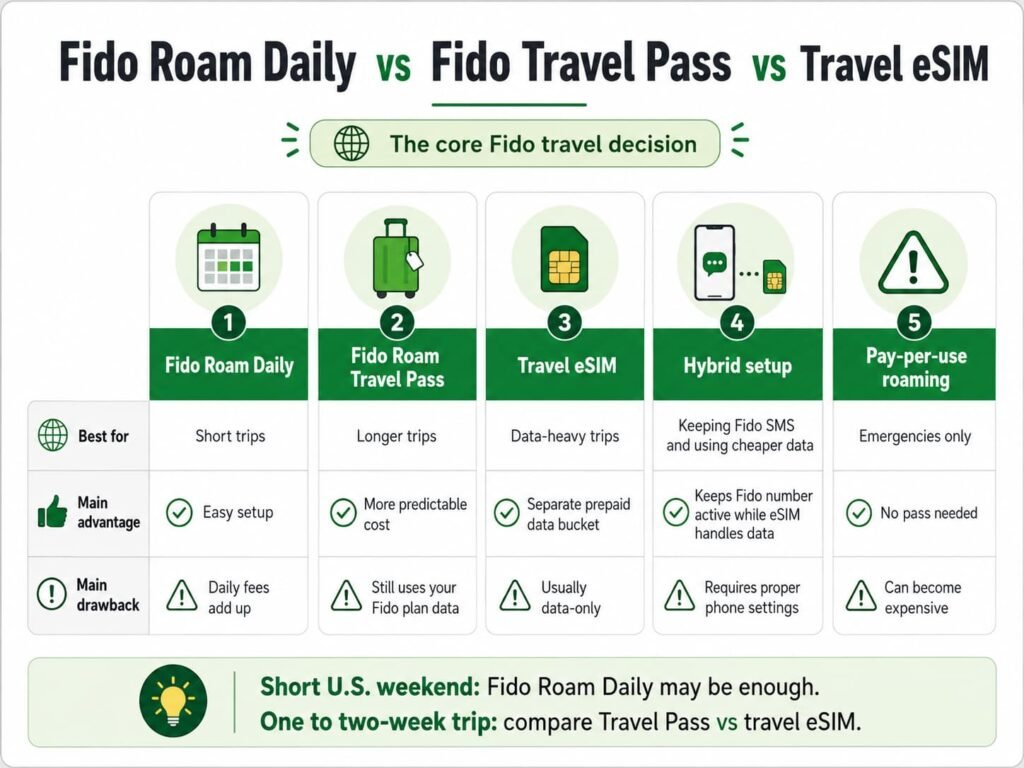
This is the core Fido decision.
You are not only choosing between Fido Roam and a travel eSIM. You may be choosing between daily roaming, a Travel Pass, or a separate travel eSIM for data.
| Option | Best For | Main Advantage | Main Drawback |
|---|---|---|---|
| Fido Roam Daily | Short trips and convenience-first travel | Easy setup and keeps your Fido number active | Daily fees add up quickly |
| Fido Roam Travel Pass | Longer trips where a pass covers your destination | More predictable than daily fees | Still uses your Fido plan data |
| Travel eSIM | Data-heavy trips, longer vacations, family travel | Separate prepaid data bucket | Usually data-only |
| Hybrid setup | Travelers who need Fido SMS plus cheaper data | Keeps Fido number active while eSIM handles data | Requires proper phone settings |
| Pay-per-use roaming | Emergency or very limited use only | No pass needed | Can become expensive and unpredictable |
For a quick U.S. weekend, Fido Roam Daily may be simple enough.
For a one-week or two-week trip, compare a Fido Travel Pass against a travel eSIM.
For a longer international trip, family vacation, hotspot-heavy trip, or multi-country itinerary, a travel eSIM is usually worth comparing first.
Fido eSIM vs Travel eSIM: Why They Are Not the Same Thing
A Fido eSIM is simply the digital version of your regular Fido SIM card.
It keeps your Canadian Fido phone number, connects to the Fido network in Canada, and follows the same Fido roaming rules when you travel.
That means switching your Fido line from a physical SIM to a Fido eSIM does not automatically give you cheaper international roaming.
A travel eSIM is different.
A travel eSIM is usually a separate prepaid data plan from another provider. It does not usually replace your Fido number, but it can handle mobile data while you keep Fido active for calls, SMS, and verification codes.
For travel, the best setup is often:
- Fido SIM or eSIM stays active for your Canadian number
- Fido data roaming stays off
- travel eSIM handles mobile data
- automatic data switching stays off
This is how you can keep your Fido number available while avoiding unnecessary Fido data roaming.
Fido Roam Uses Your Canadian Data Plan
Fido Roam does not usually give you a separate travel data allowance.
Fido Roam Daily and Fido Travel Passes use your existing Fido plan data, talk, and text.
That means your travel usage can reduce the same monthly data bucket you use in Canada.
This matters if you use mobile data heavily while travelling for:
- maps and navigation
- rideshare apps
- hotel and airline apps
- WhatsApp calls
- iMessage and FaceTime
- social media uploads
- cloud backups
- video calls
- streaming
- hotspot and tethering
- remote work apps
A travel eSIM works differently because it gives you a separate data bucket for the trip.
That makes it easier to control travel data use without draining your regular Fido plan.
Why Fido Data Overage Protection Still Matters Abroad
Fido customers should understand how their regular data rules apply while roaming.
Because Fido Roam uses your regular Canadian plan data, your domestic data limit still matters while you are travelling.
If you use up your Fido data while abroad, your data experience can be affected just like it would at home.
For example:
- data may pause if your plan has overage protection
- you may need to buy a domestic data top-up
- hotspot use can drain your plan faster
- family or shared-style usage can affect multiple users
- you may return to Canada with less data left for the billing cycle
This is one of the strongest reasons to compare a travel eSIM.
A travel eSIM keeps your travel data separate from your regular Fido data bucket.
Fido Roaming Charges Apply Per Line
Fido roaming charges apply per line or device.
This is a major cost issue for couples, families, and anyone travelling with multiple connected devices.
If one Fido line uses Roam Daily, that line can trigger the daily charge.
If four Fido lines use roaming, each line can trigger its own daily charge.
| Number of Fido Lines | Estimated 10-Day International Fido Roam Daily Cost |
|---|---|
| 1 line | About $180 CAD |
| 2 lines | About $360 CAD |
| 3 lines | About $540 CAD |
| 4 lines | About $720 CAD |
These examples are before taxes and do not include Travel Passes, destination-specific rules, cruise roaming, or pay-per-use charges.
For family travel, this is where travel eSIMs can make a big difference.
Instead of every Fido line triggering daily roaming, each traveler can use a prepaid travel eSIM for mobile data.
One Fido line can stay active for important calls, texts, or verification codes if needed.
The Fido Eastern Time Rule: Why Your Roaming Day May Not Match Local Time
Fido Roam Daily and Fido Travel Pass timing can follow Eastern Time.
For Fido Roam Daily, the daily rate applies until 11:59 p.m. ET of each calendar day.
For Travel Passes, Fido says the pass starts at 12 a.m. ET on the activation date and ends at 11:59 p.m. ET on the final day.
This is important because your local destination time may be very different from Eastern Time.
For example:
- midnight in France is not midnight in Toronto
- a Japan arrival may fall on a very different Fido timing window
- late-night U.S. flights can cross timing boundaries
- overnight layovers may make roaming costs harder to predict
This does not mean Fido is bad.
It means travelers should understand how the timing works before relying on daily roaming or a pass.
Travel eSIMs are usually simpler in this area because the data package is prepaid and tied to the eSIM provider’s validity rules.
When Fido Roam Daily Makes Sense
Fido Roam Daily may make sense when convenience matters more than savings.
It can be a good option if:
- your trip is only one or two days
- you are taking a quick U.S. trip
- you need your Fido number active for calls
- you need SMS verification codes
- your employer pays roaming charges
- you do not want to install a travel eSIM
- you will use very little mobile data
- you are comfortable with the daily fee
For short travel, the convenience can be worth it.
You do not need to compare providers, scan QR codes, manage dual-SIM settings, or install another mobile plan.
Your Fido line simply works when roaming is turned on.
When a Fido Travel Pass May Be Better Than Daily Roaming
A Fido Travel Pass may be better when your trip is longer than a quick getaway but you still want to keep your Fido number and plan active.
Travel Passes can be useful for:
- one-week vacations
- two-week U.S. trips
- longer family visits
- trips where you need calls and texts
- travelers who want a fixed roaming option
- users who do not want a separate eSIM
Fido currently shows examples such as U.S. 3-day, 7-day, 14-day, and 30-day pass options, along with regional and cruise-related passes.
However, the pass still needs to be compared carefully.
A Travel Pass may reduce daily roaming cost, but it still uses your Fido plan’s data.
If you need a lot of mobile data, a travel eSIM may still be cheaper or more flexible.
When Fido Customers May Not Need a Travel eSIM
A travel eSIM is helpful, but not every Fido customer needs one.
You may not need a travel eSIM if:
- your trip is very short
- you mostly need calls and SMS
- your data use will be light
- a Fido Travel Pass covers your trip well
- your employer pays your roaming bill
- you prefer one simple setup
- you do not want to manage dual SIM settings
- you are travelling with only one phone line
For some short trips, the easiest setup may be to use Fido Roam Daily or a Fido Travel Pass.
The key is knowing the total cost before you leave.
When a Travel eSIM Is Better Than Fido Roam
A travel eSIM is usually better when cost control and mobile data matter more than keeping everything on Fido.
It is especially useful for:
- trips longer than a few days
- Europe travel
- Asia travel
- Latin America travel
- Portugal, Spain, France, Italy, Japan, or Ecuador trips
- family vacations
- remote work
- hotspot-heavy travel
- multi-country trips
- travelers who mainly use apps instead of phone calls
- travelers who want a separate travel data bucket
- travelers who want predictable upfront pricing
Travel eSIMs are usually prepaid data plans for a country or region.
That means you can often pay once for the trip instead of triggering daily roaming charges every day.
For many Fido customers, this makes budgeting easier.
Fido Roam for the United States
Fido Roam Daily can be convenient for short U.S. trips.
If you are travelling to Buffalo, New York, Florida, Las Vegas, Seattle, Detroit, or another U.S. destination for one or two days, paying the daily rate may be simple enough.
For longer U.S. trips, compare Fido’s U.S. Travel Pass options against a U.S. travel eSIM.
A U.S. travel eSIM may be better if you mainly need data for maps, messaging, browsing, streaming, hotspot, and travel apps.
A Fido Travel Pass may be better if you want to use your regular Fido number and plan throughout the trip.
Fido Roam Coverage and Common Destination Zones
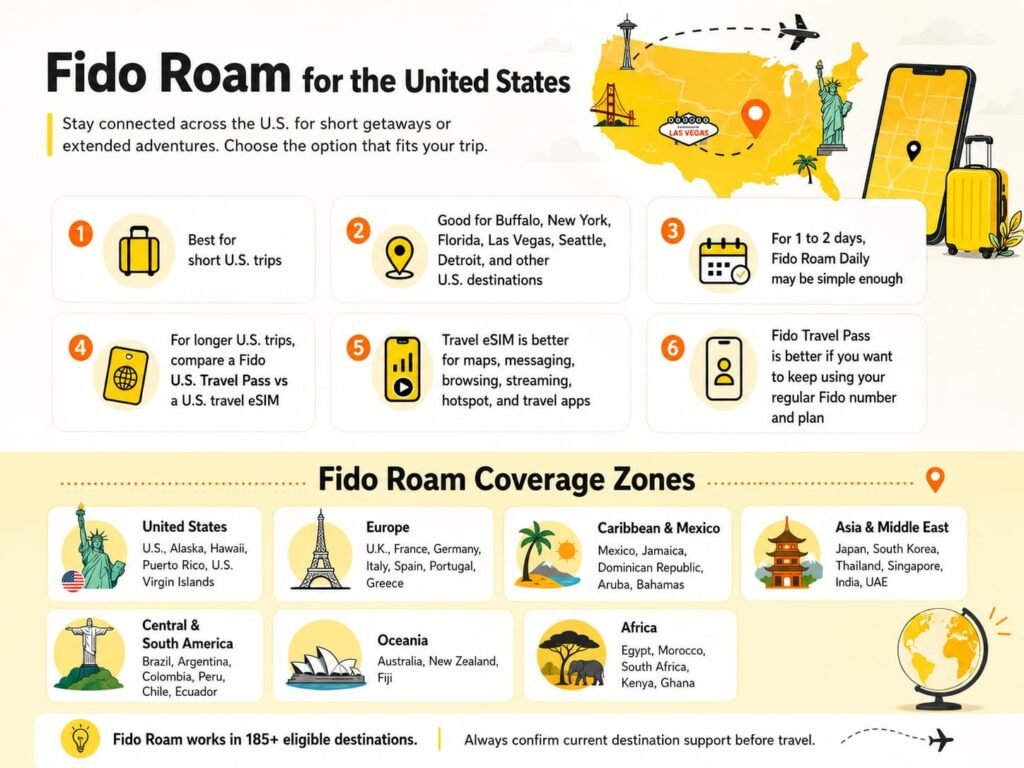
Fido Roam works in more than 185 eligible destinations, but pricing and Travel Pass options are organized by destination zone.
Here is a simpler way to think about the main Fido Roam zones:
| Zone | Common Examples |
|---|---|
| United States | U.S., Alaska, Hawaii, Puerto Rico, U.S. Virgin Islands |
| Europe | U.K., France, Germany, Italy, Spain, Portugal, Greece |
| Caribbean and Mexico | Mexico, Jamaica, Dominican Republic, Aruba, Bahamas |
| Asia and Middle East | Japan, South Korea, Thailand, Singapore, India, UAE |
| Central and South America | Brazil, Argentina, Colombia, Peru, Chile, Ecuador |
| Oceania | Australia, New Zealand, Fiji |
| Africa | Egypt, Morocco, South Africa, Kenya, Ghana |
Always use Fido’s travel destination search before departure because destination support, partner networks, and pass eligibility can change.
Fido Roam for Europe and Multi-Country Travel
Europe is where a travel eSIM often becomes worth comparing.
If you are travelling to Portugal, Spain, France, Italy, Germany, the United Kingdom, or several European countries in one trip, daily roaming can add up quickly.
A regional Europe travel eSIM may cover multiple countries under one prepaid data plan.
That can be especially useful for:
- train travel
- city-hopping
- multi-country vacations
- remote work
- hotspot use
- long stays
- family travel
Fido may also offer Europe Travel Pass options, so compare both.
The best choice depends on whether you need your Fido number active for calls and texts or whether you mainly need mobile data.
Fido Roam for Cruises and Land & Sea Travel
Cruise travel is different from regular roaming.
Fido offers certain cruise-related roaming and Travel Pass options, including Land & Sea style options for eligible ships and destinations.
These can be useful, but they need to be reviewed carefully because cruise ship networks are different from land-based roaming networks.
Fido’s roaming page notes that cruise ship data at the fastest available speeds may be limited to 1 GB per 24 hours, with reduced speeds after that on eligible cruise options.
For many cruise travelers, the safest setup is:
- use Airplane Mode while at sea if you do not want roaming charges
- use cruise Wi-Fi when needed
- use a travel eSIM only while in port on land-based networks
- turn off automatic data switching
- keep Fido data roaming off unless you intentionally want to use it
Cruise roaming can be convenient, but it should never be treated like normal land roaming.
Best Hybrid Setup for Fido Customers
For many Fido customers, the smartest travel setup is a hybrid setup.
That means:
- keep Fido active for calls and SMS if needed
- use a travel eSIM for mobile data
- turn Fido data roaming off
- turn automatic data switching off
- use Wi-Fi calling carefully
- monitor which line is handling data
This setup can help you keep your Canadian number active while using lower-cost data through a travel eSIM.
It is especially useful for:
- bank verification texts
- login codes
- business calls
- family calls
- emergency contact
- WhatsApp, FaceTime, iMessage, Signal, and Messenger over eSIM data
How to Use a Travel eSIM With Fido on iPhone
Install your travel eSIM before leaving Canada when possible.
Then set your iPhone so the travel eSIM handles mobile data.
- Install your travel eSIM before departure.
- Go to Settings > Cellular.
- Label your Fido line as Primary.
- Label your travel eSIM as Travel Data.
- Tap Cellular Data and select the travel eSIM.
- Turn off Allow Cellular Data Switching.
- Open your Fido line settings.
- Turn Data Roaming off for Fido unless you intentionally want to use Fido Roam.
- Keep Fido active only if you need calls or texts.
For full setup help before travelling, follow our How to Activate an eSIM on iPhone in Canada guide.
How to Use a Travel eSIM With Fido on Android
Android menus vary by brand, but the goal is the same.
Your travel eSIM should handle mobile data. Your Fido line should not use roaming data unless you intentionally want to use Fido Roam.
For most devices:
- Samsung Galaxy: Settings > Connections > SIM manager > Mobile Data, then select your travel eSIM
- Google Pixel: Settings > Network & Internet > SIMs, then select your travel eSIM for mobile data
- Motorola: Settings > Network & Internet > SIMs, then select your travel eSIM for mobile data
Then open your Fido SIM settings and turn off roaming unless you plan to use Fido Roam.
For full Android setup help before travelling, follow our Activate eSIM on Android Canada guide.
How to Avoid Accidental Fido Roaming Charges
If you are using a travel eSIM, set up your phone before leaving Canada.
Use this checklist:
- check whether Fido Roam is active on your account
- check Fido Roam Daily pricing for your destination
- compare available Fido Travel Passes
- install your travel eSIM before departure
- set the travel eSIM as your mobile data line
- turn Fido data roaming off
- turn automatic data switching off
- turn off Wi-Fi Assist or similar settings if needed
- avoid sending SMS messages unless you accept possible roaming charges
- avoid answering calls unless you accept possible roaming charges
- use Airplane Mode at sea on cruises unless you intentionally use a cruise roaming option
Fido’s official billing FAQ notes that incoming text messages and unanswered calls sent to your device do not trigger charges in the same way, but sending texts, making or answering calls, checking voicemail, Wi-Fi Calling to non-Canadian numbers, and background data can still lead to roaming charges.
For current roaming billing rules, check Fido’s official Roaming Charges FAQ.
Fido Roam vs Rogers, Bell, TELUS, and Freedom
Fido works similarly to Rogers because Fido is Rogers’ flanker brand.
But the reader intent is different.
Fido customers are often more budget-conscious, so the eSIM comparison matters quickly once daily roaming costs begin to stack up.
| Carrier | Roaming Style | Best For | Main Caution |
|---|---|---|---|
| Fido | Fido Roam Daily or Travel Pass | Short trips and Fido customers who need their number active | Uses regular Fido plan data |
| Rogers | Roam Like Home daily fee | Short trips and simple setup | Daily fees and data bucket usage can add up |
| Bell | Roam Better daily fee | Short trips with Bell number access | Uses regular Bell data plan |
| TELUS | Easy Roam daily fee, passes, and some included plan options | Travelers who want TELUS number access | Need to compare Easy Roam, pass, and eSIM options |
| Freedom Mobile | Included roaming on eligible Roam Beyond plans | Travelers whose destination and data fit the plan | Not every plan or destination is included |
Fido is strongest when you want a simple roaming setup.
Travel eSIMs are strongest when you want more control over data and cost.
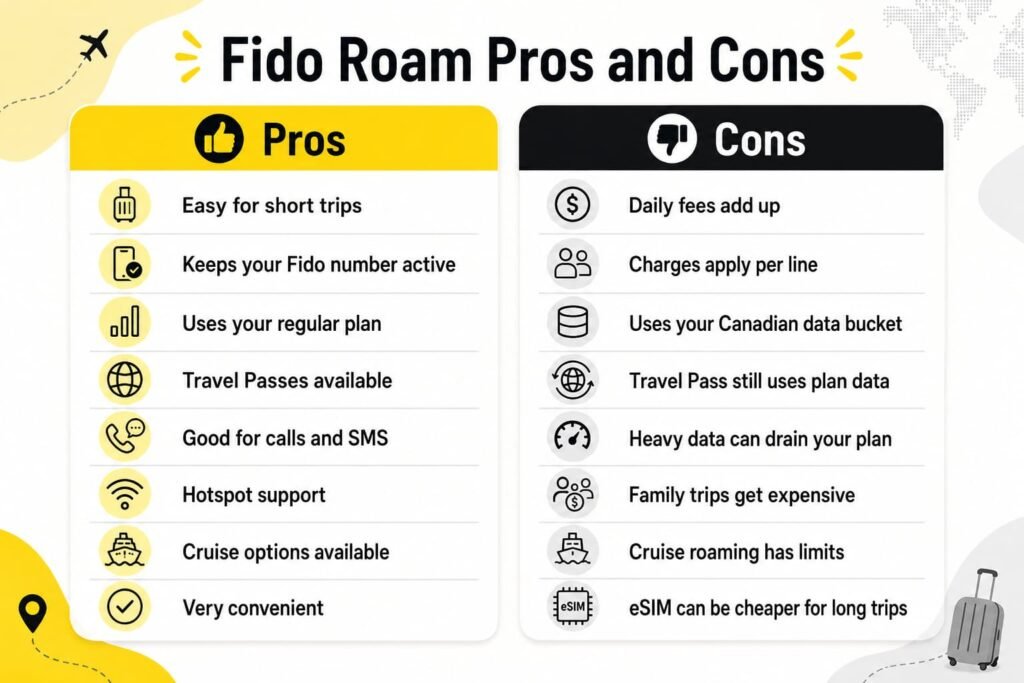
Fido Roam Pros and Cons
| Pros | Cons |
|---|---|
| Easy to use for short trips | Daily fees can add up quickly |
| Keeps your Fido number active | Charges usually apply per line |
| Uses your regular Fido plan | Uses your Canadian data bucket |
| Travel Passes are available | Travel Passes still use your plan data |
| Useful for calls and SMS | Heavy data use can drain your plan |
| Can support hotspot and tethering | Family trips can become expensive |
| Cruise options may be available | Cruise roaming has special limits |
| Good for convenience-first travelers | Travel eSIMs may be cheaper for long trips |
Fido Roam is useful, but it needs to be compared carefully.
For short trips, it may be the easiest choice.
For longer or data-heavy trips, a travel eSIM may be the better value.
Frequently Asked Questions About Fido Roam vs Travel eSIMs
How does Fido Roam compare with a travel eSIM?
Fido Roam is built for convenience. It lets eligible Fido customers use their regular Canadian plan while travelling in supported destinations, including access to their Fido number for calls, texts, and mobile data.
A travel eSIM is usually better for data cost control. Instead of using your regular Fido data bucket, you buy a separate prepaid travel data plan for your destination or region. This is often better for longer trips, Europe travel, family vacations, hotspot use, and travelers who mainly need apps instead of regular phone calls.
When should I use Fido Roam Daily instead of a Fido Travel Pass?
Fido Roam Daily usually makes the most sense for very short trips where convenience matters more than savings. A quick U.S. visit, a one-day business trip, or an emergency trip may be easier with the daily option.
A Travel Pass is worth comparing when your trip lasts several days and Fido offers a pass that fits your destination and dates. The daily option is simple, but once several roaming days are involved, the pass or a travel eSIM may be cheaper.
When is a Fido Travel Pass better than Fido Roam Daily?
A Fido Travel Pass may be better when you want a more predictable roaming cost for a longer trip and still want to use your Fido number, calls, texts, and plan data.
The important detail is that a Fido Travel Pass does not usually give you a separate travel data bucket. It still uses your regular Fido plan data, so heavy data users should compare the pass against a travel eSIM before buying.
Does Fido Roam use my regular Canadian data plan?
Fido Roam usually uses your existing Canadian Fido data plan while you travel. That means your roaming data comes out of the same monthly data bucket you use at home.
This matters if you use maps, hotspot, video calls, social media uploads, cloud backups, or work apps while travelling. A travel eSIM gives you a separate travel data allowance, which can help protect your regular Fido data.
Does Fido Roam use a 24-hour timer or Eastern Time?
Fido Roam Daily is not based on a rolling 24-hour timer from the moment you first use your phone. Fido’s roaming day is based on Eastern Time.
That means the timing may not match the local time in Europe, Asia, or another destination. If you use roaming close to the Eastern Time reset, you could end up with another roaming day sooner than expected.
Does Fido cap roaming charges after 20 days?
Fido Roam Daily has a 20-day charge cap per monthly billing cycle per line. After 20 charged Fido Roam Daily days in the same billing cycle, additional eligible daily roaming use in that cycle is not charged again.
The cap does not give you extra data, and it does not protect your regular Fido data bucket from being used. If your trip crosses into a new billing cycle, the 20-day count may restart, so check your billing dates before relying on the cap.
Why was I charged for Fido Roam when data roaming was turned off?
Turning off data roaming helps stop Fido mobile data, but your Fido line may still connect to foreign networks for voice and SMS. Calls, voicemail, outgoing texts, MMS, and certain network interactions can still create roaming activity.
For the safest setup with a travel eSIM, turn Fido data roaming off, set the travel eSIM as your mobile data line, disable automatic data switching, and avoid using the Fido line for calls, outgoing texts, or voicemail unless you accept possible roaming charges.
Can declining a call or checking voicemail trigger Fido Roam?
Interacting with calls while abroad can trigger roaming activity. That can include answering a call, making a call, checking voicemail, or in some cases actively declining a call and sending it to voicemail.
If you are trying to avoid Fido Roam charges, let unwanted calls ring through, avoid checking voicemail, and use Wi-Fi or app-based calling through your travel eSIM data when possible.
Can MMS or group messages trigger Fido Roam?
Standard incoming text messages are different from MMS. A plain incoming SMS may not trigger the same type of charge, but photos, videos, and some group messages often use MMS data.
If your Fido line downloads an MMS while roaming, that can create mobile data usage on the Fido line. To reduce the risk, avoid sending or downloading MMS while abroad and use apps like WhatsApp, iMessage, Signal, or Messenger through your travel eSIM data instead.
Can I keep Fido on for bank verification texts while using a travel eSIM?
Many travelers keep their Fido line active so they can receive bank verification texts and login codes while using a travel eSIM for mobile data.
The safer setup is to keep Fido active for voice and SMS, turn Fido data roaming off, set your travel eSIM as the mobile data line, and turn off automatic data switching. You should also set up authenticator apps and backup codes before leaving Canada in case SMS is delayed or unavailable.
What happens if I forget to turn off Allow Cellular Data Switching?
On iPhone, Allow Cellular Data Switching can let your phone switch back to your Fido line for data if the travel eSIM has weak service or no service. That can trigger Fido Roam.
Before travelling, go to your cellular settings and make sure your travel eSIM is selected for mobile data. Then turn off Allow Cellular Data Switching so your phone does not quietly use Fido roaming data in the background.
Why does my travel eSIM need data roaming turned on?
This is one of the most confusing parts of using a travel eSIM. You may need data roaming turned on for the travel eSIM because many travel eSIM providers connect through partner networks in the destination country.
The key is to turn roaming on only for the travel eSIM and keep Fido data roaming off. Your travel eSIM should handle mobile data, while Fido stays available only if you need calls or SMS.
Can I switch from a physical Fido SIM to a Fido eSIM while outside Canada?
It is better to switch from a physical Fido SIM to a Fido eSIM before leaving Canada. Fido may require account verification, SMS confirmation, or access to the Canadian network during the swap process.
f you wait until you are already abroad, the conversion may be harder or may not work as expected. Set up your Fido eSIM and test it in Canada before relying on it during travel.
How should Fido customers use the Canadian Roaming Savings Calculator?
Fido customers should use the Canadian Roaming Savings Calculator before travelling to compare Fido Roam Daily, Fido Travel Passes, and travel eSIM pricing.
Enter your destination, trip length, number of travelers, and expected data use. Then compare whether Fido roaming, a Fido Travel Pass, or a separate travel eSIM gives you the better setup for your trip.
More eSIM and Roaming Guides for Canadian Travelers
Compare Roaming Costs and eSIM Options
- Canadian Roaming Savings Calculator
- Rogers Roam Like Home vs Travel eSIMs
- Bell Roam Better vs Travel eSIMs
- SaskTel Roaming vs Travel eSIMs
- Chatr Mobile Roaming vs Travel eSIMs
- TELUS Easy Roam vs Travel eSIMs
- Freedom Mobile Roam Beyond vs Travel eSIMs
- Virgin Plus Roam Sweet Roam vs Travel eSIMs
- Koodo Easy Roam vs Travel eSIMs
- Public Mobile Roaming vs Travel eSIMs
- eSIM Canada: Best Providers, Setup & Guide for Travelers & Locals
Set Up or Fix Your Fido eSIM
- How to Activate Fido eSIM in Canada
- Phone Supports eSIM But Not Working in Canada?
- How to Fix eSIM Not Working in Canada
Compare Travel eSIM Providers
Final Thoughts
Fido Roam vs travel eSIMs comes down to convenience, trip length, data use, and whether you need your Fido number active while travelling.
Fido Roam Daily is easy for short trips.
Fido Travel Passes can make sense for longer stays if the pass fits your destination, dates, and plan.
But both options usually use your regular Fido plan data, which means heavy travel usage can drain the same data bucket you rely on in Canada.
For longer vacations, family travel, Europe trips, multi-country itineraries, hotspot use, or data-heavy travel, a travel eSIM is usually worth comparing before you leave.
For many Fido customers, the best setup is a hybrid setup: keep Fido active for calls and texts, but use a travel eSIM for mobile data.
Before leaving Canada, check your Fido plan, compare Fido Roam Daily and Travel Pass pricing, confirm your destination, and compare the total cost against travel eSIM options for the same trip.