If you are a Bell customer travelling outside Canada, Bell Roam Better is one of the easiest ways to keep your phone working abroad.
It is simple. Your Bell phone connects to a roaming partner network, your Canadian number stays active, and you can use your regular Bell plan in many destinations.
But that convenience comes with a cost.
For short trips, Bell roaming may be worth it. For longer vacations, family travel, Europe trips, cruise travel, or heavy mobile data use, a travel eSIM can often be the cheaper and more predictable option.
This Bell Roam Better vs travel eSIMs guide compares both options so you can decide which setup makes more sense before your next trip.
Estimate Your Bell Roaming Cost Before You Travel
Before deciding between Bell Roam Better and a travel eSIM, it helps to estimate the full cost of your trip.
The most important things to compare are:
- your destination
- your trip length
- how many phones or devices need data
- whether you need your Bell number active
- how much mobile data you expect to use
- whether your trip crosses your billing cycle
- whether you are travelling alone or with family
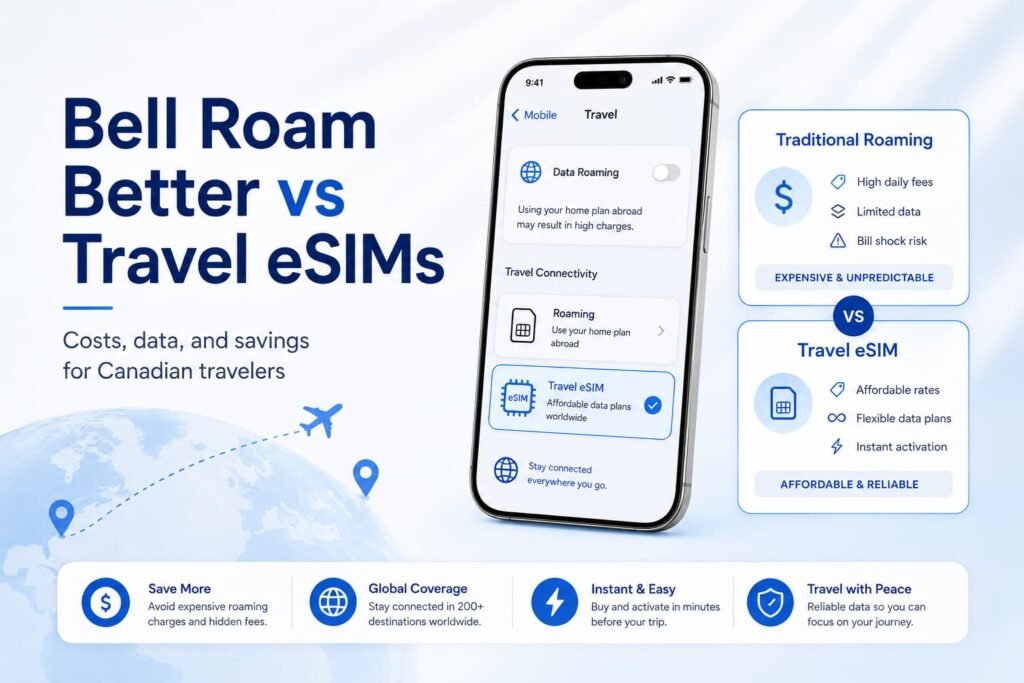
Bell roaming can feel reasonable for a short trip, but the cost can rise quickly when daily roaming fees repeat across several days or multiple lines.
Before deciding between Bell Roam Better and a travel eSIM, use the free Canadian Roaming Savings Calculator to estimate your cost based on your carrier, destination, trip length, data use, and number of travelers.
What Is Bell Roam Better?
Bell Roam Better is Bell Mobility’s daily roaming service for eligible postpaid customers travelling outside Canada.
Instead of paying separate pay-per-use charges for every call, text, or megabyte of data, Roam Better charges a daily fee when you use your phone in an eligible destination.
Once the daily fee is triggered, you can use your Bell plan while travelling.
That usually means:
- access to your regular Canadian data plan
- calling back to Canada
- local calling in the destination country
- texting support
- hotspot and tethering support
- access to Bell roaming partner networks abroad
Bell Roam Better is built for convenience. It lets you keep your Canadian number active without buying a separate SIM card or changing your phone setup.
Before relying on roaming for your trip, check Bell’s official Roam Better support page for current pricing, eligible destinations, and plan-specific details.
How Bell Roam Better Works
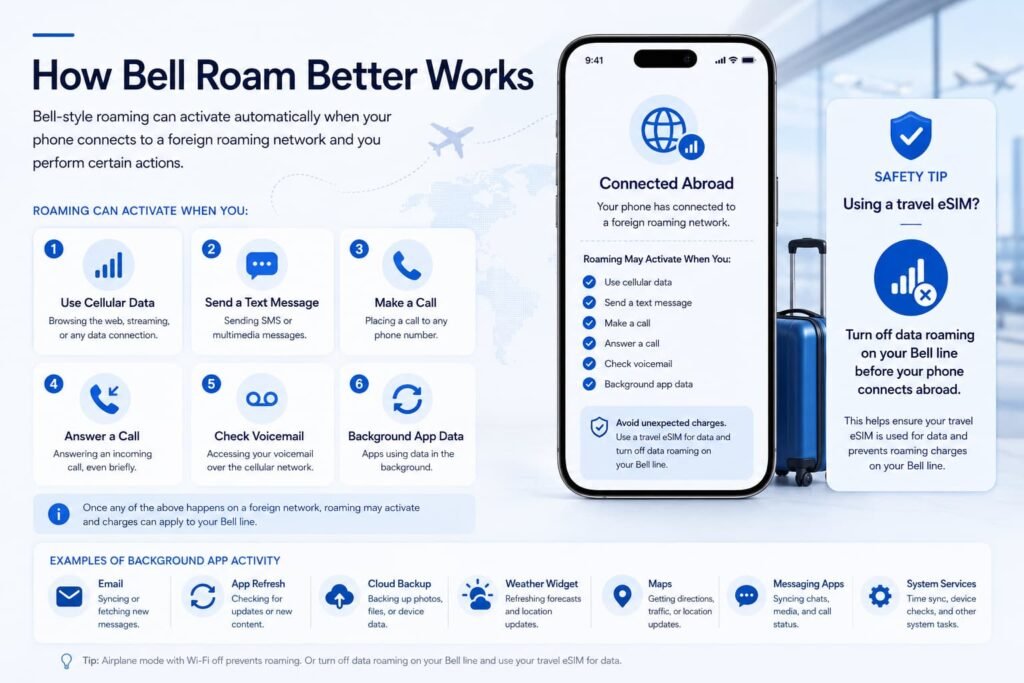
Bell Roam Better is designed to activate when you use your phone on a foreign roaming network.
The daily fee can be triggered by actions such as:
- using cellular data
- sending a text message
- making a call
- answering a call
- checking voicemail
- background app data
That last point is important.
You do not always need to open an app for roaming data to start. Your phone may use data in the background through email, app refreshes, cloud backups, weather widgets, maps, messaging apps, or system services.
If you plan to use a travel eSIM instead of Bell roaming, you should turn off data roaming on your Bell line before your phone connects abroad.
Bell Roam Better Pricing
Bell roaming pricing can change, so always confirm your exact plan and destination before travelling.
In general, Bell Roam Better is commonly structured around daily roaming fees such as:
- United States: about $13 CAD per day
- International destinations: about $16 CAD per day
These fees usually apply only on days when you use roaming.
For a very short trip, that may be acceptable.
For a longer trip, the daily charges can add up quickly.
For example:
- 2 days in the United States could cost about $26 CAD
- 7 days internationally could cost about $112 CAD
- 10 days internationally could cost about $160 CAD
- 4 Bell lines abroad for 10 days could cost about $640 CAD
That is before taxes and before considering plan-specific rules, billing-cycle timing, or extra usage.
This is why comparing Bell roaming with a travel eSIM is important before you leave Canada.
Bell Roam Better Uses Your Canadian Data Plan
One of the most important things Bell customers should understand is that Roam Better usually uses your existing Canadian data plan while you are travelling.
It does not normally give you a separate travel data bucket.
That means your roaming data comes from the same Bell data plan you use at home in Canada.
This can be convenient if you have a large data plan, but it can also drain your monthly data faster than expected.
This matters for:
- hotspot use
- Google Maps navigation
- video calls
- social media uploads
- streaming
- work apps
- cloud backups
- family shared data plans
A travel eSIM works differently because it gives you a separate travel data allowance for your destination. Your Bell data plan stays separate, which can make budgeting easier.
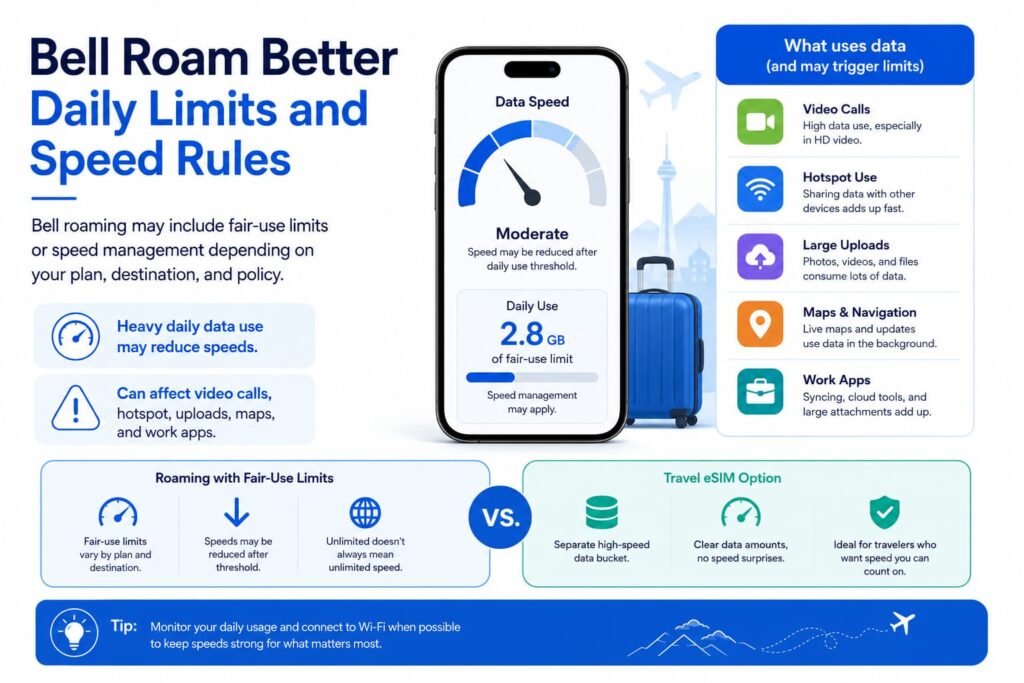
Bell Roam Better Daily Limits and Speed Rules
Bell roaming may include fair-use limits or speed management depending on your plan, destination, and current Bell roaming policy.
This is especially important for heavy data users.
If you use a lot of data in one day while travelling, your speeds may be reduced after a certain amount of high-speed usage. That can affect things like video calls, hotspot use, large uploads, maps, and work apps.
For light use, this may not matter much.
For heavy use, it can become frustrating.
A travel eSIM may be a better option if you want a separate data bucket with a clear amount of high-speed data for your trip.
Bell Roaming Charges Apply Per Line
Bell Roam Better charges usually apply per phone line.
This is one of the biggest cost issues for couples and families.
If one person uses Bell roaming, the daily charge applies to that line.
If four people use Bell roaming, the daily charge can apply four times.
For example, a 10-day international trip at about $16 per day could look like this:
| Number of Bell Lines | Estimated 10-Day International Roaming Cost |
|---|---|
| 1 line | About $160 CAD |
| 2 lines | About $320 CAD |
| 3 lines | About $480 CAD |
| 4 lines | About $640 CAD |
That is why travel eSIMs can be especially useful for family travel.
Instead of triggering repeated daily roaming fees across multiple Bell lines, each person can use a separate prepaid travel eSIM for mobile data.
Bell Roam Better and Billing Cycle Timing
Bell may have roaming charge caps or billing protections depending on the plan and current roaming rules.
But travellers should understand one important detail.
Roaming caps usually depend on the billing cycle, not just the trip length.
If your trip crosses your monthly Bell billing date, your chargeable roaming period may reset during the trip.
For example, if you are away for two or three weeks and your billing cycle resets halfway through, you may pay more than expected because the roaming cap may start over in the new billing cycle.
Before relying on a cap, check:
- your Bell billing cycle date
- how many days you will travel
- whether your trip crosses into a new billing period
- whether each family member has a separate Bell line
This is especially important for longer vacations, snowbird travel, and family trips.
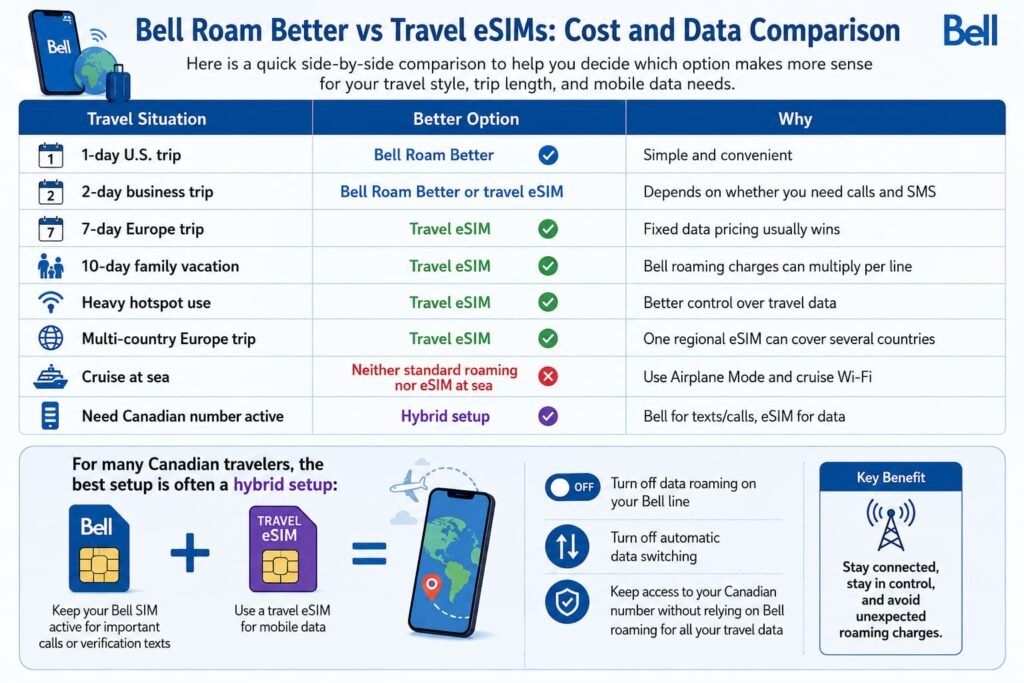
Bell Roam Better vs Travel eSIMs: Cost and Data Comparison
Here is a quick side-by-side comparison to help you decide which option makes more sense for your travel style, trip length, and mobile data needs.
| Travel Situation | Better Option | Why |
|---|---|---|
| 1-day U.S. trip | Bell Roam Better | Simple and convenient |
| 2-day business trip | Bell Roam Better or travel eSIM | Depends on whether you need calls and SMS |
| 7-day Europe trip | Travel eSIM | Fixed data pricing usually wins |
| 10-day family vacation | Travel eSIM | Bell roaming charges can multiply per line |
| Heavy hotspot use | Travel eSIM | Better control over travel data |
| Multi-country Europe trip | Travel eSIM | One regional eSIM can cover several countries |
| Cruise at sea | Neither standard roaming nor eSIM at sea | Use Airplane Mode and cruise Wi-Fi |
| Need Canadian number active | Hybrid setup | Bell for texts/calls, eSIM for data |
For many Canadian travelers, the best setup is often a hybrid setup:
- keep your Bell SIM active for important calls or verification texts
- use a travel eSIM for mobile data
- turn off data roaming on the Bell line
- turn off automatic data switching
This lets you keep access to your Canadian number without relying on Bell roaming for all your travel data.
When Bell Roam Better Makes Sense
Bell roaming can still be a good choice in certain situations.
It may make sense if:
- your trip is only one or two days
- you are travelling to the United States for a short visit
- you need regular calls from your Bell number
- you do not want to install a travel eSIM
- your employer pays your roaming charges
- you rely on SMS verification throughout your trip
- your Bell plan already includes some roaming coverage
For a short business trip or quick cross-border visit, Bell Roam Better can be the easiest option.
You do not have to install another SIM or adjust many settings. Your phone keeps working on your Bell number.
When a Travel eSIM Is Better Than Bell Roaming
When comparing Bell Roam Better vs travel eSIMs, a travel eSIM is usually better when cost control matters more than convenience.
It is especially useful for:
- Europe trips
- Asia travel
- Latin America travel
- Portugal, Spain, France, Italy, Japan, and Ecuador trips
- vacations longer than a few days
- family travel
- multi-country trips
- remote work
- hotspot use
- heavy data use
- travellers who mainly use WhatsApp, iMessage, Google Maps, email, and apps
For example, a regional Europe eSIM can often cover multiple countries under one fixed data plan.
If you are visiting Portugal, Spain, France, and Italy on the same trip, a regional travel eSIM can be easier to manage than paying Bell daily roaming fees every day.
Bell Roaming in the United States
Bell Roam Better is convenient for U.S. travel because your phone can connect to Bell roaming partner networks in the United States.
For short trips, this can be simple.
If you are going to New York, Florida, Las Vegas, Buffalo, Chicago, or another U.S. destination for a day or two, Bell Roam Better may be reasonable.
But for longer U.S. trips, a U.S. travel eSIM may be cheaper.
This is especially true if you mostly need mobile data for:
- maps
- rideshare apps
- hotel check-ins
- social media
- messaging apps
- hotspot use
Before travelling, check whether your Bell plan already includes Canada-U.S. or Canada-U.S.-Mexico coverage. If it does, you may not need a separate travel eSIM for that specific trip.
Bell Roaming in Europe
Europe is where travel eSIMs often become much more attractive.
If you are travelling to Portugal, Spain, France, Italy, Germany, the Netherlands, or the United Kingdom, Bell international roaming can become expensive quickly because daily roaming fees repeat each day.
A Europe travel eSIM can often cover many countries under one regional data plan.
This is useful if you are:
- visiting multiple countries
- travelling by train
- taking a cruise with port stops
- staying for one or two weeks
- using lots of maps and travel apps
- sharing data with a laptop or tablet
For many Europe trips, a travel eSIM gives Bell customers more predictable data costs than daily roaming.
Bell Roaming in Japan, Ecuador, and Other International Destinations
Bell roaming can work in many international destinations, including Japan and Ecuador, depending on current roaming partner coverage and plan eligibility.
However, daily roaming still needs to be compared carefully.
For Japan, many travelers prefer travel eSIMs because local data coverage is strong and data-only eSIM plans are easy to buy before leaving Canada.
For Ecuador and other Latin American destinations, travel eSIM pricing and coverage can vary by provider, so compare options before you travel.
The key point is simple.
If you mainly need mobile data, compare a travel eSIM first.
If you need traditional calls and texts on your Bell number every day, Bell roaming may still be useful.
Bell Roaming and Cruise Travel
Cruise travel needs special care.
Bell Roam Better is generally designed for land-based mobile networks, not maritime satellite networks used by cruise ships at sea.
If your phone connects to a ship cellular network, regular roaming rules may not apply. Separate maritime or satellite rates can be expensive.
For cruises, the safer setup is:
- turn on Airplane Mode while at sea
- use the ship’s Wi-Fi package if needed
- use a travel eSIM only while in port
- keep offline maps and booking details downloaded
- turn off automatic data switching
This matters even if you have a travel eSIM because eSIMs normally work on land-based mobile networks, not cruise ship satellite towers.
How to Use a Travel eSIM With Bell
The best way to avoid Bell roaming charges while using a travel eSIM is to set up your phone before you leave Canada.
On iPhone
- Install your travel eSIM before departure.
- Go to Settings > Cellular.
- Label your Bell line as Primary.
- Label your travel eSIM as Travel Data.
- Set Cellular Data to the travel eSIM.
- Turn off Allow Cellular Data Switching.
- Select your Bell line and turn Data Roaming off.
- Keep your Bell line on only if you need calls or texts.
Need more help with iPhone setup? Our guide on How to Activate an eSIM on iPhone in Canada walks you through the full process step by step.
On Android
- Install your travel eSIM before departure.
- Go to Settings > Connections or Network & Internet.
- Open SIM manager or SIMs.
- Set mobile data to the travel eSIM.
- Turn off automatic data switching.
- Select your Bell SIM and turn Data Roaming off.
- Keep calls and texts on Bell only if needed.
If you are using Samsung, Google Pixel, Motorola, or another Android phone, our guide on How to Activate an eSIM on Android in Canada covers the full setup process in more detail.
The exact settings vary by Samsung, Google Pixel, Motorola, and other Android phones, but the idea is the same.
Your travel eSIM should handle data. Your Bell line should not use roaming data unless you intentionally want it to.
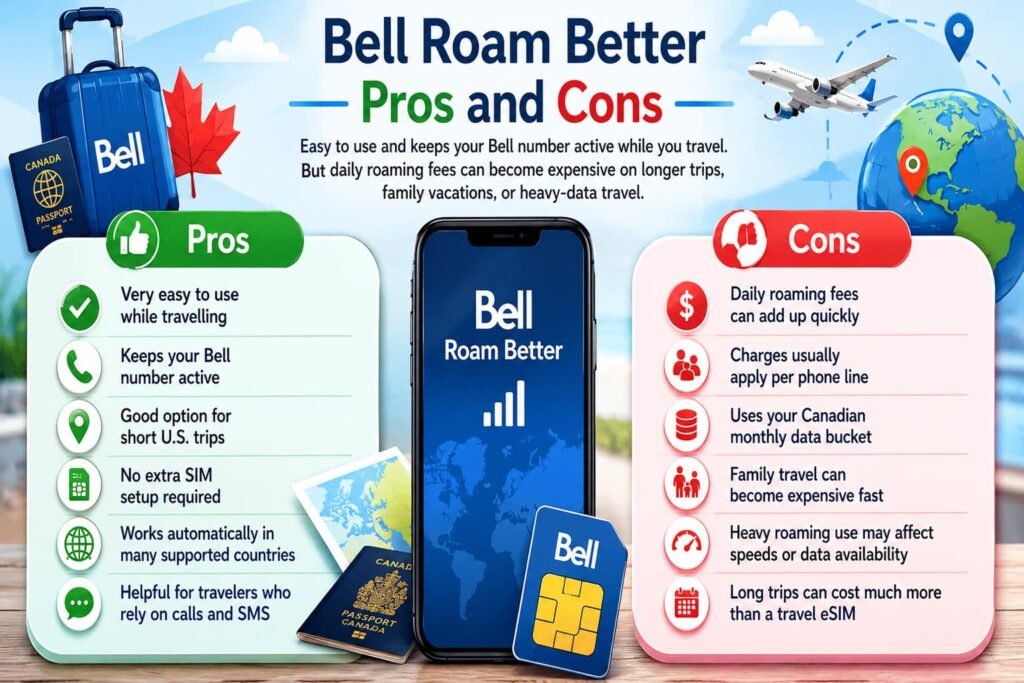
Bell Roam Better Pros and Cons
Bell Roam Better is easy to use and keeps your Bell number active while you travel. However, the daily roaming fees can become expensive on longer trips, family vacations, or heavy-data travel.
| Pros | Cons |
|---|---|
| Very easy to use while travelling | Daily roaming fees can add up quickly |
| Keeps your Bell number active | Charges usually apply per phone line |
| Good option for short U.S. trips | Uses your Canadian monthly data bucket |
| No extra SIM setup required | Family travel can become expensive fast |
| Works automatically in many supported countries | Heavy roaming use may affect speeds or data availability |
| Helpful for travelers who rely on calls and SMS | Long trips can cost much more than a travel eSIM |
Can You Receive Bell Texts While Using a Travel eSIM?
In many cases, yes.
Many travelers keep their Bell SIM active so they can receive SMS messages, including bank verification codes and login codes.
However, you need to be careful.
Receiving a standard incoming SMS is not the same as sending a text, answering a call, checking voicemail, or using Bell data.
To reduce the risk of roaming charges:
- keep Bell data roaming off
- do not send SMS messages unless you accept possible charges
- avoid answering regular phone calls unless needed
- turn off automatic data switching
- use WhatsApp, FaceTime, iMessage, Signal, or other data-based apps through the travel eSIM
If you rely heavily on bank verification codes, set up backup authentication methods before travelling.
How to Avoid Bell Roaming Charges
Before leaving Canada, do this:
- check whether your Bell plan includes roaming
- confirm current Roam Better pricing
- install your travel eSIM while you still have reliable Wi-Fi
- turn off data roaming on the Bell line
- turn off automatic data switching
- set the travel eSIM as your mobile data line
- download offline maps and travel apps
- prepare authentication apps for important logins
After arriving, test your connection carefully.
Open your phone settings and confirm mobile data is using the travel eSIM, not Bell.
Recommended Setup for Most Bell Customers
For most Bell customers travelling internationally, the best setup is:
- Bell SIM active for important calls and texts
- Travel eSIM used for mobile data
- Bell data roaming turned off
- automatic data switching turned off
- Wi-Fi calling enabled before departure if you use it
This setup gives you a good balance of savings and convenience.
You keep access to your Canadian number, but your travel data does not run through Bell roaming.
Frequently Asked Questions About Bell Roam Better vs Travel eSIMs
How does Bell Roam Better vs travel eSIMs compare for Canadian travelers?
Bell Roam Better is built for convenience. It allows Bell customers to use their regular Canadian mobile plan while travelling in many supported destinations.
A travel eSIM is usually better for cost control. Instead of paying a daily roaming fee, you buy a separate data plan for your destination. For longer trips, family vacations, Europe travel, and heavy data use, a travel eSIM can often be much cheaper than relying on Bell roaming every day.
The best choice depends on how you travel. If you are away for one or two days and need your Bell number active, Roam Better may be fine. If you mainly need mobile data, a travel eSIM is worth comparing first.
When is Bell Roam Better worth using?
Bell Roam Better can be worth using when convenience matters more than savings. It is useful for short trips, business travel, quick U.S. visits, and situations where you need your Bell number active for calls or SMS.
It may also make sense if your employer pays your roaming charges or you do not want to manage eSIM settings.
Where Bell Roam Better becomes less attractive is on longer trips. Once you travel for several days, especially internationally, the daily roaming fees can add up quickly.
When is a travel eSIM cheaper than Bell roaming?
A travel eSIM is usually cheaper when your trip lasts more than a few days, when multiple people need data, or when you are travelling internationally.
Bell roaming is charged daily when used, while travel eSIMs are usually sold as fixed data packages for a set period.
For example, a 10-day international trip with Bell roaming can cost much more than a single travel eSIM plan, especially if several family members need data.
How much does Bell Roam Better cost per day?
Bell roaming pricing can change, so always check Bell’s current roaming information before travelling. In general, Bell Roam Better uses separate daily rates for U.S. and international travel.
The daily price matters, but the total trip cost matters more. A daily fee may feel fine for a weekend, but it can become expensive on a one-week or two-week vacation.
How does Bell Roam Better use my Canadian data plan?
Bell Roam Better usually uses your regular Canadian data plan while you travel. That means your data abroad comes from the same monthly data bucket you use at home.
This can be convenient, but it also means travel data can reduce the amount of data you have left in your billing cycle.
A travel eSIM gives you a separate travel data bucket, which can help keep your Bell data plan untouched.
Why can Bell roaming become expensive for families?
Bell roaming fees usually apply per line. If four family members each use Bell Roam Better on the same international trip, the daily charges can multiply quickly.
That is one of the biggest reasons families should compare travel eSIMs before leaving Canada.
Even if one parent keeps Bell roaming active for calls or emergencies, the rest of the family can often use travel eSIMs for mobile data and reduce the total trip cost.
Can I use Bell and a travel eSIM at the same time?
Yes, most modern eSIM-compatible phones allow you to use your Bell SIM and a travel eSIM at the same time.
The common setup is to keep Bell active for calls and texts, then use the travel eSIM for mobile data.
To make this work properly, set the travel eSIM as your mobile data line, turn off data roaming on Bell, and disable automatic data switching.
Which SIM should handle mobile data while travelling?
If your goal is to avoid Bell roaming data charges, your travel eSIM should handle mobile data.
Your Bell SIM can stay active for calls and texts if needed, but it should not be used for mobile data unless you intentionally want to use Bell Roam Better.
Before leaving Canada, confirm that cellular data is assigned to the travel eSIM.
Will I still receive Bell verification texts while using a travel eSIM?
In many cases, yes. If your Bell line stays active and connects to a supported roaming network, you may still receive SMS verification texts.
However, sending texts, answering calls, checking voicemail, or using Bell data may trigger roaming charges.
For extra safety, set up backup login methods before travelling, such as authenticator apps and saved backup codes.
What happens if I leave Bell data roaming on?
If Bell data roaming is left on, your phone may use Bell roaming data in the background and trigger a daily roaming fee.
Small background actions can be enough. Email syncing, app refreshes, maps, weather widgets, messaging apps, and cloud backups can all use data without you noticing.
If you are using a travel eSIM, turn Bell data roaming off before you land.
How can I avoid Bell roaming charges while travelling?
The safest way to avoid Bell roaming charges is to control which line handles data.
Install your travel eSIM before departure, set it as your mobile data line, turn off Bell data roaming, and disable automatic data switching.
You can also reduce risk by using Wi-Fi when available, downloading offline maps, turning off background app refresh, and avoiding regular phone calls or outgoing SMS on your Bell line unless needed.
Can Bell Roam Better be used on cruise ships?
Bell Roam Better is generally designed for land-based mobile networks, not cruise ship satellite networks.
If your phone connects to a ship cellular network at sea, standard roaming rules may not apply.
For cruises, the safest setup is Airplane Mode at sea, cruise Wi-Fi if needed, and a travel eSIM only while in port.
Is a travel eSIM better for Europe than Bell roaming?
For many Bell customers, yes. European trips often last several days and may include multiple countries.
Bell roaming may charge a daily fee each day you use your phone, while a regional Europe travel eSIM can cover several countries under one fixed data plan.
If you are visiting Portugal, Spain, France, Italy, Germany, or the United Kingdom, a Europe travel eSIM is often worth comparing before you leave Canada.
Should I turn off my Bell SIM when using a travel eSIM?
You do not always need to turn off your Bell SIM.
If you want to receive calls or texts, you can keep Bell active while using the travel eSIM for mobile data.
The safer setup is to leave Bell on for voice and SMS only, turn off Bell data roaming, and make sure your travel eSIM is selected for cellular data.
What is the best Bell travel setup for most Canadians?
For most Bell customers, the best setup is a hybrid setup.
Keep Bell available for important calls or verification texts, but use a travel eSIM for mobile data.
Before you leave, make sure your travel eSIM is installed, Bell data roaming is off, and automatic data switching is disabled.
More eSIM and Roaming Guides for Canadian Travelers
Planning your trip from Canada? These guides can help you compare costs, check compatibility, and set up your phone before you leave.
Compare Your Options
- eSIM Canada: Best Providers, Setup & Guide for Travelers & Locals
- Canadian Roaming Savings Calculator
- Rogers Roam Like Home vs Travel eSIMs
- Eastlink Roaming vs Travel eSIMs
- Freedom Mobile Roam Beyond vs Travel eSIMs
- TELUS Easy Roam vs Travel eSIMs
- Virgin Plus Roam Sweet Roam vs Travel eSIMs
- Videotron Roaming vs Travel eSIMs
- SaskTel Roaming vs Travel eSIMs
- Fido Roam vs Travel eSIMs
- Lucky Mobile Roaming vs Travel eSIMs
Set Up Your Phone
- How to Activate Bell eSIM in Canada: Step-by-Step Guide
- How to Activate an eSIM on iPhone in Canada
- How to Activate an eSIM on Android in Canada
Compare Travel eSIM Providers
Final Thoughts
Bell Roam Better vs travel eSIMs is not just about price. Bell Roam Better is convenient, but it is not always the cheapest way to use your phone outside Canada.
For short trips, Bell roaming can be simple and reliable. For longer vacations, Europe travel, family trips, heavy data use, or multi-country travel, a travel eSIM is usually worth comparing before you leave.
The best option for many Bell customers is a hybrid setup: keep Bell active for important calls or texts, but use a travel eSIM for mobile data.
Before your next trip, compare your estimated Bell roaming cost with travel eSIM pricing so you know what makes sense for your destination and travel style.