Canadian Roaming Savings Calculator
Use this free Canadian Roaming Savings Calculator to estimate whether you could save money by using a travel eSIM instead of your regular Canadian carrier roaming plan on your next trip.
Canadian Roaming Savings Calculator
Compare estimated Canadian carrier roaming costs with a travel eSIM and see how much you could save on your next trip.
Your Estimated Travel Mobile Costs
- Confirm your phone supports eSIM.
- Check that your phone is unlocked before buying a travel eSIM.
- Install your travel eSIM before leaving Canada when possible.
- Turn off data roaming on your Canadian SIM if you want to avoid carrier roaming charges.
- Keep your Canadian SIM active only if you need calls, texts, or verification codes.
Prices are estimates in CAD and may vary by carrier, plan, destination, taxes, exchange rates, promotions, fair-use rules, and current eSIM provider pricing. Always confirm final pricing with your carrier or eSIM provider before buying.
Related eSIM Guides on eSIMs.ca
Last updated: August 2026
Calculator results are estimates. Always confirm current roaming prices, plan rules, taxes, travel eSIM pricing, and destination support before you buy or travel.
Roaming charges can add up fast for Canadians, especially when daily roaming fees are charged per line, per traveler, or per device. A short weekend trip may not feel expensive, but a longer vacation, family trip, Europe itinerary, cruise, or remote-work trip can quickly push roaming costs much higher than expected.
This calculator helps you compare your estimated Canadian carrier roaming cost against a travel eSIM estimate based on your carrier, destination, trip length, data use, and number of travelers.
The goal is simple: help you decide whether to use your Canadian carrier roaming, buy a travel eSIM, use an included roaming plan, or set up a hybrid option before leaving Canada.
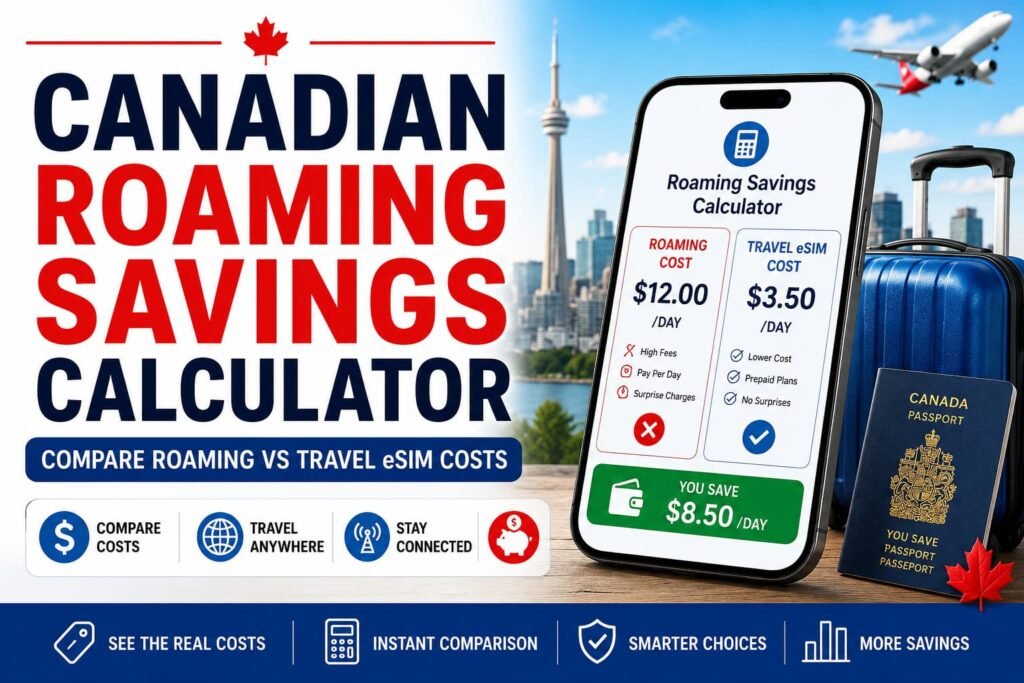
Quick Answer: Is a Travel eSIM Cheaper Than Canadian Roaming?
A travel eSIM is often cheaper than Canadian carrier roaming for longer trips, family travel, Europe trips, Asia trips, Latin America travel, and heavy mobile data use.
Carrier roaming may still be better for very short trips, Canada-U.S. plans, eligible included roaming plans, or travelers who need their Canadian number active for regular calls and texts.
Use the free Canadian Roaming Savings Calculator above to estimate your cost based on your carrier, destination, trip length, data use, and number of travelers.
How to Use the Canadian Roaming Savings Calculator
Start by choosing your Canadian carrier, then select the region where you are travelling. Enter your trip length, expected data use, and the number of travelers or devices that need mobile data.
For best results, be realistic about your data use. Choose light data if you mainly use maps, email, and messaging. Choose medium data if you browse, use social media, and upload some photos. Choose heavy data if you use hotspot, video, cloud backups, or remote-work apps.
Think of this as an travel eSIM calculator for planning trips where you need mobile data, but do not want to guess whether carrier roaming or a travel eSIM will cost less.
After you calculate the result, compare the estimated roaming cost with the estimated travel eSIM cost. If the savings are large, check travel eSIM plans before leaving Canada. If the difference is small, your carrier roaming plan may still be worth using for convenience.
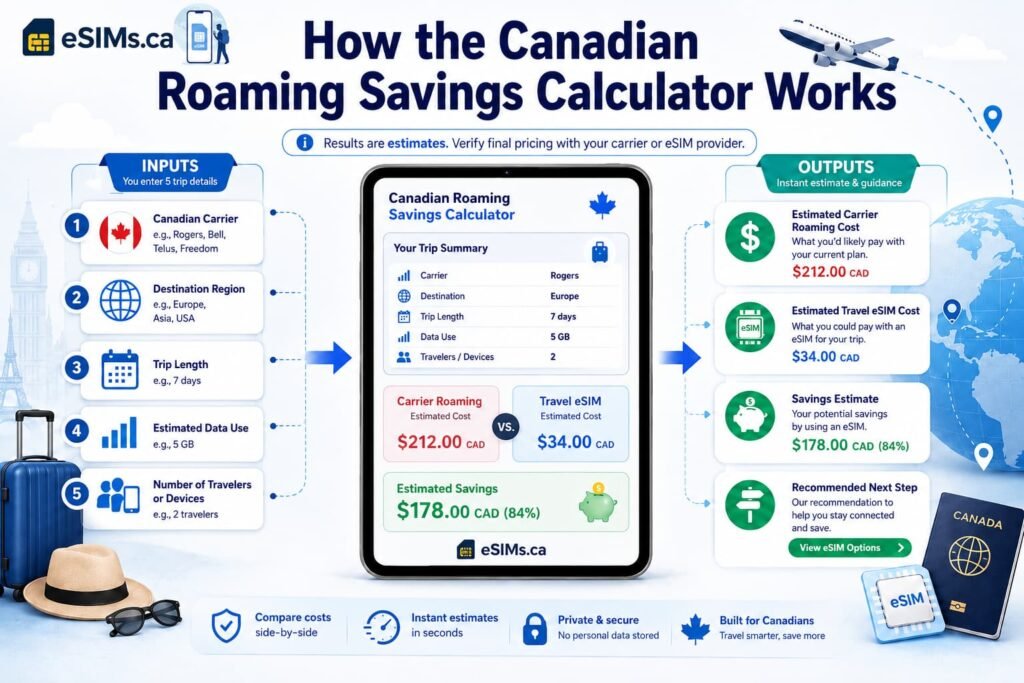
How the Canadian Roaming Savings Calculator Works
The Canadian Roaming Savings Calculator estimates your travel mobile cost using a few simple details:
- your Canadian carrier
- your destination region
- your trip length
- your estimated data use
- the number of travelers or devices
The tool compares an estimated Canadian carrier roaming cost with an estimated travel eSIM cost. This Canadian roaming calculator then gives you a practical savings estimate and a recommended next step based on your trip.
This calculator is not meant to replace official carrier pricing. Roaming rates, taxes, travel passes, included roaming plans, fair-use limits, destination rules, exchange rates, and eSIM promotions can change. The calculator gives you a useful starting point before you check final details with your carrier or eSIM provider.
What Your Calculator Result Means
Your result should be used as a travel planning guide, not a final bill prediction.
If the calculator shows a large estimated savings amount, a travel eSIM is worth comparing before you leave Canada. This is especially true for long trips, family travel, heavy data use, and international destinations outside the United States.
If the calculator shows little or no savings, your Canadian plan may already be a good fit. This can happen if your plan includes roaming, your trip is very short, you are travelling to the United States with a Canada-U.S. plan, or you are with a carrier that includes roaming in your current plan.
If your carrier does not support your destination, install a travel eSIM before departure instead of waiting until you land. This is especially important for prepaid users, unsupported international destinations, and trips where you need data as soon as you arrive.
eSIM vs Roaming: What Is the Difference?
Carrier roaming lets you use your regular Canadian phone plan while travelling outside Canada. Depending on your carrier, roaming may allow your existing Canadian number, data, calls, and texts to work on partner networks abroad.
A travel eSIM works differently. It gives your phone a separate prepaid mobile data plan for the country or region you are visiting. In most cases, travel eSIMs are data-only, which means they are great for maps, messaging apps, browsing, email, hotel apps, rideshare apps, and travel bookings.
For many travelers, the best setup is a hybrid setup:
- use the travel eSIM for mobile data
- keep the Canadian SIM active only if needed for calls, texts, or verification codes
- turn off data roaming on the Canadian SIM
- turn off automatic data switching
- install and test everything before leaving Canada
This setup can reduce roaming charges while still keeping your Canadian number available when you need it.
Why Canadian Roaming Can Get Expensive
Many Canadian carriers charge roaming by the day. That can be convenient, but it becomes expensive when the trip is longer or when more than one person needs service.
The biggest cost drivers are:
- daily roaming fees
- per-line charges for couples and families
- shared family data being used abroad
- hotspot use
- cruise ship or maritime roaming
- trips that cross into a new billing cycle
- accidental background data use
- multiple countries or regions on one trip
A daily fee that seems manageable for one traveler can become expensive for a family of four. A 10-day international trip with multiple devices can quickly cost several hundred dollars if each line triggers daily roaming.
A travel eSIM usually works better when you mainly need mobile data and want a fixed prepaid cost before the trip starts.
Canadian Carrier Roaming vs Travel eSIM Comparison
Here is the basic difference between common travel connectivity options for Canadians.
| Option | Best For | Main Advantage | Main Drawback |
|---|---|---|---|
| Carrier roaming | Short trips and simple setup | Uses your regular Canadian number and plan | Daily fees can add up |
| Travel eSIM | Data-heavy travel, longer trips, and international trips | Often cheaper for mobile data | Usually data-only |
| Included roaming plan | Travelers whose plan already includes roaming | May cost less if already included | Destination and data limits vary |
| Carrier travel add-on | Prepaid or destination-specific use | Can be managed through your carrier account | Rules vary by carrier and destination |
| Local SIM | Long stays in one country | Can offer low local pricing and local number | Requires buying and setting up SIM abroad |
| Hybrid setup | Keeping Canadian number plus cheaper data | Flexible and cost-conscious | Requires correct phone settings |
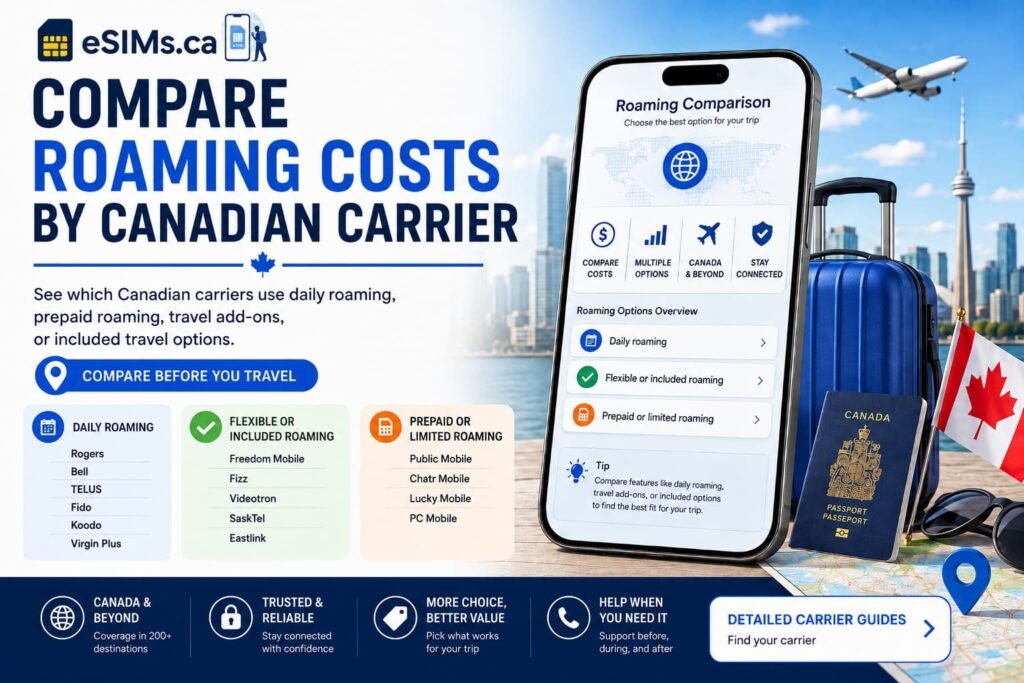
Compare Roaming Costs by Canadian Carrier
Use this table to find your carrier’s detailed roaming comparison after running the calculator. Each guide explains the carrier’s roaming rules, travel eSIM alternatives, setup tips, and situations where roaming may or may not be worth it.
| Canadian Carrier | Roaming Style | Best For | Detailed Guide |
| Rogers | Roam Like Home daily roaming | Short trips and simple setup | Rogers Roam Like Home vs Travel eSIMs |
| Bell | Roam Better daily roaming | Short trips and Canadian number access | Bell Roam Better vs Travel eSIMs |
| TELUS | Easy Roam daily roaming | Convenience and short travel | TELUS Easy Roam vs Travel eSIMs |
| Fido | Fido Roam daily roaming | Rogers-family users and short trips | Fido Roam vs Travel eSIMs |
| Koodo | Easy Roam daily roaming | TELUS-family users and short trips | Koodo Easy Roam vs Travel eSIMs |
| Virgin Plus | Roam Sweet Roam daily roaming | Bell-family users and short trips | Virgin Plus Roam Sweet Roam vs Travel eSIMs |
| Freedom Mobile | Roam Beyond or included roaming on select plans | Travelers with eligible included destinations | Freedom Mobile Roam Beyond vs Travel eSIMs |
| Public Mobile | Prepaid roaming and North America-focused options | Budget users travelling to supported destinations | Public Mobile Roaming vs Travel eSIMs |
| Chatr Mobile | Prepaid roaming add-ons and balances | Light prepaid travel use | Chatr Mobile Roaming vs Travel eSIMs |
| Lucky Mobile | Canada-focused prepaid service | Low-cost Canadian service, not international roaming | Lucky Mobile Roaming vs Travel eSIMs |
| PC Mobile | Prepaid Canadian service with no current roaming support | PC Optimum-focused users in Canada | PC Mobile Roaming vs Travel eSIMs |
| Fizz | Travel Add-ons, Wallet, and coverage-area setup | Quebec and digital-first prepaid users | Fizz Roaming vs Travel eSIMs |
| Videotron | Daily Traveller Pass and travel plans | Quebec and Montreal travelers | Videotron Roaming vs Travel eSIMs |
| SaskTel | Roam & Relax, travel packs, and pay-per-use zones | Saskatchewan travelers wanting carrier support | SaskTel Roaming vs Travel eSIMs |
| Eastlink | easyTravel, travel packs, and pay-per-use fallback | Atlantic Canadian travelers | Eastlink Roaming vs Travel eSIMs |
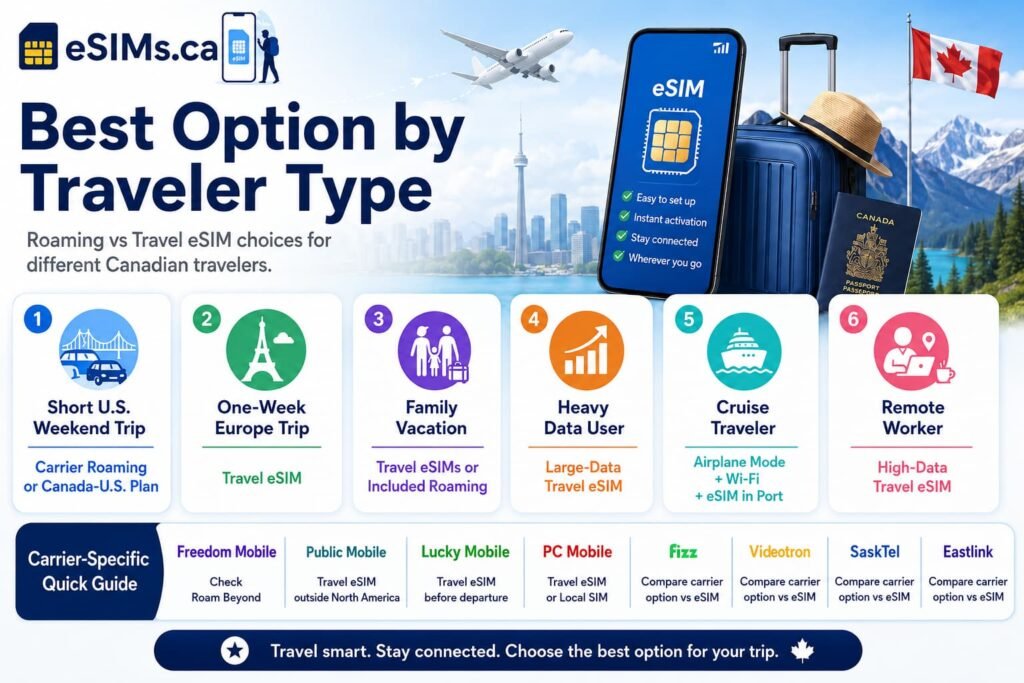
Best Option by Traveler Type
Different travelers need different setups. Use this table after running the calculator.
| Traveler Type | Best Starting Point | Why It Matters |
| Short U.S. weekend trip | Carrier roaming or Canada-U.S. plan | Convenience may matter more than small savings |
| One-week Europe trip | Travel eSIM | Daily roaming fees usually add up quickly |
| Family vacation | Travel eSIMs or included family-friendly roaming | Carrier roaming charges often multiply per line |
| Heavy data user | Large-data or unlimited-style travel eSIM | Hotspot, video, and maps can drain carrier plans fast |
| Freedom Mobile customer | Check Roam Beyond first | Your plan may already include roaming in the destination |
| Public Mobile customer | Travel eSIM outside supported North America options | International support can be limited |
| Lucky Mobile customer | Travel eSIM before leaving Canada | Lucky Mobile is not built for international roaming |
| PC Mobile customer | Travel eSIM or local SIM before travel | PC Mobile does not currently offer international roaming |
| Fizz customer | Compare Fizz Travel Add-on, Wallet, and travel eSIM | Fizz can work well, but setup is more manual |
| Videotron customer | Compare Daily Traveller Pass and travel eSIM | Short supported trips may be convenient |
| SaskTel customer | Travel eSIM for most data-heavy trips | Daily data buckets can be restrictive |
| Eastlink customer | Travel eSIM for longer trips | easyTravel can add up on long travel |
| Cruise traveler | Airplane Mode, cruise Wi-Fi, and eSIM in port | Standard roaming usually does not cover maritime networks |
| Remote worker | High-data travel eSIM | Better control over hotspot and work data |
When a Travel eSIM Usually Saves Money
A travel eSIM is usually worth comparing if:
- your trip is longer than a few days
- you mostly need mobile data, not traditional voice calling
- you are travelling with family
- you are visiting Europe, Asia, Latin America, or multiple countries
- you use maps, messaging apps, email, rideshare apps, and browsing daily
- you need hotspot data
- your Canadian plan does not include your destination
- your prepaid carrier has limited or no international roaming
- you want a fixed prepaid cost before the trip starts
A travel eSIM can also be useful as a backup connection, even if your carrier plan includes some roaming. This is especially helpful if your included roaming data is limited or your destination support is unclear.
When Carrier Roaming May Be Better
Carrier roaming can still be the better option if:
- your trip is very short
- your plan already includes roaming
- you need regular voice calling from your Canadian number
- you do not want to install or manage a separate eSIM
- you are travelling to the United States and already have a Canada-U.S. plan
- you are with Freedom Mobile and your destination is included in your Roam Beyond plan
- you need your Canadian line fully active for work or family reasons
The cheapest option is not always the best option. If your carrier already includes roaming in your plan, or if you only need service for one or two days, carrier roaming may be simpler.
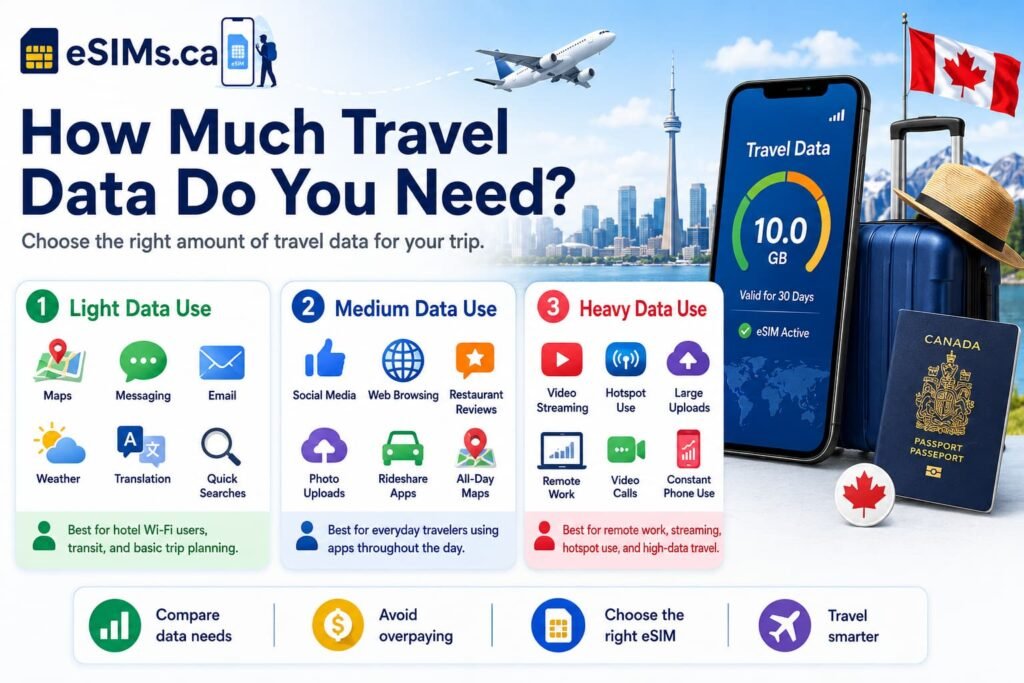
How Much Travel Data Do You Need?
Your estimated data use affects whether roaming or an eSIM is cheaper.
Light Data Use
Light data is usually enough for maps, messaging, email, weather apps, translation apps, and quick searches.
This can work well if you mostly use hotel Wi-Fi and only need mobile data while walking around, using transit, or checking travel details.
Medium Data Use
Medium data is better if you use social media, browse websites, check restaurant reviews, upload some photos, use rideshare apps, and rely on maps throughout the day.
This is the most common option for everyday travelers.
Heavy Data Use
Heavy data is better if you stream video, use hotspot, upload large files, work remotely, use video calls, or rely on your phone constantly while travelling.
In this case, daily carrier roaming can become expensive or drain your domestic data bucket quickly.
Unlimited-Style Data
Unlimited-style travel eSIM plans can be helpful if you do not want to monitor every gigabyte.
However, many unlimited eSIM plans still have fair-use rules, speed reductions, hotspot limits, or video-streaming restrictions. Always read the plan details before buying.
How to Avoid Roaming Charges While Using a Travel eSIM
If you buy a travel eSIM, set up your phone carefully so your Canadian carrier does not accidentally handle mobile data abroad.
On iPhone
- Go to Settings > Cellular.
- Select your Canadian SIM.
- Turn Data Roaming off.
- Install your travel eSIM.
- Set Cellular Data to your travel eSIM.
- Turn off Allow Cellular Data Switching.
- Keep your Canadian line on only if you need calls or texts.
For detailed setup help, use the How to Activate an eSIM on iPhone in Canada guide.
On Android
- Go to Settings > Network & Internet or Connections.
- Open SIMs or SIM Manager.
- Select your Canadian SIM.
- Turn Data Roaming off.
- Install your travel eSIM.
- Set mobile data to the travel eSIM.
- Turn off Auto Data Switching if available.
For detailed setup help, use the Activate eSIM on Android Canada guide.
The exact settings vary by phone brand, but the goal is the same: your travel eSIM should handle mobile data, while your Canadian SIM should not use roaming data unless you intentionally allow it.
Because roaming rates, destination rules, and included plan features can change, always confirm current details with your carrier before travelling. You can check official information from Rogers Roam Like Home, Bell Roam Better, TELUS Easy Roam, and Freedom Mobile Roam Beyond before making your final decision.
What to Do After Using the Calculator
After you run the calculator, use the result as a guide.
If the calculator shows major savings, compare travel eSIM providers before your trip. Good providers to compare include Airalo, Holafly, Nomad, aloSIM, Saily, Ubigi, GigSky, Jetpac, Flexiroam, Yesim, Airhub, Keepgo, and Mobimatter.
If the calculator shows little or no savings, check whether your Canadian plan already includes roaming. This is especially important for Freedom Mobile Roam Beyond, Canada-U.S. plans, premium roaming plans, and prepaid travel add-ons.
If the result is close, think about convenience. Sometimes paying a little more for carrier roaming may be worth it if you need your Canadian number active, regular voice calling, or a simple setup.
If the calculator shows your carrier has limited or no destination support, set up a travel eSIM before leaving Canada.
Two Helpful Tools for Canadian eSIM Users
This Canadian eSIM calculator works best alongside the eSIM Compatibility Checker.
Use the eSIM Compatibility Checker if you are not sure whether your phone can install a travel eSIM.
Use this Canadian Roaming Savings Calculator if you want to compare estimated carrier roaming costs against travel eSIM costs.
Together, these tools answer two important questions:
- Can my phone use eSIM?
- Will I save money by using a travel eSIM instead of roaming?
Frequently Asked Questions About the Canadian Roaming Savings Calculator
Is the Canadian Roaming Savings Calculator free to use?
The Canadian Roaming Savings Calculator is free to use and helps Canadians estimate whether carrier roaming or a travel eSIM may cost less for a trip.
Enter your carrier, destination, trip length, expected data use, and number of travelers to compare estimated costs. Always confirm final prices with your carrier or eSIM provider before buying.
Should I use the calculator before every trip?
It is a good idea to use the calculator before every trip because roaming costs, travel eSIM prices, destination support, and carrier plan rules can change.
A setup that works for a weekend in the United States may not be the best choice for a two-week Europe trip, family vacation, cruise, or multi-country itinerary.
How does the Canadian Roaming Savings Calculator work?
The Canadian Roaming Savings Calculator estimates your potential roaming cost based on your carrier, destination, trip length, expected data use, and number of travelers.
It then compares that estimate with a typical travel eSIM cost so you can quickly see whether roaming or a travel eSIM may be the better starting point for your trip.
What information do I need to use the calculator?
You need your Canadian carrier, destination region, trip length, estimated data use, and number of travelers or devices.
The more realistic your inputs are, the more useful the estimate will be. For example, a solo traveler using light data for maps and messaging will get a very different result from a family using hotspot data every day.
Are the calculator results exact or estimated?
The calculator results are estimates, not guaranteed final prices.
Carrier roaming rates, travel eSIM prices, taxes, promotions, exchange rates, plan inclusions, destination support, and fair-use limits can change. Always verify current pricing before you travel or buy a plan.
Why does the calculator compare roaming and travel eSIMs separately?
Carrier roaming and travel eSIMs work differently.
Roaming connects your Canadian plan to a foreign partner network, while a travel eSIM gives you a separate prepaid data plan for your destination. Comparing them separately helps you decide whether convenience or cost savings matters more for your trip.
Why does the number of travelers matter?
Most Canadian roaming fees apply per line or per device.
A daily roaming fee that looks reasonable for one person can become expensive for a couple or family. The calculator includes travelers because family roaming costs can multiply quickly.
How much can Canadians save by using a travel eSIM instead of roaming?
Savings depend on your carrier, destination, trip length, data use, and number of devices.
Short trips may only save a small amount. Longer international trips, family vacations, Europe trips, Asia trips, Latin America travel, and hotspot-heavy trips can create much larger savings.
When is a travel eSIM usually cheaper than Canadian carrier roaming?
A travel eSIM is usually cheaper when you travel for more than a few days, use a lot of data, visit multiple countries, or travel with family.
It is also useful when your carrier charges daily roaming fees or does not support the destination well. For many travelers, the biggest advantage is predictable prepaid data cost.
When is carrier roaming still better?
Carrier roaming may be better for very short trips, business travel, emergency phone access, or situations where you need your Canadian number active for regular calls and texts.
It can also make sense if your current plan already includes roaming, such as some Canada-U.S. plans or eligible Freedom Mobile Roam Beyond plans.
Can I keep my Canadian number active while using a travel eSIM?
Many modern phones allow your Canadian SIM and travel eSIM to stay active at the same time.
You can use the travel eSIM for data while keeping your Canadian number available for calls or texts, depending on your carrier, phone settings, and destination support. Just make sure your Canadian line is not accidentally using mobile data abroad.
Will I still receive bank verification texts while using a travel eSIM?
You may still receive bank verification texts if your Canadian SIM stays active and your carrier supports receiving SMS in the destination you are visiting.
Because prepaid carriers and unsupported destinations can behave differently, set up backup verification before travelling. Use authenticator apps, backup codes, trusted devices, or email verification whenever possible.
What happens if I leave data roaming on by mistake?
Leaving data roaming on can trigger carrier roaming charges or pay-per-use data charges when your phone connects outside Canada.
Small background actions can be enough to trigger usage, including email syncing, cloud backups, app notifications, widgets, maps, and automatic updates. Turn off data roaming on your Canadian SIM if your travel eSIM is handling mobile data.
Should I turn off my Canadian SIM when using a travel eSIM?
You do not always need to turn it off completely.
Many travelers leave the Canadian SIM on for calls and texts but turn off data roaming on that line. If you want the safest setup, you can disable the Canadian SIM while abroad and rely fully on the travel eSIM plus Wi-Fi apps.
Which SIM should I use for mobile data while travelling?
Your travel eSIM should usually be set as the main mobile data line while you are outside Canada.
Keep your Canadian SIM away from mobile data unless you intentionally want to use carrier roaming. Turn off automatic data switching so your phone does not switch back to your Canadian carrier by mistake.
Why did my carrier charge me even though I barely used my phone?
Daily roaming can be triggered by small actions like sending a text, answering a call, checking voicemail, or using background data.
Even if you barely touch your phone, apps and system services may connect in the background. This is why dual-SIM setup and roaming settings matter before you travel.
What should cruise travelers do to avoid roaming charges?
Cruise travelers should be extra careful because standard Canadian carrier roaming usually does not cover maritime satellite networks.
Use Airplane Mode while at sea, connect to cruise Wi-Fi if needed, and use a travel eSIM only while in port where regular mobile networks are available. Do not rely on normal roaming while the ship is away from land-based towers.
Does this calculator replace official carrier pricing?
The calculator does not replace official pricing.
Use it as a quick planning tool, then confirm the final roaming rate, travel pass, destination support, taxes, fair-use limits, and eSIM plan details before you buy or travel.
Related eSIM Canada Guides
Main eSIM and Travel Guides
- eSIM Canada: Best Providers, Setup & Guide for Travelers & Locals
- Best eSIM for International Travel
- Compare Canadian eSIM Providers
- eSIM Compatibility Checker
Popular Travel eSIM Provider Reviews
- Airalo eSIM Review
- Holafly eSIM Review
- Nomad eSIM Review
- aloSIM eSIM Review
- Saily eSIM Review
- eSIM Providers by Country
Setup and Troubleshooting Guides
- How to Activate eSIM on Samsung Galaxy in Canada
- How to Activate eSIM on Motorola Phones
- How to Activate eSIM on Google Pixel in Canada
- How to Fix eSIM Not Working in Canada
- What to Do If eSIM Activation Fails in Canada
- How to Reinstall or Reactivate an eSIM in Canada
Final Thoughts
The Canadian Roaming Savings Calculator is built to give you a clearer starting point before you travel. Instead of guessing whether your Canadian carrier roaming plan is “good enough,” you can compare the estimated cost against a travel eSIM and see which option makes more sense for your trip.
For short trips, included roaming plans, or Canada-U.S. travel, your regular carrier may still be the easiest choice. But for longer vacations, family trips, Europe travel, Asia travel, Latin America travel, hotspot use, cruise ports, and data-heavy trips, a travel eSIM can often give you better cost control.
The smartest setup is not always one or the other. Many Canadians use their regular SIM for calls, texts, or verification codes, then use a travel eSIM for mobile data. That hybrid setup can help you keep your Canadian number available while avoiding unnecessary roaming data charges.
Before your next trip, run the calculator, check your carrier’s roaming rules, confirm your phone supports eSIM, and set up your device before leaving Canada. A few minutes of planning can save money, avoid surprise charges, and help you land with a working data connection.