Bought a Metro by T-Mobile phone in the U.S. and now trying to use it in Canada?
You are not alone.
A lot of Canadians run into problems after buying Metro phones during U.S. trips, ordering discounted devices online, or picking up used Metro phones from Facebook Marketplace, eBay, or Amazon refurbished sellers.
At first, everything may look compatible. The phone shows Add eSIM, supports 5G, and appears unlocked. Then the problems start.
Maybe Rogers or TELUS cannot activate the eSIM. Maybe a travel eSIM like Airalo installs but never connects properly. Sometimes VoLTE fails, hotspot access disappears, or the phone cannot connect to Canadian 5G bands correctly.
That confusion is exactly why this guide exists.
Yes, MetroPCS, now called Metro by T-Mobile, supports eSIM on many newer iPhone and Android devices. But for Canadians, compatibility depends on much more than simply having eSIM hardware.
Things like unlock status, LTE Band 66 support, firmware region, IMEI restrictions, VoLTE certification, and carrier provisioning can all affect whether a Metro phone works properly in Canada.
This guide explains what Canadians and travelers actually need to know before using Metro by T-Mobile eSIM in Canada, switching carriers, buying a used Metro phone, or installing a travel eSIM like Airalo or Holafly.
Who This Guide Is For
This guide is especially useful if you:
- bought a Metro by T-Mobile phone in the U.S.
- are visiting Canada with a Metro device
- want to use a travel eSIM on a Metro phone
- are switching from Metro to a Canadian carrier
- bought a used Metro phone from Facebook Marketplace or eBay
- see “Add eSIM” on your phone but activation still fails
- want to know whether your Metro phone supports Canadian 5G and VoLTE
Does MetroPCS Have eSIM Support?
Yes. Metro by T-Mobile supports eSIM on many modern smartphones, including newer iPhones, Samsung Galaxy phones, Google Pixel devices, and selected Motorola phones.
Metro activation may happen through QR code setup, Metro account provisioning, in-app activation, or manual activation support.
However, eSIM support depends on more than just the phone model itself.
A phone may technically support eSIM hardware while still failing activation because of carrier restrictions, original sales region, firmware limitations, lock status, IMEI restrictions, or unsupported Canadian network features.
Metro by T-Mobile also explains compatible devices and activation requirements through its official eSIM support documentation.
Can Metro by T-Mobile eSIM Work in Canada?
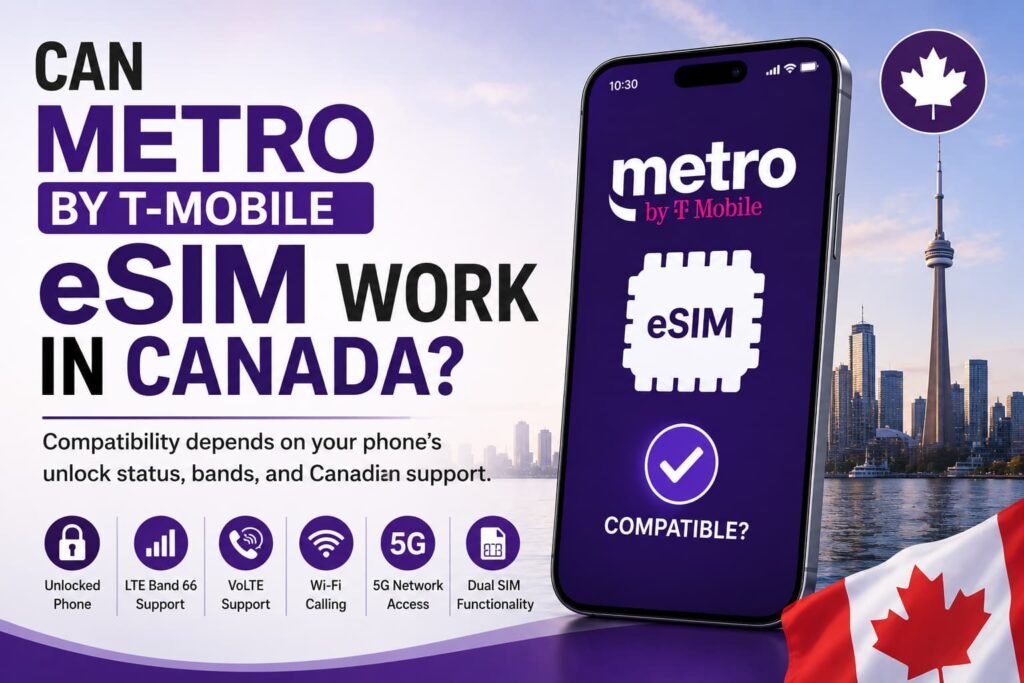
Yes, many Metro phones can work in Canada, especially when they are fully unlocked.
Still, compatibility is not guaranteed.
Some Metro devices work extremely well with Canadian carriers, while others may lose features like VoLTE, Wi-Fi Calling, hotspot support, 5G access, or dual SIM functionality.
The biggest factors are unlock status, LTE Band 66 compatibility, Canadian VoLTE support, firmware region, carrier provisioning, and original Metro restrictions.
Canadian Carrier Compatibility on Unlocked Metro Phones
| Canadian Carrier | Usually Works on Unlocked Metro Phones? | Notes |
|---|---|---|
| Rogers | Usually | LTE Band 66 important |
| Bell | Usually | VoLTE support may vary |
| TELUS | Usually | Firmware differences matter |
| Fido | Usually | Similar compatibility to Rogers |
| Freedom Mobile | Sometimes | Regional support varies |
| Koodo | Usually | Unlock status important |
| Virgin Plus | Usually | VoLTE may vary |
| Public Mobile | Usually | LTE support matters |
If you are unsure whether your phone supports Canadian eSIM properly, check our Phone Supports eSIM But Not Working in Canada guide.
Can You Use Travel eSIMs on Metro Phones?
In many cases, yes.
Unlocked Metro phones often work well with travel eSIM providers like Airalo, Holafly, Nomad, aloSIM, Ubigi, Saily, GigSky, Jetpac, and Mobimatter.
This is especially common on unlocked iPhones, Google Pixel devices, Samsung Galaxy S series phones, and Motorola Razr devices.
Still, users often confuse seeing the “Add eSIM” option with true compatibility.
A phone may display Add eSIM while still failing activation because the phone remains carrier locked, the IMEI is restricted, the firmware blocks certain carriers, Metro provisioning is incomplete, or the device lacks proper Canadian VoLTE support.
Travel eSIMs also behave differently from Canadian carrier eSIMs.
Metro Roaming in Canada vs Travel eSIMs
This is one of the biggest areas of confusion for Metro users visiting Canada.
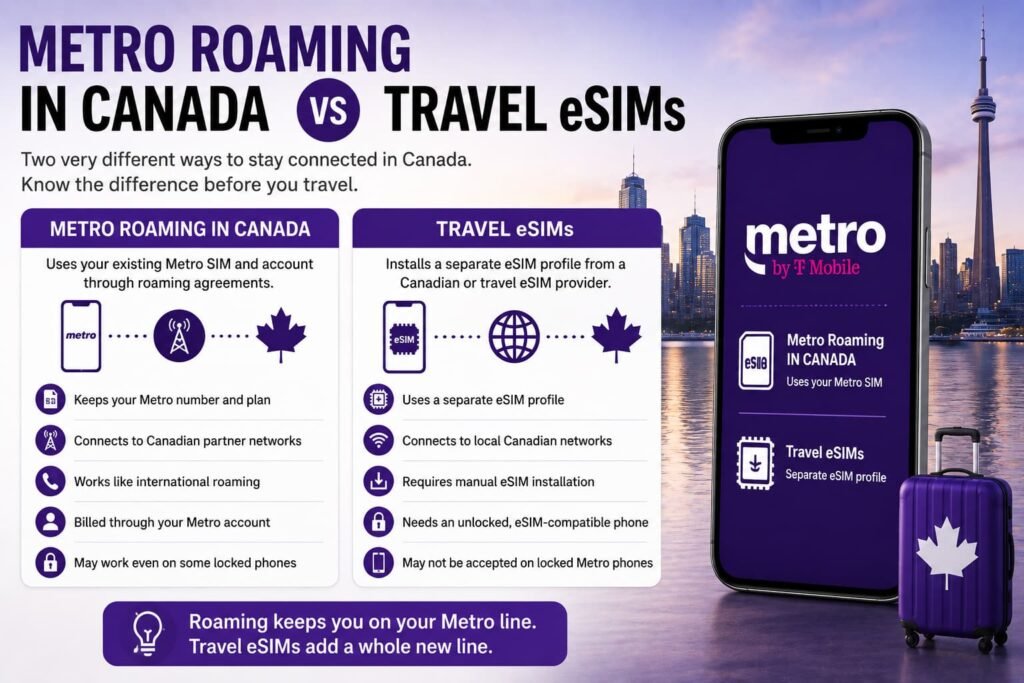
Using Metro roaming in Canada is completely different from installing a Canadian or travel eSIM. When roaming is enabled, the Metro SIM stays active and connects to Canadian partner towers through Metro roaming agreements. In that situation, the phone continues using the original Metro line and account provisioning.
Travel eSIMs work differently because they install a completely separate eSIM profile onto the device. That means the phone must allow manual eSIM provisioning and support outside carrier profiles properly. Some locked Metro phones may still roam successfully in Canada while rejecting travel eSIM installation entirely.
This is why some users assume their phone fully supports eSIM because roaming works normally, only to discover later that Airalo, Holafly, or Canadian carrier eSIMs fail activation.
Most travel eSIM providers are data-only, app-based, QR-code activated, and optimized for temporary roaming.
Canadian carrier eSIMs often require account verification, carrier provisioning, VoLTE certification, and regional compatibility.
If you are comparing providers, see our Airalo eSIM Review and Best eSIM for International Travel guide.
Metro Locked Phones and eSIM Restrictions
This is one of the biggest problems Canadians run into with Metro devices.
A Metro phone can support eSIM hardware perfectly while still rejecting Canadian carrier eSIMs, travel eSIM installations, dual SIM activation, or carrier switching.
That usually happens because the device remains locked to Metro by T-Mobile.
Some users buy used Metro phones believing they are unlocked, only to discover the phone still has financing restrictions, the unlock policy requirements were not completed, the IMEI is restricted, or another carrier cannot provision eSIM correctly.
Even worse, some Android phones still show Add eSIM even when activation will fail afterward.
Metro by T-Mobile also explains its official device unlock requirements through its official device unlock policy documentation.
Metro eSIM Compatibility on iPhone and Android
iPhone
Most iPhones from the iPhone XR and newer support eSIM.
Canadian users generally have the best experience on iPhone 13 series, iPhone 14 series, iPhone 15 series, iPhone 16 series, and newer eSIM-first iPhones.
Still, regional differences matter.
Some U.S. iPhones are eSIM-only, dual eSIM capable, and provisioned differently from Canadian models.
If you need setup help, follow our How to Activate eSIM on iPhone in Canada guide.
Samsung Galaxy
Samsung compatibility can become messy quickly because firmware and CSC regions matter heavily.
Generally, Galaxy S series, Galaxy Z Fold, and Galaxy Z Flip devices work best.
Some imported or carrier-branded models may hide Add eSIM, block certain carriers, lose dual SIM support, or fail Canadian provisioning.
If you need help with Samsung setup or SIM Manager issues, follow our How to Activate eSIM on Samsung Galaxy in Canada guide.
Google Pixel
Google Pixel devices usually offer one of the cleanest eSIM experiences on Android.
Most Pixel 7 and newer devices work very well in Canada, especially when unlocked.
Still, imported regional variants may behave differently depending on firmware, carrier restrictions, and VoLTE provisioning.
For setup help, see our How to Activate eSIM on Google Pixel in Canada guide.
Motorola
Motorola compatibility varies heavily depending on the model family.
The most reliable choices are usually Razr series and Edge series phones.
Moto G devices are much less predictable because support varies by region, firmware, carrier edition, and prepaid restrictions.
For setup help, see our How to Activate eSIM on Motorola Phones in Canada guide.
Why Some Metro Phones Fail eSIM Activation in Canada
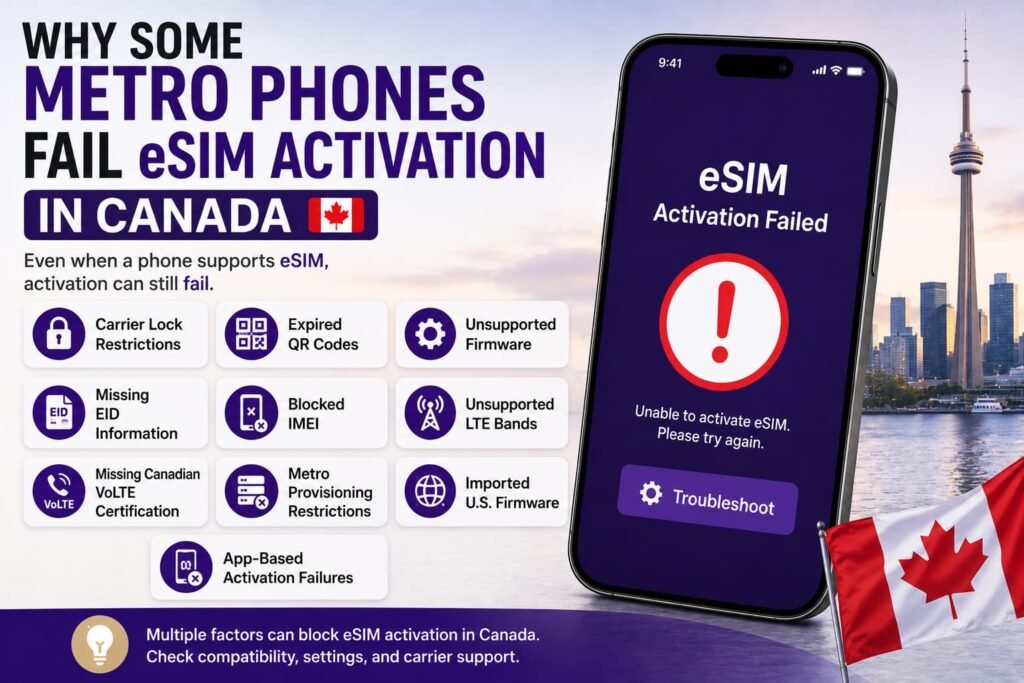
Even when a phone technically supports eSIM, activation can still fail.
Common causes include carrier lock restrictions, expired QR codes, unsupported firmware, missing EID information, blocked IMEI, unsupported LTE bands, missing Canadian VoLTE certification, Metro provisioning restrictions, imported U.S. firmware, and app-based activation failures.
Why Mobile Data Sometimes Fails Even After eSIM Activation
Some Metro phones successfully install a Canadian or travel eSIM profile but still fail mobile data afterward.
This is especially common on imported Android phones and carrier-branded prepaid devices where the phone keeps older Metro network settings instead of switching properly to the new carrier profile.
In some situations, the eSIM itself installs correctly but the phone still cannot authenticate properly on Canadian towers because of APN conflicts, roaming restrictions, VoLTE problems, or provisioning mismatches.
Common causes include:
- incorrect APN settings
- roaming disabled in settings
- old Metro carrier profiles remaining active
- unsupported Canadian VoLTE provisioning
- firmware restrictions on prepaid Android devices
- the phone failing to refresh tower authentication after crossing the border
Sometimes a simple restart fixes the issue after entering Canada because the device drops the original T-Mobile signal and reconnects to Canadian partner networks more cleanly.
Quick Troubleshooting Checklist
Before assuming the phone is incompatible, check:
- Is the phone fully unlocked?
- Does the phone show an EID?
- Is Add eSIM available?
- Is the IMEI clean?
- Does the device support LTE Band 66?
- Is the phone updated to the latest software?
- Was the QR code already used?
- Does the Canadian carrier support that exact model?
- Is VoLTE enabled and supported?
- Was the device imported from another region?
If activation still fails, follow our How to Fix eSIM Not Working in Canada guide.
What to Check Before Buying a Used Metro Phone
Used Metro phones can be a good deal, but they can also create major eSIM headaches.
Before buying one from Facebook Marketplace, eBay, Amazon Marketplace, or refurbished sellers, always verify the exact model number, EID availability, IMEI2 support, unlock status, clean IMEI, LTE Band 66 support, VoLTE compatibility, original sales region, and firmware restrictions.
Metro Phone Red Flags
Be careful if:
- the seller cannot confirm the unlock status
- EID information is missing
- Add eSIM does not appear
- the phone was heavily carrier customized
- the device came from a prepaid bundle
- the IMEI is blacklisted
- the phone lacks Canadian LTE support
This is especially important for imported Samsung and Motorola devices.
Frequently Asked Questions About MetroPCS eSIM
Does MetroPCS support eSIM on iPhone?
Metro by T-Mobile supports eSIM on many newer iPhone models, including most iPhone XR and newer generations. In real-world use, newer iPhones usually provide the smoothest Metro eSIM experience because Apple handles eSIM provisioning more consistently across regions compared to many Android devices.
Still, Canadians using Metro iPhones can run into problems depending on the original sales region, carrier lock status, and firmware restrictions. Some U.S. iPhone models are fully eSIM-only, while Canadian versions may still include physical SIM support alongside eSIM. Before switching carriers or installing a travel eSIM, it is important to confirm the phone is unlocked, updated to the latest iOS version, and compatible with Canadian VoLTE and LTE bands.
Can Metro phones work in Canada?
Many unlocked Metro phones work very well in Canada, especially newer iPhones, Google Pixel devices, and flagship Samsung Galaxy models. In many cases, users can activate Rogers, Bell, TELUS, Fido, Koodo, or Public Mobile service without major problems.
The bigger issue is that compatibility is not always identical across all Metro devices. Some imported or prepaid-specific phones may lack proper Canadian VoLTE support, LTE Band 66 compatibility, or regional firmware support. This is one of the main reasons some users experience dropped calls, missing 5G access, hotspot restrictions, or eSIM activation failures even when the phone technically supports eSIM.
Can I use Airalo on a Metro phone?
Airalo and other travel eSIM providers often work well on unlocked Metro phones, especially on newer iPhones, Pixels, and premium Samsung Galaxy devices. Travelers commonly use Metro phones with travel eSIMs while visiting Canada, Europe, South America, and other destinations because travel eSIMs are usually easier to install than full carrier eSIM setups.
Problems usually happen when the Metro phone is still carrier locked or running heavily customized prepaid firmware. Some users also assume that seeing “Add eSIM” means every provider will work automatically, but that is not always true. A phone may support travel eSIM installation while still failing activation with Canadian carriers because carrier provisioning and VoLTE certification requirements are different.
Why does my Metro phone show Add eSIM but not activate?
This is one of the most common problems people run into with imported or prepaid Metro phones. The phone may technically support eSIM hardware and still display the Add eSIM option in settings, but activation can fail afterward because of carrier locks, firmware restrictions, IMEI provisioning rules, or unsupported Canadian network settings.
Another common issue is regional firmware differences. Some U.S. carrier-branded Android devices hide or restrict certain eSIM functions even when the hardware itself supports dual SIM or eSIM. In other cases, the phone may connect to data but fail VoLTE activation, hotspot functionality, or Canadian 5G access.
Some Metro-branded Android phones may also install a Canadian or travel eSIM correctly but fail mobile data because the phone keeps older Metro APN settings instead of switching automatically. This can create a confusing situation where the eSIM appears active but mobile data never works properly.
This is why checking unlock status and Canadian compatibility matters more than simply checking whether Add eSIM appears in settings.
Are Metro phones locked?
Many Metro by T-Mobile devices remain locked for a period of time after purchase, especially prepaid phones sold through promotional deals or bundled plans. This becomes a major issue for Canadians who buy used Metro devices online without verifying the unlock status first.
Even when the phone supports eSIM, a locked Metro device may reject Canadian carrier activation or prevent travel eSIM installation entirely. Some users only discover the restriction after trying to activate Rogers, TELUS, Bell, or a travel eSIM provider like Airalo or Holafly. Before buying a used Metro phone, it is always safer to confirm the IMEI is clean, the device is fully unlocked, and the seller can verify the original account restrictions have been removed.
Can I switch from Metro to Rogers or TELUS?
Most newer unlocked Metro phones can work with Rogers or TELUS in Canada, especially flagship iPhones, Pixels, and Samsung Galaxy devices. In many situations, users can activate a Canadian eSIM normally once the phone is fully unlocked and compatible with Canadian LTE and 5G bands.
The experience is not always identical across every phone model, though. Some imported devices may lose Wi-Fi Calling, VoLTE support, hotspot access, or portions of Canadian 5G compatibility because of firmware restrictions or carrier provisioning differences. This is especially common on heavily carrier-customized Android phones originally sold through prepaid promotions.
Do Metro phones support Canadian 5G?
Some Metro phones support Canadian 5G very well, particularly newer flagship models from Apple, Samsung, and Google. Devices that support the proper Canadian LTE and 5G bands can often connect normally on Rogers, Bell, TELUS, and their flanker brands.
Older prepaid devices and lower-cost imported phones are more unpredictable. Some may connect to LTE properly but miss important Canadian 5G bands or experience weaker VoLTE support. This is why checking the exact model number matters so much before buying a used Metro device for Canadian use.
Can I use dual SIM on Metro devices?
Many newer Metro-compatible phones support dual SIM or dual eSIM functionality, especially newer iPhones and premium Samsung Galaxy devices. This can be extremely useful for Canadians who want to keep a U.S. Metro line active while also using a Canadian carrier or travel eSIM.
Still, dual SIM functionality is not always guaranteed on imported or carrier-branded models. Some phones may technically support dual SIM hardware while firmware restrictions limit how eSIM profiles work in real-world use. In some cases, users can install two eSIMs but only one line may support full VoLTE or 5G access at a time.
Does Metro support QR code activation?
Metro by T-Mobile commonly supports QR code eSIM activation on compatible phones. Most newer iPhones and Android devices can scan a QR code directly through the eSIM setup section in settings, although some activations may also require account verification through Metro support or the Metro app.
Users sometimes run into problems when reusing expired QR codes or attempting activation on devices that are still carrier locked. If activation fails repeatedly, it is often worth checking whether the phone is fully unlocked, updated to the latest software version, and properly provisioned for eSIM use.
How do I check if my Metro phone supports eSIM?
The safest way to verify Metro eSIM compatibility is to check more than just the phone model name. Many users assume all versions of a device support eSIM equally, but compatibility can change depending on the original carrier, firmware region, and prepaid restrictions.
A proper compatibility check should include the exact model number, EID availability, unlock status, LTE Band 66 support, VoLTE compatibility, and Canadian carrier support. This is especially important for imported Samsung, Motorola, and prepaid Android devices where eSIM support may vary heavily between regional variants.
More Helpful eSIM Guides for Canada
Check Your Device First
Fix eSIM Activation Problems
Set Up eSIM by Device
Final Thoughts
So, does MetroPCS have eSIM support?
Yes, Metro by T-Mobile supports eSIM on many modern iPhones and Android phones, but Canadian compatibility depends on much more than simply having eSIM hardware. Unlock status, firmware region, VoLTE support, LTE Band compatibility, and Metro provisioning restrictions can all affect whether the phone works properly once you cross the border or try switching carriers.
For most Canadians, newer unlocked iPhones, Pixels, and flagship Samsung devices provide the smoothest experience. Older prepaid Android phones and imported carrier-branded devices are far more unpredictable, especially when using Canadian carrier eSIMs or travel eSIM providers like Airalo and Holafly.
Before buying a used Metro phone or switching to a Canadian carrier, it is always safer to verify the exact model number, EID support, unlock status, and Canadian network compatibility first.