Most travel eSIM providers are easy to compare.
Airhub is not.
At first glance, some of the pricing looks surprisingly cheap compared to providers like Holafly, GigSky, or Ubigi.
But once you start digging into the plans, things become less straightforward.
That is because Airhub works more like a marketplace than a traditional eSIM provider.
Instead of offering one consistent experience, it gives you access to multiple providers, different pricing structures, and varying network partnerships depending on where you travel.
In some destinations, that flexibility can lead to excellent pricing and strong value. In others, the experience can feel less polished or predictable compared to simpler providers like Saily or aloSIM.
In this Airhub eSIM review, you will see how the platform works, how pricing compares across different regions, what kind of performance to expect, and whether Airhub is actually worth using for international travel.

Airhub eSIM Review: What You Need to Know
Airhub is built around flexibility.
Unlike providers that offer one standard experience across all destinations, Airhub gives travelers access to multiple eSIM plans from different partner providers through a marketplace-style platform.
That means:
- more plan choices
- wider pricing variation
- different regional options
- varying performance depending on provider
In some destinations, Airhub can be significantly cheaper than providers like Holafly or GigSky.
In other regions, the experience can feel less consistent because plan quality depends heavily on which carrier or provider is being used behind the scenes.
This makes Airhub more appealing for travelers who are comfortable comparing plans and looking for better pricing rather than simply choosing the easiest option.
Compared to beginner-friendly providers like Saily or aloSIM, Airhub requires slightly more attention during the buying process.
The tradeoff is flexibility.
Is Airhub eSIM Worth It for Travel?
Airhub can absolutely be worth it if pricing flexibility matters more than having the most polished experience.
In many destinations, the platform offers lower-cost plans and more variety than providers that use a fixed pricing structure.
Airhub is a good fit for:
- travelers comparing multiple pricing options
- users comfortable choosing between providers
- trips where lower pricing matters more than simplicity
- travelers looking for regional flexibility
It may not be the best option if:
- finding the lowest predictable pricing matters most, compare plans in the Airalo eSIM review
- structured regional plans are more important, see the Nomad eSIM review
- you want the simplest possible setup, read the Saily eSIM review
- stable performance is the priority, see the Ubigi eSIM review
- unlimited data is required, check the Holafly eSIM review
- you prefer predictable pricing, explore the aloSIM eSIM review
- premium global reliability matters most, read the GigSky eSIM review
The biggest advantage with Airhub is choice.
The biggest downside is that not every plan performs equally well.
What Airhub eSIM Is and How It Works
Airhub is a global eSIM marketplace headquartered in San Francisco, California, that allows travelers to purchase digital data plans for different countries and regions.
Instead of operating one unified network experience, Airhub connects users with plans from different providers and carrier partners depending on the destination.
That marketplace approach creates more variation than most eSIM providers.
Some plans prioritize lower pricing.
Others focus on larger data allowances.
Some perform very well in cities but less consistently outside major travel hubs.
Setup works similarly to most eSIM providers:
- choose a destination and plan
- purchase the eSIM
- install using QR code or app instructions
- activate the eSIM when you arrive
Like most travel eSIM providers, Airhub is data-only.
Apps like WhatsApp, FaceTime, Telegram, iMessage, and Google Maps continue working normally.
You can browse plans directly on the official Airhub website.
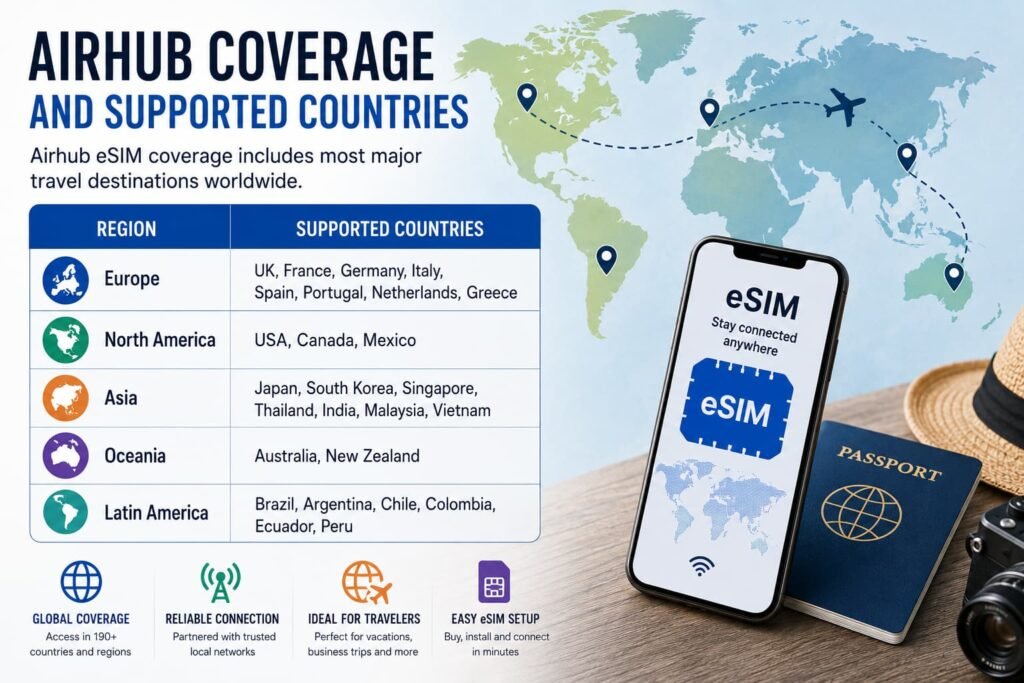
Airhub Coverage and Supported Countries
Airhub eSIM coverage includes most major travel destinations worldwide.
| Region | Supported Countries |
|---|---|
| Europe | UK, France, Germany, Italy, Spain, Portugal, Netherlands, Greece |
| North America | USA, Canada, Mexico |
| Asia | Japan, South Korea, Singapore, Thailand, India, Malaysia, Vietnam |
| Oceania | Australia, New Zealand |
| Latin America | Brazil, Argentina, Chile, Colombia, Ecuador, Peru |
Coverage quality depends heavily on which local carrier and provider the specific plan uses.
In major cities and common travel routes, connectivity is usually stable enough for maps, messaging, browsing, and general travel use.
Performance can become less predictable in:
- rural areas
- smaller towns
- remote regions
- destinations with weaker infrastructure
Coverage across Europe is generally strong due to mature carrier infrastructure and dense network availability.
South America can vary more depending on the country and provider.
If you want to compare providers and destinations more closely, see the eSIM Providers by Country.
Airhub Data Plans Explained
Airhub offers a mix of:
- fixed data plans
- regional plans
- marketplace provider plans
- varying duration options
Unlike providers with a highly standardized structure, Airhub allows multiple providers to compete within the same platform.
That means you may find:
- cheaper short-term plans
- larger data packages
- regional bundles
- promotional pricing
- different carrier combinations
This flexibility is one of Airhub’s biggest advantages.
At the same time, it creates more complexity because travelers need to compare plans carefully.
Some plans are excellent value.
Others are less competitive.
Compared to Nomad or Airalo, Airhub feels less structured but potentially more flexible.
Airhub Pricing and Plan Costs
Pricing is one of the main reasons travelers consider Airhub.
Because the platform works more like a marketplace, pricing can vary significantly depending on:
- the destination
- the provider behind the plan
- regional carrier partnerships
- promotional offers available at the time
In some countries, Airhub can be noticeably cheaper than premium providers.
In other regions, pricing differences are smaller, especially when comparing plans with stronger carrier partnerships or higher data allowances.
Example pricing by destination:
| Destination | Data | Duration | Price (USD) |
|---|---|---|---|
| USA | 10GB | 30 Days | ~$12–$20 |
| Canada | 10GB | 30 Days | ~$18–$28 |
| Mexico | 5GB | 30 Days | ~$12–$18 |
| India | 10GB | 30 Days | ~$9–$16 |
| Japan | 10GB | 30 Days | ~$15–$24 |
| Thailand | 5GB | 30 Days | ~$10–$16 |
| South Korea | 10GB | 30 Days | ~$14–$22 |
| Europe Regional | 10GB | 30 Days | ~$16–$28 |
| Brazil | 5GB | 30 Days | ~$18–$30 |
| Argentina | 5GB | 30 Days | ~$18–$28 |
| South Africa | 5GB | 30 Days | ~$16–$26 |
| Kenya | 3GB | 30 Days | ~$12–$20 |
| Egypt | 5GB | 30 Days | ~$14–$24 |
| Australia | 10GB | 30 Days | ~$18–$30 |
Coverage across Europe includes destinations like the UK, France, Germany, Italy, and Spain, where stronger carrier competition often leads to more stable pricing and better overall speeds.
Coverage across Asia can vary more depending on the country and provider. In destinations like India, Thailand, and South Korea, some plans offer excellent value while others prioritize larger data allowances over speed consistency.
Africa shows even more variation.
Pricing and performance in countries like South Africa, Kenya, and Egypt depend heavily on local carrier infrastructure and roaming agreements. Some plans perform surprisingly well in cities, while rural coverage can become less predictable.
Typical pricing tiers:
- 1GB plans usually range from around $3 to $8
- 5GB plans typically range from around $10 to $22
- 10GB plans generally range from around $15 to $35
- larger regional plans can vary significantly depending on provider and destination
Compared to providers like Holafly or GigSky, Airhub often competes more aggressively on pricing.
The tradeoff is consistency.
Because multiple providers operate inside the marketplace, plan quality and network performance can vary more than with providers using a tightly controlled platform.
That flexibility is part of the appeal, but it also means travelers should compare plans carefully before purchasing.
For the latest plans and pricing, it’s worth checking the official Airhub pricing page before purchasing.

Airhub Speeds and Real World Performance
Airhub performance depends heavily on which local carrier and provider a specific plan uses.
That means real-world performance varies more than providers with tighter infrastructure control.
In major cities and airports, speeds are usually strong enough for:
- maps and navigation
- messaging apps
- browsing and email
- video calls
- social media
- light streaming
You can typically expect:
- 4G LTE in most destinations
- 5G in supported cities
- lower latency in many regions because plans often connect directly through local carriers
- stable city performance on stronger networks
Where things become less predictable is when:
- moving between regions
- using lower-cost marketplace plans
- traveling outside major cities
- switching between partner networks
Some plans perform surprisingly well.
Others feel slower or less stable depending on how traffic is routed.
Compared to Ubigi or GigSky, Airhub focuses more on pricing flexibility than network consistency.
Real-world speeds vary significantly depending on the provider behind the plan. In many destinations, users report speeds ranging from around 20 Mbps to 50 Mbps, which is enough for navigation, video calls, browsing, and streaming. Faster speeds are possible in stronger 5G markets, but performance is not as consistently fast as providers like Ubigi.
That distinction is important.
Airhub works best when travelers understand they are trading some predictability for potentially better pricing.
Airhub vs Other eSIM Providers
Airhub vs Airalo
Airhub and Airalo differ mainly in pricing structure and marketplace flexibility.
Airalo focuses on a more structured experience with standardized plans.
Airhub focuses on provider variety and deal-style pricing.
- If you want a cleaner and more predictable experience, Airalo is the better option. You can compare pricing in the Airalo eSIM review.
- If you prefer browsing multiple pricing options, Airhub offers more flexibility.
Quick take: Airalo for structure, Airhub for marketplace pricing.
Airhub vs Nomad
Airhub and Nomad differ mainly in organization versus flexibility.
Nomad focuses on structured regional plans.
Airhub focuses on broader marketplace variation.
- If you want simpler regional pricing, Nomad is easier to manage. I break that down in the Nomad eSIM review.
- If you want more provider choices and pricing variation, Airhub is the better fit.
Quick take: Nomad for structure, Airhub for pricing flexibility.
Airhub vs Yesim
Airhub and Yesim differ mainly in marketplace flexibility versus user experience.
Yesim focuses on cleaner plan structure and guided setup.
Airhub focuses on provider choice and pricing variety.
- If you want a more polished experience, Yesim is easier to use. You can see how that works in the Yesim eSIM review.
- If comparing provider pricing matters more, Airhub offers more flexibility.
Quick take: Yesim for experience, Airhub for marketplace flexibility.
Airhub vs Ubigi
Airhub and Ubigi differ mainly in consistency versus pricing.
Ubigi focuses on stable connectivity and reliable routing.
Airhub focuses on lower pricing and provider flexibility.
- If connection stability matters most, Ubigi is the stronger option. You’ll see why in the Ubigi eSIM review.
- If lower pricing and more provider options matter more, Airhub is the better fit.
Quick take: Ubigi for reliability, Airhub for pricing flexibility.
Airhub vs Holafly
Airhub and Holafly differ mainly in pricing structure and data usage.
Holafly focuses heavily on unlimited data plans with a more standardized experience.
Airhub focuses on flexible marketplace pricing with multiple provider options.
Holafly focuses on unlimited data.
Airhub focuses on cheaper marketplace plans.
- If unlimited data is important, Holafly is the better option. I explain how that works in the Holafly eSIM review.
- If you want lower pricing and more plan variety, Airhub is more flexible.
Quick take: Holafly for unlimited data, Airhub for deal pricing.
Airhub vs Saily
Airhub and Saily differ mainly in simplicity versus marketplace flexibility.
Saily focuses on guided setup and fewer decisions.
Airhub focuses on provider variety and pricing flexibility.
- If you want the easiest possible setup, Saily is the better choice. You can see how that works in the Saily eSIM review.
- If you prefer comparing plans and providers, Airhub offers more flexibility.
Quick take: Saily for simplicity, Airhub for flexibility.
Airhub vs aloSIM
Airhub and aloSIM differ mainly in predictability versus marketplace choice.
aloSIM focuses on straightforward plans and predictable pricing.
Airhub focuses on provider variety.
- If you want simple predictable pricing, aloSIM is the easier option. You can explore that in the aloSIM eSIM review.
- If you want access to more plan combinations, Airhub offers more flexibility.
Quick take: aloSIM for predictability, Airhub for marketplace flexibility.
Airhub vs GigSky
Airhub and GigSky target very different travelers.
GigSky focuses on premium global reliability.
Airhub focuses on lower-cost marketplace flexibility.
- If stable premium connectivity matters most, GigSky is the stronger option. I go deeper into that in the GigSky eSIM review.
- If lower pricing and more provider options matter more, Airhub is the better fit.
Quick take: GigSky for premium reliability, Airhub for pricing flexibility.
Best Use Cases for Airhub
Airhub works best for:
- travelers comparing pricing between providers
- users comfortable browsing multiple plan options
- regional travel with flexible data needs
- travelers looking for cheaper alternatives to premium providers
- trips where lower pricing matters more than perfect consistency
It is less ideal for:
- travelers wanting a beginner-friendly experience
- users who want the simplest possible setup
- travelers needing highly consistent premium performance
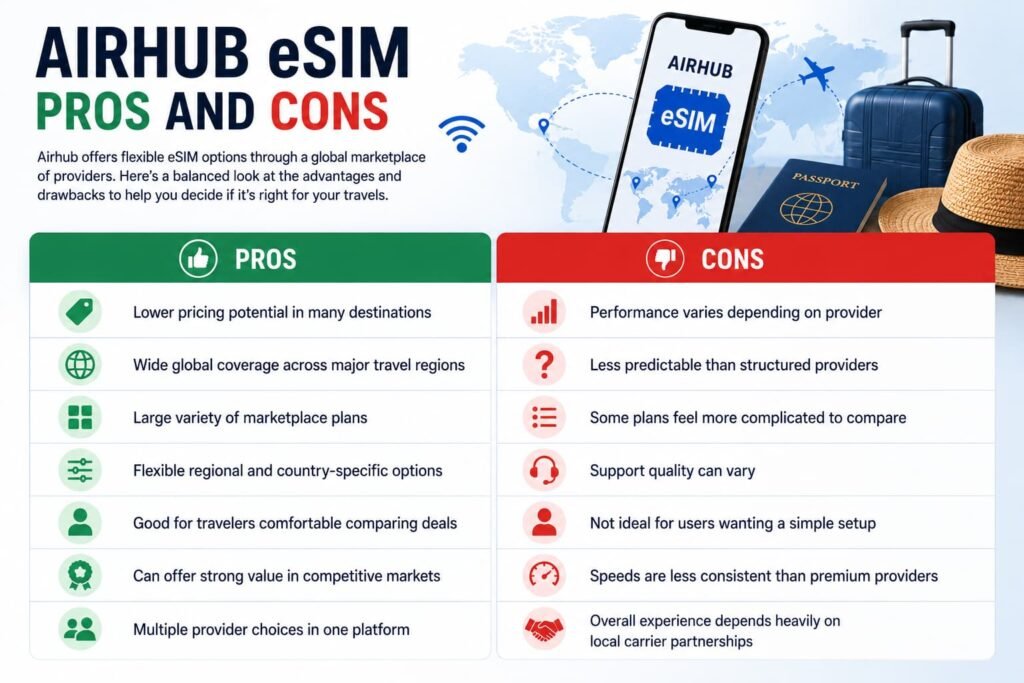
Airhub eSIM Pros and Cons
| Pros | Cons |
|---|---|
| Lower pricing potential in many destinations | Performance varies depending on provider |
| Wide global coverage across major travel regions | Less predictable than structured providers |
| Large variety of marketplace plans | Some plans feel more complicated to compare |
| Flexible regional and country-specific options | Support quality can vary |
| Good for travelers comfortable comparing deals | Not ideal for users wanting a simple setup |
| Can offer strong value in competitive markets | Speeds are less consistent than premium providers |
| Multiple provider choices in one platform | Overall experience depends heavily on local carrier partnerships |
Unlike providers focused on simplicity or premium consistency, Airhub trades predictability for flexibility.
For travelers willing to compare plans carefully, that can sometimes lead to better value.
For users who simply want the easiest experience possible, providers like Saily or aloSIM will usually feel more straightforward.
Alternatives to Airhub eSIM
Airhub is not the best fit for every situation.
- Airalo for structured budget pricing
- Nomad for simpler regional pricing
- Ubigi for stable performance and stronger consistency
- Holafly for unlimited data plans
- GigSky for premium global reliability
- aloSIM for simple setup and predictable pricing
- Saily for a beginner-friendly experience with minimal setup friction
- Yesim for a cleaner user experience with more structured flexibility
Related Guides
If you’re still comparing options or getting your setup ready, these guides will help:
- Compare provider pricing and flexibility using the Airalo eSIM review
- See how regional plans work in the Nomad eSIM review
- Explore unlimited data options in the Holafly eSIM review
- Understand stable performance differences in the Ubigi eSIM review
- Explore premium global coverage in the GigSky eSIM review
- Compare simpler setup experiences in the Saily eSIM review
- Explore predictable pricing in the aloSIM eSIM review
- Find coverage by destination in the eSIM Providers by Country
- Explore recommendations in the Best eSIM for International Travel (2026 Guide)]
- Follow setup instructions in the How to Activate eSIM on iPhone Step-by-Step Guide]
- Set up your Android device using the How to Activate eSIM on Android Step-by-Step Guide]
Final Thoughts
Airhub is one of the more flexible eSIM platforms available right now.
Instead of giving travelers one standardized experience, it offers a marketplace with different providers, pricing structures, and regional options.
That flexibility can create excellent value in some destinations.
At the same time, it also creates more variation in performance and overall experience compared to providers that operate with tighter infrastructure control.
If your main goal is finding lower pricing and comparing multiple plans, Airhub can be a strong option.
If you want a simpler, more predictable experience, providers like Saily, aloSIM, or Ubigi may feel easier to manage.
Overall, Airhub works best for travelers who are comfortable comparing plans and understand that flexibility sometimes comes with tradeoffs in consistency.