Cuba is not a destination where I would shop for an eSIM the same way I would for Japan, Mexico, or Europe. The local telecom environment is more limited, fewer international eSIM providers have clearly documented Cuba service, and a lot of the information still circulating online is outdated or incomplete.
That makes choosing the best eSIM for Cuba from Canada less about sorting by the cheapest price and more about answering three practical questions: does the provider currently support Cuba, what kind of service can you realistically expect once you arrive, and what backup do you have if mobile data is weak or unavailable.
For most Canadian travellers, GigSky is still the first provider I would check, while Roamless is a strong alternative for light users because of its pay-as-you-go model, fixed Cuba plans, hotspot support, and in-app calling. Yesim gives you another clearly documented option with several fixed-data and unlimited plans. CubacelTur remains the local alternative if having a Cuban mobile line, traditional calls, and SMS matters more than installing everything before departure.
The main thing to understand is that a Cuba eSIM is often buying you convenience before arrival, not automatically the cheapest mobile data on the island.
Quick Picks
| Recommendation | Best For | Why It Stands Out |
|---|---|---|
| GigSky | Best overall starting point | Dedicated Cuba service and Cuba-specific setup guidance make it one of the first options I would verify before travelling. |
| Roamless | Best for light or flexible data use | Offers Cuba pay-as-you-go data, fixed plans, hotspot use, automatic activation, and in-app international calling through Roamless credits. |
| Yesim | Best for more plan choices | Offers several current fixed-data and unlimited Cuba plans with clear pricing and app-based setup. |
| CubacelTur | Best local alternative | ETECSA’s official tourist service gives you a temporary Cuban mobile line with data, voice minutes, and SMS. |
Cuba is one destination where I would not buy from a comparison table alone. Open the current provider page immediately before paying and verify that the Cuba plan you want is still available.
Best Cuba eSIM Options at a Glance
| Option | Best For | Plan Style | Calls and SMS | Main Advantage | Main Limitation |
|---|---|---|---|---|---|
| GigSky | Travellers prioritizing a well-established Cuba option | Travel data eSIM | Data-focused | Dedicated Cuba offering and simple pre-trip setup | Current plan availability should be checked before purchase |
| Roamless | Light users, frequent travellers, hotspot users | Pay-as-you-go + fixed data | In-app calls available with Roamless credits | Flexible usage, no-expiry purchased credits, hotspot support | Cuba data is still relatively expensive per GB |
| Yesim | Travellers wanting more plan choice | Fixed data + unlimited | Data only | Several current allowances and plan styles | Cuba data is expensive compared with many destinations |
| CubacelTur | Travellers wanting a Cuban mobile line | Local tourist SIM | Included | Data, calls, SMS, and local service | Requires obtaining a physical tourist SIM |
GigSky, Roamless, and Yesim are international travel eSIM services. CubacelTur is a local tourist product from Cuba’s telecom system.
That distinction matters. The travel eSIMs are mainly about being ready before you arrive. CubacelTur becomes more attractive if you want something closer to normal local mobile service.
Why Choosing an eSIM for Cuba Is Different
For destinations such as Japan, Mexico, or the UK, I often compare eSIMs partly by which local network they use.
Cuba gives you much less room to solve weak service simply by choosing another domestic carrier.
The local mobile environment is centred around ETECSA and Cubacel, and several international providers that currently serve Cuba identify Cubacel as the underlying network.
That means a weak connection may not always be something you can fix by switching eSIM brands. If local coverage is poor, congestion is heavy, or a power interruption affects telecom infrastructure, another travel eSIM may run into the same underlying limitation.
That is why the buying order is different here:
Verify the provider first. Compare the plan second.
How to Choose the Best eSIM for Cuba From Canada
The best option depends less on finding the cheapest plan and more on matching the service to how you’ll actually travel. Before choosing between GigSky, Roamless, Yesim, or CubacelTur, I’d narrow it down using a few practical questions:
- Decide whether you want data ready before arrival or a local Cuban mobile line.
- Estimate how much data you’ll realistically use for maps, messaging, browsing, and hotspot use.
- Think about where you’ll spend most of the trip, such as Havana, a Varadero resort, or a multi-city road trip.
- Check whether hotspot, calls, SMS, or keeping your Canadian number active matters to you.
- Verify that the provider still offers Cuba service and that the exact plan you want is available before paying.
GigSky: My First Choice to Check for Cuba
GigSky’s Cuba eSIM page is still the first place I would check for a Cuba trip.
GigSky has maintained a dedicated Cuba product page and Cuba-specific guidance rather than treating the country as a generic line item in a global coverage list.
Its Cuba travel material says the service connects through Cubacel and recommends installing the eSIM before travelling.
Why GigSky Still Stands Out
The biggest advantage is preparation.
If a suitable Cuba plan is available, you can purchase and install the eSIM while you still have dependable Wi-Fi in Canada instead of making connectivity your first job after landing.
That is useful for:
- WhatsApp and messaging
- Google Maps or Apple Maps
- hotel and airline apps
- browsing
- social media
- internet-based voice and video calls
GigSky is primarily a data solution rather than a replacement for your Canadian mobile number.
If you need your Canadian line for verification texts or important calls, a dual-SIM setup can make more sense: GigSky for data, Canadian SIM available only when needed.
For a broader provider overview, see the GigSky eSIM Review.
Roamless: Best for Flexible or Light Cuba Data
Roamless currently offers Cuba service through Cubacel with both fixed data plans and its reusable pay-as-you-go model.
This is particularly interesting in Cuba because mobile data is expensive. If you only need maps, WhatsApp, email, and occasional browsing, paying for what you actually use can make more sense than buying a large fixed package.
I would keep the price comparison simple:
| Roamless Option | Data / Validity | Official Price | CAD |
|---|---|---|---|
| Pay as you go | 1 GB equivalent, no expiry on purchased balance | US$15.45 | C$21.54 |
| Fixed plan | 1 GB / 30 days | US$16.95 | C$23.63 |
Why Roamless Is Especially Interesting for Cuba
There are three features that make it different from the other options in this guide.
First, the same Roamless eSIM can remain installed for future supported destinations. Purchased pay-as-you-go credits do not expire, so unused balance can remain available for another trip.
Second, Roamless currently promotes hotspot and tethering on its Cuba service, which makes it worth comparing if you need to connect a laptop or tablet.
Third, Roamless credits can also be used for in-app international calls. That does not turn the Cuba data plan into a conventional Cuban phone line, but it gives you another way to make calls without relying on your Canadian carrier.
For a light user, I would compare Roamless seriously against a small GigSky or Yesim package. For heavier usage, the high cost per gigabyte makes larger fixed plans worth comparing carefully.
See the Roamless eSIM Review for a deeper explanation of FLEX credits, FIX plans, hotspot use, and in-app calling.
Yesim: Best for More Cuba Plan Choices
Yesim’s Cuba eSIM plans are the easiest current option to compare when you want several clearly published fixed-data packages.
Its current Cuba lineup also includes unlimited options.
Representative fixed-data pricing is:
| Data | Validity | Official Price | CAD |
|---|---|---|---|
| 1 GB | 30 days | US$18 | C$25.10 |
| 5 GB | 30 days | US$66 | C$92.02 |
| 10 GB | 30 days | US$120 | C$167.30 |
Those prices show why I would not automatically buy the largest allowance.
Cuba data can cost dramatically more than comparable packages in Europe, Japan, or Thailand.
When Yesim Makes More Sense
Yesim is useful when you want a conventional fixed-data package with straightforward validity and an app-led setup.
Its Cuba products are data-only, and Yesim currently recommends buying before the trip and activating the plan when you arrive.
Yesim also promotes hotspot functionality, although hotspot behaviour can depend on the exact plan and underlying operator. If tethering matters, check the product details before buying.
Unlimited plans deserve a closer look too. Yesim explains that daily thresholds can apply and speeds may be reduced after heavier usage.
For a broader look at the provider, see the Yesim eSIM Review.
Why I Would Be Careful With Other Cuba eSIM Providers
Large comparison sites may list many Cuba eSIMs, but availability can change and support in another Caribbean country does not tell you whether the same provider currently serves Cuba.
Watch Out
Do not assume a provider works in Cuba because it supports other Caribbean destinations.
Open the current Cuba product page before paying and save the setup information while you still have dependable internet. For this destination, a short list of current options is more useful than a long provider catalogue.
What About a CubacelTur Tourist SIM?
CubacelTur is ETECSA’s official tourist mobile service.
It solves a different problem from the travel eSIMs above.
Current tourist options include:
| CubacelTur Package | Data | Voice | SMS | Validity |
|---|---|---|---|---|
| Basic Plus | 10 GB | 100 minutes | 100 SMS | 30 days |
| Basic | 4 GB | 20 minutes | 20 SMS | 7 days |
The Basic Plus package also includes unlimited WhatsApp and Facebook access during its validity.
This is closer to traditional local mobile service than a data-only travel eSIM.
The Real Trade-Off: Convenience vs Local Service
A travel eSIM mainly buys you convenience before arrival.
You can prepare it in Canada, save the setup details, and avoid making a local SIM purchase one of the first jobs on your trip.
CubacelTur gives you more traditional local functionality, but you need to obtain the tourist SIM through Cuba’s local service process.
If I mainly wanted maps, messages, email, and travel apps, I would rather arrive with an eSIM ready. If I wanted a Cuban mobile line and conventional calls or SMS, CubacelTur would be more attractive.
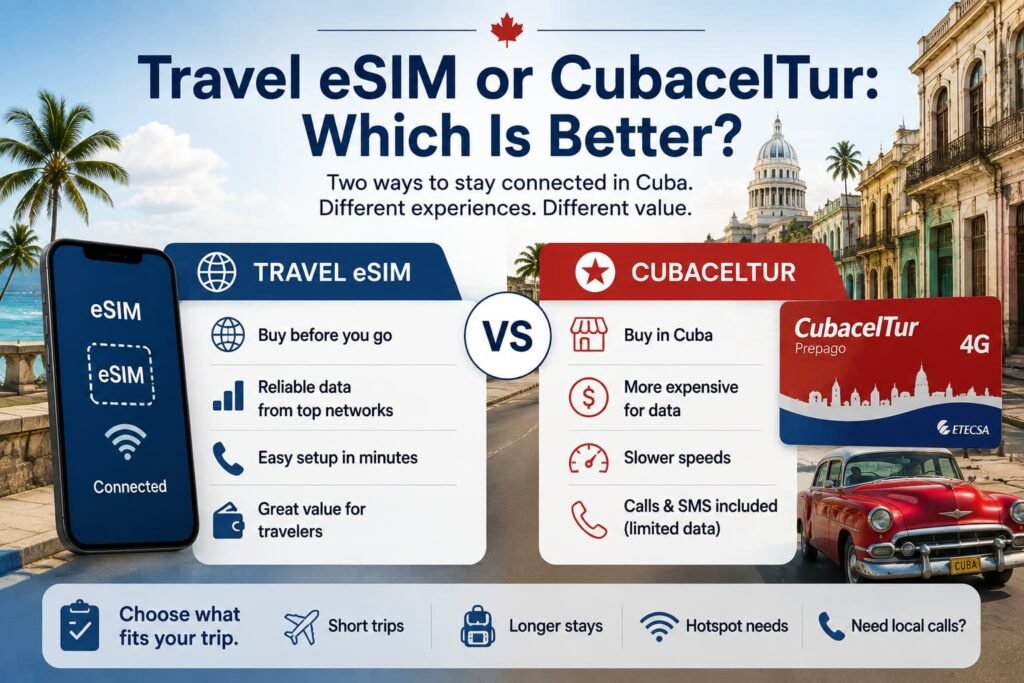
Travel eSIM or CubacelTur: Which Is Better?
| Situation | Better Starting Point |
|---|---|
| You want data prepared before arrival | Travel eSIM |
| You want a Cuban mobile line | CubacelTur |
| You mainly use WhatsApp, maps, email, and browsing | Travel eSIM |
| You need traditional calls and SMS | CubacelTur |
| You want flexible or low-volume data | Roamless |
| You want to keep your Canadian SIM installed | Travel eSIM on a dual-SIM phone |
| You are comfortable collecting a tourist SIM in Cuba | CubacelTur |
Neither option is automatically better.
For Cuba, the more useful question is what you are paying for: pre-trip convenience or fuller local mobile service.
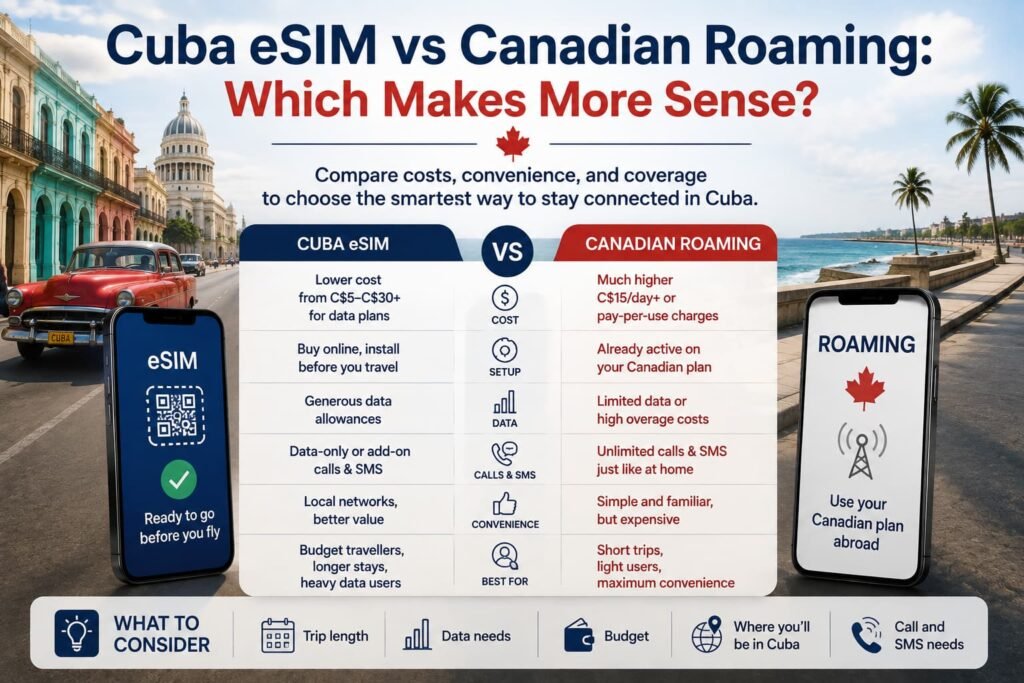
Cuba eSIM vs Canadian Roaming: Which Makes More Sense?
Now that this guide is covering the complete Cuba connectivity decision, Canadian carrier roaming deserves a proper comparison too.
The choice is not simply “eSIM is cheaper, so roaming is bad.” Rogers, Bell, and TELUS let eligible customers keep using their Canadian number and familiar mobile plan in Cuba. That convenience can be useful when conventional calls, texts, voicemail, or keeping your normal number fully available matters more than minimizing the cost.
A Cuba travel eSIM solves a different problem. It gives you a separate prepaid data connection for maps, WhatsApp, browsing, accommodation apps, and other internet-based travel use.
For many travellers, the strongest middle ground is a hybrid setup: use the Cuba eSIM for mobile data while keeping the Canadian line available carefully for the number and services you still need.
| Travel Situation | Better Starting Point | Why |
|---|---|---|
| Mainly need maps, WhatsApp, browsing, and travel apps | Cuba travel eSIM | Separate prepaid data is usually easier to control |
| Need your Canadian number working normally | Canadian carrier roaming | Calls, texts, and your regular line remain much simpler |
| Need Canadian verification texts plus travel data | Hybrid setup | Keep the Canadian line available while the eSIM handles data |
| Want a Cuban number and conventional local service | CubacelTur | Local line with data, calls, and SMS |
| Longer trip where data is the main priority | Travel eSIM or CubacelTur | Daily roaming costs become harder to justify |
| Work pays the roaming bill | Canadian roaming may be reasonable | Simplicity can matter more than the price difference |
Rogers Roaming in Cuba
Rogers currently includes Cuba among the destinations covered by its Roam Like Home Travel Pass options.
Its international passes currently include a 14-day pass for C$100 and a 30-day pass for C$120. These let eligible customers continue using their existing Rogers plan while travelling in covered destinations rather than buying separate travel data.
For someone who needs their Rogers number fully active throughout a longer Cuba trip, those passes deserve comparison.
For someone who mainly needs data for maps and messaging, a travel eSIM can still cost much less.
Bell Roam Better in Cuba
Bell currently includes Cuba among its Roam Better destinations.
Roam Better currently costs C$16 per chargeable international day for eligible consumer plans and lets you use home-plan data along with included calling and texting under Bell’s roaming rules.
Seven chargeable days at C$16 works out to C$112.
That is considerably more than a small Cuba eSIM, but the products are not equivalent. Bell roaming keeps your normal Canadian mobile service much more intact, while most Cuba travel eSIMs are primarily data products.
TELUS Easy Roam in Cuba
TELUS currently includes Cuba in its international Easy Roam destination list.
The regular international Easy Roam rate is currently C$18 per chargeable day. It uses data from your monthly plan and includes calls to Canada and within Cuba, plus incoming and outgoing texts under the current Easy Roam rules.
Seven chargeable days would total C$126.
TELUS also says incoming texts alone do not activate Easy Roam, which can be useful if you want to leave your Canadian line available for verification messages while using a Cuba eSIM for data.
The Price Difference Is Useful, but It Is Not Apples to Apples
A Roamless 1 GB fixed plan at roughly C$24 and seven days of Bell or TELUS daily roaming are obviously very different prices.
But they are also different products.
The eSIM gives you a separate data allowance.
Carrier roaming can give you:
- your Canadian number
- your normal calls and texts
- access to your existing Canadian data plan
- fewer dual-SIM settings to manage
- one familiar carrier account
That convenience has value.
For most travellers who mainly want maps, WhatsApp, email, and browsing, I would start with the travel eSIM. If your Canadian number needs to work normally throughout the trip, roaming becomes easier to justify.
If you want to compare the numbers for your own carrier and trip length, use the Canadian Roaming Savings Calculator before deciding.
How Much Data Do You Need in Cuba?
Cuba is one place where estimating your usage before buying can save a meaningful amount of money.
1 GB to 3 GB
This can work if you mainly need:
- messaging
- maps
- quick searches
- accommodation and airline apps
This is also where Roamless becomes particularly interesting. Light users may prefer pay-as-you-go usage or a small fixed package instead of committing to 5 GB or 10 GB.
Around 5 GB
Five gigabytes gives you more room for normal browsing, social media, navigation, and regular messaging.
For many one-week trips, this is enough if hotel or resort Wi-Fi handles larger downloads and streaming.
10 GB or More
A larger package makes more sense if you expect:
- remote work
- frequent tethering
- large photo or video uploads
- limited Wi-Fi access
- a longer stay
This is where Cuba becomes expensive.
Before paying for a large allowance, compare whether your actual trip really needs that much cellular data.
Use the eSIM Plan Comparison Tool once you know roughly how much data you need.
Havana, Varadero, Resorts and Road Trips
Your itinerary matters just as much as the data allowance.
Havana
Mobile data is especially useful in Havana because you are more likely to use maps, messaging, translation, accommodation details, restaurant searches, and transportation information throughout the day.
I would still download an offline map before leaving Canada.
Even with a working eSIM, I would not make mobile data my only navigation option in Cuba.
Varadero
A resort holiday can use much less cellular data.
Hotel or resort Wi-Fi may handle larger downloads and normal evening use, while a small eSIM covers airport transfers, excursions, maps, messages, and time away from the property.
That can make a small Roamless or GigSky package more sensible than buying 10 GB just because the option exists.
Cayo Coco and Other Resort Areas
I would be more conservative about expectations once you move away from the easiest urban conditions.
Coverage and performance can vary, and power interruptions can affect telecom service.
Keep your resort address, transfer details, maps, and important contacts saved offline.
Travelling Around Cuba
A road trip or multi-city itinerary makes independent mobile data more useful, but it also increases the importance of offline preparation.
If you are moving between Havana, Viñales, Trinidad, Santa Clara, Holguín, Santiago de Cuba, or smaller communities, do not assume your connection will behave the same way everywhere.
Internet Access in Cuba: What Canadian Travellers Should Expect
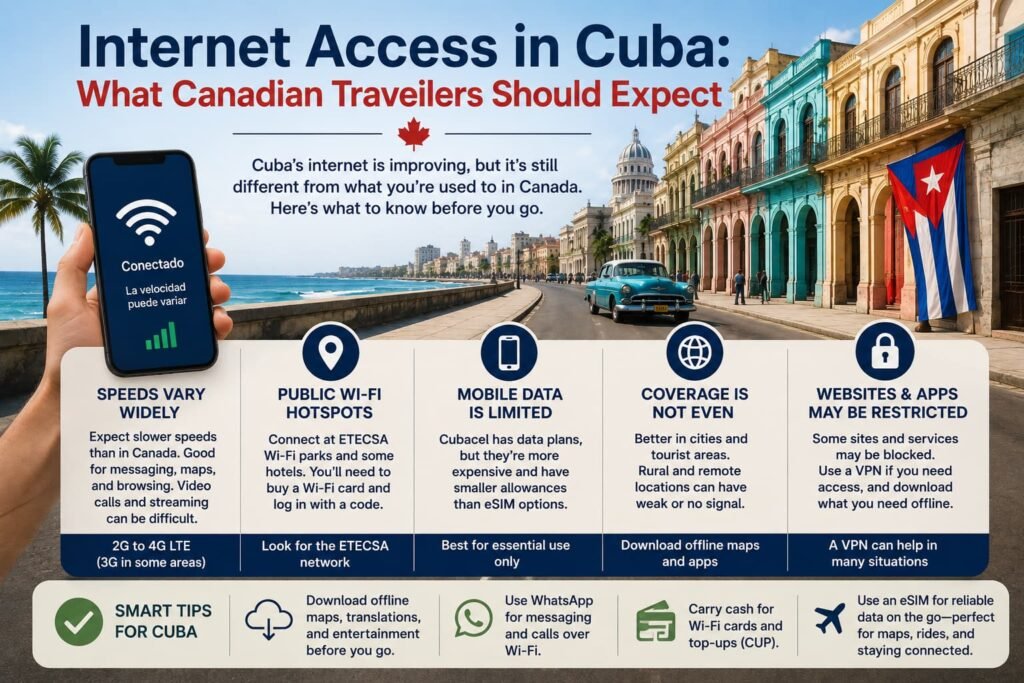
Having a working eSIM does not turn Cuba’s internet infrastructure into the network you are used to in Canada.
Mobile data and Wi-Fi are available, but reliability can vary. Power outages can disrupt telecommunications, and connections may be slower or less predictable than in Canada, the United States, or Western Europe.
That does not mean an eSIM is a bad purchase. It means the goal should be useful connectivity, not perfect connectivity.
Hotel and Resort Wi-Fi
Hotel and resort Wi-Fi can be useful for:
- software updates
- photo backups
- video calls
- streaming
- larger downloads
But I would not rely on it as the only connection for the trip.
Performance can vary between properties, and the connection in a lobby or public area may be better than what you get in your room.
An eSIM gives you another option for maps, messages, and travel details when Wi-Fi is inconvenient.
Mobile Performance Can Vary
If a page loads slowly or a video call becomes unstable, that does not automatically mean the eSIM provider has failed.
The underlying Cuban network, congestion, location, and electricity availability all matter.
For travel use, I would judge the connection by whether it can handle the important tasks:
- messaging
- maps
- basic browsing
- accommodation and airline apps
Internet Access Can Be Restricted
Internet access in Cuba is subject to government controls, and access to some online services can be restricted.
For a traveller, the important point is practical: make sure you can continue the trip if a website, app, cloud account, or mobile connection is unavailable when you need it.
Save Important Information Offline
Before leaving Canada, download or save:
- offline maps
- boarding passes
- flight details
- accommodation addresses
- airport-transfer information
- insurance documents
- emergency contacts
- secure copies of important travel documents
- provider setup and troubleshooting instructions
Do the same before long transfer days.
An eSIM should make the trip easier. It should not become the only way you can access information you cannot afford to lose.
Cuba-Only eSIM or a Regional Plan?
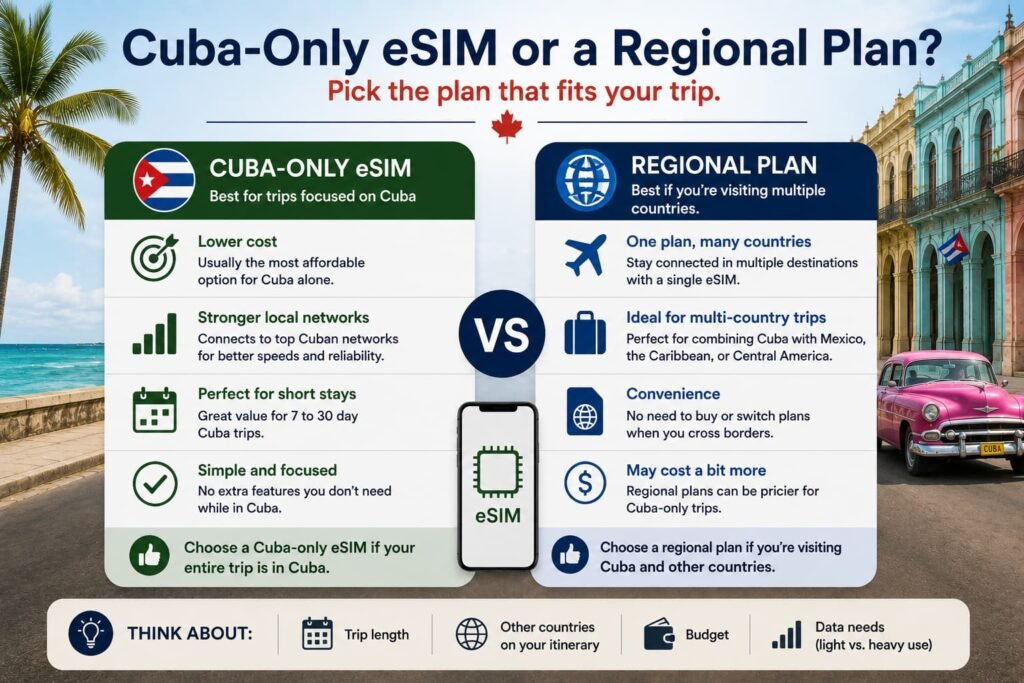
For a Cuba-only holiday, a dedicated Cuba plan is usually the cleanest choice.
If your itinerary includes several countries, compare the exact coverage list before buying a Caribbean, Latin America, or global plan.
Cuba may be treated differently from neighbouring destinations.
If Cuba is only one stop on a larger trip, use the Best eSIM for International Travel guide to compare country-specific, regional, and global options.
Roamless also becomes more interesting for this type of trip because its reusable eSIM and pay-as-you-go balance can continue working across other supported destinations without installing a new profile each time.
Set Up Your Cuba eSIM Before Leaving Canada
Cuba is one destination where I would prepare as much as possible before the flight.
1. Check That Your Phone Supports eSIM
Your phone needs to support eSIM and should be unlocked.
Use the eSIM Compatibility Checker if you are unsure about your exact device.
2. Buy While You Have Reliable Internet
Purchase the plan over dependable Wi-Fi.
Save:
- confirmation emails
- QR codes
- app login details
- setup instructions
- provider support information
Keep anything important available offline.
3. Install Before Departure, but Check Activation Timing
Installation and activation are not always the same event.
Roamless fixed plans activate when the eSIM connects in Cuba. Yesim also recommends buying before the trip and activating on arrival.
GigSky’s activation timing can depend on the plan type, so follow the exact instructions for the Cuba product you buy.
4. Give Your Lines Clear Names
Use labels such as:
Canada
Cuba Data
This makes dual-SIM management much easier.
5. Download Offline Maps
Download the regions you expect to visit before departure.
Even with a good eSIM, I would never make mobile data the only navigation system I have in Cuba.
Keep Your Canadian Number or Use Roaming?
A compatible dual-SIM phone gives you more than two choices. You do not have to pick between completely turning off your Canadian line and paying for roaming throughout the entire trip.
Keep the Canadian Line Available for Important Texts
This can be useful when you still need:
- banking verification codes
- account alerts
- work messages
- access to your regular Canadian number
Set the Cuba eSIM as the mobile-data line and keep data roaming disabled on the Canadian line.
TELUS currently says incoming texts do not activate Easy Roam. Other carrier rules can differ, so confirm what receiving SMS does on your own plan before relying on that setup.
Use Carrier Roaming When You Need Your Number Normally
If you expect conventional calls, outgoing SMS, voicemail, or regular use of your Canadian number, carrier roaming may be worth paying for.
That is particularly true on a short business trip or when work is covering the mobile bill.
You avoid much of the dual-SIM management and keep using the service you already know.
Use a Hybrid Setup When Data Is the Main Need
For many Canadian travellers, this is the setup I prefer:
Canadian line: number, important texts, occasional communication
Cuba eSIM: mobile data
The key is preventing the Canadian SIM from quietly becoming the data connection.
Turn off automatic cellular-data switching if your phone supports it, and be careful with calls, outgoing texts, and voicemail because those can follow different roaming billing rules.
Calls, Texts and WhatsApp in Cuba
Data-only travel eSIMs work well with internet-based communication.
WhatsApp, FaceTime, Signal, Messenger, and Telegram can use the eSIM data connection.
Your existing WhatsApp account can normally remain attached to your Canadian number.
Roamless adds another option because its app supports international calling through Roamless credits.
That does not turn the eSIM into a Cuban mobile line, but it can be useful if you need to call a hotel, airline, family member, or another number without using your Canadian carrier.
If you specifically need a local Cuban line with traditional calling and SMS, CubacelTur remains the clearer choice.
Hotspot and Tethering
Hotspot rules vary enough that I would check them before buying.
Roamless currently promotes hotspot and tethering on its Cuba service.
Yesim also promotes hotspot functionality, although individual plan behaviour can depend on the operator.
The other problem is how quickly a laptop can consume expensive Cuba data.
Cloud backups, operating-system updates, video meetings, and large uploads can turn a modest plan into a very small one.
Disable automatic syncing before tethering.
Cuba eSIM Coverage and Phone Compatibility
A travel eSIM still relies on Cuba’s local mobile infrastructure.
ETECSA identifies 1800 MHz, Band 3 as relevant to its 4G/LTE service.
Most recent Canadian-market iPhones, Samsung Galaxy phones, Google Pixels, and other mainstream devices support a broad range of LTE bands.
Older or imported models deserve more attention.
eSIM compatibility and radio-band compatibility are separate issues.
A phone can support eSIM installation but still have limitations with a particular local network.
What I Would Choose for Different Cuba Trips
One Week at a Varadero Resort
I would probably buy a small data allowance.
Resort Wi-Fi can handle heavier usage while the eSIM covers messages, maps, excursions, and airport transfers.
Roamless is particularly attractive here if you expect light use. GigSky would still be the first provider I would check for a simple Cuba-specific plan.
If keeping your Canadian number working normally matters more than saving on data, I would also compare the full trip cost against your carrier’s current Cuba roaming option.
Havana City Trip
I would prioritize having the eSIM installed before flying.
I would also download offline maps and keep accommodation details available locally.
Two or Three Weeks Travelling Around Cuba
I would compare Roamless, GigSky, and Yesim more carefully.
Roamless becomes attractive if your usage is irregular. Yesim gives you clearly priced larger allowances. GigSky remains worth checking for a dedicated Cuba plan.
I would also consider CubacelTur more seriously on a longer trip if local calling becomes useful.
Traveller Who Needs a Cuban Mobile Line
CubacelTur is the better fit.
A data-only travel eSIM is excellent for apps and internet calling, but it is not the same as local Cuban mobile service.
Traveller Who Needs Their Canadian Number
A hybrid setup is usually the first option I would consider.
Let the travel eSIM handle data and keep the Canadian line available selectively. If you need the Canadian number behaving normally throughout the trip, compare the cost of full carrier roaming instead.
Is a Cuba eSIM Worth It?
For many Canadian travellers, yes, particularly when the priority is having mobile data prepared before departure.
A travel eSIM can remove the need to sort out local data immediately after landing, while CubacelTur may offer better local functionality if you need a Cuban mobile line. Canadian roaming remains the simpler option when your regular number needs to work normally.
Whatever you choose, keep offline maps and essential information available. In Cuba, connectivity should make the trip easier without becoming something the trip depends on completely.
Frequently Asked Questions About Cuba eSIMs and Internet Access
Does a travel eSIM actually work in Cuba?
International travel eSIMs can work in Cuba when the provider supports the country specifically. Roamless currently lists Cuba service through Cubacel, Yesim sells active Cuba plans, and GigSky maintains a dedicated Cuba product page and Cuba-specific setup guidance.
That is different from Cuba having a broad domestic tourist-eSIM market. The safest approach is to check the current Cuba page immediately before paying rather than relying on an old article or a plan database that may not reflect current availability.
Is a Cuba travel eSIM better than CubacelTur?
A travel eSIM is better when your priority is getting data prepared before leaving Canada. You can keep your Canadian SIM installed and use the travel eSIM for maps, messages, browsing, and apps without making a local SIM purchase your first job after landing.
CubacelTur is better suited to travellers who want a Cuban mobile line, conventional voice minutes, and SMS. The trade-off is not simply price. It is pre-trip convenience versus fuller local mobile service.
Is a Cuba eSIM cheaper than Rogers, Bell, or TELUS roaming?
A small Cuba travel eSIM can cost much less than using Canadian daily roaming for several chargeable days. Bell currently lists international Roam Better at C$16 per day, while TELUS lists international Easy Roam at C$18 per day. Rogers also offers multi-day international passes, including current 14-day and 30-day options that cover Cuba.
The comparison is not perfectly equal. Carrier roaming keeps your Canadian number, conventional calls, texts, and access to your existing plan much more intact. A typical travel eSIM is primarily buying prepaid mobile data. If data is your main need, I would usually compare an eSIM first; if your Canadian number must work normally, roaming may justify the higher cost.
Can tourists access the internet freely in Cuba?
Internet access is available to tourists through mobile data, hotel Wi-Fi, and other supported connections, but it is more limited and less predictable than in Canada. Power outages can interrupt telecommunications, and connection quality can vary by location.
Internet access is also subject to government controls, and access to some online services can be restricted. Keep offline maps, accommodation details, boarding passes, insurance information, and essential contacts saved independently rather than assuming everything will remain accessible online.
Will my Rogers, Bell, or TELUS phone work in Cuba?
Rogers, Bell, and TELUS currently provide roaming options that include Cuba on eligible services, but availability still depends on your account, device, and the local network.
Bell lists Cuba among Roam Better destinations, TELUS includes Cuba in its international Easy Roam list, and Rogers includes Cuba among destinations covered by its current Travel Pass options. Check your own account before departure because plan eligibility, roaming features, pricing, and destination rules can change.
Which parts of Cuba have the best mobile coverage?
Major cities and tourism centres are the most sensible places to expect useful mobile service, but performance can still vary.
Havana and Varadero are obvious places where travellers are more likely to rely on mobile data. Once your itinerary includes rural areas, long road routes, smaller communities, or more remote resort regions, prepare for weaker or less predictable service and keep maps offline.
Can I use WhatsApp in Cuba with a travel eSIM?
WhatsApp can use the mobile-data connection from a Cuba eSIM, so you do not need a new phone number just to message or make internet calls.
Your existing WhatsApp account can normally remain associated with your Canadian number. Text messaging uses very little data, while voice and video calls need a stronger connection, so call quality can vary when the network is congested or unstable.
Should I install my Cuba eSIM before leaving Canada?
Installing before departure is usually the easiest option because you still have dependable Wi-Fi and time to fix a setup problem.
The important distinction is activation timing. Roamless fixed plans start when they connect in Cuba, and Yesim recommends purchasing before travel and activating on arrival. Follow the exact rules for the provider and plan you buy.
Can I use hotspot with a Cuba eSIM?
Hotspot is available on some Cuba eSIMs, but the rules vary.
Roamless currently promotes hotspot and tethering for its Cuba service. Yesim also supports hotspot functionality, although plan-level conditions can depend on the operator. If tethering is important, check the exact product before paying.
How much data should I buy for a Cuba trip?
For light maps, WhatsApp, email, and quick searches, 1 GB to 3 GB can be enough for a short trip.
Around 5 GB gives a normal holiday traveller more flexibility, while 10 GB or more becomes relevant for remote work, hotspot use, and heavier uploads. Because Cuba data is expensive, I would choose based on actual usage rather than automatically buying the largest plan.
Is it possible to keep my Canadian SIM active while using a Cuba eSIM?
Most compatible dual-SIM phones can keep the Canadian line installed while the travel eSIM handles data.
Set the Cuba eSIM as the mobile-data line, disable automatic data switching, and keep data roaming off on the Canadian line unless you intentionally want Canadian roaming. Calls, outgoing texts, and voicemail can have separate carrier charges.
Related eSIM Guides
Compare Your Travel Options
- Best eSIM for International Travel
- eSIM Providers by Country
- eSIM Plan Comparison Tool
- Canadian Roaming Savings Calculator
Explore More Destinations
- Best eSIM for Mexico From Canada
- Best eSIM for Japan From Canada
- Best eSIM for UK From Canada
- Best eSIM for Thailand Travel From Canada
Compare Providers
Prepare Your Phone
- eSIM Compatibility Checker
- How to Activate eSIM on iPhone in Canada
- Activate eSIM on Android Canada
- How to Fix eSIM Not Working in Canada
Final Thoughts
For Cuba, I would start with the option that best matches how I expect to use my phone rather than automatically buying the largest plan or defaulting to Canadian roaming.
GigSky remains my first Cuba-specific provider to check. Roamless is particularly appealing for lighter or flexible usage, while Yesim gives you a broader menu of fixed-data and unlimited plans. CubacelTur is the better fit when a local Cuban mobile line, traditional calls, and SMS matter more than pre-trip setup.
Canadian roaming still has a place when keeping your regular number working normally matters more than minimizing the cost. For many travellers, though, a hybrid setup gives you the useful middle ground: Cuba eSIM for data, Canadian line available selectively.
Prepare the connection before departure where possible, keep important information offline, and treat mobile data as a useful travel tool rather than your only connection to the information you need.