A week at a Cancún resort, five days in Mexico City and a road trip through the Yucatán do not put the same demands on a travel eSIM. That is why choosing the best eSIM for Mexico from Canada is less about finding the cheapest plan and more about matching the network, data allowance and plan type to the trip you are actually taking.
For most Canadian travellers, a prepaid Mexico eSIM is an easy way to use maps, rideshare apps, messaging, restaurant searches and hotel apps without relying on your Canadian line for mobile data. The harder question is which provider makes the most sense.
For a straightforward city or resort trip, a competitively priced fixed-data plan is usually enough. Heavy data users may prefer unlimited data. Travellers who need regular calls or SMS have fewer good choices, while anyone driving through more remote areas should pay much closer attention to the Mexican network behind the eSIM.
Quick Picks
Nomad is my best overall pick for a typical city or resort trip because its Mexico plans combine strong fixed-data pricing with useful 7-day and 30-day options.
Holafly is the better fit when you want unlimited phone data and do not want to monitor usage.
Airalo stands out when you want a Mexico plan that can include conventional calls and SMS as well as data.
aloSIM makes the most sense for a Canada, U.S. and Mexico itinerary because it also sells a true three-country North America plan.
Saily is a good fit if you value a simple app experience, flexible hotspot use and built-in security features.
The Best Mexico eSIM Depends on Where You Are Going
Mexico is one of those destinations where the cheapest eSIM is not automatically the smartest purchase.
If you are flying into Cancún, spending a week at a Riviera Maya resort and making a few excursions around Playa del Carmen or Tulum, several mainstream travel eSIMs can be perfectly reasonable choices. The same is true for a city-focused trip to Mexico City, Guadalajara or Puerto Vallarta.
Coverage becomes a bigger part of the decision when you start adding islands, rural roads, smaller towns or longer driving routes.
Telcel, AT&T México and Movistar are the three network names you will encounter most often when comparing Mexico eSIMs. Telcel’s coverage information describes its network as having Mexico’s broadest national coverage, although real-world reception can still vary with terrain, buildings, congestion and local conditions.
The important part is that a travel eSIM does not automatically give you access to every Mexican network. One plan might use AT&T and Movistar, another may use Telcel and Movistar, and another may not clearly identify its partner network at all.
That matters more to me than saving a few dollars on a coverage-sensitive trip.
Best Mexico eSIM Options for Canadian Travellers
Nomad: Best Overall for Most Trips
Nomad is the first Mexico eSIM I would compare for a typical Canadian vacation because its current Mexico lineup gives you a good choice of small, medium and larger fixed-data plans without forcing you into an unlimited package.
Nomad’s current Mexico plans include 1 GB for US$5, 3 GB for US$7, 5 GB for US$11, 10 GB for US$15.50 and 20 GB for US$27.50. Nomad also sells unlimited-duration packages, including a current 7-day option for US$22. Its Mexico page currently identifies AT&T and Movistar as the networks used by the plan.
For a one-week vacation where you mainly need Google Maps, WhatsApp, restaurant searches, rideshare apps and normal browsing, the 5 GB or 10 GB range gives you a much better chance of paying only for data you will actually use.
Nomad also supports hotspot and allows add-on data on eligible plans. Installation can be completed before departure, with the plan starting when it connects in Mexico according to the provider’s activation instructions.
Best fit: travellers who want a well-priced fixed-data plan and are spending most of the trip in major cities, resorts and mainstream tourist areas.
The trade-off: the current Mexico plan lists AT&T and Movistar rather than Telcel. For a remote road trip, I would compare the exact route and alternative network options before buying.
For a deeper look at how the provider works overall, see the Nomad eSIM Review.
Holafly: Best for Heavy Phone-Data Use
Holafly takes a different approach. Its Mexico product is built around unlimited data rather than a menu of fixed gigabyte allowances.
That can be worth paying more for if you stream frequently, upload a lot of photos and video, use navigation constantly or simply do not want to keep checking a remaining-data balance.
Holafly’s Mexico eSIM currently lists Movistar Mexico and Telcel as its networks. Current prices include US$23.90 for 7 days, US$31.90 for 10 days and US$64.90 for 30 days.
There are two important catches.
First, unlimited phone data does not mean unlimited hotspot. Holafly currently allows 1 GB of shared hotspot data per day on its Mexico plan. That is fine for occasional laptop use, but it is a real limitation if tethering is one of the main reasons you are buying the plan.
Second, Holafly is unusually clear about some geographic exclusions. Its current Mexico page states that the eSIM does not have coverage on Holbox Island, Contoy Island, Chiquilá, Ojo de Agua and some sections of the Playa-Mérida federal highway.
That is useful information because it shows why a provider saying it uses Telcel does not guarantee perfect service everywhere.
Where Holafly makes more sense: heavy phone-data use when you would rather pay more for unlimited data than manage a fixed allowance.
Main drawback: it is comparatively expensive, hotspot sharing is limited, and its published Mexico exclusions matter if Holbox or certain Yucatán routes are part of your itinerary.
You can also read the Holafly eSIM Review before deciding.
Airalo: Best If You Need Calls and SMS
Most travel eSIMs are still primarily data products. Airalo is interesting in Mexico because it currently sells packages that combine data, voice minutes and SMS.
Airalo’s current Mexico plans include an option with 10 GB, 100 minutes and 100 SMS for US$23.50. Larger packages are available as well, including a 50 GB option with 500 minutes and 500 SMS. Airalo identifies Movistar as the primary network on the current Mexico product page.
Airalo’s calls and texts support documentation makes the distinction important: packages labelled Data, Voice & Text include conventional calls and SMS, while data-only plans do not.
That makes Airalo one of the more useful choices if you want a Mexico eSIM that does more than run WhatsApp and FaceTime over data.
Choose Airalo if: you specifically want a package that includes local calls and SMS in addition to mobile data.
What to check: Airalo sells several Mexico package types, so do not assume every plan includes voice, text or identical network access.
The broader Airalo eSIM Review covers its app, plan structure and general travel use in more detail.
aloSIM: Best for Canada, U.S. and Mexico Travel
aloSIM is a useful Mexico option on its own, but I think its strongest reason for inclusion is actually its regional coverage.
Its Mexico eSIM plans currently include 1 GB for US$5, 5 GB for US$17 and 10 GB for US$25, plus unlimited-duration options. aloSIM identifies the Mexico network as CLARO – AMX Group on the current destination page.
Where aloSIM becomes more interesting for Canadians is its North America eSIM, which covers Canada, the United States and Mexico with one plan. The current regional page lists Rogers, T-Mobile and TELCEL GSM among its networks.
That can be much simpler if you are driving south through the United States, combining a U.S. stop with a Mexico vacation, or want one travel-data profile working across all three countries.
aloSIM also includes an international phone-number benefit with its plans, although travellers should read exactly how that number works rather than treating it as the same thing as a normal Canadian or Mexican carrier number.
aloSIM is strongest when: Mexico is part of a wider Canada-U.S.-Mexico itinerary.
The limitation: for a Mexico-only trip, other providers can be more compelling depending on the amount of data and network access you want.
See the aloSIM eSIM Review for more on the provider.
Saily: Best for Simple Setup and Hotspot Use
Saily makes sense for travellers who want an uncomplicated app-led experience and do not need conventional mobile calls or SMS from the Mexico plan itself.
Saily’s current Mexico plans include 1 GB for US$4.99, 3 GB for US$9.99, 5 GB for US$14.99, 10 GB for US$23.99 and 20 GB for US$37.99. Unlimited options are also available, currently starting at US$43.99 depending on the selected duration.
Saily’s base Mexico eSIM is data-only, but the provider currently allows unrestricted hotspot sharing on the plan and includes security tools such as virtual location, ad blocking and malicious-site protection.
One limitation is that Saily’s public Mexico page does not name its specific Mexican network partners. It says service uses local networks and notes that remote and rural areas may have limited coverage.
For a city or resort trip that may not matter much. For a remote driving itinerary, I prefer having clearer network information before buying.
Saily suits: travellers who prioritize app simplicity, hotspot flexibility and security features over knowing the exact Mexican partner network in advance.
Coverage consideration: the lack of a named network partner makes a coverage-sensitive itinerary harder to judge before purchase.
For more detail, see the Saily eSIM Review.
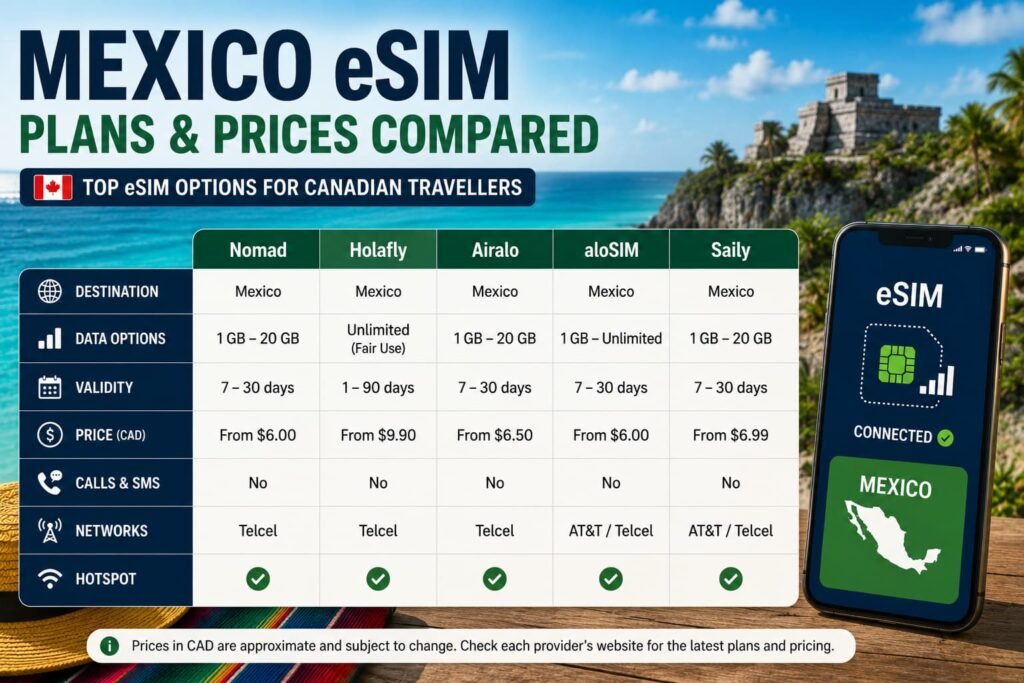
Mexico eSIM Plans and Prices Compared
The prices below are representative rather than a complete catalogue. They were checked against current official provider pages on August 8, 2026.
| Provider | Best fit | Representative plan | USD | CAD |
|---|---|---|---|---|
| Nomad | Fixed-data value | 10 GB / 30 days | US$15.50 | C$21.63 |
| Holafly | Heavy data | Unlimited / 7 days | US$23.90 | C$33.35 |
| Airalo | Data + calls + SMS | 10 GB + 100 min + 100 SMS | US$23.50 | C$32.79 |
| aloSIM | Straightforward fixed data | 5 GB / 30 days | US$17.00 | C$23.72 |
| Saily | Simple app + hotspot | 5 GB / 30 days | US$14.99 | C$20.92 |
Prices can change, and CAD amounts may vary with exchange rates. Confirm the latest pricing before purchasing.
What stands out is that the fixed-data prices are fairly close. That is why I would not make a decision based on a C$2 or C$3 difference alone.
A better comparison is:
- Which network does the plan use?
- How much data do you realistically need?
- Do you need hotspot?
- Do you need conventional calls or SMS?
- Are you staying only in Mexico or crossing into the U.S. as well?
- Does the provider publish any exclusions for your route?
You can use the eSIM Plan Comparison Tool to compare travel eSIM options in CAD before buying.
Cancún Is Easy. Holbox and Road Trips Need More Care
For many Canadian travellers, Mexico means Cancún, Riviera Maya, Playa del Carmen, Puerto Vallarta, Los Cabos or Mexico City.
Those are relatively straightforward eSIM scenarios. You still need a compatible phone and a suitable plan, but you are not usually choosing a travel eSIM solely because you need the widest possible rural footprint.
The decision changes if the trip includes more challenging routes.
Holbox is a good example. Holafly’s current Mexico coverage information specifically excludes Holbox Island and Chiquilá, along with some nearby routes. That is stronger evidence than generic claims that a provider simply offers “Mexico coverage.”
Recent traveller discussions also show recurring questions about eSIM connectivity on Holbox and rural Mexico. Those reports are anecdotal and inconsistent, so they should not be treated as a coverage map. They do reinforce the practical point that islands and less-connected routes deserve more attention than a downtown Mexico City trip.
If your itinerary includes Holbox, remote roads, small towns or long stretches away from major tourist centres, check the exact network and coverage information for the specific eSIM plan before buying. “Works in Mexico” is not enough detail for a coverage-sensitive trip.
For a driving trip, I would also download offline Google Maps before leaving Wi-Fi. Mobile coverage can fail for reasons that have nothing to do with the eSIM provider, and an offline map is cheap insurance.
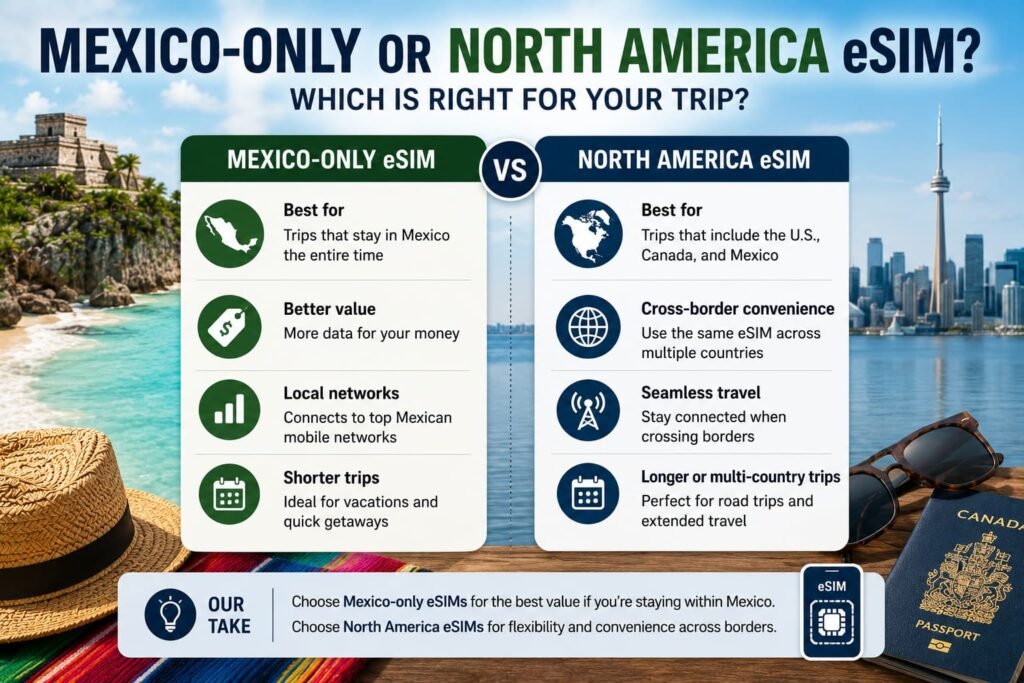
Mexico-Only or North America eSIM?
A Mexico-only plan is normally the simplest choice when you are flying directly from Canada to Mexico and spending the entire trip there.
There is little reason to pay for regional coverage you will never use.
A North America eSIM becomes more useful when the itinerary genuinely crosses borders. Examples include driving from Canada through the United States into Mexico, stopping in the U.S. before or after a Mexico vacation, or spending significant time in all three countries.
aloSIM’s North America eSIM is a particularly clear example because it expressly covers Canada, the United States and Mexico.
Airalo and Nomad also offer regional plans that can include Mexico. Nomad’s current Mexico page lists a three-destination North America option, while Airalo surfaces North America packages from its Mexico product page.
A Latin America eSIM is a different product. It can make sense if Mexico is the first stop before travelling south into Central or South America, but it does not automatically include Canada.
The label matters less than the actual country list.
When Unlimited Data Is Worth Paying For
Unlimited data sounds like the obvious upgrade, but many Mexico trips do not need it.
A fixed 5 GB or 10 GB plan can be plenty for a one-week holiday if you use hotel or resort Wi-Fi for streaming and save mobile data for maps, WhatsApp, rideshare apps, email and normal browsing.
For example, Nomad’s current 10 GB plan costs US$15.50. That is a lot of mobile data for a normal one-week vacation without paying an unlimited premium.
Unlimited data starts making more sense when you:
- stream video away from Wi-Fi
- upload a lot of photos and video
- use your phone heavily for work
- spend long days driving and navigating
- dislike monitoring a data balance
- are travelling for several weeks
Even then, check the fair-use and hotspot rules.
Holafly may provide unlimited phone data, but hotspot sharing is currently limited to 1 GB per day. Saily allows unrestricted hotspot sharing on its Mexico data product, making it potentially more practical for travellers who expect to tether a tablet or laptop.
The word unlimited should start the comparison, not end it.
When I Would Consider a Local Telcel Tourist eSIM
There is another Mexico option that is worth understanding: buying directly from Telcel rather than using an international travel eSIM provider.
Telcel sells an official Tourist International eSIM. The appeal is obvious for travellers who want a direct relationship with a major Mexican carrier and place a high priority on local network coverage.
The complication is registration.
Since January 9, 2026, Mexican telecom rules require mobile lines in Mexico, including Telcel Tourist eSIMs, to be registered in the user’s name. Telcel’s process requires identity verification using a valid government-issued photo ID such as a passport, along with a liveness check. An unregistered line cannot be used.
Telcel also advises tourists to install the eSIM after arrival because the plan’s validity begins when the eSIM is installed.
That is more friction than buying most international travel eSIMs in Canada and having the profile ready before the flight.
For a seven-day resort trip, I would usually favour the convenience of a mainstream travel eSIM.
For a longer stay, a snowbird trip or a coverage-sensitive itinerary where direct Telcel service is especially valuable, the extra setup may be worth considering.
Keep Your Canadian Number Without Using It for Travel Data
One of the best features of travelling with an eSIM-compatible dual-SIM phone is that you do not necessarily have to turn off your Canadian line completely.
A practical setup is:
Canadian line
- keep your normal Canadian number available
- receive important texts where your carrier permits it
- keep it available for verification codes or emergency use
- avoid using it as the mobile-data line
Mexico eSIM
- set it as the primary mobile-data line
- use it for maps, messaging, hotel apps, rideshare services and browsing
- turn on data roaming for the travel eSIM if that provider requires it
The important precaution is making sure your Canadian line does not quietly take over mobile data.
On an iPhone, turn off Allow Cellular Data Switching and keep data roaming disabled on the Canadian line unless you deliberately want your carrier’s roaming service.
On Android, the menu names vary by manufacturer, but the same principle applies: Mexico eSIM for mobile data, Canadian line only for the services you intentionally want to keep active.
Airalo’s dual-SIM support guidance describes the same approach, with the home line kept for calls and SMS while the travel eSIM handles mobile data.
Canadian roaming can still be the simpler option for a very short trip, a business visit, or when you need your regular Canadian number working normally for calls and texts. If mobile-data cost is the bigger concern, the Mexico eSIM options above are usually more worth comparing.
If you are still deciding which approach fits your trip, the separate Mexico eSIM vs Roaming Canada guide covers Canadian roaming, Travel Passes and hybrid setups in more detail.
What to Set Up Before Leaving Canada
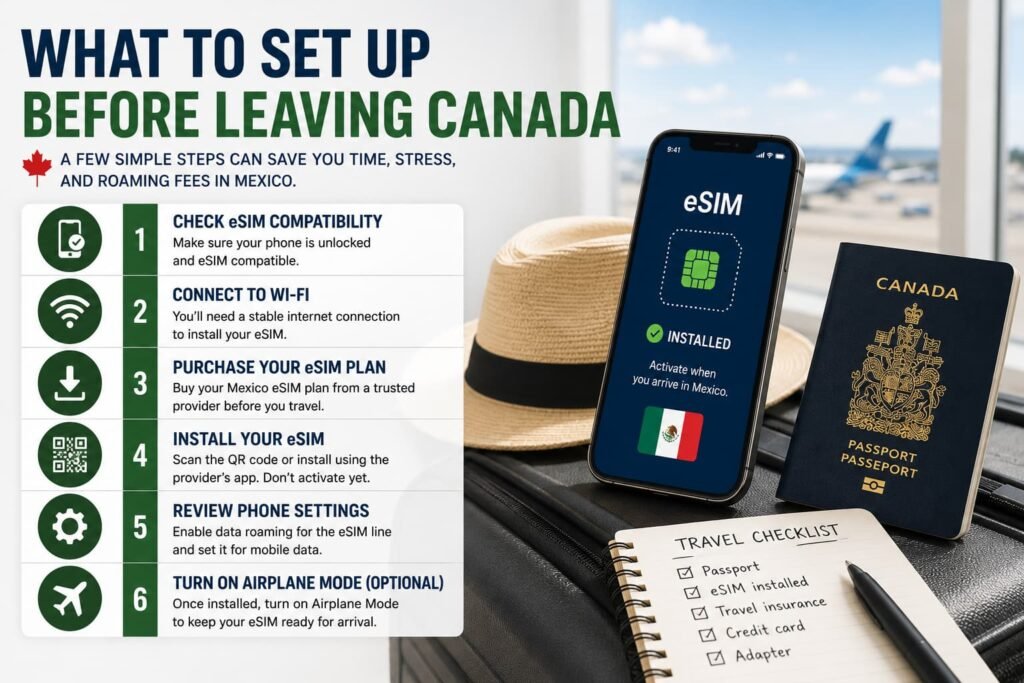
Most eSIM problems are easier to deal with at home than at an airport after landing.
Before buying, check your exact phone model with the eSIM Compatibility Checker and make sure the device is unlocked.
Then:
- Buy the plan that matches your actual itinerary.
- Read the provider’s activation rule before installing it.
- Install the eSIM over a stable Wi-Fi connection when the provider allows advance installation.
- Label your lines clearly, such as Primary and Mexico Travel.
- Save the provider app login, QR code or installation information somewhere accessible offline.
- Set the Mexico eSIM as your mobile-data line when you arrive.
- Keep data roaming off on the Canadian line unless you knowingly want Canadian roaming.
- Turn data roaming on for the travel eSIM if your provider requires it.
- Download offline maps for any rural or road-trip portion of the trip.
Activation timing is worth checking because providers handle it differently. Nomad currently allows advance installation and starts the plan when it connects at the destination, while Saily says its Mexico plan activates automatically when you arrive as long as the eSIM is enabled and roaming is turned on. Telcel’s Tourist eSIM is different again because its validity starts when you install the profile.
For full device-specific instructions, use the iPhone eSIM activation guide or Android eSIM activation guide.
Frequently Asked Questions About Mexico eSIMs
Which eSIM has the best coverage in Mexico?
Coverage depends on the exact eSIM plan and the Mexican network behind it, so I would not name one travel eSIM as best everywhere in Mexico.
Telcel is an important network for national coverage, while AT&T México and Movistar also serve major parts of the country. Travel eSIM providers use different combinations of these networks, and access can vary by plan.
For city and resort travel, several options can work well. For rural routes or islands, verify the exact network and published coverage details before buying.
How much data do I need for a one-week Mexico trip?
Around 5 GB is a sensible starting point for a light-to-average traveller using hotel Wi-Fi for large downloads and streaming.
Consider 10 GB or more if you use social media heavily, navigate for long periods, upload photos and video or spend much of the day away from Wi-Fi. Unlimited data is most useful when you expect genuinely heavy daily use and do not want to monitor a balance.
Can a Mexico eSIM include regular calls and SMS?
Some can. Airalo currently offers Mexico packages labelled Data, Voice & Text that include conventional minutes and SMS alongside mobile data. Many other travel eSIM products are primarily data-only, so check the exact package rather than assuming voice service is included.
Which eSIM should I use for Holbox or a Yucatán road trip?
This is a trip where I would prioritize published coverage information over small price differences.
Holafly currently states that its Mexico eSIM does not cover Holbox Island, Chiquilá and some sections of the Playa-Mérida federal highway. For an itinerary involving those areas, check the exact network and route coverage of any alternative before buying, and download offline maps as a backup.
Should I buy a Mexico-only or North America eSIM?
A Mexico-only eSIM is usually the better fit if you are flying directly from Canada and remaining in Mexico.
Choose a North America plan when your itinerary genuinely requires mobile data in Canada, the United States and Mexico. aloSIM currently offers a regional product covering all three countries, and other providers also sell multi-country options.
When should I install my Mexico eSIM?
Follow the activation rule for the exact provider.
Many international travel eSIMs can be installed in Canada before departure and start only after connecting at the destination. Telcel’s Tourist International eSIM is an important exception because Telcel states that plan validity starts when the eSIM is installed.
Can I keep my Canadian number active while using a Mexico eSIM?
A dual-SIM phone can normally keep your Canadian line active while a Mexico eSIM handles mobile data.
Set the travel eSIM as the data line, prevent automatic cellular-data switching and keep roaming disabled on the Canadian line unless you intentionally want to use your carrier’s roaming service. This setup can keep your normal number available while reducing the chance of accidental Canadian mobile-data roaming.
Will WhatsApp still work with my Canadian number when I use a Mexico eSIM?
WhatsApp normally keeps using the phone number already registered to your account even when mobile data comes from a Mexico travel eSIM. You do not need to change your WhatsApp number just because you switch the phone’s data connection to the travel eSIM.
If you are ever prompted to register a different number in WhatsApp, keep your existing Canadian number unless you actually want to move the account to another number.
Related eSIM Canada Guides
Plan Your Mexico Connection
- Mexico eSIM vs Roaming Canada
- Best eSIM for International Travel
- eSIM Plan Comparison Tool
- Travel eSIM vs International Roaming for Canadians
Compare Key Mexico eSIM Options
Set Up Before You Travel
- eSIM Compatibility Checker
- How to Activate eSIM on iPhone in Canada
- How to Activate eSIM on Samsung Galaxy
- How to Activate eSIM on Google Pixel
- How to Activate eSIM on Motorola Phones
Final Thoughts
The best Mexico eSIM is not necessarily the provider with the lowest starting price or the biggest data number.
For a normal Cancún, Playa del Carmen, Puerto Vallarta or Mexico City vacation, I would start with Nomad and compare the amount of fixed data you actually need. Its current Mexico pricing is strong enough that many travellers do not need to pay extra for unlimited data.
Choose Holafly when heavy phone-data use makes unlimited service worth the premium. Airalo is more interesting when conventional calls and SMS matter. aloSIM deserves a close look when Mexico is part of a Canada-U.S.-Mexico trip, while Saily is a good fit for travellers who value simple setup and flexible hotspot sharing.
Coverage deserves more weight if you are leaving the major tourist corridors. Holbox, rural roads and less-connected areas are exactly where the network behind the eSIM matters more than a small difference in price.
For most Canadians, the practical setup is simple: keep the Canadian line available when you need your number, use the Mexico eSIM for mobile data, and make sure your Canadian SIM cannot quietly take over roaming data.