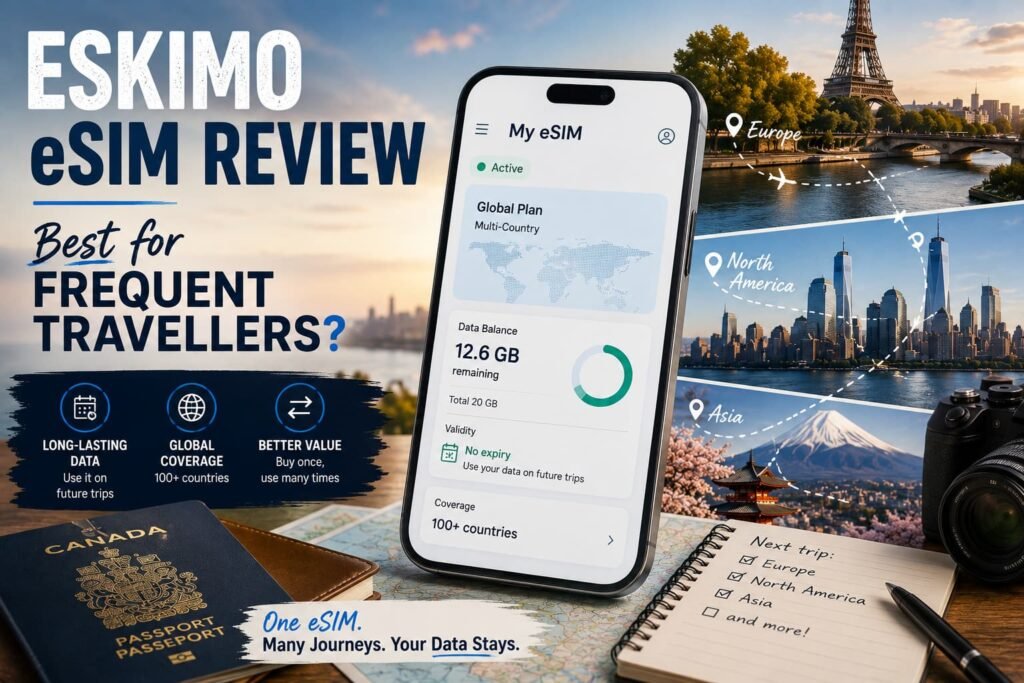
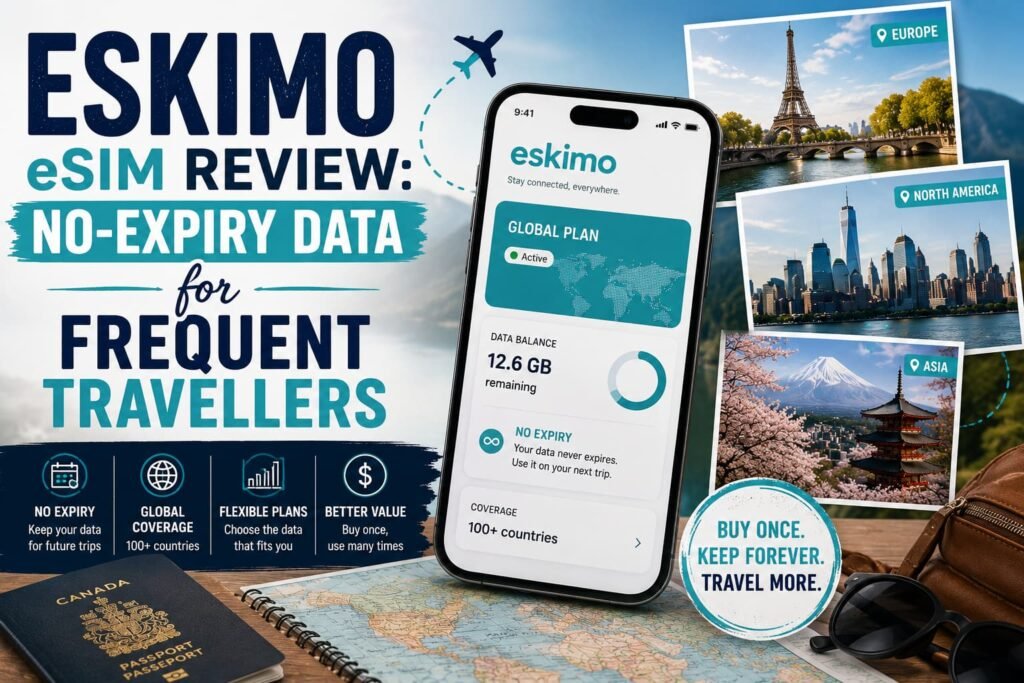
Eskimo eSIM stands out for one reason most travel eSIMs do not: your unused fixed data does not have to disappear when the trip ends. That difference is what matters most in this Eskimo eSIM review, especially for Canadians who travel regularly. Instead of pushing you into the usual 7-day, 15-day, or 30-day countdown, Eskimo is built around data you can keep for future travel.
That changes how I look at Eskimo.
Most travel eSIMs are easy to judge one trip at a time. You compare the destination, price, allowance, network, and validity period, then buy what fits the itinerary. Eskimo starts making more sense when you stop thinking about one departure and look at a year of travel instead.
Unused fixed data can remain available for later trips, and eligible paid fixed data can also be transferred to another Eskimo user. If you travel several times a year, that gives Eskimo a clearer reason to exist than another provider selling short-term prepaid data.
There is still a trade-off. If you are taking one predictable vacation and another provider has a cheaper plan that fits it perfectly, I would not choose Eskimo just because the data lasts longer.
For repeat travellers, though, the story changes.
My Take on Eskimo eSIM
I think Eskimo works best as a repeat-travel eSIM, not as a provider you automatically choose every time you leave Canada.
What I like most is what happens to the data you do not use. Instead of watching an unfinished balance disappear because the validity period ends, you can keep eligible fixed data for another trip. Transferability also gives couples, families, and frequent travellers another way to make use of uneven balances.
That is genuinely useful if your travel habits are unpredictable.
Eskimo would be high on my shortlist if you travel internationally several times a year, often come home with unused data, want one travel eSIM to remain installed between trips, travel with someone who could benefit from transferred data, or simply prefer buying fixed gigabytes instead of keeping track of pay-as-you-go credit.
If none of those sound like you, Eskimo becomes much less distinctive. Someone taking one international holiday every year or two may get better value from a cheaper destination-specific plan.
Eskimo eSIM Pros and Cons
| Pros | Cons |
|---|---|
| Long-validity fixed data helps reduce wasted data between trips. | Not always the cheapest option for a single short vacation. |
| Eligible paid data can be transferred to another Eskimo user. | Voice calls and SMS are not included with standard data plans. |
| Coverage spans 200+ destinations with regional and Global options. | The long-validity model offers less value if you rarely travel. |
| One eSIM can stay installed and be reused for future trips. | Some travellers may prefer simpler destination-only pricing. |
| Hotspot support makes it useful for laptops and tablets while travelling. | Network performance still depends on the local partner carrier. |
Why Eskimo Works Better Across Several Trips
The usual travel eSIM model makes you solve two problems at once: how much data you need, and how quickly you can use it before the plan expires.
That creates a lot of unnecessary guesswork. Imagine flying from Toronto to London for ten days and expecting to use somewhere between 3 GB and 5 GB. With a typical 30-day plan, buying the larger allowance can feel wasteful because anything left over may eventually disappear.
Eskimo removes much of that pressure. Its paid fixed-data plans do not use the normal short expiry window, subject to the account conditions in Eskimo’s current Terms of Service. Use part of the balance in London, come home, and the remainder can still be there when the next eligible trip comes around.
I would still buy sensibly. Buying a huge data allowance just because it never expires is not much of a bargain if it sits on your phone for the next two years.
Where Eskimo starts to make sense is in taking some pressure off the estimate. You do not have to predict your usage perfectly every time you leave Canada, which is helpful if one trip involves light sightseeing and the next turns into a week of navigation, video calls, and laptop tethering.
Transferable data makes the same balance more flexible
Eskimo’s transferable-data feature makes that long-term model more useful. Eligible paid fixed data can be moved to another Eskimo user under the provider’s current transfer rules.
That can be particularly useful when:
- one traveller uses far more data than another
- a couple finishes a trip with an uneven balance
- a family member is travelling later in the year
- one partner needs extra data for a work trip
Picture two people travelling through Europe by train. One is constantly checking maps, downloading tickets, looking up restaurants, and tethering a laptop. The other spends most of the trip on hotel and train Wi-Fi.
With separate short-validity plans, one person can run low while the other comes home with most of the allowance untouched. Eskimo gives that unused balance somewhere else to go.
This is not enough on its own to make me choose Eskimo. Price and coverage still have to make sense. But when the underlying plan is competitive, transferability makes the whole setup noticeably more practical.
One limitation: the account cannot be abandoned indefinitely
Eskimo’s no-expiry model still operates within account terms. The current terms say an account with remaining data can be considered dormant after more than two continuous years with no connection, no data usage, no purchase, and no data transfer.
For someone actually using Eskimo as a repeat-travel service, that is unlikely to matter. I would simply think of the fixed plans as no normal expiry, rather than treating the balance like something that can sit untouched forever.
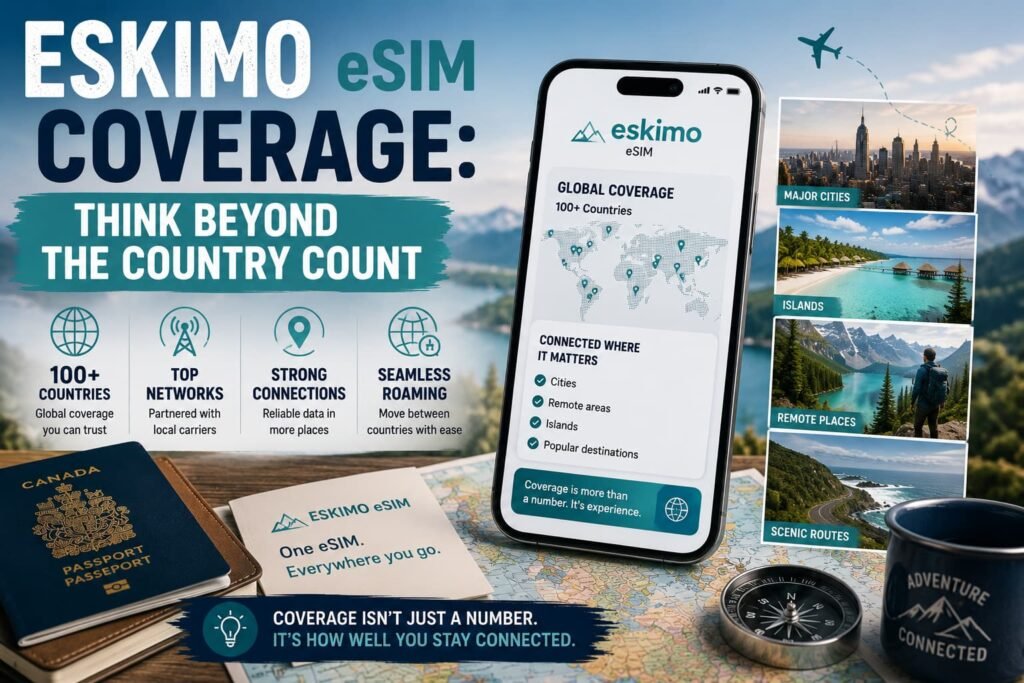
Eskimo eSIM Coverage: Think Beyond the Country Count
Eskimo eSIM coverage is broad, but I would not choose a plan because the website shows a large country number.
What matters more is whether the plan covers both the trip in front of you and the places where you may want to reuse the remaining data later.
One Eskimo eSIM can stay installed on your phone, but country, regional, and Global plans still have different coverage areas.
| Region | Representative Eskimo destinations |
|---|---|
| Europe | United Kingdom, France, Germany, Spain, Italy, Portugal, Netherlands, Greece |
| North America | Canada, United States, Mexico |
| Asia | Japan, Thailand, Singapore, South Korea, Malaysia, Indonesia, China |
| Oceania | Australia, New Zealand |
| South America | Brazil, Argentina, Chile, Colombia, Peru |
| Middle East | United Arab Emirates, Saudi Arabia, Qatar, Türkiye |
| Africa | South Africa, Egypt, Kenya, Morocco |
Eskimo’s official network coverage page is the place to confirm the current country list before purchasing.
For a straightforward one-country trip, a destination-specific plan may be all you need. If I were rail-hopping through France, Germany, and Italy, I would look at the Europe plan before buying separate country coverage.
Broader plans become more appealing when your travel calendar is scattered. Someone visiting New York in spring, Paris in summer, and Tokyo later in the year has far more reason to care about reusable coverage than someone taking one annual resort trip.
A non-expiring balance only helps if the next place you go is still covered. If you are comparing several destinations, the eSIM Providers by Country guide can help you see when Eskimo fits and when another provider may make more sense.
Look at the partner networks, not just the coverage map
Eskimo does not operate its own mobile network. Like most travel eSIM providers, it relies on local carrier partners, so the experience can change from one destination to another.
Current official destination pages identify partner networks in several major markets, including:
- Rogers in Canada
- T-Mobile and Verizon in the United States
- Bouygues and Orange in France
- SoftBank and KDDI in Japan
- AIS in Thailand
I find that more useful than simply seeing a 4G or 5G badge. Knowing which networks may sit behind the connection gives you a better idea of what you are actually buying.
Even then, familiar carrier names do not guarantee identical performance. Signal strength, roaming priority, congestion, device support, and routing can all change how the connection feels once you are travelling.
Eskimo eSIM Pricing: Where the Model Starts to Get Interesting
Eskimo’s no-expiry idea only matters if the plans themselves are priced sensibly.
In several popular markets, they are.
The table below compares current 5 GB fixed-data plans across country, regional, and Global options. Eskimo lists these plans in U.S. dollars, so I have included Canadian-dollar estimates for easier comparison.
| Destination or Region | Data | Validity | USD | CAD |
|---|---|---|---|---|
| Canada | 5 GB | No expiry | US$11.00 | C$15.33 |
| United States | 5 GB | No expiry | US$7.00 | C$9.76 |
| France | 5 GB | No expiry | US$9.00 | C$12.54 |
| Japan | 5 GB | No expiry | US$7.00 | C$9.76 |
| North America | 5 GB | No expiry | US$11.95 | C$16.65 |
| Europe | 5 GB | No expiry | US$9.95 | C$13.87 |
| Asia Pacific | 5 GB | No expiry | US$8.95 | C$12.47 |
| Global | 5 GB | No expiry | US$12.45 | C$17.35 |
CAD values are estimates for comparison only. Your final Canadian-dollar cost may differ at checkout.
Current pricing and plan details are available on Eskimo’s official Global plan page and the corresponding country and regional plan pages.
Country plans are the easy choice for simple trips
The United States and Japan examples are especially appealing at US$7 for 5 GB. If I were taking a straightforward week in Tokyo or making another U.S. city break, I would start with the country plan rather than automatically paying for broader coverage.
Canada costs more at US$11 for the same 5 GB allowance, but the fixed-plan no-expiry structure remains the same.
For a single-destination trip, that narrower plan is usually the option I would check first.
Europe is where Eskimo starts looking more interesting
The Europe plan is a good example of why regional coverage can be worth paying a little more for.
A 5 GB France plan costs US$9, while 5 GB across Europe costs US$9.95. If I were crossing France, Germany, and Italy on the same trip, I would take the regional plan before buying separate country coverage. For less than a dollar more, the extra flexibility is hard to argue with.
Asia follows the same pattern. Japan alone costs US$7 for 5 GB, while Asia Pacific costs US$8.95.
For backpackers, rail travellers, and anyone building a multi-country itinerary, this is where I think Eskimo genuinely earns its place. Managing one regional balance is simply easier than treating every border as a new purchase.
North America works the same way. The 5 GB regional plan costs US$11.95 and covers Canada, the United States, and Mexico, which makes more sense if you regularly move between those markets.
Global is for travellers who actually cross regions
The 5 GB Global plan costs US$12.45.
Personally, I would skip it if most of my travel stayed inside one region. The Europe plan is the smarter buy if Europe is where you spend most of your time.
Global becomes more compelling when your year genuinely includes different regions. A consultant flying from Canada to the U.S., Europe, and Asia throughout the year is a much better fit than someone spending two weeks in Spain.
If that were my travel pattern, I would pay the extra for wider coverage. Otherwise, I would keep the plan narrower.
If you want to compare current travel eSIM options for a specific itinerary, the eSIM Plan Comparison Tool is a better next step than comparing headline prices alone.
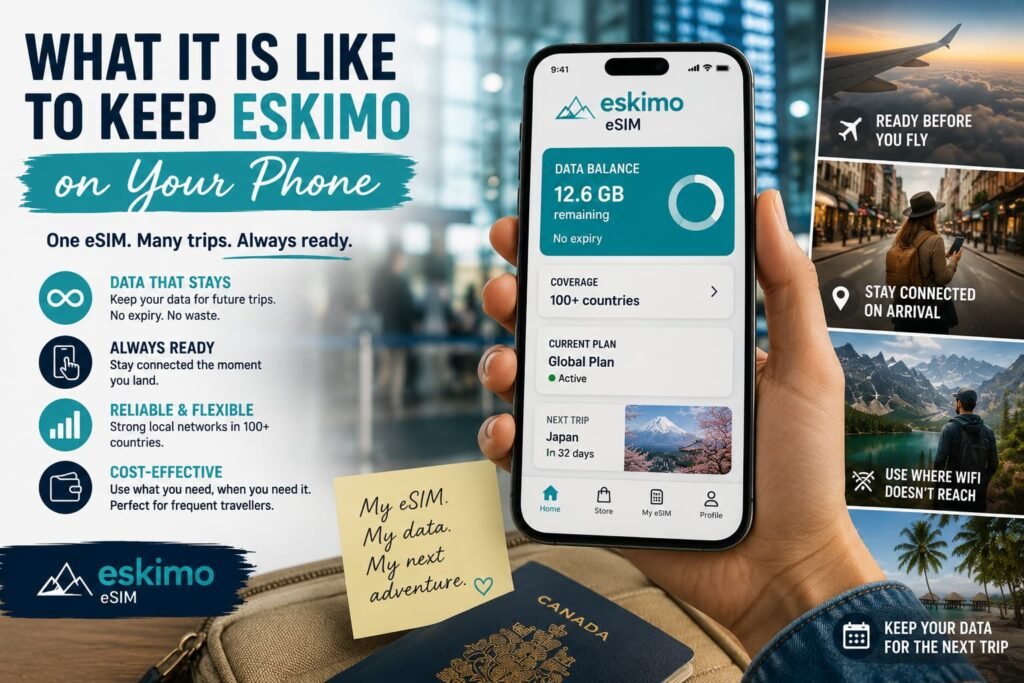
What It Is Like to Keep Eskimo on Your Phone
One of the things I like about Eskimo is that you do not have to treat the eSIM itself as disposable.
Install it once, keep it on the phone, and manage future data through the same account. If you travel often, that feels much cleaner than collecting a new eSIM profile every time you book another flight.
I would happily leave Eskimo installed between trips. That is exactly the kind of convenience that matters more after your third or fourth trip than it does on day one.
The Eskimo eSIM app becomes part of the routine
The Eskimo eSIM app is available for both iPhone and Android and acts as the main account interface for buying plans, checking balances, and managing your travel eSIM.
You can find the official app on the Apple App Store and Google Play.
For a reusable travel eSIM, the app matters more than it does with something you might buy once and delete. If Eskimo becomes your regular travel line, this is where you come back before the next trip instead of starting from scratch.
Hotspot support is especially useful for business travel
Eskimo supports personal hotspot on current plans.
This is one feature I actually care about if the trip involves work. A weekend city break may barely touch your allowance, while a later business trip could have you tethering a laptop from an airport lounge or hotel room.
Just watch the background usage. Cloud backups, software updates, large file transfers, and streaming can chew through fixed data quickly, so I would size the plan around laptop use rather than normal phone browsing if hotspot was going to matter.
Eskimo is primarily data-only
Eskimo travel eSIM plans are designed mainly for mobile data.
For Canadians, the setup I would normally use is keeping your regular Canadian SIM or eSIM active for your phone number while Eskimo handles data abroad. WhatsApp, FaceTime, Messenger, and other internet-based services can then use the Eskimo connection.
If you still need your Canadian line for verification texts, calls, or banking messages, check your carrier’s roaming rules carefully. The Travel eSIM vs International Roaming for Canadians guide explains how to manage that dual-SIM setup without accidentally turning your Canadian roaming back on.
Keep the setup simple
Eskimo installation is straightforward enough that I would not overcomplicate it.
Before buying, confirm that your phone supports eSIM and is carrier-unlocked. The eSIM Compatibility Checker can help confirm your exact model.
For a typical Canadian dual-SIM setup:
- install Eskimo while you still have reliable Wi-Fi
- label the travel line clearly
- select Eskimo for mobile data abroad
- enable Data Roaming on the Eskimo line when required
- keep Canadian-line data roaming off unless you intentionally want carrier roaming
- review automatic data switching so the phone does not unexpectedly fall back to Canadian roaming data
For full device instructions, use the iPhone eSIM activation guide or the Android eSIM activation guide.
What the refund policy actually covers
Eskimo advertises 24/7 human support.
Its current Terms of Service state that customers who cannot install the eSIM or establish a connection can qualify for a refund after Eskimo verifies the issue through its support process.
I like having that protection if the eSIM simply will not install or connect, but it is not enough on its own to make me choose the provider. More importantly, I would not treat it as a blanket refund policy for any unused balance. If you are planning to keep a larger amount of data in the account for future trips, that distinction matters.
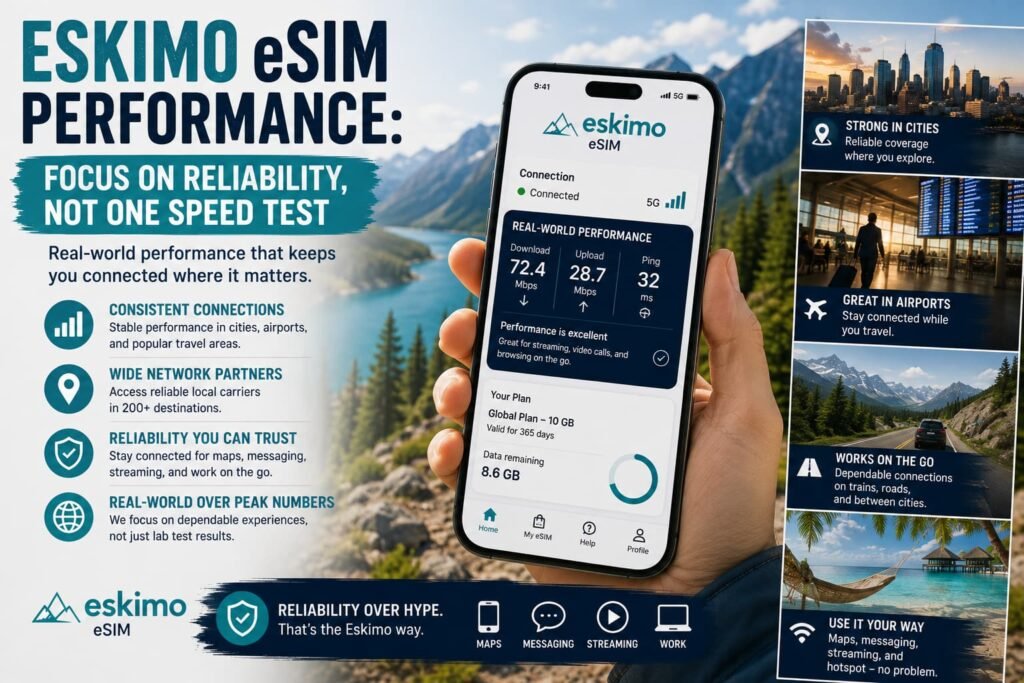
Eskimo eSIM Performance: Focus on Reliability, Not One Speed Test
I would be cautious about any Eskimo eSIM review that gives one universal speed figure. There is no single Eskimo speed.
A traveller landing at Heathrow, another using the service in Tokyo, and someone driving across rural Canada can all have very different experiences even with the same provider.
Performance depends on the partner network, signal strength, congestion, roaming priority, device capabilities, LTE or 5G availability, and routing.
When I am judging a travel eSIM, I care much more about whether the connection handles the things you actually need on the road:
- maps and navigation
- rideshare apps
- airline and hotel apps
- messaging and email
- web browsing and social media
- video calls and light streaming
- hotspot when needed
A responsive LTE connection can feel much better than a poor 5G connection, especially if latency or routing is working against you.
Eskimo’s broad coverage is useful, but performance can still vary between cities and countries. One speed test is useful context, not a verdict on the entire Eskimo service.
Eskimo eSIM vs Other Travel eSIM Providers
Eskimo becomes easier to judge once you compare it with providers built around different ways of buying travel data.
Eskimo eSIM vs Roamless
Roamless is probably the closest conceptual alternative because both services try to reduce the waste of starting over on every trip.
If I wanted predictable gigabytes I could keep between trips, Eskimo would be my pick. The fixed allowance makes it easy to see exactly how much data remains, and eligible paid data can also be transferred to another user.
Roamless is the better fit when a reusable wallet feels more natural and you want charges to follow actual consumption instead of choosing a fixed allowance before departure.
The difference is simple: Eskimo gives you data to keep, while Roamless FLEX gives you credit to spend.
The Roamless eSIM Review explains the pay-as-you-go model in more detail.
Eskimo eSIM vs BNESIM
BNESIM competes more directly with Eskimo on long-term flexibility, but the experience is more complex.
If simplicity were my priority, Eskimo would be the easier choice: buy fixed data, keep what remains, and transfer eligible data when useful.
BNESIM makes more sense if you want more plan structures and are comfortable comparing non-expiring, fixed-validity, recurring, regional, and broader plan options.
For someone who wants reusable fixed data without much decision fatigue, Eskimo feels easier to live with. If the wider choice of plan types matters more than simplicity, read the BNESIM eSIM Review.
Eskimo eSIM vs Airalo
Airalo is the more conventional option.
For frequent travel, I would lean toward Eskimo when unfinished data is likely to stay useful after the current trip.
Airalo is the smarter choice for a simple destination-specific purchase when you find the right allowance, network, and price for one vacation.
If I were taking one straightforward trip to Portugal and Airalo was clearly cheaper, I would not pay extra for Eskimo flexibility I was unlikely to use. If another trip was already coming up two months later, the decision would be different.
The Airalo eSIM Review covers Airalo’s more traditional fixed-plan approach in detail.
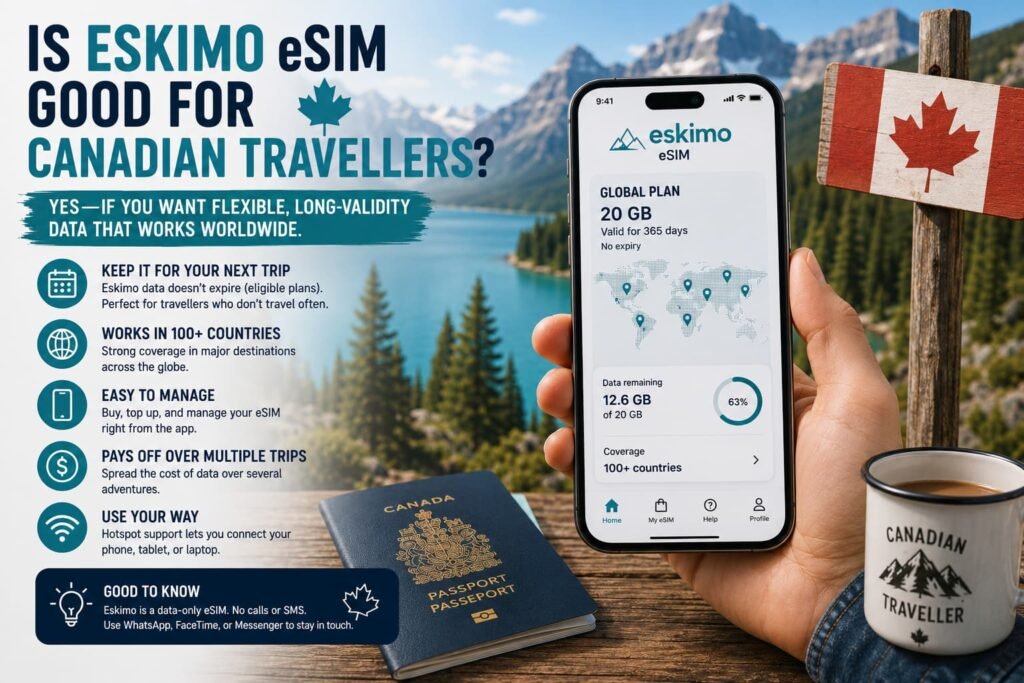
Is Eskimo eSIM Good for Canadian Travellers?
I think Eskimo is a particularly good fit for Canadians who travel often enough to benefit from continuity.
I would recommend it most strongly to travellers who:
- leave the country several times a year
- often come home with unused travel data
- travel for work
- visit several countries over the course of a year
- want one eSIM to remain installed
- travel with a partner or family member who could use transferred data
- prefer fixed gigabytes over pay-as-you-go credit
You are better off comparing other providers if you take one short international trip every year or two, usually buy exactly the amount of data you need, or find a substantially cheaper destination-specific plan elsewhere.
Eskimo is also less suitable if you need a local phone number with traditional calls and SMS, or if your travel style revolves around very heavy unlimited usage.
For me, the bigger advantage is continuity. If your travel habits give you a chance to reuse the same balance, Eskimo makes a lot of sense. If they do not, there is no reason to force the fit.
Frequently Asked Questions About Eskimo eSIM
Does Eskimo eSIM data expire?
Eskimo’s paid fixed-data plans do not use the short validity periods common with many travel eSIMs. The remaining balance can stay available for future eligible travel subject to Eskimo’s account terms.
An account can still be affected by Eskimo’s dormancy rules after an extended period without connection, usage, purchases, or transfers. For an active repeat traveller, that is very different from a plan automatically expiring after a few weeks.
What happens to unused Eskimo data after a trip?
Unused eligible fixed data remains available in the Eskimo account rather than disappearing simply because the original trip has ended.
Whether you can use that balance on the next trip depends on the coverage attached to the plan. A country plan is more restrictive, while regional and Global plans can give the remaining data more opportunities to be useful later.
Which Eskimo eSIM plan is best for multi-country travel?
A regional plan is usually the best starting point when all of your destinations fall within the same region, while the Global plan becomes more useful when an itinerary crosses several regions.
For example, the current Europe fixed plan can make more sense than separate country plans for a multi-country European trip. Before buying, check Eskimo’s current coverage list against every stop on your itinerary.
How does Eskimo eSIM work for Canadians visiting the United States?
Eskimo can be particularly useful for Canadians who make repeated U.S. trips because both U.S.-specific and North America fixed-data options are available.
The U.S. plan is the more focused choice when your travel stays south of the border, while North America coverage can make more sense if the same balance may later be used in Canada or Mexico. Eskimo currently lists T-Mobile and Verizon as U.S. partner networks.
Can I keep my Canadian phone number while using Eskimo?
A compatible dual-SIM phone can keep your Canadian carrier line available while Eskimo handles mobile data abroad.
This can help when you still need your normal number for verification texts or other services, but your Canadian carrier’s roaming rules still apply. The Travel eSIM vs International Roaming for Canadians guide explains how to manage that setup more carefully.
How does Eskimo eSIM hotspot use affect my data balance?
Personal hotspot uses the same Eskimo data allowance as the phone itself, so tethering a laptop or tablet directly reduces the remaining balance.
Normal browsing may use relatively little data, but cloud syncing, software updates, large file transfers, and video streaming can consume several gigabytes quickly. If hotspot is central to the trip, choose the allowance based on laptop use rather than phone use alone.
What calling and SMS options do I have with Eskimo eSIM?
Eskimo is primarily a data-only travel eSIM, so traditional local calls, SMS, and a local mobile number are not the main service being provided.
Internet-based services such as WhatsApp, FaceTime, Signal, and Messenger can use the Eskimo data connection, while a compatible dual-SIM phone can keep your Canadian line available separately when you need your normal number.
What should I check before installing an Eskimo eSIM?
Your phone should support eSIM and be carrier-unlocked before you purchase a travel plan. The eSIM Compatibility Checker can help confirm your exact model.
It is also easier to install the travel line while you still have reliable internet access. For complete device instructions, use the iPhone eSIM activation guide or Android eSIM activation guide.
Related eSIM Canada Guides
If Eskimo’s long-validity model appeals to you, these provider reviews are the most useful next comparisons. They cover different ways of handling reusable data, regional travel, unlimited plans, and conventional short-term eSIMs.
Compare Other Travel eSIM Providers
- SimOptions eSIM Review – explore a marketplace approach that lets you compare eSIM plans from multiple providers instead of buying from a single network.
- Saily eSIM Review – compare Eskimo’s long-validity approach with Saily’s simpler destination-based travel eSIM plans and app-focused experience.
- Keepgo eSIM Review – explore another long-validity approach built around persistent travel data and rollover-style use.
- Flexiroam eSIM Review – compare Eskimo with a provider focused more heavily on long-term roaming continuity across countries.
- Firsty eSIM Review – consider a very different model built around a free entry tier and paid upgrades for travellers who prioritize low-cost backup connectivity.
- Airalo eSIM Review – compare Eskimo’s repeat-trip flexibility with a mainstream destination-based fixed-plan approach.
- Nomad eSIM Review – useful if regional fixed-data plans and straightforward multi-country travel matter more than retaining data indefinitely.
- Holafly eSIM Review – compare Eskimo’s fixed allowances with an unlimited-style option for heavier data use.
Compare Plans and Travel Options
- Best eSIM for International Travel – compare leading provider types based on how and where you travel.
- eSIM Plan Comparison Tool – compare allowances, validity, pricing, and plan structures before buying.
- eSIM Providers by Country – check which providers and coverage options fit a specific destination.
Final Thoughts
I think Eskimo eSIM gets one important thing right: frequent travellers have a better chance of actually using the data they paid for.
If you travel several times a year, keep one travel eSIM installed, sometimes come home with data left over, or travel with someone who could use part of the balance, Eskimo belongs near the top of the shortlist.
Its biggest limitation is just as clear. If you take one short trip every year or two and find a cheaper destination-specific plan that fits perfectly, I would take the cheaper option. There is no point paying for flexibility you are unlikely to use.
What I like most about Eskimo is how consistently the pieces fit the repeat-travel idea. No-expiry fixed data, transferable balances, regional coverage, hotspot support, and an install-once approach all work together rather than feeling like unrelated features.
That is where Eskimo earns its place for me. It is easier to understand than some of the more complicated long-validity providers, but gives frequent travellers more continuity than the usual short-expiry destination plan.
For Canadians who travel often and hate wasting unused data, I recommend Eskimo. If your priority is simply getting the lowest price for one trip, compare a few other providers first.