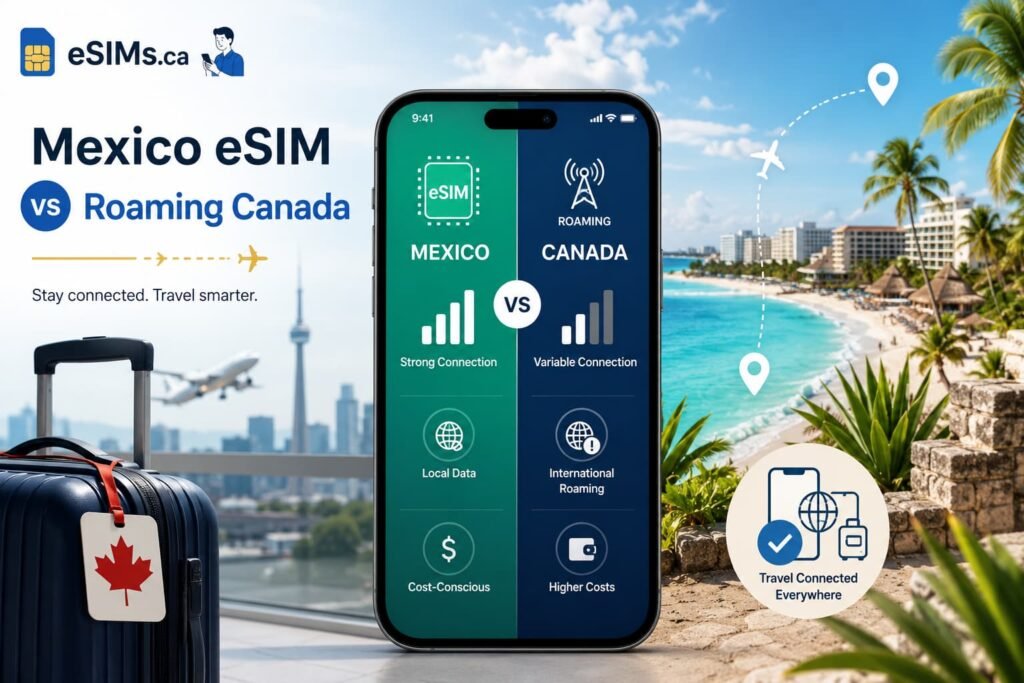
If you are travelling from Canada to Mexico, comparing Mexico eSIM vs roaming Canada before you leave can help you avoid paying more than you need for mobile data.
A Mexico vacation can feel simple from a phone-planning perspective. Many travellers assume resort Wi-Fi will cover most of the trip. That may be true while you are sitting by the pool, but the gaps usually show up at the airport, during a hotel transfer, while booking an excursion, or when you leave the resort for dinner.
You may be heading to Cancún for one week, staying at an all-inclusive in Riviera Maya, visiting family in Mexico City, spending part of the winter in Puerto Vallarta, or travelling through several regions. In each case, reliable mobile data can make the trip easier.
Canadian carrier roaming is convenient because your regular number stays active and your phone can connect automatically. The tradeoff is that daily charges can add up quickly, especially when more than one person in the family turns on roaming.
A Mexico travel eSIM gives you another option. It adds a separate prepaid data plan to your phone, so you can use mobile data in Mexico while keeping your Canadian SIM available only when you need important texts, verification codes, or calls. If you have already decided to use an eSIM, see our Best eSIM for Mexico From Canada guide to compare the strongest current options.
This guide explains when Canadian roaming still makes sense, when a Mexico eSIM is the better option, how carrier Travel Passes compare, what snowbirds should consider, and how to avoid accidental roaming charges while travelling in Mexico.
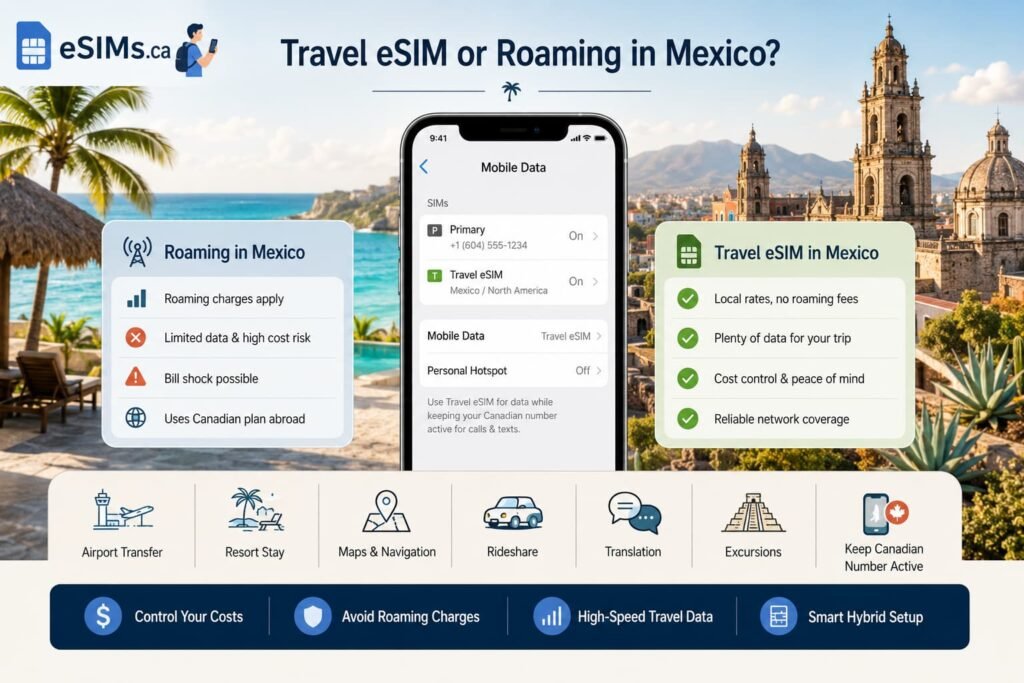
For most Canadians travelling to Mexico, a travel eSIM is usually the better-value option for mobile data. Canadian roaming can still make sense for a short trip or when you need your regular number fully active. For many travellers, the best balance is a hybrid setup: keep the Canadian SIM active for important texts and use a Mexico eSIM for data.
Mexico eSIM vs Roaming Canada at a Glance
| Travel Situation | Best Option | Why |
|---|---|---|
| Short resort weekend | Roaming or small Mexico eSIM | Choose based on simplicity versus mobile data cost |
| One-week vacation | Mexico eSIM for data | Often better for maps, messaging, rideshares, and hotel apps |
| Family vacation | Mexico eSIMs for each phone | Daily roaming fees can multiply across several lines |
| Longer winter stay | Mexico eSIM or local option | Better for extended use and larger data needs |
| Canada, U.S., and Mexico trip | North America eSIM | One regional plan may be easier across several countries |
| Need bank texts and travel data | Hybrid setup | Keep your Canadian SIM active and use the Mexico eSIM for data |
Canadian roaming may still be worth it for a short trip, business travel, or situations where you need your Canadian number fully active for regular calls and texts. It is also the simplest option because you do not need to install another eSIM or change much on your phone.
For a longer vacation, family trip, snowbird stay, or data-heavy itinerary, a Mexico travel eSIM is usually worth comparing before leaving Canada.
Use the free Canadian Roaming Savings Calculator to estimate your carrier roaming cost based on your trip length, number of travellers, and expected mobile data use.
Canadian Roaming in Mexico Can Get Expensive Fast
Mexico is one of the most popular vacation destinations for Canadians, but it is also easy to underestimate the total roaming cost.
A daily fee may not look too serious when you see it listed as a single-day charge. The problem is that a one-week vacation can trigger several daily charges per line. If two adults and two teenagers all use roaming, the total can climb quickly.
For example, if international roaming costs around $16 to $18 CAD per day, one phone can cost roughly $112 to $126 CAD for a 7-day trip. For two travellers, that becomes about $224 to $252 CAD. For a family of four, the total can reach roughly $448 to $504 CAD before taxes.
That does not automatically mean roaming is the wrong choice. Some carriers now offer Mexico Travel Passes or monthly plans that include Mexico usage. The better choice changes once you factor in your current plan, the length of the trip, how many phones need data, and whether your Canadian number needs to stay fully active.
Mexico eSIM vs Canadian Roaming Cost Comparison
Last checked: May 2026
Carrier rates, Travel Pass pricing, included destinations, and plan rules can change. Always confirm the latest details with your carrier before travelling.
| Option | Current Cost Signal | Best For | Watch Out For |
|---|---|---|---|
| Rogers Roam Like Home or Mexico Travel Pass | Rogers offers daily roaming and multi-day Travel Pass options that can include Mexico. Some current Rogers plans also include Mexico usage | Rogers customers who want their regular line active | Check whether your current plan already includes Mexico before paying for roaming |
| Bell Roam Better | International roaming is currently listed at $16/day. Bell also lists a Caribbean and Mexico 14-day Travel Pass at $70 | Bell customers staying one to two weeks | Add the pass on the correct day because it activates immediately |
| TELUS Easy Roam | International Easy Roam is currently listed at $18/day. TELUS currently shows a Caribbean & Mexico 7-day pass at a promotional $49, with regular pricing listed at $60 | TELUS customers taking a one-week vacation | Promotions can change, so confirm the live price before buying |
| Fido Roam or Travel Pass | Fido currently lists international roaming at $18/day and offers Caribbean & Mexico Travel Pass options | Fido customers who want their regular plan active | Compare the Travel Pass with a prepaid eSIM before leaving Canada |
| Koodo Easy Roam or Travel Pass | International Easy Roam is currently listed at $18/day. Koodo also shows a Caribbean & Mexico 7-Day Pass at a promotional $49, with regular pricing listed at $60 | Koodo customers who want a predictable roaming option | Promotions can change, so confirm the live price before travelling |
| Virgin Plus Roam Sweet Roam | Virgin Plus currently lists international roaming at $16/day and a Caribbean and Mexico 14-day Travel Pass at $70 | Virgin Plus customers staying up to two weeks | Background data, voicemail, or app activity can trigger roaming usage |
| Mexico travel eSIM | Prepaid data pricing depends on provider, plan size, and validity period | Data savings, family travel, longer trips, and resort vacations | Most plans are data-only, so regular calls and SMS may still need your Canadian line |
| North America eSIM | Regional plan covering Canada, the U.S., and Mexico | Multi-country road trips and travellers crossing several borders | Check the exact country list and whether Canada data is actually needed |
A carrier Travel Pass may be a good middle ground for travellers who want convenience without paying the full daily roaming total. A travel eSIM may be better when mobile data is the main priority and you do not need regular Canadian calls throughout the trip.
For a typical one-week resort vacation, the real decision is usually between a carrier Travel Pass and a small prepaid Mexico eSIM. Paying the full daily roaming rate becomes harder to justify once more than one phone is involved.

How Canadian Carrier Roaming Works in Mexico
Canadian carrier roaming lets your regular mobile plan connect to a partner network in Mexico.
When you arrive, your phone may connect automatically. Depending on your carrier and plan, using mobile data, sending a text, answering a call, making a call, or checking voicemail can trigger a daily roaming fee.
The biggest advantage is simplicity. Your regular Canadian number stays active, your contacts can reach you normally, and you do not need to install a second SIM profile.
Roaming can be helpful if you need:
- Your Canadian number for regular calls
- Bank verification texts
- Work messages
- Emergency contact
- A simple setup for a short trip
- No eSIM app or QR code setup
The convenience can become expensive quickly. Your phone may quietly use roaming data for maps, app updates, social media, cloud backups, hotel apps, or background syncing. Once roaming activates, the charge can apply even if you only used a small amount of data.
Current Canadian Carrier Mexico Roaming Options
Mexico roaming is changing. Some carriers still rely on international daily roaming, while others promote multi-day Travel Passes or monthly plans that include Mexico.
Rogers Mexico Roaming
Rogers offers daily roaming and multi-day Travel Pass options that can include Mexico, depending on your plan and trip length.
The most important first step is checking whether your Rogers plan already includes Mexico usage. Rogers has current Canada+U.S.+Mexico mobile plan options that let eligible customers use talk, text, and data in Mexico without paying the daily Roam Like Home fee.
For current included-plan rules, see the official Rogers Canada+U.S.+Mexico plan FAQ.
If your plan does not include Mexico, compare the current roaming option against a Mexico travel eSIM before leaving Canada. Rogers customers can review the full cost breakdown in Rogers Roam Like Home vs Travel eSIMs.
Bell Roam Better in Mexico
Bell currently lists international Roam Better at $16/day. Bell also lists a Caribbean and Mexico 14-day Travel Pass at $70.
The 14-day pass can be a useful middle-ground option for Canadians taking a typical one-week or two-week Mexico vacation because it uses the data from your regular plan and includes talk and text within the destination and back to Canada.
Bell says the Travel Pass activates immediately when it is added and remains valid until 11:59 p.m. Eastern Time on the expiry date. Add it on the day your trip starts, before arriving in Mexico.
The Bell Roam Better vs Travel eSIMs guide explains when the 14-day pass may make more sense than paying the daily rate.
TELUS Easy Roam in Mexico
TELUS currently lists international Easy Roam at $18/day. TELUS also shows a Caribbean & Mexico Easy Roam 7-Day Pass, with promotional pricing that may change.
A 7-day pass can be useful for a one-week resort vacation because it uses the data from your existing plan plus unlimited talk and text within eligible destinations.
TELUS says the pass activates when you arrive and must be used within 30 days from the date it is added to your account. Confirm the live price and eligibility before buying.
For a closer look at the TELUS pass rules and daily roaming option, use the TELUS Easy Roam vs Travel eSIMs guide.
Fido Roam in Mexico
Fido currently lists international roaming at $18/day and offers Caribbean & Mexico Travel Pass options.
A Travel Pass may work well for travellers who want to keep their regular line active and use their existing plan in Mexico. A travel eSIM may offer better value if you mainly need mobile data and are comfortable using WhatsApp, FaceTime, iMessage, Messenger, or email.
Fido customers planning a Mexico trip can compare the options in Fido Roam vs Travel eSIMs.
Koodo Easy Roam in Mexico
Koodo currently lists international Easy Roam at $18/day. It also shows a Caribbean & Mexico 7-Day Pass at a promotional $49, with regular pricing listed at $60.
That can be useful for a one-week resort stay because you know the roaming cost before leaving Canada. Check the official Koodo roaming page before buying because promotional pricing, eligibility, and pass details can change.
The Koodo Easy Roam vs Travel eSIMs comparison gives Koodo customers a clearer view of when a pass or travel eSIM may fit better.
Virgin Plus Roam Sweet Roam in Mexico
Virgin Plus currently lists international Roam Sweet Roam at $16/day and a Caribbean and Mexico 14-day Travel Pass at $70.
The Travel Pass uses the data from your existing mobility plan and includes unlimited texting plus calling within your destination and back to Canada. Virgin Plus also warns that emails, Visual Voicemail, and apps use data while roaming, so background activity can matter.
Virgin Plus customers can use Virgin Plus Roam Sweet Roam vs Travel eSIMs to compare the pass against prepaid travel data.
When Your Canadian Plan Already Includes Mexico Usage
Before buying a travel eSIM, check the exact mobile plan you already have.
Some current Canadian plans include Mexico usage as part of a broader Canada+U.S.+Mexico or international roaming package. If your plan already covers Mexico calls, texts, and data, you may not need to buy a travel eSIM for a short vacation.
That can be the best option if you:
- Travel to Mexico several times per year
- Spend part of the winter in Mexico
- Travel between Canada, the United States, and Mexico
- Need your regular Canadian number working normally
- Use your phone for work
- Do not want to manage a second SIM profile
The tradeoff is monthly cost. A plan with included Mexico coverage may be convenient, but it may cost more each month. If you only travel once per year, a prepaid Mexico eSIM or carrier Travel Pass may still be the better fit.

How a Mexico Travel eSIM Works
A Mexico travel eSIM is a digital SIM profile that gives your phone a separate prepaid data plan for Mexico.
You usually buy the eSIM online or through an app, install it over Wi-Fi before leaving Canada, and activate it according to the provider’s instructions. Once you arrive in Mexico, set the travel eSIM as the mobile data line.
Most travel eSIMs are data-only. That means the eSIM gives you internet access, but not necessarily a regular Mexican phone number for traditional calls and SMS.
A Mexico travel eSIM works well for:
- Maps and navigation
- Airport transfers
- Rideshare apps
- Hotel and resort apps
- Restaurant searches
- Attraction tickets
- Translation tools
- Messaging apps
- Social media
- Browsing
- Hotspot use, if supported
For provider ideas, see Best eSIM for International Travel and the eSIM Providers by Country hub.
Mexico-Only eSIM vs North America eSIM
A Mexico-only eSIM is usually the better choice if your entire trip is inside Mexico.
A North America eSIM may be more useful if your trip includes Canada, the United States, and Mexico. That can work well for a road trip, multi-country vacation, or extended trip where you want one regional plan instead of switching eSIM profiles.
For example, a Canadian traveller flying directly to Cancún may only need a Mexico eSIM. A traveller driving through the United States and continuing into Mexico may prefer a North America plan.
Always check the provider’s included country list before buying. A plan labelled “North America” may not cover every destination or may offer different data allowances by country.
When Canadian Roaming May Still Make Sense for a Mexico Trip
Canadian roaming is not always the wrong choice for Mexico.
It may still make sense if:
- Your trip is only one or two days
- You need your Canadian number fully active
- Your employer pays your phone bill
- Your carrier Travel Pass fits the trip length
- Your plan already includes Mexico usage
- You do not want to install an eSIM
- You expect regular calls and texts
- Convenience matters more than the lowest possible cost
For a short trip or business visit, roaming may be worth the simplicity.
When a Mexico eSIM Is the Better Choice
A Mexico travel eSIM is usually better when your main need is mobile data and your Canadian plan does not already include Mexico coverage.
A prepaid eSIM may make more sense if:
- Your trip lasts a week or longer
- You mainly need maps, messaging, rideshares, and apps
- You are travelling with family
- You want predictable prepaid data costs
- You are staying at a resort but do not want to depend on Wi-Fi
- You plan to explore outside the resort
- You need hotspot for a tablet or laptop
- You are staying in Mexico for the winter
Resort Wi-Fi can be useful, but it is rarely the whole solution. The moments when mobile data matters most are often the times when you are away from the hotel: at the airport, during a transfer, while booking an excursion, or when you need a map after dinner.
Best Setup: Keep Your Canadian Number and Use a Mexico eSIM for Data
For this kind of trip, a hybrid setup is often the most practical option.
Use your Canadian SIM for:
- Incoming texts
- Bank verification codes
- Important calls
- Emergency access
- Your regular Canadian number
Use your Mexico eSIM for:
- Mobile data
- Maps
- Messaging apps
- Hotel apps
- Rideshare apps
- Restaurant searches
- Browsing
- Hotspot, if supported
On iPhone, label your Canadian line as Primary and the Mexico eSIM as Travel Data. Then choose the Mexico eSIM for Cellular Data and turn off Allow Cellular Data Switching.
On Android, the wording depends on your phone. Samsung Galaxy users usually start in Settings > Connections > SIM Manager. Google Pixel users usually start in Settings > Network & Internet > SIMs.
Use the eSIM Compatibility Checker before purchasing a travel eSIM to confirm that your phone supports eSIM.
How to Avoid Accidental Roaming Charges in Mexico
Accidental roaming usually happens when your Canadian line quietly uses data in the background.
Before leaving Canada:
- Install the Mexico travel eSIM over Wi-Fi.
- Label your Canadian line as Primary.
- Label your Mexico eSIM as Travel Data.
- Turn off data roaming on your Canadian line.
- Turn off automatic cellular data switching.
- Save your eSIM QR code or app login details.
- Confirm whether the Mexico eSIM requires data roaming to be turned on for the travel line.
When you arrive in Mexico:
- Turn on the Mexico eSIM.
- Choose the Mexico eSIM as your mobile data line.
- Turn on data roaming for the Mexico eSIM only if the provider requires it.
- Keep data roaming off on your Canadian SIM.
- Avoid answering calls or sending SMS on the Canadian line unless you accept possible roaming charges.
- Check that apps, maps, and browsing are using the Mexico eSIM data connection.
For setup help, follow the How to Activate eSIM on iPhone in Canada guide or the Activate eSIM on Android Canada guide before travelling.

Mexico eSIM vs Roaming Canada by Trip Type
| Trip Type | Better Option | Why |
|---|---|---|
| One-day business trip | Canadian roaming | Simple if you need your regular number active |
| Weekend resort trip | Roaming or small Mexico eSIM | Choose based on convenience versus mobile data cost |
| 7-day vacation | Mexico eSIM or carrier Travel Pass | Compare prepaid data with the full Travel Pass cost |
| 14-day resort stay | Mexico eSIM or carrier Travel Pass | Better value depends on calls, texts, and data needs |
| Family vacation | Mexico eSIMs for each phone | Daily roaming fees can multiply across several lines |
| Mexico City trip | Mexico eSIM | Useful for maps, rideshares, restaurant searches, and transit |
| Resort plus excursions | Mexico eSIM | Helpful when leaving hotel Wi-Fi behind |
| Canada, U.S., and Mexico road trip | North America eSIM | One regional plan may be simpler across borders |
| Snowbird stay | Larger Mexico eSIM or local option | Better for extended data use |
| Traveller needing bank texts only | Hybrid setup | Keep the Canadian SIM active and use the eSIM for data |
For most one-week vacations, start by comparing the carrier Travel Pass with a small Mexico eSIM. For snowbird stays or family trips with several phones, prepaid travel data usually deserves a closer look because the total roaming cost can grow quickly.
Mexico eSIM vs Roaming Canada: Cost Example
Here is a simple example.
If international roaming costs $16 to $18 CAD per day, one phone can cost about $112 to $126 CAD for a 7-day Mexico trip.
For two travellers, that becomes about $224 to $252 CAD. For a family of four, the total can reach roughly $448 to $504 CAD before taxes.
A carrier Travel Pass can reduce that cost for some trips. A prepaid Mexico eSIM may still be better if the main need is mobile data and the traveller does not need regular Canadian calls throughout the vacation.
The best choice depends on the plan you already have, the number of lines travelling, and how much data you expect to use outside hotel Wi-Fi.
Frequently Asked Questions About Mexico eSIM vs Roaming Canada
Is a Mexico eSIM cheaper than Canadian roaming?
A Mexico travel eSIM can be cheaper than Canadian roaming, especially for a one-week vacation, a family trip, or a longer winter stay. Daily roaming fees can add up across several lines, even when each individual daily charge seems manageable.
The final answer depends on your carrier and whether a Travel Pass is available. Before buying an eSIM, check your current mobile plan and compare the full trip cost.
Should Canadians use roaming or a travel eSIM in Mexico?
A travel eSIM is often a good choice when mobile data is the main priority. It can handle maps, rideshares, messaging, hotel apps, restaurant searches, and browsing without using your Canadian line for roaming data.
Canadian roaming may still be better for a very short trip, a business visit, or a traveller who needs regular calls and texts from their Canadian number.
Can I keep my Canadian number active while using a Mexico eSIM?
Most modern dual SIM phones let you keep your Canadian line active while using a Mexico eSIM for mobile data.
Set the Mexico eSIM as the data line, turn off data roaming on your Canadian SIM, and disable automatic data switching. That reduces the risk that your Canadian line quietly uses roaming data in the background.
Can I receive Canadian bank verification texts while using a Mexico eSIM?
In many cases, yes. You can often keep your Canadian SIM active for incoming SMS while the Mexico eSIM handles mobile data.
Carrier rules can vary. Keep data roaming off on the Canadian line, and avoid sending texts, answering calls, or checking voicemail unless you are comfortable with possible roaming charges.
Is resort Wi-Fi enough for a Mexico vacation?
Resort Wi-Fi can help reduce mobile data use, but it may not be enough for the entire trip.
You may still need data at the airport, during hotel transfers, while booking excursions, when using maps, or when leaving the resort property. A small prepaid Mexico eSIM can provide a useful backup.
Is a Mexico-only eSIM better than a North America eSIM?
A Mexico-only eSIM is usually better if your trip stays entirely inside Mexico.
A North America eSIM may make more sense if your itinerary includes Canada, the United States, and Mexico, or if you are taking a longer road trip through several countries.
Should snowbirds use a Mexico eSIM or a Canadian roaming plan?
For an extended winter stay, paying a daily roaming fee can become expensive. A larger Mexico eSIM, local option, or Canadian plan with included Mexico coverage may be more practical.
Snowbirds should compare the full monthly cost, data amount, hotspot needs, and whether they need their Canadian number active for regular calls and texts.
Can I install a Mexico eSIM before leaving Canada?
It is usually easier to install the Mexico travel eSIM before leaving Canada while you still have reliable Wi-Fi.
Read the provider’s activation instructions carefully. Some plans begin when installed, while others start only after connecting to a supported network in Mexico.
Do Mexico travel eSIMs include regular calls and texts?
Many Mexico travel eSIMs are data-only. They give you mobile internet, but not always a regular Mexican phone number for traditional calls and SMS.
You can still use apps such as WhatsApp, FaceTime, iMessage, Messenger, Signal, Telegram, email, and other internet-based services over the eSIM data connection.
Can I use hotspot with a Mexico eSIM?
Many Mexico travel eSIMs support hotspot, but the rules depend on the provider and plan.
Check hotspot support before buying if you want to connect a tablet, laptop, or another phone. Hotspot use can drain data faster than expected.
Does a Canada+U.S. plan automatically include Mexico?
Not always. Some plans cover only Canada and the United States, while other plans include Canada, the United States, and Mexico.
Read the exact plan name and included-country list before travelling. Do not assume Mexico is included just because U.S. roaming is included.
What should Canadians check before buying a Mexico eSIM?
Before buying a Mexico eSIM, confirm that the phone supports eSIM, the device is unlocked, Mexico is included in the plan, the validity period fits the trip, hotspot is allowed if needed, and the data amount matches the itinerary.
Also check whether the plan is data-only, whether top-ups are available, and when the validity period begins.
Related eSIM Travel Guides for Canadians
Destination Comparisons
- USA eSIM vs Roaming Canada
- Europe eSIM vs Roaming Canada
- Best eSIM for Mexico From Canada
- Best eSIM for USA Travel for Canadians
- Best eSIM for Europe Travel From Canada
- Best eSIM for International Travel
- eSIM Providers by Country
Closely Related Carrier Comparisons
- Rogers Roam Like Home vs Travel eSIMs
- Bell Roam Better vs Travel eSIMs
- TELUS Easy Roam vs Travel eSIMs
Setup Help
- How to Activate eSIM on iPhone in Canada
- Activate eSIM on Android Canada
- How to Fix eSIM Not Working in Canada
Final Thoughts
The better choice between Mexico eSIM vs roaming Canada depends on the kind of trip you are planning.
For a quick business visit or a short resort weekend, Canadian roaming may be worth the simplicity. A carrier Travel Pass can also be a practical middle ground for a one-week vacation if you want to keep your regular calls and texts working normally.
A Mexico travel eSIM becomes more appealing when the trip is longer, several family members need data, or you want to stay connected away from resort Wi-Fi. It can handle maps, transfers, rideshares, hotel apps, restaurant searches, and messaging without relying on your Canadian line for mobile data.
For many travellers, the most practical setup is to keep the Canadian SIM active only when needed and use the Mexico eSIM as the main data line.
Before leaving Canada, check whether your current mobile plan already includes Mexico usage, compare the full trip cost, confirm that your phone supports eSIM, and install the travel profile while you still have reliable Wi-Fi.