After spending a month testing eSIM providers across the UK, I found that the best eSIM for UK from Canada depends more on how and where you travel than on who has the cheapest plan. Britain gives travellers a wider choice than many destinations: you can buy a straightforward data-only travel eSIM, choose a plan with calls and texts, or get something much closer to local UK mobile service with a British phone number.
I used the providers featured in this guide in busy city centres, on inter-city trains, while tethering other devices, and in more difficult coverage areas including parts of Scotland and Wales. I also looked at 5G performance, network behaviour, app settings, activation, sustained data use, and how each service performed once conditions became less predictable.
That testing changed how I rank the options. Ubigi and Sim Local/EE delivered the strongest overall performance during my trip, but for different reasons. Ubigi gave me an excellent balance of speed, network flexibility and hotspot use, while Sim Local stood out for strong everyday responsiveness, rural performance and the fastest measured 5G result in my testing. Saily and Nomad could also perform well, but plan choice and configuration mattered more. Holafly stayed reliably connected, although its unlimited-data experience became less attractive once heavier daily use resulted in substantial speed reductions.
What I Tested During a Month in the UK
My testing covered busy urban areas, inter-city rail journeys, laptop tethering, sustained data use and more challenging coverage in Scotland and Wales. I paid particular attention to 5G performance, connection reliability, network switching, latency, app behaviour and what happened when I pushed the services beyond basic maps and messaging.
I also compared how much work was required to get the best experience from each provider. That became particularly important with Saily, where one app setting had a noticeable effect on performance, and with Holafly, where heavier daily data use revealed a limitation that would not be obvious from the unlimited-data label alone.
My Recommendation for the Best eSIM for UK From Canada
Ubigi: My overall pick for most Canadian travellers. It gave me the best balance of speed, reliability, network flexibility and hotspot performance during my month in the UK.
Sim Local / EE: The better choice if you want a real UK number, strong 5G performance or expect to spend more time outside major cities. It also produced the fastest 5G result I measured.
Saily: A good option for travellers who want a simple app and straightforward plans, but I got much better performance after changing one important setting.
Nomad: Best suited to travellers who value plan flexibility or want an option that can also make sense for a wider Europe trip.
Holafly: Reliable for heavy phone-data use, but the speed reduction I experienced after sustained daily use makes it less appealing for travellers who expect unrestricted high-speed performance.
For a typical Canadian trip, I would start with Ubigi. It was the most complete all-around option in my testing and handled everyday phone use, inter-city travel and tethering well without forcing me to make many compromises.
Sim Local / EE is the one I would choose instead when local-style UK service matters more. The combination of a UK number, strong rural performance and the fastest measured 5G result in my testing gave it a clear advantage for certain trips.
My UK Testing Highlights
| Provider | What stood out during my testing |
|---|---|
| Ubigi | Strong balance of 5G performance, network flexibility, reliability and hotspot use |
| Sim Local / EE | Fastest measured 5G result at 114.1 Mbps, responsive everyday use and strong rural performance |
| Saily | Much better performance after disabling the Virtual Location feature |
| Nomad | Good flexibility, with performance depending more on plan choice and configuration |
| Holafly | Reliable connectivity, but substantial speed reduction after roughly 2.5 GB of heavy daily use |
These are results from my own UK testing, not guaranteed speeds or thresholds for every traveller. Network congestion, location, device, plan type and provider changes can all affect performance.
Best UK eSIMs for Canadian Travellers Compared
| Provider | Best for | Representative UK plan | Official price | CAD | Calls / SMS | Hotspot |
|---|---|---|---|---|---|---|
| Ubigi | Most data-focused UK trips | 10 GB / 30 days | US$11 | C$15.35 | Data only | Yes |
| Saily | Simple app and moderate use | 5 GB / 30 days | US$12.99 | C$18.12 | Optional phone services are separate | Yes |
| Sim Local / EE | UK number and local-style service | 80 GB / 30 days | US$20 promo | C$27.90 | Unlimited local calls and SMS | Yes |
| Nomad | Flexible plan choices | 10 GB + 200 min + 200 SMS / 30 days | US$19 | C$26.51 | Included on this plan | Yes |
| Holafly | Unlimited phone data | Unlimited / 7 days | US$27.50 | C$38.37 | Data only | Up to 1 GB/day on current UK plan |
Prices checked August 10, 2026. Promotions and checkout prices can change.
You can also use the eSIM Plan Comparison Tool to compare current travel eSIM options before buying.
The UK eSIM Decision Most Travellers Miss
For many destinations, choosing an eSIM means comparing different versions of the same basic product: a prepaid data package that connects to a local partner network.
The UK gives you another choice.
A regular travel eSIM
This is the simplest option if your phone use is mostly maps, WhatsApp, train apps, Uber, browsing, email, social media and internet calling.
Providers such as Ubigi, Saily and Holafly work well for this model. Your Canadian number stays separate and the travel eSIM handles mobile data.
An eSIM closer to local UK mobile service
Some current UK products go further.
Sim Local sells an EE UK tourist eSIM that includes a UK phone number, local calls, SMS and mobile data. During my testing, its connection felt particularly responsive and the overall experience was closer to using domestic UK mobile service than several of the international travel eSIMs I tested.
Nomad also has selected UK packages combining data with calling minutes and SMS.
For a short holiday, most Canadians will not need a UK number. For a longer stay, visiting family, dealing with local businesses or making conventional calls, it can become genuinely useful.
Ubigi: My Pick for Most Canadian UK Trips
Ubigi is the option I would start with for a typical Canadian holiday where mobile data is the priority.
Its current UK eSIM plan offers 10 GB for 30 days at US$11, which works out to roughly C$15.35 using the conversion applied in this article.
Ten gigabytes is plenty for many one- or two-week trips if your normal use is navigation, messaging, transport apps, browsing and moderate social media.
What stood out during my UK testing
Ubigi was one of the strongest performers throughout my trip. I used it while moving between cities and on inter-city train journeys, where its ability to connect through supported partner networks helped it remain useful as coverage conditions changed.
Hotspot performance was another strength. I tethered laptops and secondary devices without running into the kind of restrictive behaviour that can make some travel plans frustrating for remote work or longer sessions.
That combination of speed, flexibility and hotspot use is why Ubigi remains my overall recommendation for most Canadian travellers who mainly need data.
For a broader look at the provider, see my Ubigi eSIM Review.
Sim Local / EE: Best When Performance and a UK Number Matter
Sim Local solves a different problem.
Its current EE UK tourist eSIM provides 80 GB for 30 days at a promotional US$20, along with a local UK number, unlimited local calls, unlimited local SMS, 5G access and hotspot support.
That works out to roughly C$27.90 at the conversion used here.
The data allowance is attractive, but the more important distinction is that it gives travellers something much closer to a conventional UK mobile service than a standard data-only travel eSIM.
My fastest 5G result in the UK
Sim Local produced the fastest measured 5G result during my testing, reaching 114.1 Mbps.
Speed tests are only one part of a travel connection, but Sim Local also felt particularly responsive during everyday use. I noticed less delay than I experienced with several of the roaming-based travel eSIMs I tested.
Strong performance outside major cities
Sim Local also stood out once I moved beyond the easiest urban coverage.
I used it in more challenging locations including parts of the Scottish Highlands and rural Wales, where the underlying network mattered far more than it did in London. During my trip, EE-based service through Sim Local was one of the most dependable connections I tested in those harder-to-cover areas.
That makes it particularly attractive for travellers doing more than a London city break.
There is one setup detail you should not miss. The current Sim Local EE plan starts when the eSIM is installed, so Sim Local advises travellers to wait until they arrive in the UK before installing it.
Saily: Good Performance Once the Settings Are Right
Saily makes sense when you want a straightforward buying and setup process without digging through a huge catalogue.
Its current UK eSIM range includes plans for short trips as well as larger 30-day allowances. Representative options include 1 GB for 7 days at US$4.49, 5 GB for 30 days at US$12.99 and 10 GB for 30 days at US$18.99, with larger and unlimited options also available.
The 5 GB plan is roughly C$18.12 at the conversion used here.
The setting that changed my Saily performance
One of the more useful findings from my testing involved Saily’s Virtual Location privacy feature.
With Virtual Location enabled, I saw a significant reduction in performance. Once I disabled it, speeds improved noticeably.
I would not describe that as something every traveller is guaranteed to encounter because app behaviour can change with software updates. But if Saily feels unexpectedly slow in the UK, Virtual Location is one of the first settings I would check.
Saily otherwise remained a clean, easy option for travellers who already know roughly how much data they need.
My Saily eSIM Review covers the provider in more detail.
Nomad: Best for Flexible Plans and UK + Europe Travel
Nomad earns a place here because its UK selection covers several different traveller needs.
It sells regular prepaid data packages, unlimited-style options and selected plans that combine data with conventional calling minutes and SMS.
One current example includes 10 GB plus 200 minutes and 200 SMS for 30 days at US$19, or roughly C$26.51.
What I found during testing
Nomad could perform well, but getting the best experience depended more on selecting the right plan and configuration than it did with Ubigi or Sim Local.
I also tested how multi-network access behaved while moving between locations. The ability to work with Vodafone, O2 and Three on eligible UK plans gives Nomad useful flexibility, particularly on trips that move between different parts of the country.
Its other major strength is regional travel.
Nomad offers regional Europe eSIMs that include the UK on eligible plans, so it becomes more attractive if London is only one part of a longer European itinerary.
If you buy a UK-only Nomad plan, check the destination list rather than assuming it automatically covers the rest of Europe.
You can read the Nomad eSIM Review for more detail.
Holafly: Reliable Connectivity, but Heavy Use Has a Trade-Off
Holafly takes a different approach from fixed-data providers.
Its current UK eSIM offers unlimited mobile data and lets you choose the plan duration based on the trip.
| Trip length | Official price | CAD |
|---|---|---|
| 3 days | US$11.90 | C$16.60 |
| 7 days | US$27.50 | C$38.37 |
| 15 days | US$50.50 | C$70.46 |
| 30 days | US$73.90 | C$103.11 |
Holafly stayed consistently connected during my UK trip. For normal phone use, that reliability is valuable and means you do not need to think much about how many gigabytes remain.
What happened after heavier daily use
The limitation appeared when I deliberately pushed data usage harder.
During my testing, I saw a substantial speed reduction after roughly 2.5 GB of daily usage. Once that happened, the connection remained available but was much less useful for tasks that depended on higher throughput.
I would treat that as a result from my own test rather than a universal fixed threshold. Network management can vary by location, plan and provider policy over time. Still, it is important context for anyone buying Holafly specifically because they expect unlimited data to behave like unrestricted full-speed data all day.
The current UK plan also limits hotspot sharing to 1 GB per day, so heavy laptop users should look closely at fixed-data alternatives.
For a deeper look at the provider, see the Holafly eSIM Review.
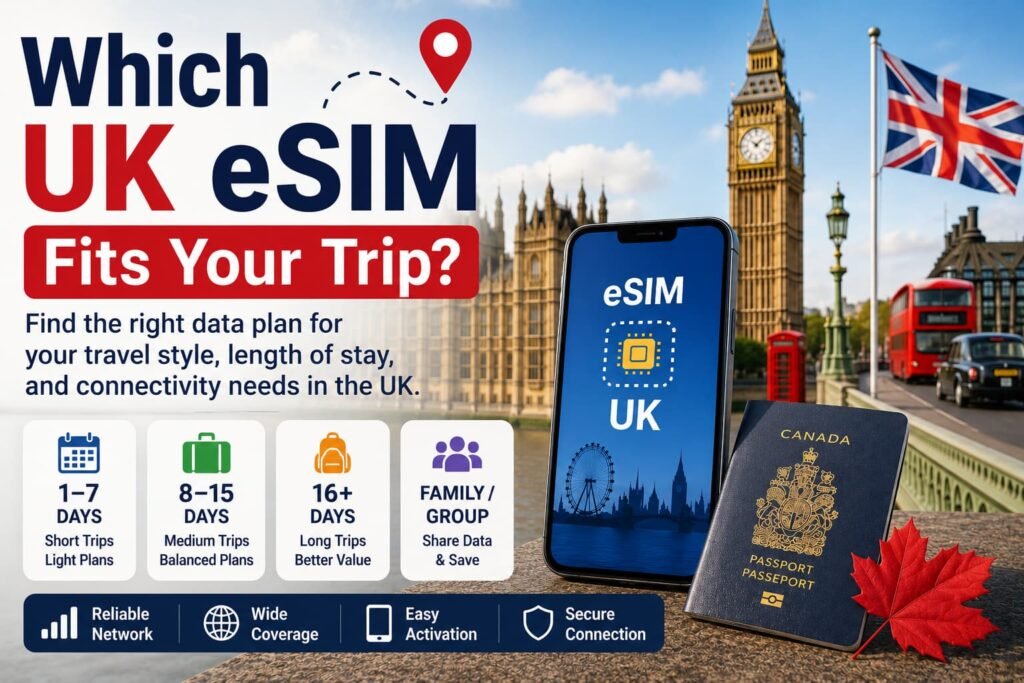
Which UK eSIM Fits Your Trip?
| Your UK trip | My starting point |
|---|---|
| One week in London | Ubigi |
| Need a UK phone number | Sim Local / EE |
| London plus continental Europe | Nomad regional plan |
| Heavy phone-data use | Holafly |
| Simple smaller-data plan | Saily |
| Scotland, Wales or rural road trip | Sim Local / EE or a plan with strong network options |
| Frequent laptop tethering | Ubigi |
This is where the testing matters more than simply ranking providers from first to fifth.
A traveller spending five days around central London does not have the same requirements as someone driving through Scotland or working remotely for a month.
UK-Only eSIM or Europe Regional eSIM?
A UK-only plan is usually the cleanest choice if Britain is your entire trip.
But many Canadians combine the UK with continental Europe. London followed by Paris, Amsterdam, Rome or Barcelona is common, and buying separate country plans can become unnecessary work.
A regional Europe eSIM may be the better choice when one plan covers the entire itinerary.
Check the actual country list before buying. The UK’s political relationship with the European Union does not determine whether an eSIM provider includes Britain in a regional Europe package.
If your trip goes beyond Britain, compare the options in the Best eSIM for Europe Travel From Canada guide before committing to a UK-only plan.
How Much Data Do You Actually Need in the UK?
More data is not automatically better value.
1 to 3 GB
This can work for a short trip when hotel Wi-Fi handles most heavy usage and you mainly need maps, messages, transport information and occasional browsing.
For a busy week, I would personally want more room.
Around 5 GB
Five gigabytes is a reasonable starting point for moderate use during a one-week trip.
It gives you enough flexibility to use maps, restaurant searches, bookings and social apps without constantly monitoring the remaining balance.
Around 10 GB
This is the range I prefer for a typical one- to two-week holiday.
It allows much more normal phone use and is one reason Ubigi’s current 10 GB package is attractive.
20 GB or more
Look here if you use social media heavily, stream video, travel for several weeks or expect to tether another device.
Unlimited
Unlimited plans are most useful for travellers who value convenience and do not want to monitor usage.
My Holafly testing is also a reminder that unlimited allowance and unrestricted full-speed data are not necessarily the same thing.
London Is Easy. Rural Britain Deserves More Attention
The differences between providers became far more obvious after I left the easiest city-centre conditions.
I tested these eSIMs in areas including the Scottish Highlands, Welsh valleys and other locations where terrain makes mobile coverage more challenging.
In those situations, I cared much less about saving a few dollars and much more about the underlying UK network.
The major UK networks include EE, Vodafone, Three and O2. Different travel eSIMs use different network arrangements, and some can connect through more than one operator.
During my trip, Sim Local on EE was particularly dependable in the more difficult areas I visited. Ubigi’s network flexibility was also useful when travelling between cities.
That does not mean one provider will dominate every village, railway line or valley. Coverage varies locally, so check the underlying network for your actual itinerary if rural travel is an important part of the trip.
What I Learned on Inter-City Train Journeys
Rail travel is a useful test because the phone continually moves through changing coverage areas rather than sitting on one tower.
I used Ubigi and Nomad on longer inter-city routes and paid attention to how well they maintained service as the available network environment changed.
Multi-network access cannot remove every dead zone, particularly through tunnels or remote areas, but the ability to connect through more than one supported network can make a real difference as conditions change along the route.
For someone planning a UK trip built around rail rather than staying in one city, this is worth considering alongside price.
Keeping Your Canadian Number While the UK eSIM Handles Data
For many Canadians, the most practical setup is dual SIM.
The travel eSIM handles mobile data while the Canadian line stays available for your regular number, verification texts, important calls and services tied to that number.
A typical setup is:
- Install and label the travel eSIM.
- Select the UK eSIM for mobile data.
- Turn off automatic cellular-data switching.
- Follow the travel provider’s instructions for roaming on the travel line.
- Keep data roaming disabled on the Canadian line unless you intentionally want carrier roaming.
- Be careful with outgoing calls or other chargeable activity on the Canadian SIM.
Many travel eSIMs require data roaming to be enabled on the travel eSIM because they use partner networks. That does not mean roaming should also be enabled on your Canadian line.
Before buying, check your phone with the eSIM Compatibility Checker.
When Should You Install Your UK eSIM?
Activation timing varies by provider.
Ubigi
Eligible Ubigi plans can be installed before departure, making it convenient to prepare your phone while you still have reliable Wi-Fi.
Saily
Saily allows installation before travel and activates eligible plans according to its destination-connection rules. Check the current activation window before buying far in advance.
Nomad
Nomad generally allows travellers to purchase and install before departure, with eligible UK plans starting when they connect at the destination. Plan-specific rules can vary.
Holafly
Holafly recommends installing before departure and activating the service for use at the destination.
Sim Local / EE
The current EE tourist eSIM sold through Sim Local is different because its validity begins when you install it.
For that plan, wait until you reach the UK before completing installation.
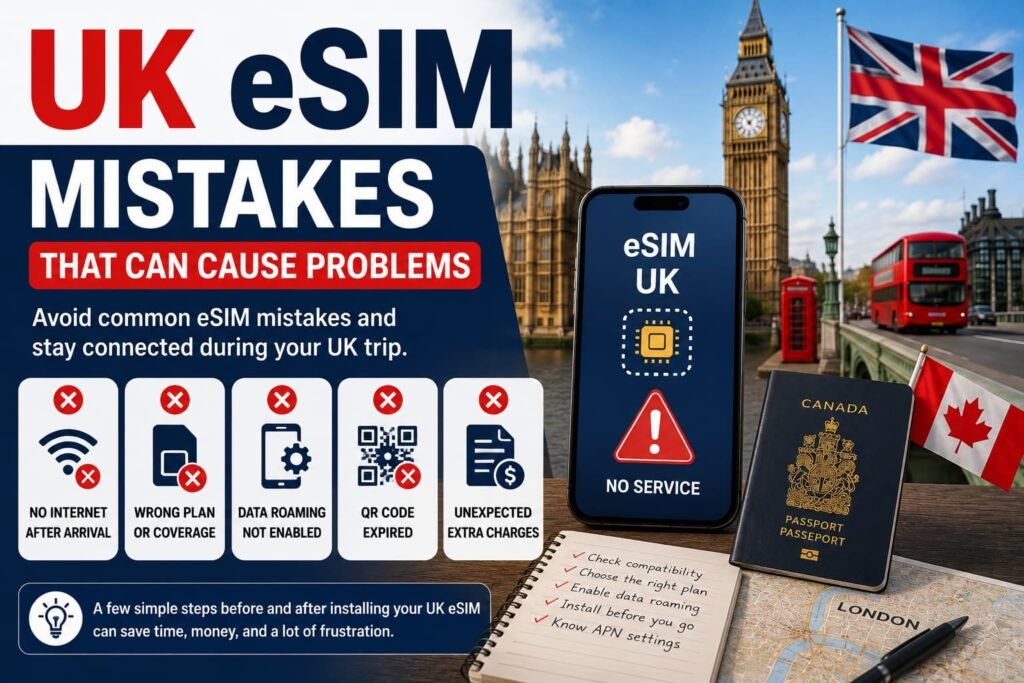
UK eSIM Mistakes That Can Cause Problems
Installing the wrong plan too early
Activation rules are not universal. Sim Local’s current EE plan starts when installed, while several other providers can be prepared ahead of departure.
Ignoring the underlying network
A plan that works perfectly in central London may behave very differently in rural Scotland or Wales.
Leaving automatic data switching enabled
If your phone switches mobile data back to the Canadian SIM, you can trigger roaming charges despite having purchased a travel eSIM.
Assuming unlimited means unrestricted
My Holafly testing showed that heavy daily usage can result in substantial speed reduction even when the headline allowance is unlimited.
Ignoring app settings
Saily’s Virtual Location feature significantly affected performance during my testing. Settings inside the provider app can matter just as much as the advertised plan.
Forgetting hotspot limits
A plan can provide plenty of phone data while placing much tighter limits on tethering.
When a Travel eSIM Is Not Automatically the Best UK Choice
You need your Canadian line exactly as normal
Carrier roaming remains the simplest experience when regular calls, texts and your normal Canadian number matter more than cost.
For the broader comparison, see Travel eSIM vs International Roaming for Canadians.
You are staying for several months
A local UK mobile plan can make more sense for a long stay, particularly if a permanent British number becomes part of everyday life.
You rely heavily on laptop tethering
Check hotspot rules separately from the headline data allowance.
For my own UK use, Ubigi was one of the stronger tethering choices. Holafly’s current UK plan is much less attractive for sustained laptop use because its hotspot allowance is limited.
What About Airalo?
I also tested Airalo during my month in the UK.
It remains a solid option, especially for travellers already familiar with its app and plan structure. It is also one of the easiest providers to understand if you have used travel eSIMs before and simply want a conventional prepaid data package.
I have not put it in the main five because the other providers have clearer reasons to recommend them for this particular destination. Ubigi was stronger for my overall UK use, Sim Local offered a genuinely different local-service experience, Saily has a clear simplicity angle, Nomad gives more flexibility for UK and Europe travel, and Holafly targets heavy phone-data users.
That does not make Airalo a poor choice. It simply means familiarity alone is not enough to make it one of my top recommendations for the UK.
You can read my Airalo eSIM Review for the broader provider evaluation.
Frequently Asked Questions About UK eSIMs
Which eSIM is best for the UK from Canada?
For most Canadians who mainly need mobile data, Ubigi is my current recommendation. During my month testing providers in the UK, it gave me one of the best combinations of speed, network flexibility, hotspot performance and general reliability.
Sim Local/EE is the option I would move ahead of it when a UK number or difficult rural coverage is particularly important. It also produced the fastest measured 5G result in my testing at 114.1 Mbps.
How much mobile data do I need for a week in the UK?
Around 5 to 10 GB is comfortable for many travellers using maps, messaging, transport apps, email, browsing and moderate social media. Five gigabytes can work for a lighter week, while 10 GB gives you considerably more freedom.
Heavy streaming, video uploads, laptop tethering and remote work can push usage much higher. If you fall into that category, compare larger fixed-data plans with unlimited options rather than assuming unlimited will automatically provide the best sustained performance.
Can I keep my Canadian number active with a UK eSIM?
Most modern dual-SIM phones allow the Canadian line to remain active while the UK eSIM handles mobile data. That is useful for verification texts, important calls, iMessage and services linked to your regular number.
Set the UK eSIM as the data line and disable automatic data switching where available. Keep data roaming off on the Canadian SIM unless you deliberately want to use your carrier’s roaming service.
What if I need a real UK phone number for calls and texts?
Choose a plan that specifically includes conventional UK mobile service rather than assuming every travel eSIM provides a phone number. Sim Local’s current EE tourist eSIM includes a British number, local calls and SMS along with mobile data.
That combination is one of the reasons Sim Local stood out during my testing. It gives travellers a more local-style mobile experience than a standard data-only travel eSIM, which can be useful on longer stays or when you regularly need conventional local calling.
Should I buy a UK-only eSIM or a Europe regional plan?
A UK-only plan is usually the simplest choice when Britain is the entire trip. It lets you compare the strongest local options without paying for coverage in countries you will not visit.
A regional Europe eSIM becomes more useful when your itinerary continues to France, Italy, Spain, the Netherlands or other destinations. Check the actual country list because Europe plans do not all include exactly the same places.
When should I install my UK eSIM before flying?
Follow the activation rule for the exact plan you purchased. Ubigi, Saily, Nomad and Holafly have products that can be prepared before departure according to their current activation rules.
The Sim Local EE tourist plan currently begins its validity when installed, so that one should be installed after arrival. This is why I would never apply one provider’s installation advice to every eSIM.
Can I use the same eSIM in England, Scotland, Wales and Northern Ireland?
A plan that lists United Kingdom coverage is intended to work across all four UK nations. You do not normally need separate plans simply because your itinerary moves between England, Scotland, Wales and Northern Ireland.
Actual signal quality still varies by location and underlying network. My own testing showed much larger differences outside major cities, particularly in difficult terrain, so network choice deserves more attention for rural itineraries.
Does hotspot work with UK travel eSIMs?
The Ubigi, Saily, Nomad and Sim Local options discussed here support hotspot use. Ubigi performed particularly well for tethering during my testing and was one of the options I was most comfortable using with a laptop.
Holafly also supports data sharing, but the current UK plan limits hotspot use to 1 GB per day. Anyone planning substantial remote work should compare hotspot rules separately from the main phone-data allowance.
Why might Saily feel slower than expected?
One setting worth checking is Saily’s Virtual Location feature. During my UK testing, performance was substantially lower with that privacy feature enabled and improved after I turned it off.
That does not mean every device or future app version will behave identically. However, if Saily seems unusually slow, I would check Virtual Location before assuming the network or eSIM itself is the problem.
Related eSIM Guides
Plan a UK or Europe Trip
- Best eSIM for Europe Travel From Canada
- Travel eSIM vs International Roaming for Canadians
- eSIM Plan Comparison Tool
Compare the UK Options
Check Your Phone Before Flying
Final Thoughts
After spending a month testing these services around the UK, Ubigi is the option I would recommend to most Canadian travellers. It gave me the best overall combination of performance, network flexibility, hotspot use and straightforward travel-data value.
Sim Local/EE was the standout when raw performance and local-style service mattered more. Its 114.1 Mbps result was the fastest I measured, and its strong performance in more difficult parts of Scotland and Wales made it much more than just another large-data plan.
Saily became a much better performer once I adjusted its Virtual Location setting. Nomad remains useful when plan flexibility or a wider European trip matters. Holafly was consistently connected, but the substantial speed reduction I experienced after roughly 2.5 GB of heavy daily usage makes me cautious about recommending it to people who specifically want unrestricted high-speed data.
The most important lesson from my UK testing is that there is no single number on a pricing page that tells you which eSIM will be best. Network access, latency, software settings, hotspot rules and where you actually travel can matter just as much as the advertised data allowance.
For a normal Canadian holiday, start with the type of connection you need, then choose the provider that best matches the trip.