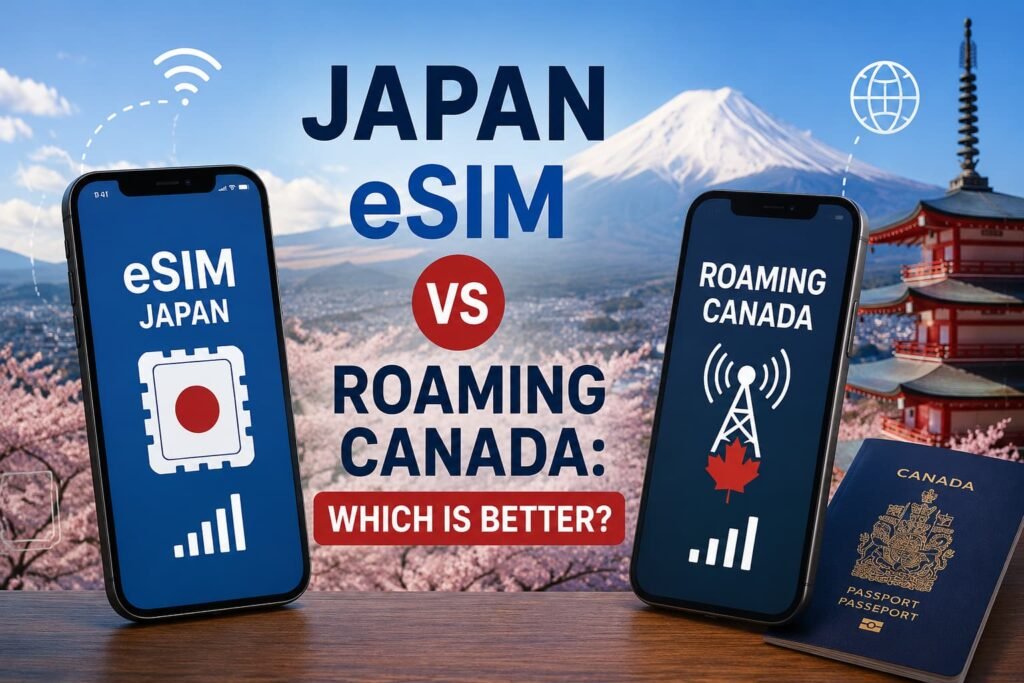
Japan is one of the easier places to use a travel eSIM, but the Japan eSIM vs roaming Canada decision is not as one-sided as it used to be. Rogers, Bell and TELUS now offer multi-day roaming passes that can make a two-week trip considerably cheaper than paying an international daily rate from departure to return.
A travel eSIM still usually wins when your priority is affordable mobile data. Carrier roaming wins on simplicity because you keep using your Canadian number, regular plan and familiar phone setup. For many travellers, though, the best option is somewhere in the middle: use a Japan eSIM for data while keeping your Canadian line available carefully for your number, texts and emergencies.
If Japan is part of a longer multi-country trip, my Best eSIM for International Travel guide compares broader provider options across multiple destinations.
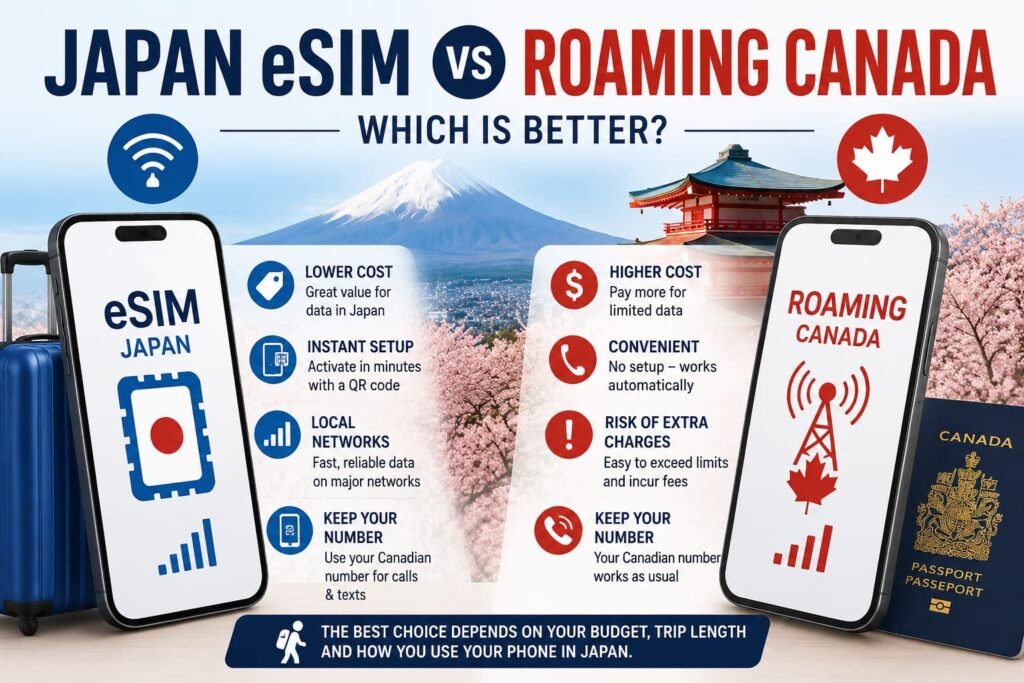
For most Canadians travelling to Japan, I would choose a travel eSIM if mobile data is the main priority. Current Japan eSIM plans can cost a fraction of a Canadian carrier’s roaming pass, especially on trips of two weeks or longer.
I would still consider carrier roaming for a short business trip, when receiving and making normal calls on your Canadian number matters, or when you simply want everything to work without changing SIM settings. Freedom Mobile customers should check their existing plan first because Japan is included in Roam Beyond coverage on eligible plans and passes.
The Cost Difference Is Smaller Than It Used to Be
The usual argument against Canadian roaming is simple: take a daily roaming fee, multiply it by 10 or 14 days, and the bill becomes painful very quickly.
That comparison is now incomplete.
Rogers, Bell and TELUS have introduced longer travel passes that change the numbers considerably. Japan is included in the relevant international or Asia coverage from all three carriers.
Here is a practical two-week comparison using current advertised prices:
| Option | Representative Cost | What You Get |
|---|---|---|
| TELUS Asia Easy Roam 14-Day Pass | C$70 | Your existing plan data plus talk and text |
| Bell Asia 14-Day Travel Pass | C$75 | Your existing plan data plus talk and text |
| Rogers International 14-Day Travel Pass | C$100 | Your existing plan data, talk and text |
| Ubigi Japan 10 GB / 30 days | US$16.50 (about C$23) | 10 GB of travel data |
Important: Roaming prices, travel eSIM plans, and eligibility can change without notice. Always confirm the latest pricing and terms with your carrier or eSIM provider before purchasing.
The difference is still substantial. A 10 GB Japan travel eSIM can cost around one-third of the least expensive Big Three 14-day pass in this example.
But those products are not identical.
The carrier passes let you continue using your Canadian mobile service much more normally. A typical Japan travel eSIM gives you a separate data connection instead. That distinction matters if you need conventional calls, want people to reach your Canadian number normally, or do not want to manage two lines.
If you want to compare the numbers for your own trip length, use the Canadian Roaming Savings Calculator. A five-day Tokyo trip and a three-week Japan trip can produce very different answers.
When I Would Still Use Canadian Roaming in Japan
Travel eSIMs are cheaper often enough that it is tempting to dismiss carrier roaming completely. I would not.
There are situations where paying more is reasonable.
You are taking a short trip
For three or four days in Tokyo, the savings from setting up another mobile plan may not matter much to you.
Carrier roaming means your phone behaves much more like it does in Canada. You land, connect to a partner network and continue using your existing number and plan according to the roaming option on your account.
For someone travelling for work or squeezing Japan into a short stopover, that convenience can be worth paying for.
Your Canadian number needs to work normally
A data-only travel eSIM does not replace your Canadian phone number.
WhatsApp, FaceTime, iMessage, Signal, Messenger and other internet services can continue over travel-eSIM data, but conventional cellular calling and SMS still involve your Canadian line unless your travel plan specifically includes those services.
If clients, family members or organizations need to call your Canadian number normally, a carrier roaming pass removes a lot of friction.
Your employer is covering roaming
If the business is paying the bill, saving C$50 or C$75 may be less important than keeping your existing mobile setup intact.
That is one of the clearest cases where I would favour simplicity.
Your Canadian plan already includes useful international roaming
Always check your plan before buying anything.
This matters particularly with Freedom Mobile. Japan is currently included among Freedom’s Roam Beyond destinations, and eligible plans can include roaming data, calls and global texting without a separate daily roaming charge.
Someone who already has enough Roam Beyond data for a Japan trip may gain very little from purchasing another eSIM.
Freedom customers can compare the two approaches in my Freedom Mobile Roam Beyond vs Travel eSIMs guide.
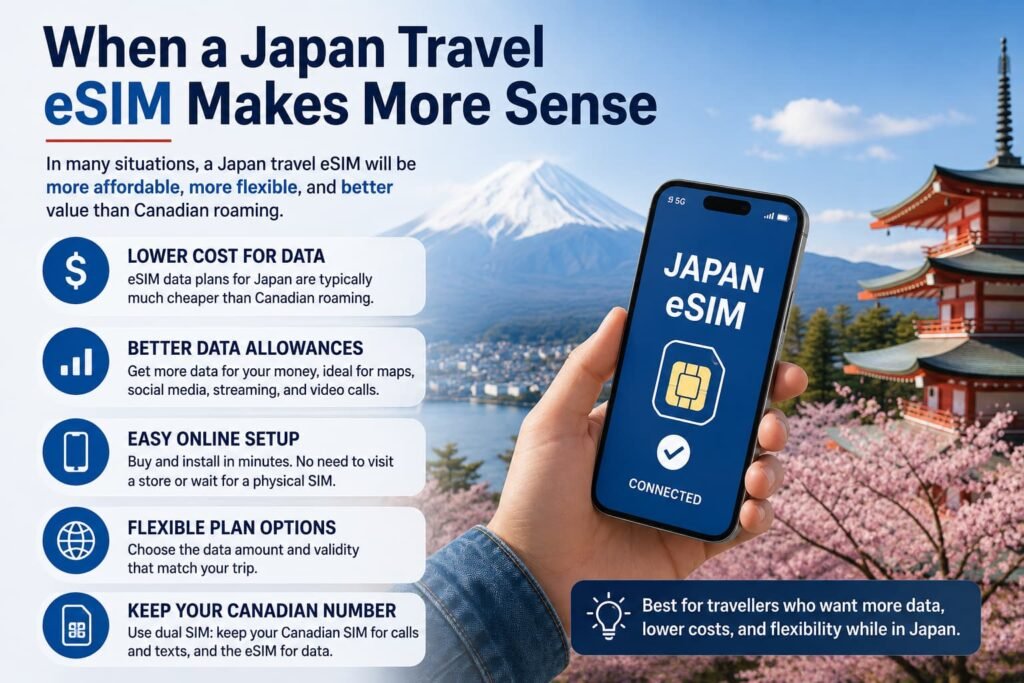
When a Japan Travel eSIM Makes More Sense
The longer the trip and the more lines you are paying for, the stronger the case for a travel eSIM becomes.
You mainly need mobile data
Japan is a very data-friendly travel destination.
You are likely to use your phone for:
- Google Maps and walking directions
- train routes and station navigation
- translation
- restaurant searches and reservations
- messaging
- attraction tickets
- hotel information
- weather
- browsing while moving between cities
Most of that requires data rather than a Canadian cellular voice service.
If that describes how you travel, paying for a full carrier roaming package may be unnecessary.
If you have decided that a travel eSIM is the better fit, see my Best eSIM for Japan From Canada guide to compare the current Japan eSIM options and choose the right provider for your trip.
You are staying for two weeks or longer
This is where I think the decision becomes much easier for most travellers.
A current 10 GB Japan eSIM can cost roughly C$23, while the comparable 14-day Big Three roaming passes in the examples above range from C$70 to C$100.
For someone travelling through Tokyo, Kyoto and Osaka for two weeks, I would rather put the difference toward the trip unless I genuinely needed normal Canadian cellular calling.
You can use the eSIM Plan Comparison Tool to compare current travel plans in Canadian dollars rather than relying on one provider.
Several people are travelling
A family can magnify the difference quickly.
If four phones each need a carrier roaming product, you may be paying for roaming four times. Buying separate prepaid travel eSIMs can make the total much easier to control.
The exact savings depend on each person’s Canadian plan and how much data they need, so I would compare each line before assuming everyone needs the same setup.
You want a fixed travel-data budget
One advantage of a prepaid travel eSIM is simply knowing what your travel data will cost.
You purchase a defined amount of data and know what you paid. You do not have to wonder whether an app, outgoing text or phone call triggered another roaming day.
That predictability is useful in Japan because your phone tends to be in constant use for navigation and trip planning.
The Setup I Prefer: Japan eSIM for Data, Canadian SIM for Your Number
For an unlocked dual-SIM phone, the most flexible option is often neither full roaming nor travel-eSIM-only.
Use both lines, but give them different jobs.
Japan travel eSIM: mobile data
Canadian SIM: your Canadian number when you actually need it
Modern iPhones and many Android phones let you choose which line handles mobile data while keeping another line installed.
Before buying a plan, use the eSIM Compatibility Checker to confirm that your exact phone supports eSIM.
The important part is preventing accidental roaming
Keeping the Canadian SIM turned on does not automatically mean every possible use of that line is free.
Your carrier can still apply roaming charges when qualifying cellular activity occurs.
Keeping your Canadian SIM active does not automatically prevent roaming charges. An outgoing call, sent SMS, voicemail interaction or unexpected use of Canadian-line mobile data may trigger charges depending on your carrier, plan and roaming option. Review the rules for your own line before travelling rather than assuming that simply turning off data roaming eliminates every possible charge.
The safest arrangement is to:
- Label the two lines clearly, such as Canada and Japan.
- Set the Japan eSIM as the mobile-data line.
- Turn off data roaming on the Canadian line.
- Enable data roaming on the travel eSIM if its provider requires it.
- Disable cellular-data switching unless you specifically know you need it.
- Understand your Canadian carrier’s rules for calls, SMS and voicemail before leaving.
Do not blindly copy someone else’s screenshots because iPhone and Android menu paths can differ by model and software version.
What about verification texts?
This is one reason I like keeping the Canadian line available when the carrier rules make it practical.
Banks, credit-card companies and online accounts may still send one-time codes to your Canadian number.
Receiving a text can be treated differently from sending one, making a call or using Canadian-line mobile data. The rules are not identical across carriers and plans, so check how your own line handles incoming SMS before relying on this setup.
More importantly, avoid making an outgoing call, sending an SMS or accidentally using Canadian-line data simply because the line is still switched on.
If keeping the Canadian number active safely sounds like more management than you want on vacation, that is a legitimate reason to choose carrier roaming instead.
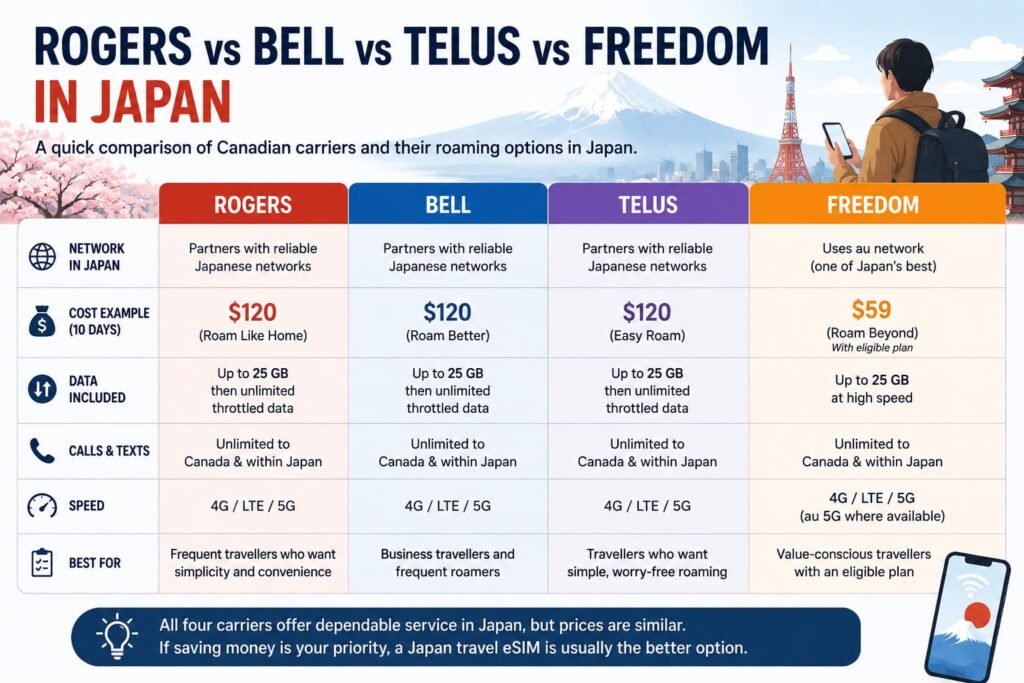
Rogers vs Bell vs TELUS vs Freedom in Japan
The major Canadian carriers now take noticeably different approaches to Japan.
Rogers
Rogers Roam Like Home includes Japan among its international destinations.
For longer trips, Rogers currently lists an International Travel Pass at C$100 for 14 days and C$120 for 30 days. It lets eligible customers use their regular talk, text and data while travelling.
That is considerably more attractive than repeatedly paying a daily international charge on a long trip, although a data-only Japan eSIM can still cost much less.
If you already use Rogers, see my full Rogers Roam Like Home vs Travel eSIMs comparison.
Bell
Bell’s current roaming options are particularly interesting for Japan because Bell offers Asia-specific Travel Passes.
The current options include C$75 for 14 days and C$90 for 30 days. They use data from your Canadian rate plan and include eligible talk and text while the pass is active.
One detail to watch is timing: Bell’s Travel Pass begins when it is added to your account rather than waiting until you first connect in Japan. If you plan to use one, add it close enough to departure that you are not using up part of the validity period while still in Canada.
For a month-long Japan trip, C$90 is a much more reasonable carrier-roaming proposition than paying a daily international rate for every active day.
The travel eSIM can still be considerably cheaper if you mainly want data, but Bell has narrowed the gap enough that convenience deserves to be part of the decision.
You can also see my Bell Roam Better vs Travel eSIMs guide.
TELUS
TELUS currently offers an Asia Easy Roam 14-Day Pass for C$70, and Japan is included in its eligible Asia destinations.
That makes TELUS the least expensive 14-day Big Three pass among the examples checked for this guide.
TELUS says the Asia pass activates when you arrive in an eligible destination, rather than when you add it, although it must be used within the carrier’s stated activation window. That makes pre-trip setup a little more forgiving than a pass whose validity begins immediately.
TELUS also offers regular Easy Roam for international destinations, currently listed at C$18 per day, plus broader Global passes for longer travel.
For a two-week Japan vacation, I would compare the C$70 Asia pass directly against a travel eSIM rather than multiplying the daily Easy Roam rate by 14.
My broader TELUS Easy Roam vs Travel eSIMs guide covers the carrier-specific trade-offs in more detail.
Freedom Mobile
Freedom deserves separate treatment because the decision can be completely different.
Freedom Roam Beyond currently includes Japan. Eligible Roam Beyond plans include international roaming data along with calls to Canada and local numbers in the destination, incoming calls and global texting.
Freedom also sells 30-day Roam Beyond passes starting from C$30.
If your existing Freedom plan already gives you enough Japan roaming data, I would use what you are already paying for before buying another travel eSIM.
That is why there is no single “Canadian roaming is expensive” answer that works for every Canadian.
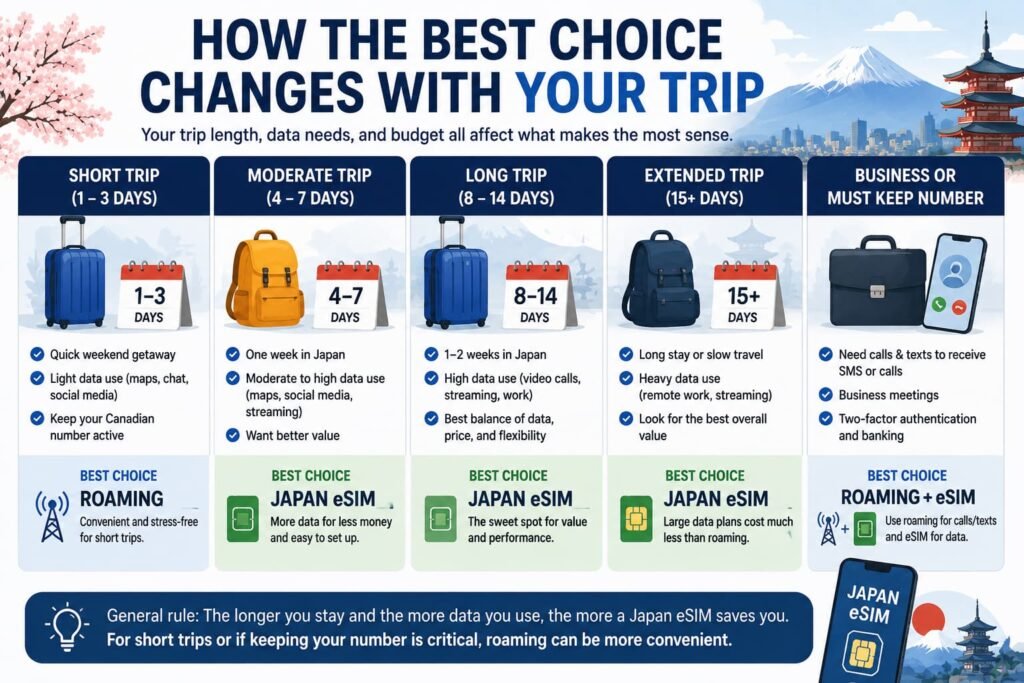
How the Best Choice Changes With Your Trip
Looking at the trip instead of the product usually makes the decision clearer.
| Japan Trip | What I Would Consider First |
|---|---|
| 3–5 days in Tokyo | Carrier roaming if simplicity matters most |
| 7–14 days across several cities | Travel eSIM for most data-focused travellers |
| 2–4 weeks | Travel eSIM unless Canadian-number use justifies a pass |
| Business trip | Carrier roaming or a hybrid setup |
| Family trip | Compare several travel eSIMs before paying roaming on every line |
| Freedom Roam Beyond customer | Check included Japan data before buying anything |
A five-day Tokyo trip
Either approach is defensible.
If I wanted the cheapest practical data connection, I would still buy an eSIM. If I wanted to land at Haneda or Narita and never think about SIM settings again, I could justify roaming.
Two weeks through Tokyo, Kyoto and Osaka
This is where I would normally choose the travel eSIM.
You are likely to use data constantly for trains, maps, translation and planning, and the current cost difference remains meaningful even after the carriers’ new passes are considered.
Three or four weeks
A prepaid eSIM is generally the stronger data-value option.
But Bell’s C$90 30-day Asia Pass and Rogers’ C$120 30-day International Pass are worth knowing about. They make full carrier roaming far more predictable than the old model of repeatedly triggering daily charges.
A family trip
Do the calculation per phone.
Maybe one parent needs the Canadian number working normally for business and uses a roaming pass, while everyone else uses inexpensive travel eSIM data.
There is no requirement for the whole family to use the same connectivity strategy.
What About Pocket Wi-Fi or a Japanese SIM?
A travel eSIM and Canadian roaming are not the only options.
Pocket Wi-Fi
Pocket Wi-Fi can still make sense for a group that wants to share one connection or for travellers carrying devices that do not support eSIM.
The disadvantages are obvious once you have travelled with one: another device to charge, carry and keep together with the group.
For one person with an eSIM-compatible phone, I would normally prefer the eSIM.
Japanese physical SIM
A prepaid Japanese SIM can work well if your phone does not support eSIM.
The trade-off is that you need to buy or receive the physical SIM and swap it into the phone. That is less appealing if you want to keep your Canadian physical SIM installed.
For most modern dual-SIM phones, a travel eSIM is the cleaner setup.
Before You Leave Canada
Do a few checks before the flight rather than trying to solve them at a Japanese airport.
Confirm eSIM support. Check the exact phone model, not just the model family.
Make sure the phone is unlocked. A compatible phone can still reject another carrier’s eSIM when it is locked.
Install the travel eSIM before departure when the provider allows it. Wi-Fi and access to your purchase confirmation are easier to deal with at home.
Check when the plan’s validity begins. Some plans start when installed, while others start when they first connect to a supported network.
Review your Canadian carrier’s roaming rules. Especially check what triggers a charge and how incoming SMS, outgoing texts, calls and voicemail are treated.
Label your lines clearly. “Canada” and “Japan” are much harder to confuse than “Primary” and “Secondary” after a long flight.
Frequently Asked Questions
How much does it cost to roam in Japan with a Canadian phone?
Roaming in Japan can cost anywhere from nothing extra on an eligible plan to C$100 or more for a two-week trip, depending on your Canadian carrier and plan. Current 14-day options include C$70 with TELUS’s Asia Easy Roam Pass, C$75 with Bell’s Asia Travel Pass, and C$100 with Rogers’
International Travel Pass. Freedom Mobile customers may pay less, or nothing beyond their regular monthly plan, if their plan already includes Japan through Roam Beyond.
Can I keep my Canadian phone number while using a Japan eSIM?
You can keep your Canadian phone number active while using a Japan eSIM on a compatible dual-SIM phone. Set the Japan eSIM as your mobile-data line and keep your Canadian line enabled for your number, incoming texts, and any services you still need.
Just configure the two lines carefully because calls, outgoing texts, voicemail, or accidental data use on the Canadian line can still trigger roaming charges depending on your carrier and plan.
Which Canadian carrier has the cheapest Japan roaming option?
Among the current 14-day Big Three roaming passes, TELUS offers the lowest-priced option at C$70 for its Asia Easy Roam 14-Day Pass. Bell charges C$75 for its 14-day Asia Travel Pass, while Rogers lists its 14-day International Travel Pass at C$100.
Freedom Mobile can be even less expensive if your plan already includes Japan through Roam Beyond. In that case, you may not need to purchase a separate roaming pass or travel eSIM at all.
Can I receive verification texts while my travel eSIM handles data?
You can often keep receiving verification texts on your Canadian number while a travel eSIM handles mobile data, as long as your phone supports dual SIM and your Canadian line remains active.
Receiving an SMS may be treated differently from sending one, making a call, or using Canadian-line data. Bell, for example, currently states that receiving texts does not trigger its Roam Better daily charge. Check your own carrier’s rules before travelling so you know exactly what can trigger roaming charges.
Should data roaming be turned off on my Canadian SIM in Japan?
If your Japan travel eSIM is handling mobile data, turn off data roaming on the Canadian line. This helps prevent your phone from using the Canadian SIM for mobile data while you are abroad.
Your travel eSIM may need data roaming enabled, depending on the provider. Also check cellular-data switching so the phone does not automatically fall back to the Canadian line.
What happens if my phone does not support eSIM?
A physical prepaid SIM or pocket Wi-Fi is usually the next best option if your phone does not support eSIM.
Before buying a Japanese physical SIM, make sure your phone is unlocked and has a compatible SIM slot. Pocket Wi-Fi can also work well if you want to connect several devices or avoid changing SIM cards.
When does Canadian roaming make more sense than a Japan eSIM?
Canadian roaming can make more sense when keeping your regular phone number working normally is more important than getting the lowest data price. It is especially useful for short business trips, travellers who expect regular calls or texts, or anyone who wants to avoid managing a second mobile line.
It can also be the better value if your existing Canadian plan already includes Japan roaming, particularly through an eligible Freedom Mobile Roam Beyond plan.
Related Japan and Roaming Guides
Japan Travel
- Best eSIM for Japan From Canada
- Best eSIM for International Travel
- Travel eSIM vs International Roaming for Canadians
Compare Canadian Roaming
- Rogers Roam Like Home vs Travel eSIMs
- Bell Roam Better vs Travel eSIMs
- TELUS Easy Roam vs Travel eSIMs
- Freedom Mobile Roam Beyond vs Travel eSIMs
- Koodo Easy Roam vs Travel eSIMs
Plan Your Mobile Setup
Final Thoughts
For most Canadians who primarily need mobile data in Japan, I would still choose a travel eSIM. A current 10 GB plan can cost around C$23, which leaves a substantial gap between prepaid travel data and even the improved two-week roaming passes from the Big Three.
But I would not make that recommendation blindly.
TELUS and Bell now have genuinely useful Asia passes, Rogers has predictable 14- and 30-day International Travel Passes, and Freedom customers may already have Japan included through Roam Beyond. Canadian roaming deserves a second look if keeping your number working normally and avoiding setup changes matter more than getting the lowest data price.
My preferred middle ground is a properly configured dual-SIM setup: Japan eSIM for mobile data, Canadian line retained only for the services you actually need. It keeps the data bill under control without completely disconnecting your Canadian number.
Check your existing plan first, compare the real cost for the length of your trip, and choose the setup that solves the way you will actually use your phone in Japan.