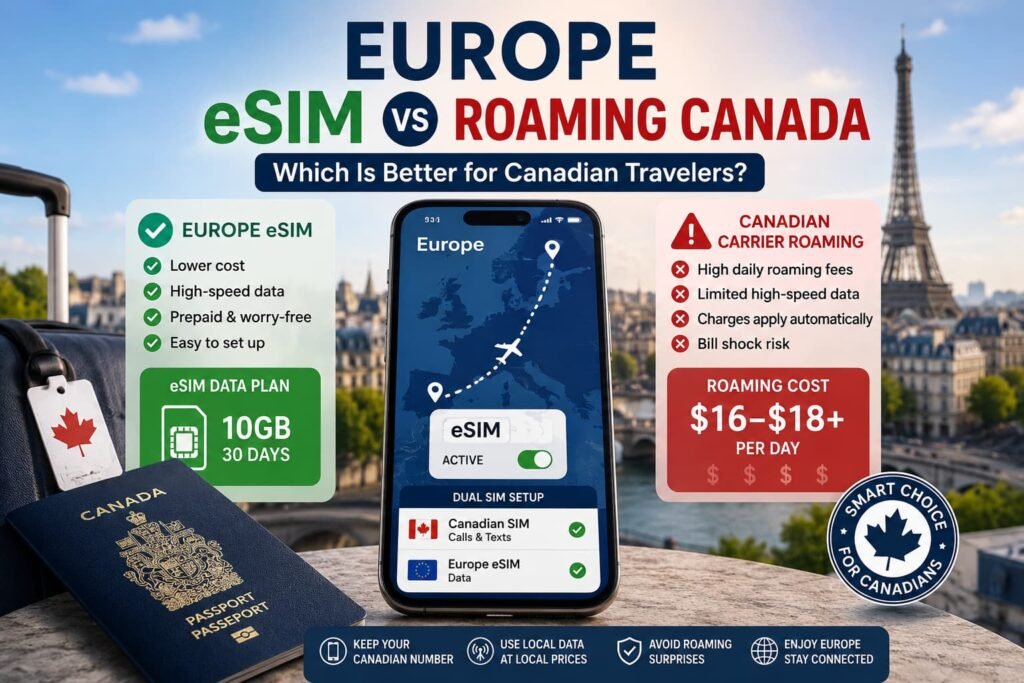
If you are travelling from Canada to Europe, comparing Europe eSIM vs roaming Canada before you leave is one of the easiest ways to avoid paying more than you need for mobile data.
Canadian roaming is simple. You land, your phone connects, and your regular number keeps working. That convenience can be helpful for short trips, work travel, bank verification texts, and anyone who does not want to touch their phone settings.
But that convenience can get expensive quickly.
A Europe travel eSIM works differently. It gives your phone a separate prepaid data plan for your trip. You can use it for maps, train tickets, hotel apps, restaurant searches, rideshares, messaging, and browsing, while keeping your Canadian SIM available only when you need texts or important calls.
This guide compares Europe travel eSIMs with Canadian carrier roaming, including Rogers, Bell, TELUS, Fido, Koodo, and Virgin Plus. It also explains the safest phone setup, how to keep your Canadian number active, and how to avoid accidental roaming charges while travelling in Europe.
Quick Answer: Europe eSIM vs Roaming Canada
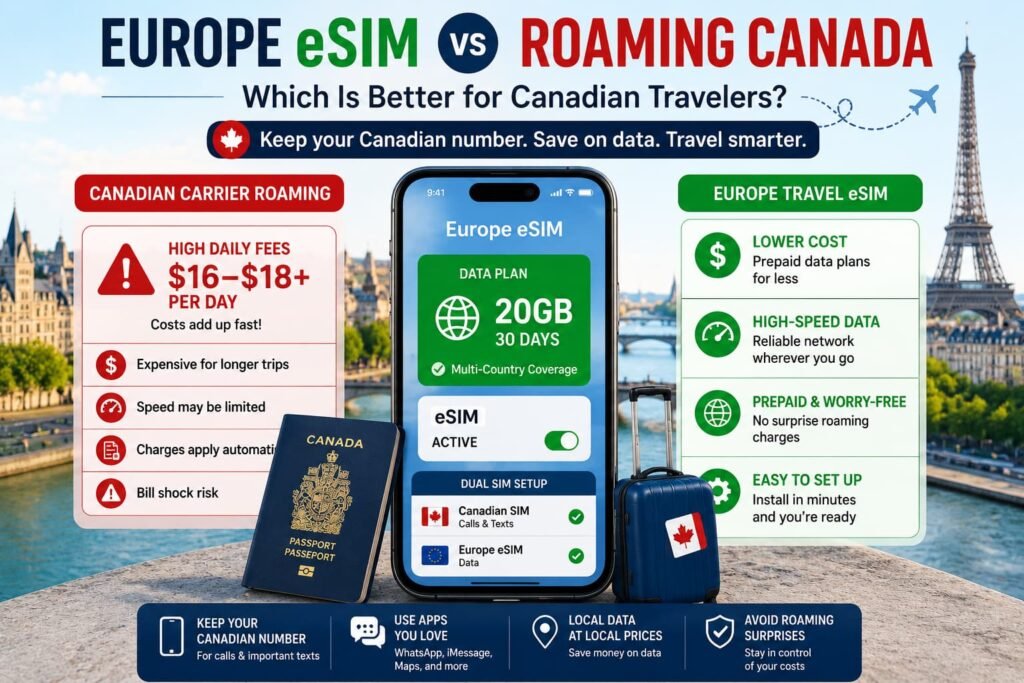
For most Canadians travelling to Europe, the best option is a hybrid setup: keep your Canadian SIM active for important texts or calls, and use a Europe travel eSIM for mobile data.
That gives you the best balance. Your Canadian number can stay available for bank verification texts, work messages, family calls, or emergency contact, while your Europe eSIM handles maps, train tickets, hotel apps, restaurant searches, rideshares, messaging, and browsing.
| Travel Situation | Best Option | Why |
|---|---|---|
| One-day Europe layover | Canadian roaming | Simple for a very short stop |
| Two to three-day Europe trip | Roaming or small Europe eSIM | Choose based on whether you need regular calls or mainly mobile data |
| One-week vacation | Europe eSIM for data | Good balance of savings and convenience |
| Two-week multi-country trip | Regional Europe eSIM | Easier when crossing borders between several countries |
| Family vacation | Europe eSIMs | Daily roaming fees can multiply across several lines |
| Need bank texts and travel data | Hybrid setup | Keep your Canadian SIM active and use the Europe eSIM for data |
Canadian roaming can still make sense for a short trip, business travel, or situations where you need your Canadian number fully active for regular calls and texts. It is also the simplest option because you do not need to install another eSIM or adjust much on your phone.
For longer trips, multi-country travel, family vacations, or travellers who mainly need mobile data, a Europe travel eSIM is usually worth comparing before leaving Canada.
Use the free Canadian Roaming Savings Calculator to compare your estimated roaming cost with a Europe travel eSIM based on your carrier, trip length, number of travellers, and expected data use.
Canadian Roaming in Europe Can Get Expensive Fast
Canadian roaming feels easy because it uses the phone plan you already have. The problem is that daily roaming fees can add up quickly.
If your carrier charges around $16 to $18 CAD per day, one phone can cost roughly $112 to $126 CAD for a 7-day Europe trip. A 14-day trip can cost about $224 to $252 CAD for one phone.
For two travelers, that same 14-day trip can climb to around $448 to $504 CAD if both lines use daily roaming every day.
That is why it is worth comparing roaming before you leave Canada. Roaming may still be convenient, but it is not always the best value if your main need is mobile data.
A Europe travel eSIM usually gives you a prepaid data plan instead. Many travelers can use one fixed-data plan for maps, tickets, messaging, browsing, translation apps, and hotel apps without paying a daily roaming fee.
Europe eSIM vs Canadian Roaming Cost Comparison
Last checked: May 2026
Carrier rates, roaming passes, and travel eSIM pricing can change. Always confirm current pricing with your carrier or eSIM provider before you travel.
| Option | Current Cost Signal | Best For | Watch Out For |
|---|---|---|---|
| Rogers Roam Like Home | International roaming is commonly around $18/day, with caps or travel pass options depending on plan and destination | Short trips, convenience, keeping your Rogers number active | Daily fees or pass costs can add up quickly |
| Bell Roam Better | International roaming is commonly around $16/day, with travel options depending on destination | Short trips, regular calls, texts, and using your Bell plan abroad | Longer trips can become expensive |
| TELUS Easy Roam | International roaming and Europe travel pass options depend on plan, destination, and current availability | TELUS customers who want simple roaming | Pass timing, coverage, and billing rules matter |
| Fido Roam | Fido offers Travel Pass options and daily roaming choices depending on destination and plan | Fido customers who want a simple setup | Costs can still be high compared with prepaid eSIM data |
| Koodo Easy Roam | Koodo may offer Easy Roam or travel pass options depending on current plan and destination | Koodo customers who want convenience | Pass limits and destination coverage should be checked |
| Virgin Plus Roam Sweet Roam | International roaming is commonly around $16/day in Roam Sweet Roam destinations | Virgin Plus customers who need their Canadian number active | Daily fees can add up on longer trips |
| Europe travel eSIM | Fixed-data and unlimited-style plans vary by provider | Lower-cost data, longer trips, family travel, hotspot use, multi-country Europe trips | Usually data-only, so regular calls and SMS may still need your Canadian line |
Rates, travel passes, daily caps, and billing rules can vary by plan, destination, and billing cycle. Always confirm the latest roaming details with your carrier before travelling.
For a weekend trip, roaming might be simple enough. For a 10-day, 14-day, or 30-day Europe trip, the cost difference can become much more noticeable, especially if more than one person is travelling.
How Canadian Carrier Roaming Works in Europe
Canadian roaming lets your regular phone plan connect to partner networks outside Canada.
When you land in Europe, your phone may connect automatically. Depending on your carrier and plan, using data, sending texts, answering calls, or making calls can trigger a daily roaming charge or pay-per-use cost.
The main benefit is convenience. Your regular number stays active, and your phone behaves almost the same way it does at home.
That can be helpful if you need:
- Your Canadian number for regular calls
- Bank verification texts
- Work calls
- Emergency access
- A simple setup for a short trip
- No QR code or eSIM app setup
The downside is that roaming usually uses your Canadian plan abroad. Your maps, train apps, hotel apps, social media, and browsing may all pull from your regular plan while also triggering travel roaming charges.
For a short trip, that may be fine. For longer travel, it can become expensive.
Watch the Roaming Day Reset
One thing many travelers miss is how a roaming “day” is counted.
Your carrier may not count a roaming day based on midnight where you are standing in Europe. The timing can depend on the carrier’s own billing window, your plan rules, or the time zone used by the carrier.
That means a traveler who lands late in the day could trigger a roaming charge for only a small amount of use, then trigger another charge when the next roaming period begins.
Before you leave Canada, check:
- When your carrier’s roaming day starts and ends
- Whether the reset follows Eastern Time or local time
- Whether a travel pass starts right away
- Whether a cap applies internationally
- Whether your trip crosses your monthly billing cycle
A prepaid Europe eSIM avoids most of this confusion because your data plan is separate from your Canadian carrier’s roaming clock.
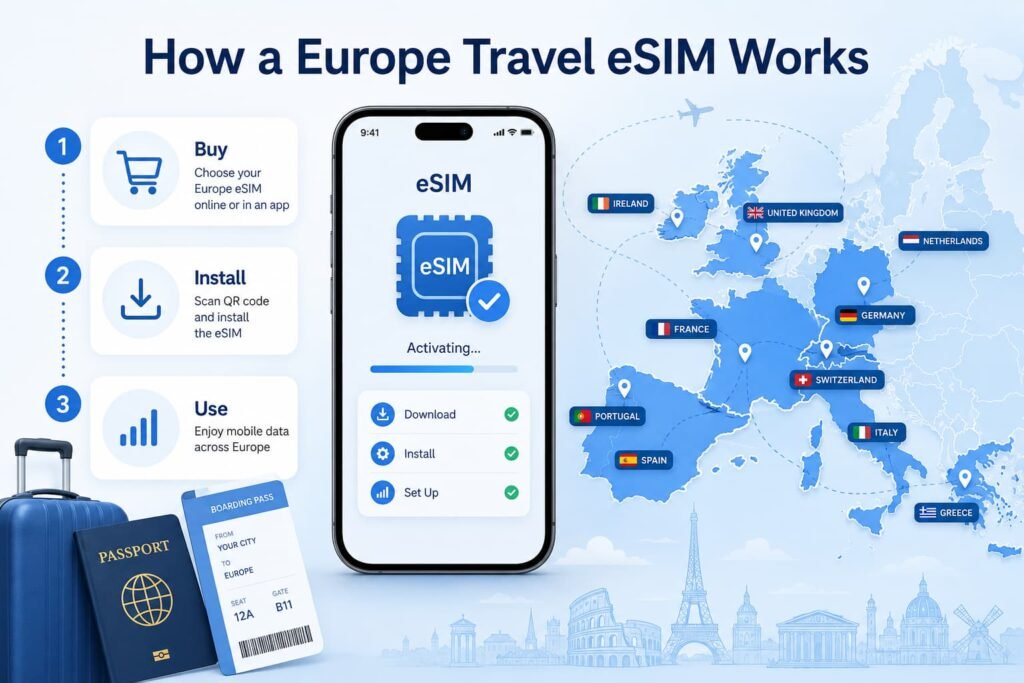
How a Europe Travel eSIM Works
A Europe travel eSIM is a digital SIM profile that gives your phone a separate mobile data plan for Europe.
You usually buy the eSIM online or through an app, install it on your phone, and use it for mobile data while travelling. Many Europe eSIMs work across multiple countries, which is helpful if your trip includes places like France, Italy, Spain, Portugal, the United Kingdom, Germany, Ireland, Greece, Switzerland, or the Netherlands.
Most travel eSIMs are data-only. That means they give you internet access, but not always a regular phone number for traditional calls and SMS.
You can still use apps like:
- iMessage
- FaceTime
- Messenger
- Signal
- Telegram
- Google Maps
- Apple Maps
- Gmail
- Outlook
- Uber
- Bolt
- Trainline
- airline apps
- hotel apps
For many Canadian travelers, that is enough. You use the Europe eSIM for data and keep your Canadian line available only when needed.
For provider options and plan examples, see the full Best eSIM for Europe Travel From Canada guide.
Travel eSIM Pricing Compared With Canadian Roaming
This post is mainly about roaming vs eSIM, not a full provider roundup. But it helps to understand the general price difference.
A Europe travel eSIM can cost much less than daily roaming if you mainly need mobile data. The final price depends on the provider, data amount, validity period, included countries, hotspot rules, and whether the plan is fixed-data or unlimited-style.
| Travel eSIM Type | Common Europe Plan Style | Best For |
|---|---|---|
| Fixed-data Europe eSIM | 10 GB to 20 GB style plans for a travel window such as 7, 15, or 30 days | Maps, tickets, messaging, hotel apps, browsing |
| Unlimited-style Europe eSIM | 7-day, 15-day, or 30-day unlimited-style plans depending on provider | Heavy data users and travelers who do not want to track GB closely |
| No-expiry eSIM | Data that can be reused across multiple trips if maintained | Frequent travelers and backup data users |
| eSIM with calls or SMS | Some providers offer local number or voice/SMS options | Travelers who need local calls for hotels, tours, restaurants, or taxi apps |
For detailed Europe provider pricing and plan comparisons, use the Best eSIM for Europe Travel From Canada guide.
Rogers, Bell and TELUS Roaming in Europe
Rogers, Bell, and TELUS are usually the first roaming options Canadians think about before travelling.
Rogers Roam Like Home
Rogers Roam Like Home lets eligible customers use their regular plan while travelling in supported destinations.
This can be useful if you want your Rogers number fully active and you prefer everything on one bill. For a short trip, that convenience may be worth it.
For longer Europe trips, compare the total roaming cost against a prepaid Europe eSIM. If most of your usage is data for maps, messaging, hotel apps, and tickets, a Europe eSIM may be better value.
Rogers also notes that Wi-Fi Calling to a non-Canadian number while travelling can incur roaming charges, so it is worth checking the roaming billing rules before relying on Wi-Fi Calling abroad.
For more details, see Rogers Roam Like Home vs Travel eSIMs.
Bell Roam Better
Bell Roam Better lets eligible customers use their plan while travelling in supported destinations. It can be useful if you need your Bell number active for calls, texts, or work.
The main thing to check is total trip cost. A few days may be manageable. A longer Europe trip can become expensive if you use roaming every day.
For more details, see Bell Roam Better vs Travel eSIMs.
TELUS Easy Roam
TELUS Easy Roam lets eligible customers use their Canadian plan abroad in supported destinations.
It can be simple and convenient, especially if you need your TELUS number active. TELUS may also offer travel pass options depending on destination, plan, and current availability.
If your main need is data, compare TELUS roaming or travel pass pricing against a Europe travel eSIM before your trip.
For more details, see TELUS Easy Roam vs Travel eSIMs.
Fido, Koodo and Virgin Plus Roaming in Europe
Fido, Koodo, and Virgin Plus also offer roaming options for Canadian travelers, but they are not always cheap just because they are sub-brands.
Fido Roam
Fido Roam can be convenient if you want to keep your regular plan active while travelling.
For a short trip, it may be simple enough. For longer Europe travel, compare Fido roaming or pass options against a prepaid Europe eSIM before you leave.
Fido also explains that its Travel Pass lets you use the data, talk, and text included in your regular plan while roaming in select destinations, so you should still check the pass details before travelling.
For more details, see Fido Roam vs Travel eSIMs.
Koodo Easy Roam
Koodo Easy Roam lets eligible customers use their Canadian plan in supported destinations.
It can work well for travelers who want a simple setup, but it may not be the cheapest option for longer trips or data-heavy travel. If you mainly need maps, messaging, transit apps, and hotel apps, a Europe eSIM may be worth comparing.
For more details, see Koodo Easy Roam vs Travel eSIMs.
Virgin Plus Roam Sweet Roam
Virgin Plus Roam Sweet Roam can help you keep your Canadian number active while travelling.
That may be useful for short trips or travelers who need regular calls and texts. For longer trips, family travel, or data-heavy travel, compare the total cost against a Europe eSIM first.
Virgin Plus also says incoming texts are always free on its international roaming rates page, but sending texts, making calls, and using data can follow different rules depending on destination and plan.
For more details, see Virgin Plus Roam Sweet Roam vs Travel eSIMs.
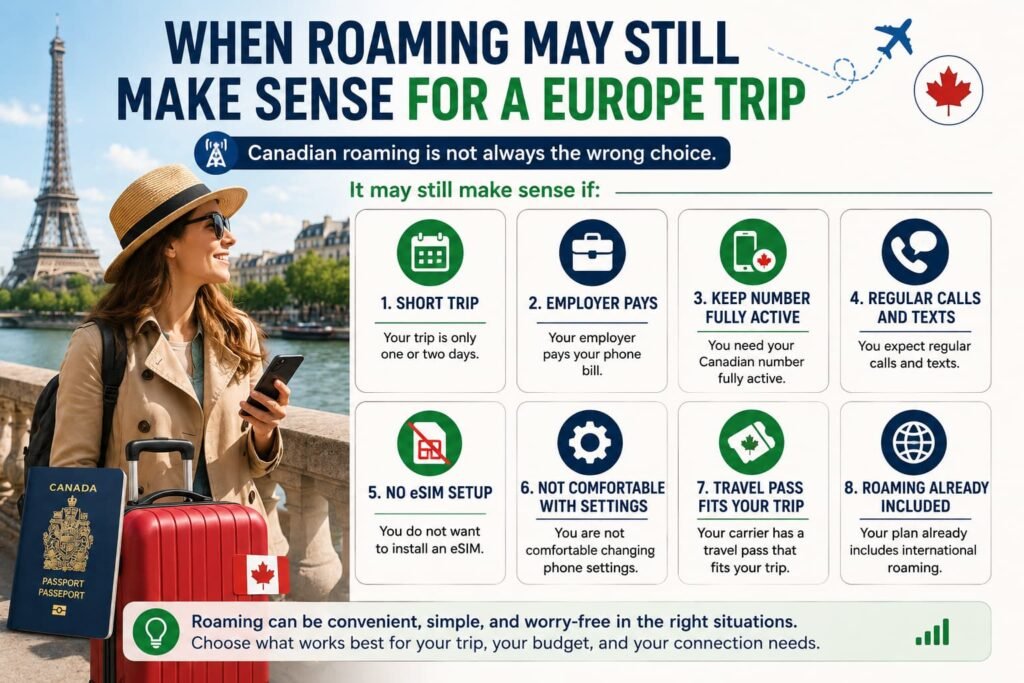
When Roaming May Still Make Sense for a Europe Trip
Canadian roaming is not always the wrong choice for a Europe trip.
It may still make sense if:
- Your trip is only one or two days
- Your employer pays your phone bill
- You need your Canadian number fully active
- You expect regular calls and texts
- You do not want to install an eSIM
- You are not comfortable changing phone settings
- Your carrier has a travel pass that fits your trip
- Your plan already includes international roaming
Roaming is also useful as a backup. Even if you use a Europe eSIM for data, keeping your Canadian line available for texts or emergency calls can be helpful.
The key is to make sure your Canadian line does not become the main data line by mistake.
When a Europe eSIM Is the Better Choice
A Europe eSIM is usually better when your main need is mobile data.
A travel eSIM may be the better choice if:
- Your trip is longer than a few days
- You are visiting multiple countries
- You use maps and transit apps often
- You need train tickets, hotel apps, and rideshare apps
- You are travelling with family
- You want predictable prepaid data costs
- You plan to use hotspot
- You want to avoid daily roaming fees
- You are comfortable using WhatsApp, FaceTime, or Messenger for calls
Europe travel can use more data than you expect. You may be checking directions, train platforms, restaurant menus, hotel bookings, attraction tickets, translation apps, and rideshares all day.
A Europe travel eSIM keeps that data use separate from your Canadian phone plan.
Best Setup: Keep Your Canadian Number and Use a Europe eSIM for Data
For many Canadians, the best option is not roaming-only or eSIM-only. It is a hybrid setup.
Use your Canadian SIM for:
- Incoming texts
- Bank verification codes
- Important calls
- Emergency access
- Your regular Canadian number
Use your Europe eSIM for:
- Mobile data
- Maps
- Messaging apps
- Hotel apps
- Airline apps
- Train and transit apps
- Restaurant searches
- Browsing
- Hotspot, if supported
On iPhone, label your Canadian line as Primary and your Europe eSIM as Travel Data. Then choose the Europe eSIM for cellular data and turn off automatic cellular data switching.
On Android, the wording depends on your phone brand. Samsung users usually start in Settings > Connections > SIM Manager. Google Pixel users usually start in Settings > Network & Internet > SIMs.
Before buying a travel eSIM, use the eSIM Compatibility Checker to confirm that your phone supports eSIM.
Receiving Canadian Bank Texts While Using a Europe eSIM
Banking access is one of the biggest concerns for Canadians travelling with an eSIM.
Many Canadian banks and credit cards still use SMS codes for verification. That includes banks such as RBC, TD, Scotiabank, BMO, CIBC, National Bank, and credit card providers.
In many cases, you can keep your Canadian SIM active for incoming SMS while your Europe eSIM handles mobile data. That way, your phone can receive verification codes while your travel eSIM handles maps, apps, browsing, and messaging.
The important part is to avoid using your Canadian SIM for mobile data. You should also avoid sending SMS, answering calls, checking voicemail over cellular, or making outbound calls on your Canadian number unless you are comfortable with possible roaming charges.
Carrier rules can vary, so check your own plan before travelling. For many travelers, the safest setup is simple: Canadian SIM for important texts, Europe eSIM for data.
How to Avoid Accidental Roaming Charges in Europe
Accidental roaming usually happens when your phone quietly uses your Canadian SIM for data, calls, texts, voicemail, app syncing, or Wi-Fi Calling behavior.
Before leaving Canada:
- Install your Europe travel eSIM over Wi-Fi.
- Label your Canadian line as Primary.
- Label your Europe eSIM as Travel Data.
- Turn off data roaming on your Canadian SIM.
- Turn off automatic cellular data switching.
- Keep the Europe eSIM off until you are ready to use it, if your provider recommends waiting.
- Save your eSIM QR code or app login details.
- Check whether your Europe eSIM requires data roaming to be on for the eSIM line.
When you arrive in Europe:
- Turn on your Europe eSIM.
- Set the Europe eSIM as your mobile data line.
- Turn on data roaming for the Europe eSIM only if the provider requires it.
- Keep data roaming off on your Canadian SIM.
- Confirm your phone is not using your Canadian SIM for data.
- Use Wi-Fi Calling carefully, especially when calling non-Canadian numbers.
For setup help, use the How to Activate eSIM on iPhone in Canada guide or the Activate eSIM on Android Canada guide before travelling.
iPhone Settings to Avoid Canadian Roaming Charges
On iPhone, the main goal is simple: your Europe eSIM should handle data, not your Canadian line.
Before you leave Canada or before you start using the eSIM abroad:
- Go to Settings > Cellular.
- Tap your Canadian line.
- Turn Data Roaming off for the Canadian line.
- Go back to the main Cellular screen.
- Tap Cellular Data.
- Choose your Europe travel eSIM.
- Turn Allow Cellular Data Switching off.
- Label your lines clearly, such as Primary and Travel Data.
That last setting matters. If Allow Cellular Data Switching is left on, your iPhone may switch back to your Canadian line if the Europe eSIM signal drops or has not connected yet.
Android Settings to Avoid Canadian Roaming Charges
On Android, the exact wording changes depending on the phone.
For Samsung Galaxy phones, start with:
Settings > Connections > SIM Manager
For Google Pixel phones, start with:
Settings > Network & Internet > SIMs
Then check these settings:
- Set your Europe eSIM as the preferred mobile data line.
- Turn data roaming off on your Canadian SIM.
- Turn data roaming on for the Europe eSIM only if the provider requires it.
- Turn off auto data switching or switch data connection if your phone has that option.
- Confirm your Canadian SIM is not selected for mobile data.
The wording may vary, but the goal is the same. Your Europe eSIM handles data, and your Canadian line stays away from roaming data.
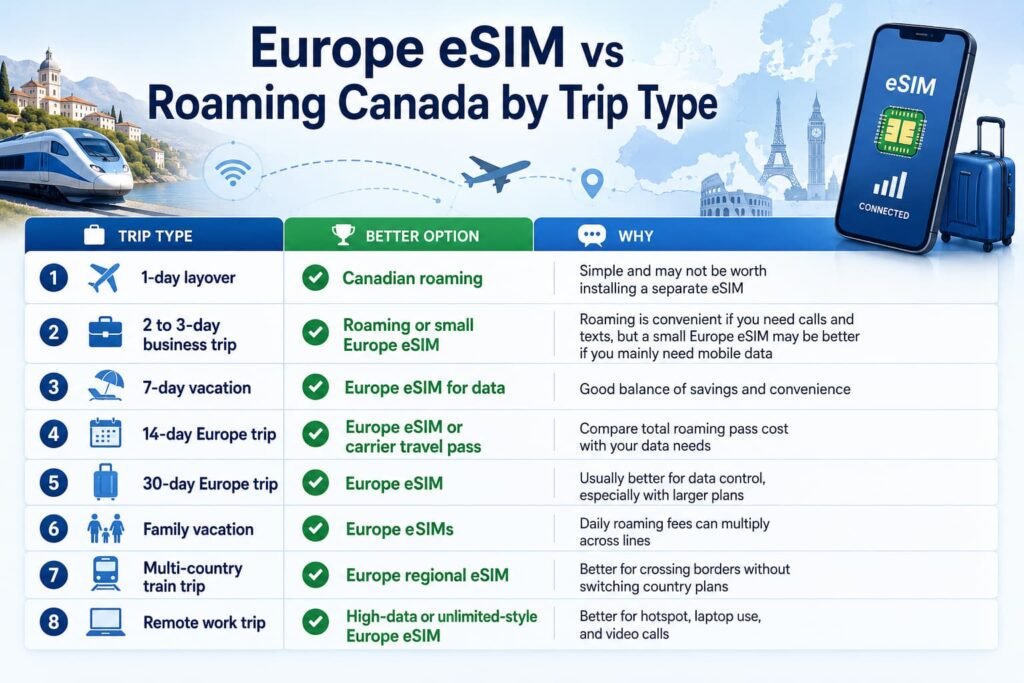
Europe eSIM vs Roaming Canada by Trip Type
| Trip Type | Better Option | Why |
|---|---|---|
| 1-day layover | Canadian roaming | Simple and may not be worth installing a separate eSIM |
| 2 to 3-day business trip | Roaming or small Europe eSIM | Roaming is convenient if you need calls and texts, but a small Europe eSIM may be better if you mainly need mobile data |
| 7-day vacation | Europe eSIM for data | Good balance of savings and convenience |
| 14-day Europe trip | Europe eSIM or carrier travel pass | Compare total roaming pass cost with your data needs |
| 30-day Europe trip | Europe eSIM | Usually better for data control, especially with larger plans |
| Family vacation | Europe eSIMs | Daily roaming fees can multiply across lines |
| Multi-country train trip | Europe regional eSIM | Better for crossing borders without switching country plans |
| Remote work trip | High-data or unlimited-style Europe eSIM | Better for hotspot, laptop use, and video calls |
| Traveler needing regular calls | Roaming or hybrid setup | Canadian number may need to stay active |
| Traveler needing bank codes only | Hybrid setup | Keep Canadian line active for texts and use eSIM for data |
Europe eSIM vs Roaming Canada: Cost Example
Here is a simple example.
If international roaming costs $16 to $18 per day, one phone could cost about $112 to $126 for a 7-day Europe trip, or about $224 to $252 for a 14-day trip.
For two travelers, that can become about $224 to $252 for one week, or about $448 to $504 for two weeks.
A Europe eSIM price depends on the provider, data amount, validity period, and whether you choose fixed data or unlimited-style data. But for travelers who mainly need maps, messaging, tickets, browsing, and apps, a prepaid eSIM can often cost much less than daily roaming.
Use the Canadian Roaming Savings Calculator to estimate this based on your own carrier, trip length, number of travelers, and data use.
Frequently Asked Questions About Europe eSIM vs Roaming Canada
Is it cheaper to use a travel eSIM or my Canadian carrier’s roaming plan in Europe?
A Europe travel eSIM is often cheaper than Canadian carrier roaming, especially for trips longer than a few days. Canadian roaming fees can add up quickly because many plans charge a daily fee when you use your phone abroad.
A travel eSIM gives you a separate prepaid data plan for Europe. If your main needs are maps, messaging, tickets, browsing, hotel apps, and rideshare apps, an eSIM may cost much less than daily roaming. Use the Canadian Roaming Savings Calculator to compare your own trip length, carrier, and data use.
How much do Rogers, Bell, and TELUS charge per day for roaming in Europe?
Rogers, Bell, and TELUS international roaming rates are commonly in the $16 to $18 CAD per day range, depending on the carrier, destination, plan, and current travel options.
Because rates and travel passes can change, always check your carrier’s official roaming page before travelling. This post should be treated as a planning guide, not a permanent price guarantee.
Will activating a Europe eSIM cancel or replace my current Canadian mobile plan?
Activating a Europe travel eSIM does not cancel or replace your Canadian mobile plan.
On a dual SIM phone, your Canadian line and travel eSIM can exist on the same device. Your Canadian SIM can stay active for calls or texts, while the Europe eSIM handles mobile data. When the trip is over, you can turn off or delete the travel eSIM profile.
Can I still receive Canadian bank verification texts with a Europe eSIM?
Usually, yes. Many Canadian travelers keep their Canadian SIM active for incoming SMS while using a Europe travel eSIM for mobile data.
This can help you receive verification codes from banks, credit cards, and online accounts. The important part is to turn off data roaming on your Canadian line and avoid sending SMS, answering calls, or using your Canadian line for mobile data unless you accept possible roaming charges.
What iPhone settings help prevent roaming charges in Europe?
On iPhone, go to Settings > Cellular, tap your Canadian line, and turn Data Roaming off. Then go back to Cellular Data and choose your Europe travel eSIM as the data line.
Also turn Allow Cellular Data Switching off. This helps prevent your iPhone from switching back to your Canadian line for data if the Europe eSIM signal drops or is not active yet.
What happens if I accidentally answer a phone call on my Canadian number in Europe?
Answering a call on your Canadian number may trigger roaming charges depending on your carrier and plan. Sending SMS, making outbound calls, or checking voicemail over cellular may also trigger roaming charges.
If you do not want to risk roaming fees, let non-urgent calls go to voicemail and use data-based apps such as WhatsApp, FaceTime Audio, Messenger, Signal, or Skype over your Europe eSIM data connection.
Do Fido, Koodo, and Virgin Plus offer cheaper European roaming passes?
Fido, Koodo, and Virgin Plus may offer daily roaming, travel passes, or destination-specific roaming options depending on current plans. These can be more predictable than pay-per-use roaming, but they are not always cheaper than a prepaid Europe eSIM.
For longer trips or family travel, compare the full pass cost against a Europe eSIM before you leave Canada.
Does Rogers Roam Like Home or TELUS Easy Roam have a maximum monthly billing cap?
Rogers and TELUS may have billing cycle caps for roaming charges depending on the plan and destination. The details can change and may reset with your billing cycle.
Always check your carrier’s current roaming rules before you travel, especially if your trip is longer than one billing cycle or crosses your monthly bill date.
Can I use iMessage and WhatsApp with my Canadian number while using a Europe data eSIM?
Apps like iMessage and WhatsApp can continue using your Canadian number while your Europe eSIM provides mobile data.
When you install or activate a travel eSIM, keep your existing number connected to iMessage, FaceTime, and WhatsApp if your phone asks. Your contacts can still message your regular Canadian number while your data runs through the Europe eSIM.
Do I need to physically remove my Canadian SIM card to use a travel eSIM?
In most cases, you do not need to remove your Canadian SIM card.
Your travel eSIM is digital and can run alongside your physical SIM or existing Canadian eSIM on a compatible dual SIM phone. You manage both lines in your phone’s settings.
Should I buy my Europe eSIM before leaving Canada or when I land?
It is usually better to buy and install your Europe eSIM before leaving Canada while you have stable Wi-Fi.
This gives you time to install the profile, label your lines, check your settings, and avoid trying to set up your eSIM at a busy airport with weak Wi-Fi. Depending on the provider, you may install the eSIM in Canada and only turn it on or activate it when you arrive in Europe.
Can Canadian roaming days reset while I am still travelling in Europe?
Some roaming charges are based on your carrier’s roaming day or billing window, not always the local time in Europe. That means you could land late in the day, use your phone briefly, and still trigger a roaming charge.
Before travelling, check when your carrier counts a roaming day, whether a travel pass starts right away, and whether your trip crosses your monthly billing cycle. This is one more reason a prepaid Europe eSIM can feel easier to manage, because your travel data is separate from your Canadian carrier’s roaming clock.
What should Canadians do if their phone does not support eSIM?
If your phone does not support eSIM, you still have options. You can compare your Canadian carrier’s roaming pass, buy a local physical SIM after arriving, or use portable Wi-Fi if it makes sense for your trip.
Before travelling, use the eSIM Compatibility Checker to confirm your phone’s eSIM support. If your device is not compatible, plan your backup before you leave Canada.
Related eSIM Travel Guides for Canadians
Start Here
- Best eSIM for Europe Travel From Canada
- Best eSIM for International Travel
- Best eSIM for USA Travel for Canadians
- Canadian Roaming Savings Calculator
- eSIM Compatibility Checker
Canadian Carrier Roaming Comparisons
- Rogers Roam Like Home vs Travel eSIMs
- Bell Roam Better vs Travel eSIMs
- TELUS Easy Roam vs Travel eSIMs
- Fido Roam vs Travel eSIMs
- Koodo Easy Roam vs Travel eSIMs
- Virgin Plus Roam Sweet Roam vs Travel eSIMs
Setup Help
- How to Activate eSIM on iPhone in Canada
- Activate eSIM on Android Canada
- How to Fix eSIM Not Working in Canada
Final Thoughts
The choice between a Europe eSIM and Canadian roaming depends on how you travel.
If you want the simplest setup and need your Canadian number fully active, roaming may still be worth it for a short trip. If you are travelling for a week or more, visiting multiple countries, using maps every day, travelling with family, or relying on mobile data heavily, a Europe travel eSIM is usually worth comparing before you leave Canada.
For many Canadians, the strongest setup is a hybrid setup. Keep your Canadian SIM active for texts or important calls, then use a Europe travel eSIM for data.
Before you travel, check your phone compatibility, compare your estimated roaming cost, confirm your Europe eSIM covers every country on your itinerary, and set up your phone before leaving Canada.