eSIM Plan Comparison Tool
Use this free eSIM plan comparison tool to compare prepaid travel eSIM plans from popular providers, with prices displayed in Canadian dollars. Filter Airalo, Holafly, Nomad, Saily, aloSIM, and Jetpac plans by destination, data size, hotspot support, and budget so you can find an option that makes sense for your trip.
Travel eSIM Plan Comparison Tool
Compare travel eSIM providers by destination, trip length, data use, and travel priorities. Results update automatically as you change your selections.
Important: Plan pricing is displayed in Canadian dollars and is approximate. Prices, plan availability, data allowances, hotspot limits, validity periods, network partners, and promotions can change at any time. Always confirm the final price and current plan details directly on the provider’s website before purchasing. Some USD-denominated plans are converted using an approximate exchange rate, so the price at checkout may vary slightly.
Last checked: September 15, 2026
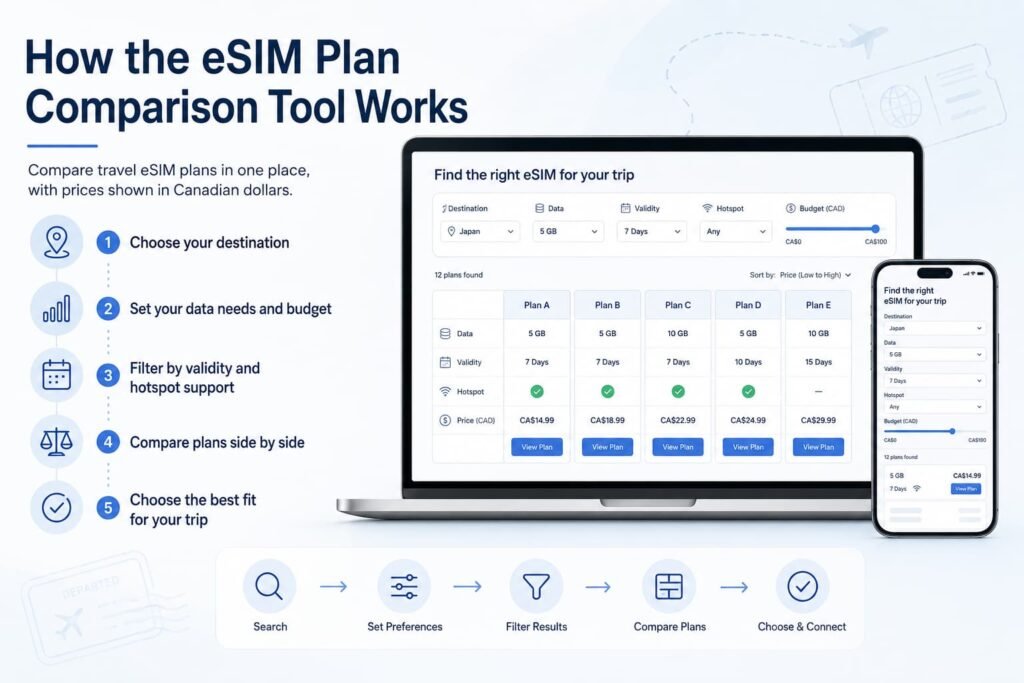
Quick Answer: How Does the eSIM Plan Comparison Tool Work?
The eSIM plan comparison tool helps Canadian travellers compare prepaid travel eSIM plans without opening several provider websites or converting US dollars into Canadian dollars manually.
Start by selecting your destination. You can then filter plans based on how much data you expect to use, whether you need hotspot support, and how much you want to spend. The tool shows the approximate price in CAD, validity period, data allowance, price per gigabyte, and other useful plan details side by side.
If you are still deciding whether to use your Canadian carrier’s roaming option or buy a travel eSIM, start with the free Canadian Roaming Savings Calculator instead. That tool helps you compare the estimated cost of carrier roaming against a travel eSIM based on your destination, trip length, number of travellers, and expected data use.
How to Use the eSIM Plan Comparison Tool
The tool is designed to keep the comparison simple. You do not need to understand every technical detail before getting started.
Step 1: Choose Your Destination
Select the country or region you are visiting. The current tool includes Canada, the United States, Europe, Mexico, and global multi-region plans.
A regional plan may be useful if your trip includes more than one country. For example, a Europe regional eSIM can be easier to manage than buying separate plans for Portugal, Spain, France, and Italy.
Step 2: Choose Your Data Size
Pick the data category that best matches how you normally use your phone.
- Light data use: maps, WhatsApp, email, transit apps, and occasional browsing
- Medium data use: regular browsing, social media, photo uploads, rideshare apps, and travel planning
- Heavy data use: video streaming, remote work, video calls, cloud backups, and regular hotspot use
Try to be realistic. Buying the cheapest plan is not always the best value if you run out of data halfway through your trip and need to purchase another package.
Step 3: Set a Budget
Enter your maximum budget in Canadian dollars if you want to narrow the results.
This is especially useful when several providers offer plans with similar data amounts but different validity periods, hotspot rules, or coverage areas.
Step 4: Sort the Results
Use the sort buttons to organize plans by:
- Best value
- Lowest price
- Most data
- Longest validity
The best value option compares approximate price per gigabyte for capped data plans. Unlimited-style plans should be considered separately because they do not have a fixed price per gigabyte.
Step 5: Check the Plan Details Before Purchasing
Once you find a plan that looks suitable, confirm the current price, data allowance, hotspot rules, activation instructions, and destination coverage on the provider’s official website.
Travel eSIM pricing changes frequently. A plan that offers the best value today may not remain the cheapest option several months from now.
What This Tool Compares
This eSIM plan comparison tool is built for one purpose: helping Canadian travellers compare prepaid travel eSIM plans side by side before purchasing.
Every result shows useful details that can affect whether a plan is right for your trip:
- Provider name
- Destination or region
- Data allowance
- Validity period
- Approximate price in CAD
- Approximate price per gigabyte
- Hotspot or tethering support
- Multi-country coverage
- Capped or unlimited-style data
The tool focuses on travel eSIM plans. It does not estimate Canadian carrier roaming fees.
If you want to compare Rogers Roam Like Home, Bell Roam Better, TELUS Easy Roam, Fido Roam, Koodo Easy Roam, Freedom Mobile Roam Beyond, or another Canadian roaming option against a travel eSIM, use the Canadian Roaming Savings Calculator.
How Plan Prices Are Updated
Prices in this tool are displayed in Canadian dollars so you can compare plans without doing the currency conversion yourself.
Some providers list plans in US dollars. In those cases, the displayed CAD amount is approximate and may differ slightly at checkout because exchange rates, taxes, and promotions can change.
Plan availability can also vary by destination. A provider may offer an affordable 10 GB option for Europe but a different data package for Mexico, Canada, or a global region.
The comparison data is reviewed regularly, but you should always confirm the final details directly with the provider before purchasing. This is especially important when you need a specific feature such as hotspot support, unlimited-style data, 5G access, or multi-country coverage.
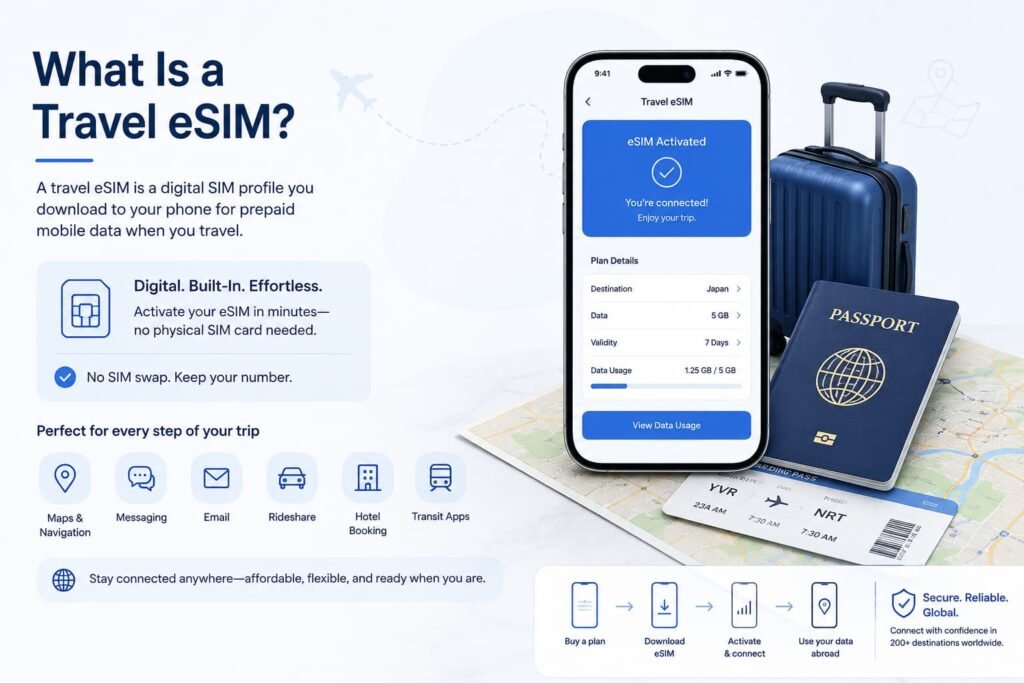
What Is a Travel eSIM?
A travel eSIM is a digital SIM profile that gives your phone a prepaid mobile data plan for the country or region you are visiting.
Unlike a physical SIM card, an eSIM is downloaded directly to your phone. You do not need to remove your Canadian SIM card, visit a mobile store after landing, or carry a SIM ejector tool while travelling.
Many travel eSIM plans are data-only. They are useful for:
- Google Maps and Apple Maps
- WhatsApp, iMessage, and Messenger
- Rideshare apps
- Hotel bookings
- Transit apps
- Restaurant searches
- Social media
- General browsing
Some providers also offer plans with calls, texts, or an optional internet-based phone number. Always check the plan details if regular calling or SMS support matters for your trip.
On many modern dual-SIM phones, you can keep your Canadian SIM active while using the travel eSIM for mobile data. This can be helpful if you need bank verification codes, work messages, or important texts sent to your regular Canadian number.
However, keeping your Canadian SIM turned on does not automatically prevent roaming charges. Calls, outgoing texts, voicemail activity, automatic data switching, and carrier roaming features may still trigger fees depending on your Canadian plan. Before travelling, set the travel eSIM as your mobile data line, turn off data roaming on your Canadian SIM, and confirm your carrier’s roaming rules.
For a broader explanation of eSIM setup, providers, compatibility, and Canadian carrier options, read the complete eSIM Canada guide.
[INSERT IN-POST IMAGE HERE]
Understanding the Providers in This Tool
The tool compares a curated group of popular travel eSIM providers. It is not meant to list every eSIM company on the internet.
The goal is to make it easier to compare several useful options without overwhelming you with hundreds of plans that may not match your trip.
Airalo
Airalo is one of the best-known travel eSIM platforms and offers single-country, regional, and global plans.
Many Airalo plans use capped data allowances such as 1 GB, 3 GB, 5 GB, 10 GB, or 20 GB. This makes Airalo useful for travellers who want to choose a specific amount of data and compare the price per gigabyte before buying.
Airalo generally supports hotspot use when the device and network allow it. Many plans are data-only, but selected options include calls and texts. For example, Airalo’s Discover+ global eSIM includes data, calls, and texts.
Airalo is worth comparing when you want a flexible prepaid option for a short trip, a regional itinerary, or a destination where several capped plans are available.
Holafly
Holafly is best known for unlimited-style travel eSIM plans.
This can be helpful if you do not want to track every gigabyte while travelling. It may be a good fit for longer trips, frequent social media use, maps, browsing, and travellers who prefer predictable data access without topping up a capped plan.
Hotspot support needs a closer look. Holafly travel eSIMs allow data sharing, but the hotspot allowance may be separate from the phone’s main data access. According to Holafly’s official tethering guidance, travel eSIM plans commonly include a daily hotspot sharing limit of 500 MB or 1 GB, depending on the plan.
That may be enough for basic laptop use, email, or light browsing. It may not be ideal if you need regular hotspot access for remote work, large downloads, video calls, or several connected devices.
Holafly is worth comparing when unlimited-style phone data matters more than the lowest price per gigabyte.
Nomad
Nomad offers capped travel eSIM plans across a wide range of destinations.
It is often worth checking when you want more data for a longer trip, especially if the available plans offer a competitive price per gigabyte. Nomad supports hotspot use, which can be helpful when you need to share data with a laptop, tablet, or another traveller.
Nomad can be a practical option for travellers who want a straightforward prepaid plan without paying for unlimited-style data they may not use.
Before purchasing, compare the validity period carefully. A lower-priced plan may look attractive, but a longer trip requires enough days as well as enough data.
Saily
Saily is a newer travel eSIM provider with a simple app-based setup and plans for popular travel destinations.
It is worth comparing when several providers offer similar capped data packages and you want to check which plan gives you the best combination of price, validity, and hotspot support.
Saily supports mobile hotspot and tethering on compatible phones. As with any capped data plan, hotspot use consumes your plan allowance more quickly. This matters if you plan to connect a laptop, stream video, or share data with family members.
Saily may be a good fit for travellers who want a simple prepaid plan and do not need unlimited-style data.
aloSIM
aloSIM is a Canada-based travel eSIM provider headquartered in Ottawa.
It offers prepaid and unlimited-style travel eSIM options for many countries and regions. aloSIM also stands out because many prepaid packages include access to a phone-number offer through its sister app, Hushed. This can be useful if you need internet-based calling and texting while travelling instead of relying only on WhatsApp or FaceTime.
For travellers visiting Canada, aloSIM’s official Canada eSIM page currently lists Bell Mobility, SaskTel, and TELUS Communications as supported networks. Network availability can change, so confirm the current details before purchasing.
aloSIM is worth comparing if Canadian-based support, hotspot access, and an optional phone-number solution are important to you.
Jetpac
Jetpac offers prepaid travel eSIM plans with a strong focus on competitive data pricing.
It is worth checking when your priority is finding a lower-cost capped plan, especially for destinations where several providers offer similar data allowances.
Jetpac plans support hotspot sharing, which makes them useful for travellers who need to connect another phone, tablet, or laptop. Its Canada plans also advertise 4G/5G connectivity and multi-network support, although the network experience still depends on your device, destination, and available partner coverage.
Jetpac may be a useful budget-friendly option, but always compare the validity period and total data allowance instead of choosing a plan based only on the lowest displayed price.
Capped Data Plans vs Unlimited Plans: Which Is Better for Your Trip?
One of the most common questions when comparing travel eSIM plans is whether to choose a capped plan or an unlimited-style plan.
The right answer depends on how you plan to use your phone.
Capped Data Plans
A capped plan gives you a fixed amount of data, such as 3 GB, 5 GB, 10 GB, or 20 GB, for a set validity period.
Capped plans are usually a good starting point if you mainly use your phone for:
- Maps
- Messaging
- Browsing
- Transit apps
- Rideshare apps
- Restaurant searches
- Occasional social media
They are easier to compare by price per gigabyte, and they often offer good value for travellers who do not stream much video or use a laptop hotspot regularly.
Unlimited-Style Plans
Unlimited-style plans can be useful if you do not want to monitor every gigabyte during your trip.
They may make sense for:
- Heavy phone use
- Longer vacations
- Frequent social media use
- Video streaming
- Regular navigation
- Travellers who do not want to top up a capped plan
However, unlimited-style does not always mean unlimited use in every situation.
Some plans may have fair-use rules, speed-management policies, or separate hotspot limits. For example, a plan may allow unlimited-style data on your phone but limit how much you can share with a laptop or tablet each day.
Which One Should You Choose?
For many travellers, a capped plan between 3 GB and 10 GB is a practical starting point.
A light user may only need 3 GB or 5 GB for a one-week trip. A heavier user, remote worker, or traveller sharing data with another device may need 10 GB, 20 GB, or an unlimited-style option with suitable hotspot rules.
Do not choose based only on price. Check the data amount, validity period, hotspot allowance, destination coverage, and whether you can top up the plan if you run out.
Does Your Phone Support eSIM?
Before purchasing any travel eSIM plan, confirm that your phone supports eSIM and is unlocked.
Most newer iPhones, Samsung Galaxy phones, Google Pixel devices, and selected Android models support eSIM. However, compatibility can still vary depending on:
- Exact model number
- Purchase region
- Carrier firmware
- Software version
- Device lock status
- Whether the phone was imported
This matters because two phones with the same model name may not have the same eSIM support if they were purchased in different countries.
Use the free eSIM Compatibility Checker before buying a plan. The tool can help you check smartphones, cellular tablets, and LTE smartwatches while identifying common regional limitations.
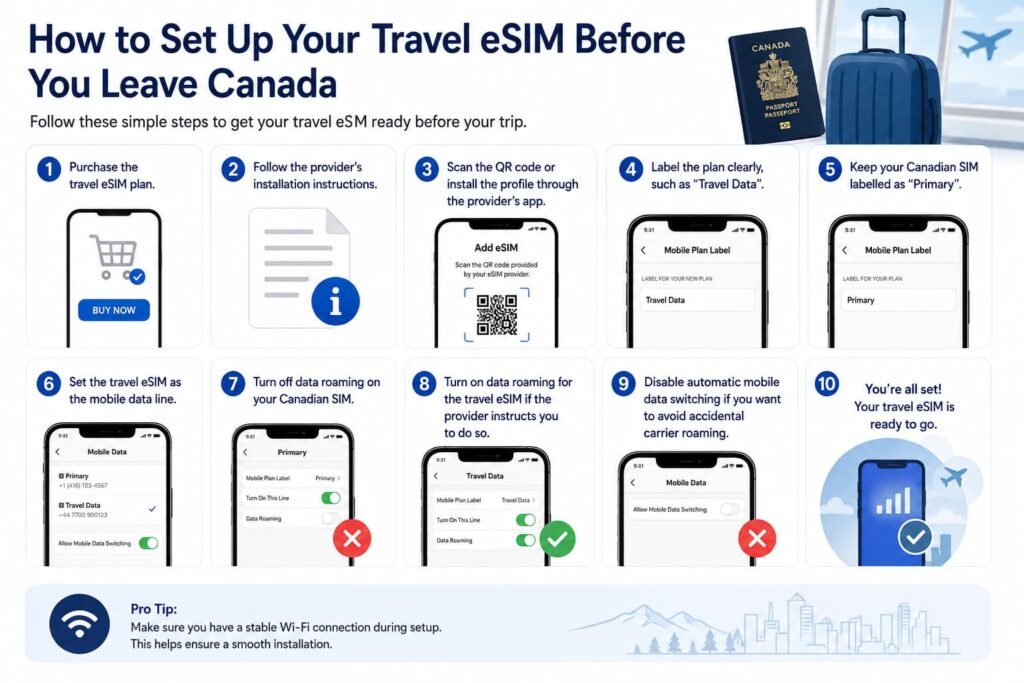
How to Set Up Your Travel eSIM Before You Leave Canada
It is usually easier to install your travel eSIM before departure while you still have reliable Wi-Fi and time to review the settings.
Do not wait until you are standing at an airport baggage carousel or trying to order a rideshare after landing.
The exact setup steps vary by device, but the general process is simple:
- Purchase the travel eSIM plan.
- Follow the provider’s installation instructions.
- Scan the QR code or install the profile through the provider’s app.
- Label the plan clearly, such as “Travel Data.”
- Keep your Canadian SIM labelled as “Primary.”
- Set the travel eSIM as the mobile data line.
- Turn off data roaming on your Canadian SIM.
- Turn on data roaming for the travel eSIM if the provider instructs you to do so.
- Disable automatic mobile data switching if you want to avoid accidental carrier roaming.
For device-specific instructions, follow the iPhone eSIM activation guide or the Android eSIM activation guide.
Destination Guides for Canadian Travellers
The comparison tool is a helpful starting point, but some trips need a more detailed breakdown.
Use these guides when you want destination-specific recommendations, roaming alternatives, and practical setup advice:
- Best eSIM for USA Travel for Canadians
- Best eSIM for Europe Travel From Canada
- Mexico eSIM vs Roaming Canada
- USA eSIM vs Roaming Canada
- Europe eSIM vs Roaming Canada
- eSIM Providers by Country
Frequently Asked Questions About the eSIM Plan Comparison Tool
What is the best eSIM plan comparison tool for Canadians?
The best eSIM plan comparison tool for Canadians should make it easy to compare travel plans without converting prices from US dollars manually or opening several provider websites at the same time.
This tool is designed specifically for that purpose. It displays approximate prices in Canadian dollars and lets you filter Airalo, Holafly, Nomad, Saily, aloSIM, and Jetpac plans by destination, data size, budget, and hotspot support. You can also sort plans by lowest price, best value, most data, or longest validity.
The tool is a useful starting point, but it should not replace the provider’s official checkout page. Once you find a plan that looks right for your trip, confirm the current price, data allowance, validity period, hotspot rules, and destination coverage directly with the provider before purchasing.
Why are the travel eSIM prices shown in Canadian dollars?
Many travel eSIM providers display their prices in US dollars. That makes it harder for Canadian travellers to understand the real cost quickly, especially when comparing several plans with different data amounts and validity periods.
This tool converts plan prices into approximate Canadian dollar amounts so you can compare options using a familiar currency and set a realistic travel budget. The amount at checkout may vary slightly because exchange rates, taxes, and provider promotions can change.
Think of the displayed CAD price as a useful planning estimate. Always confirm the final amount on the provider’s official website before completing your purchase.
How does the best value sort work?
The best value sort compares the approximate price per gigabyte for capped data plans.
For example, a 10 GB plan may cost more upfront than a 3 GB plan but provide a lower cost per gigabyte.
That can make it a better value for a longer trip or heavier data use.
Price per gigabyte is only one part of the decision. You should also check the validity period, destination coverage, hotspot support, top-up options, and whether the data amount realistically matches your trip.
Unlimited-style plans should be reviewed separately because they do not have a fixed price per gigabyte. For those plans, focus on the total cost, hotspot limits, fair-use rules, and how many days of coverage you need
Can I use more than one eSIM at the same time?
Many modern smartphones support dual SIM or dual eSIM functionality, which allows you to keep your Canadian line active while using a separate travel eSIM for mobile data.
This can be useful when you still need access to your regular phone number for bank verification codes, account login texts, work messages, or family communication.
The exact setup depends on your phone model. Some devices allow one physical SIM and one active eSIM. Newer phones may support two active eSIM profiles at the same time.
Before purchasing a plan, use the eSIM Compatibility Checker to confirm what your specific phone supports.
Will keeping my Canadian SIM active trigger roaming charges?
Your Canadian carrier may charge roaming fees if your primary line uses mobile data abroad, places or answers calls, sends outgoing texts, accesses voicemail in certain situations, or connects through automatic cellular data switching.
A safer hybrid setup is to keep your Canadian SIM active only when you need access to important texts or calls, set the travel eSIM as your mobile data line, turn off data roaming on your Canadian SIM, and disable automatic cellular data switching. It is also a good idea to review your carrier’s current roaming rules before departure.
This setup gives you more control over your mobile costs while still allowing your regular Canadian number to remain available when needed.
Is hotspot support included with every travel eSIM plan?
Hotspot support varies by provider and plan. Airalo, Nomad, Saily, aloSIM, and Jetpac generally allow hotspot or tethering on compatible phones. Holafly also supports hotspot sharing on its travel eSIMs, but many plans apply a separate daily sharing limit.
This difference matters if you are travelling with a laptop, tablet, or another person who needs mobile data. A plan may give you plenty of data on your phone while still limiting how much you can share with another device.
Before purchasing, confirm whether hotspot use is allowed, whether a daily or total sharing limit applies, whether tethering uses your main data allowance, and whether the plan is practical for remote work or only light browsing. Your phone also needs to support hotspot sharing with the eSIM.
Use the hotspot column in the comparison tool as a starting point, then confirm the current details directly with the provider before purchasing.
Does a travel eSIM work for visitors travelling in Canada?
Many international travel eSIM providers offer prepaid plans for visitors travelling in Canada.
These plans can be useful if you want mobile data without visiting a store, showing Canadian identification, or committing to a monthly carrier plan. You can often install the eSIM before arriving and connect after landing.
The available networks vary by provider. For example, aloSIM’s current Canada eSIM page lists Bell Mobility, SaskTel, and TELUS Communications as supported networks. Other providers may use different
Canadian network partners.
If you are visiting Toronto, Montreal, Vancouver, Calgary, Ottawa, Quebec City, Halifax, or another Canadian destination, compare the data amount, validity period, network information, and hotspot support before buying.
For a more detailed breakdown, read the best eSIM plans for travellers visiting Canada.
How do I install a travel eSIM?
Most travel eSIM providers let you install the plan using a QR code, a provider app, or manual activation details.
The process usually takes only a few minutes, but it is easier to complete before leaving Canada while you still have stable Wi-Fi.
1. The general process is:
2. Buy the plan from the provider.
3. Open the installation instructions.
4. Scan the QR code or install the profile through the app.
5. Label the eSIM clearly, such as “Travel Data.”
6. Keep the eSIM turned off until the provider instructs you to activate it.
7. Set it as your mobile data line when you arrive.
8. Turn on data roaming for the travel eSIM if required.
Keep data roaming turned off on your Canadian SIM.
Do not delete the eSIM profile unless the provider tells you to do so. Some QR codes can only be us
What happens if I run out of data on a capped travel eSIM plan?
When you use all the data in a capped plan, most providers stop mobile data access instead of charging an automatic overage fee.
Some providers allow you to top up the existing eSIM through their app or website. Others require you to purchase a new package.
Before travelling, check whether the plan supports top-ups and whether the extra data attaches to your existing eSIM profile. This can save time if you run out of data during a busy travel day.
You can also reduce unnecessary data use by downloading offline maps, turning off automatic photo backups, limiting video streaming, and using secure Wi-Fi at your hotel when available.
Are travel eSIM plans refundable?
Refund policies vary significantly between providers.
Some providers may offer a refund if the eSIM has not been installed, activated, or used. Others may limit refunds once the QR code has been scanned or the eSIM profile has been downloaded.
This is why it is important to confirm your device compatibility before buying. A non-refundable travel eSIM is not useful if your phone is locked or your regional model does not support eSIM.
Use the eSIM Compatibility Checker first, then review the provider’s refund policy before completing your purchase.
Does a travel eSIM replace my Canadian SIM?
A travel eSIM does not usually replace your Canadian SIM. It works as an additional mobile plan on a compatible dual-SIM phone.
For many travellers, the most practical setup is to keep the Canadian SIM active for important texts or occasional calls while using the travel eSIM for mobile data. To reduce the risk of accidental roaming charges, turn off data roaming on your Canadian SIM and disable automatic cellular data switching.
This setup allows you to stay reachable on your regular Canadian number while using the travel eSIM for more affordable data abroad.
Your Canadian carrier’s roaming rules still apply to calls, outgoing texts, voicemail, and other activity on your primary line. Review those rules before departure so you understand which actions could trigger additional fees.
How far in advance should I buy a travel eSIM?
You can often purchase and install a travel eSIM before leaving Canada. This gives you time to confirm that the profile downloads correctly while you still have reliable Wi-Fi and access to the provider’s support team if something does not work as expected.
Activation rules vary by provider and plan. Many travel eSIMs begin their validity period when they first connect to a supported network at your destination. Other plans may require a manual activation step, begin counting from the purchase date, use a fixed start date, or include an activation deadline.
Before installing the eSIM, review the provider’s instructions carefully. Confirm when the validity period begins, whether the eSIM should be installed before departure, whether it should remain turned off until you arrive, whether data roaming must be enabled on the travel eSIM, and whether an activation deadline applies.
Buying your travel eSIM in advance is usually helpful, but understanding the activation rules is just as important. Do not assume every plan works the same way.
Is a travel eSIM worth it for a short trip?
A travel eSIM can still be useful for a short trip, but the best option depends on your Canadian carrier plan, destination, and how much convenience matters to you.
For a one-day or two-day trip to the United States, Canadian carrier roaming may be simple enough if you need your regular number for calls and texts. Some Canadians also have Canada-U.S. plans that already include mobile use south of the border.
For a longer trip, family vacation, Europe itinerary, Mexico vacation, Asia trip, Latin America trip, or heavy-data travel setup, a prepaid eSIM often gives you more control over your mobile costs.
ls.
What should I do if my travel eSIM does not work after installation?
Start with the basic settings before deleting anything.
Check that the travel eSIM profile appears in your phone settings, the line is turned on, and the travel eSIM is selected as your mobile data line. Many travel eSIMs also require data roaming to be enabled on the travel profile because they connect through local partner networks.
Then restart your phone or toggle Airplane Mode on and off. Confirm that your device is unlocked and that you are in a supported destination.
Avoid deleting the eSIM immediately. Some QR codes can only be installed once, and removing the profile may create more work if you need the provider to issue a replacement.
For a complete troubleshooting checklist, follow the eSIM not working in Canada guide.
Related eSIM Guides
- eSIM Canada: Best Providers, Setup and Guide for Travellers and Locals
- eSIM Compatibility Checker
- Canadian Roaming Savings Calculator
- Compare Canadian eSIM Providers
- eSIM Providers by Country
- Best eSIM Plans for Travellers Visiting Canada
- How to Activate eSIM on iPhone in Canada
- How to Activate eSIM on Android in Canada
- How to Fix eSIM Not Working in Canada
Final Thoughts
The eSIM plan comparison tool is designed to make travel planning easier for Canadians.
Instead of opening several provider websites, converting US dollars into Canadian dollars, and trying to compare plans with different data amounts and validity periods, you can start with one side-by-side view.
The best plan is not always the one with the lowest price.
A light user may save money with a small capped plan. A remote worker may need a larger data package with strong hotspot support. A traveller visiting several countries may be better off with a regional eSIM. Someone who does not want to monitor usage may prefer an unlimited-style plan, as long as the hotspot rules fit the trip.
Start with the eSIM plan comparison tool, confirm your phone is compatible, and review the final plan details directly with the provider before purchasing.