Most travel eSIM providers are built for short trips.
Keepgo takes a different approach.
Instead of focusing on temporary tourist plans that expire quickly, Keepgo is designed around long-validity data that can remain active for months or even years with regular top-ups.
That changes how the service works in real travel.
Rather than constantly buying new eSIMs for every trip, Keepgo focuses on persistent global connectivity that stays available when you need it.
For some travelers, that flexibility makes far more sense than buying short-term plans repeatedly.
In this Keepgo eSIM review, you’ll see how Keepgo works in real travel, how rollover data functions, how pricing compares across regions, and whether it’s actually worth using over providers like Airalo, Flexiroam, or Ubigi.
Keepgo eSIM Review: What You Need to Know
Keepgo is designed around long-term connectivity instead of short-term tourist usage.
Unlike most tourist-focused eSIM providers, Keepgo behaves more like a standby global data line that stays available between trips instead of expiring after every vacation.
Most eSIM providers focus on temporary plans with strict expiration windows. Keepgo approaches things differently by allowing data to remain active for extended periods when accounts are topped up regularly.
In practice, that means:
- reusable eSIM profiles
- rollover-style data continuity
- long-validity plans
- fewer reinstallations between trips
- stable backup connectivity for ongoing travel
This makes Keepgo very different from providers that mainly target vacation travelers.
Instead of functioning like a disposable short-term travel package, Keepgo is built around persistent travel connectivity that can remain active long after a trip ends.
Instead of encouraging constant plan replacement, Keepgo focuses on maintaining long-term global connectivity.
That model works particularly well for:
- digital nomads
- business travelers
- occasional international travelers
- backup travel internet
- secondary devices and hotspots
It is less focused on:
- unlimited data
- ultra-cheap tourist pricing
- short weekend trips
- highly simplified beginner experiences
You can explore supported countries and available plans directly on the official Keepgo website, including the latest regional profiles, rollover plans, and long-validity data options.
Is Keepgo eSIM Worth It for Travel?
Keepgo can absolutely be worth it if long-validity data matters more than finding the cheapest short-term plan.
Its biggest advantage is persistence.
Instead of repeatedly reinstalling new eSIMs for every trip, Keepgo allows travelers to maintain active data over long periods with periodic top-ups.
Keepgo is a good fit for:
- long-term travelers
- digital nomads
- backup travel connectivity
- tablets and secondary devices
- travelers visiting multiple countries throughout the year
- users wanting long-validity data instead of temporary plans
It may not be the best option if:
- the cheapest pricing matters most
- unlimited data is required
- you prefer highly simplified apps and setup
- short trips are your primary use case
- maximum speed consistency is the priority
The biggest strength with Keepgo is long-term data flexibility.
The biggest downside is that pricing can sometimes feel expensive compared to providers focused on short-term tourist plans.
Here is a quick breakdown of where Keepgo performs well and where it falls short.
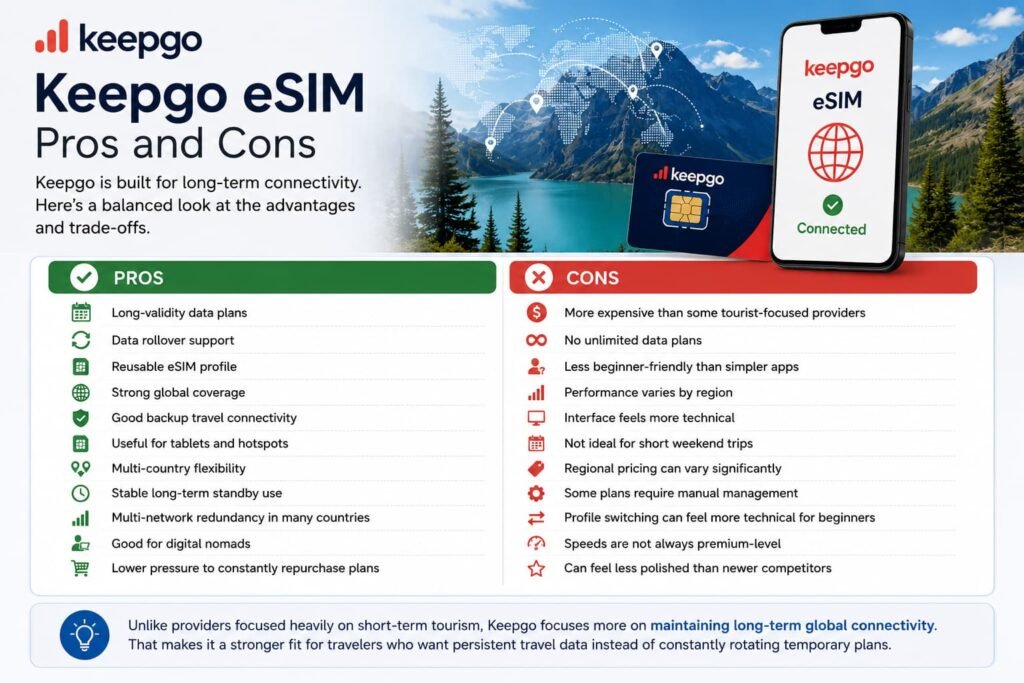
Keepgo eSIM Pros and Cons
| Pros | Cons |
|---|---|
| Long-validity data plans | More expensive than some tourist-focused providers |
| Data rollover support | No unlimited data plans |
| Reusable eSIM profile | Less beginner-friendly than simpler apps |
| Strong global coverage | Performance varies by region |
| Good backup travel connectivity | Interface feels more technical |
| Useful for tablets and hotspots | Not ideal for short weekend trips |
| Multi-country flexibility | Regional pricing can vary significantly |
| Stable long-term standby use | Some plans require manual management |
| Multi-network redundancy in many countries | Profile switching can feel more technical for beginners |
| Good for digital nomads | Speeds are not always premium-level |
| Lower pressure to constantly repurchase plans | Can feel less polished than newer competitors |
Unlike providers focused heavily on short-term tourism, Keepgo focuses more on maintaining long-term global connectivity.
That makes it a stronger fit for travelers who want persistent travel data instead of constantly rotating temporary plans.
What Keepgo eSIM Is and How It Works
Keepgo is a global eSIM provider that connects devices to local carrier networks through international roaming agreements.
The company focuses heavily on reusable travel connectivity rather than disposable short-term plans.
Keepgo is a data-only service, which means it does not include traditional calling or SMS support. Instead, it is designed for internet-based apps like WhatsApp, FaceTime, Telegram, Zoom, and Google Meet.
In real use, the setup process works like this:
- buy a Keepgo data plan
- install the eSIM through a QR code
- activate the line on your device
- connect through local carrier partnerships
The important difference is that the eSIM can remain active long-term.
Many providers operate on fixed expiration windows where unused data disappears after 7, 15, or 30 days. Keepgo instead allows unused data to remain available when the line is maintained with periodic top-ups.
Instead of expiring quickly after a single trip, many Keepgo plans stay active when topped up periodically.
That changes how travelers use the service.
Rather than treating the eSIM as disposable travel data, Keepgo works more like persistent global connectivity that follows you between trips.
What Makes Keepgo Different
Keepgo stands out because of its long-validity rollover structure.
Most travel eSIM providers are designed around temporary expiration windows. Once your trip ends, the plan usually expires and the remaining data disappears.
Keepgo approaches things differently.
With regular top-ups, unused data can remain active for extended periods instead of disappearing after every trip.
That creates several practical advantages:
- less pressure to use all your data immediately
- easier long-term travel management
- better backup connectivity between trips
- fewer repeated installations and activations
- more flexibility for occasional travelers
This model works especially well for:
- travelers who take multiple trips throughout the year
- digital nomads
- business travelers
- secondary devices
- tablets and hotspots
- users traveling multiple times per year
Keepgo also supports unrestricted hotspot and tethering usage on supported plans, which makes it more practical for laptops, tablets, travel routers, and shared travel connections than providers that limit hotspot usage.
Unlike providers such as Holafly that focus on unlimited tourist data, Keepgo behaves more like persistent international mobile infrastructure.
That difference is important.
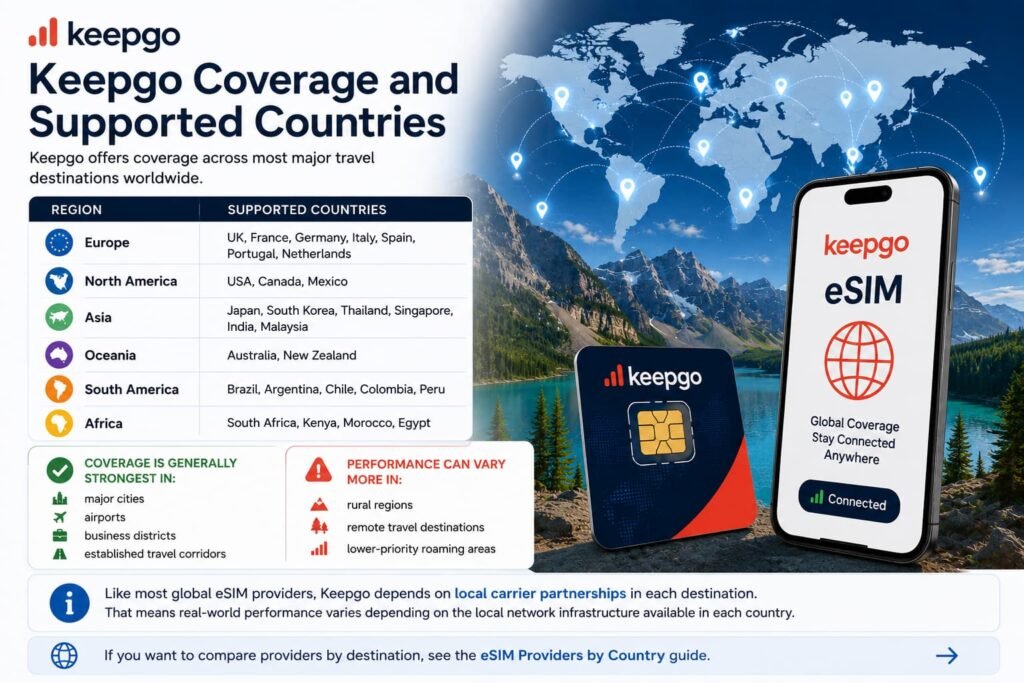
Keepgo Coverage and Supported Countries
Keepgo offers coverage across most major travel destinations worldwide.
Coverage includes:
| Region | Supported Countries |
|---|---|
| Europe | UK, France, Germany, Italy, Spain, Portugal, Netherlands |
| North America | USA, Canada, Mexico |
| Asia | Japan, South Korea, Thailand, Singapore, India, Malaysia |
| Oceania | Australia, New Zealand |
| South America | Brazil, Argentina, Chile, Colombia, Peru |
| Africa | South Africa, Kenya, Morocco, Egypt |
Coverage is generally strongest in:
- major cities
- airports
- business districts
- established travel corridors
Performance can vary more in:
- rural regions
- remote travel destinations
- lower-priority roaming areas
Like most global eSIM providers, Keepgo depends on local carrier partnerships in each destination.
That means real-world performance varies depending on the local network infrastructure available in each country.
If you want to compare providers by destination, see the eSIM Providers by Country guide.
Keepgo Pricing and Plan Costs
Keepgo pricing works differently from many tourist-focused eSIM providers.
Instead of emphasizing short-term unlimited plans, Keepgo focuses on longer-validity data that can remain active with periodic top-ups.
Example pricing by destination:
| Destination | Data | Duration | Price (USD) |
|---|---|---|---|
| USA | 10GB | 365 Days | $39–$49 |
| Canada | 10GB | 365 Days | $42–$55 |
| Europe (Regional) | 10GB | 365 Days | $35–$50 |
| Japan | 5GB | 180–365 Days | $20–$35 |
| India | 5GB | 180–365 Days | $18–$30 |
| South America | 5GB | 180 Days | $25–$40 |
| Africa | 3GB–5GB | 180 Days | $20–$38 |
| Global Plan | 10GB | 365 Days | $55–$79 |
Typical pricing tiers:
- 1GB: around $8–$12
- 5GB: around $20–$35
- 10GB: around $35–$60
- long-validity global plans cost more but remain active much longer
Compared to Airalo or Nomad, Keepgo often costs more per GB.
However, the value proposition is different.
Instead of paying primarily for cheap short-term travel data, you are paying for:
- long-term validity
- reusable connectivity
- rollover support
- fewer reinstallations
- persistent travel data management
That structure makes more sense for travelers who move internationally throughout the year instead of taking one short vacation.
Keepgo Speeds and Real World Performance
In real-world travel use, Keepgo performs reliably in major cities and established travel regions.
You can typically expect:
- 4G LTE in most destinations
- 5G in supported urban areas
- stable roaming continuity across countries
- reasonable performance in airports and business hubs
For everyday travel use, it handles:
- maps and navigation
- messaging apps
- browsing and email
- video calls
- light streaming
- hotspot usage on supported plans
Typical speeds vary significantly depending on the local carrier partnership in each country.
In many destinations, users report speeds ranging from around 15 Mbps to 50 Mbps, which is enough for most travel situations.
One of Keepgo’s strengths is continuity.
The service prioritizes persistent connectivity and network availability over chasing the absolute fastest speeds in every region.
Instead of constantly switching temporary tourist plans, travelers can maintain stable ongoing connectivity across multiple destinations.
In stronger regions like North America and Western Europe, Keepgo can connect through multiple carrier partners inside the same country.
Examples include:
- AT&T, T-Mobile, and Verizon in the United States
- Rogers, Bell, and Telus in Canada
- Vodafone, Orange, and T-Mobile partnerships across parts of Europe
That multi-network redundancy helps reduce total signal loss during travel and gives users more flexibility when crossing regions.
Advanced users can also manually switch networks on iPhone or Android if the device locks onto a slower roaming partner.
Where performance becomes less predictable:
- rural regions
- congested roaming agreements
- remote destinations
- lower-priority partner networks
Compared to Ubigi or GigSky, Keepgo focuses more on long-term flexibility and persistent connectivity than premium low-latency speed consistency.
Compared to Flexiroam, Keepgo places more emphasis on long-validity data rather than roaming continuity features.
That distinction matters because Keepgo is designed more around persistent connectivity than premium travel performance.
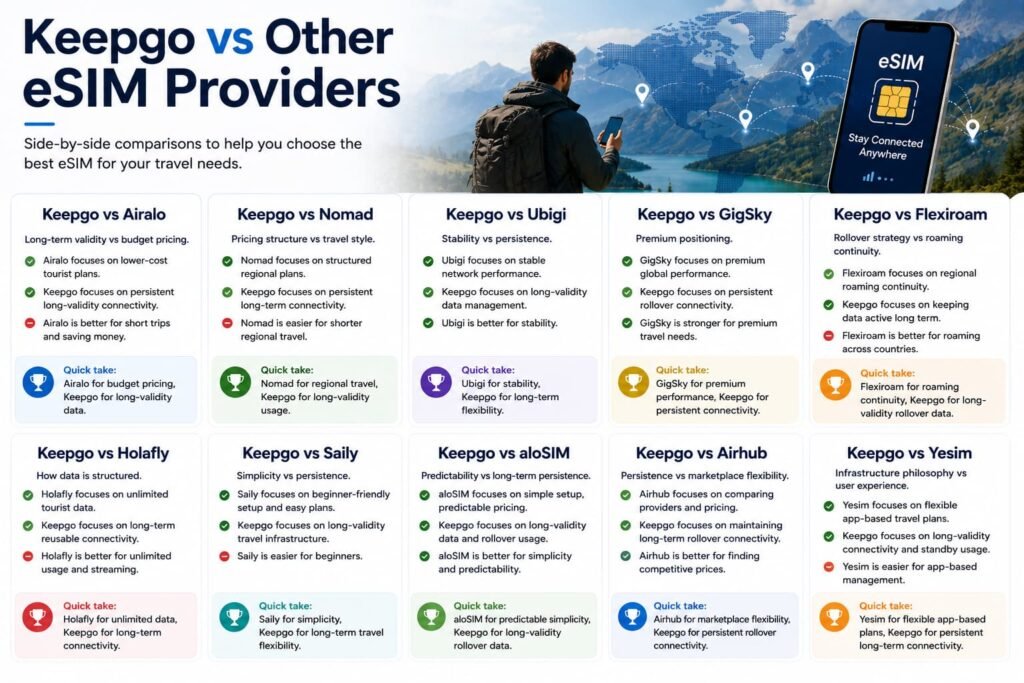
Keepgo vs Other eSIM Providers
Keepgo vs Airalo
Keepgo and Airalo differ mainly in long-term validity versus budget pricing.
Airalo focuses heavily on lower-cost tourist plans.
Keepgo focuses more on persistent long-validity connectivity.
If your main goal is saving money on short trips, Airalo is usually the better choice. You can compare pricing and plans in the Airalo eSIM review.
If long-term rollover connectivity matters more, Keepgo is often the stronger option.
Quick take: Airalo for budget pricing, Keepgo for long-validity travel data.
Keepgo vs Nomad
Keepgo and Nomad differ mainly in pricing structure and travel style.
Nomad focuses on structured regional plans.
Keepgo focuses more on persistent long-term connectivity.
For shorter regional travel, Nomad is usually easier to manage. I break that down in the Nomad eSIM review.
For ongoing international travel across multiple trips, Keepgo offers more long-term flexibility and persistent rollover connectivity.
Quick take: Nomad for regional travel, Keepgo for long-validity usage.
Keepgo vs Ubigi
Keepgo and Ubigi differ mainly in stability versus persistence.
Ubigi focuses heavily on stable network performance.
Keepgo focuses more on long-validity data management.
If stable performance matters most, Ubigi is usually the better choice. You can see why in the Ubigi eSIM review.
If maintaining long-term travel connectivity matters more, Keepgo is often the better fit.
Quick take: Ubigi for stability, Keepgo for long-term flexibility.
Keepgo vs GigSky
Keepgo and GigSky differ mainly in premium positioning.
GigSky focuses on premium global performance and business travel.
Keepgo focuses more on persistent rollover connectivity.
If premium performance and stronger infrastructure matter most, GigSky is usually stronger. I explain that further in the GigSky eSIM review.
If long-validity data and lower maintenance matter more, Keepgo becomes more practical.
Quick take: GigSky for premium performance, Keepgo for persistent travel connectivity.
Keepgo vs Flexiroam
Keepgo and Flexiroam differ mainly in rollover strategy versus roaming continuity.
Flexiroam focuses heavily on regional roaming continuity.
Keepgo focuses more on keeping data active long term.
For multi-country roaming flexibility, Flexiroam is often stronger. You can compare that in the Flexiroam eSIM review.
For standby travel connectivity, rollover usage, and long-validity data, Keepgo is usually the better option.
Quick take: Flexiroam for roaming continuity, Keepgo for long-validity rollover data.
Keepgo vs Holafly
Keepgo and Holafly differ mainly in how data is structured.
Holafly focuses on unlimited tourist data.
Keepgo focuses on long-term reusable connectivity.
If unlimited streaming and heavy daily usage matter most, Holafly is the better choice. You can see how that works in the Holafly eSIM review.
If you prefer persistent reusable travel data across multiple trips, Keepgo makes more sense.
Quick take: Holafly for unlimited data, Keepgo for long-term connectivity.
Keepgo vs Saily
Keepgo and Saily differ mainly in simplicity versus persistence.
Saily focuses on beginner-friendly setup and easy plan selection.
Keepgo focuses more on long-validity travel infrastructure.
If simplicity matters most, Saily is easier to use. I explain that in the Saily eSIM review.
If maintaining travel connectivity across multiple trips matters more, Keepgo is stronger.
Quick take: Saily for simplicity, Keepgo for long-term travel flexibility.
Keepgo vs aloSIM
Keepgo and aloSIM differ mainly in predictability versus long-term persistence.
aloSIM focuses on simple setup, predictable pricing, and a cleaner beginner-friendly experience.
Keepgo focuses more on long-validity data, rollover usage, and standby connectivity across multiple trips.
If you want straightforward pricing and an easier setup, aloSIM is usually the better option. You can compare that in the aloSIM eSIM review.
If keeping unused data active long term matters more, Keepgo is the stronger fit.
Quick take: aloSIM for predictable simplicity, Keepgo for long-validity rollover data.
Keepgo vs Airhub
Keepgo and Airhub differ mainly in persistence versus marketplace flexibility.
Airhub focuses heavily on comparing multiple providers and pricing structures.
Keepgo focuses more on maintaining long-term rollover connectivity.
If finding competitive marketplace pricing matters most, Airhub is often the better choice. You can compare that in the Airhub eSIM review.
If maintaining persistent travel data between trips matters more, Keepgo is usually the stronger option.
Quick take: Airhub for marketplace flexibility, Keepgo for persistent rollover connectivity.
Keepgo vs Yesim
Keepgo and Yesim differ mainly in infrastructure philosophy and user experience.
Yesim focuses on flexible app-based travel plans and simpler management.
Keepgo focuses more on long-validity connectivity and persistent standby usage.
If you prefer a more modern app-driven experience, Yesim is often easier to manage. I explain that further in the Yesim eSIM review.
If maintaining reusable travel connectivity long term matters more, Keepgo offers stronger rollover flexibility.
Quick take: Yesim for flexible app-based travel plans, Keepgo for persistent long-term connectivity.
Best Use Cases for Keepgo
Keepgo works best in situations where persistent connectivity matters more than short-term tourist convenience.
It is especially useful for:
- digital nomads
- occasional international travelers
- backup travel internet
- tablets and mobile hotspots
- secondary travel devices
- users taking multiple trips throughout the year
- travelers wanting long-validity data instead of constant top-ups
Keepgo is less ideal for:
- heavy streaming users
- unlimited data needs
- travelers wanting ultra-cheap short-term plans
- users wanting highly simplified apps and onboarding
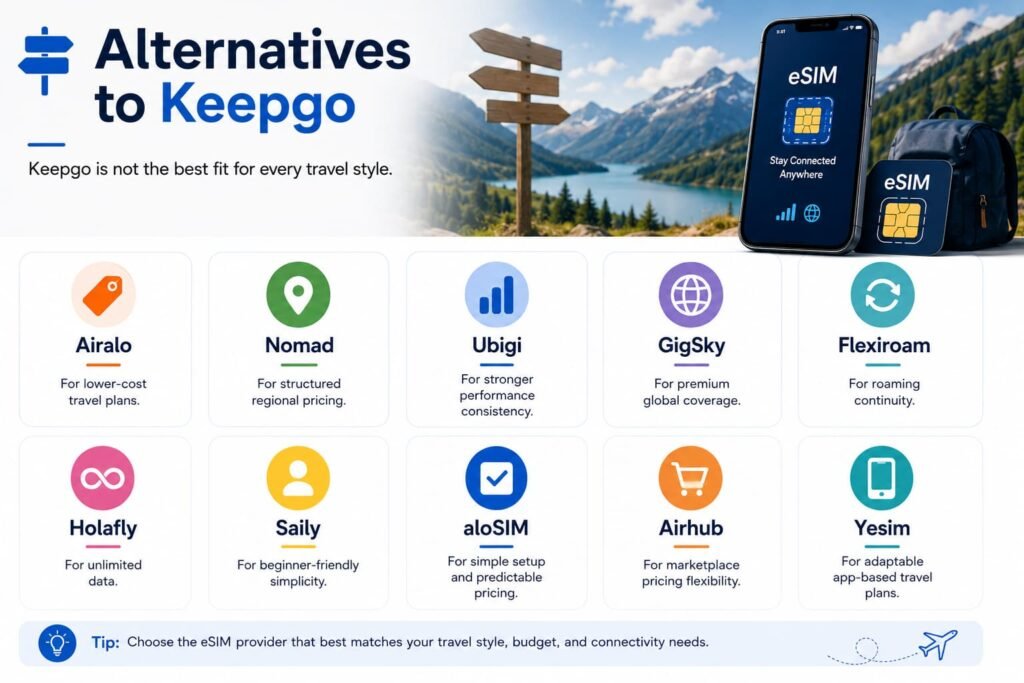
Alternatives to Keepgo
Keepgo is not the best fit for every travel style.
- Airalo for lower-cost travel plans
- Nomad for structured regional pricing
- Ubigi for stronger performance consistency
- GigSky for premium global coverage
- Flexiroam for roaming continuity
- Holafly for unlimited data
- Saily for beginner-friendly simplicity
- aloSIM for simple setup and predictable pricing
- Airhub for marketplace pricing flexibility
- Yesim for adaptable app-based travel plans
Related Guides
If you are still comparing providers or preparing your setup, these guides will help:
- Airalo eSIM review
- Nomad eSIM review
- Holafly eSIM review
- Ubigi eSIM review
- GigSky eSIM review
- Flexiroam eSIM review
- Saily eSIM review
- aloSIM eSIM review
- Airhub eSIM review
- Yesim eSIM review
- Best eSIM for International Travel
- eSIM Providers by Country
- How to Activate eSIM on iPhone in Canada
- Activate eSIM on Android Canada
Final Thoughts
Keepgo is built for a very different type of traveler than most tourist-focused eSIM providers.
It does not focus on flashy unlimited plans or ultra-cheap short-term pricing.
Instead, it focuses on long-validity global connectivity that behaves more like a persistent standby travel line than a disposable tourist eSIM.
That approach will not make sense for everyone.
If your goal is finding the cheapest data for a short vacation, providers like Airalo or Nomad are usually better options.
If unlimited streaming matters most, Holafly is the stronger fit.
But if you travel regularly throughout the year, want reusable global connectivity, or need backup travel data that stays active long term, Keepgo offers something most providers do not.
Its biggest strength is persistence.
For the right type of traveler, that flexibility can be far more valuable than saving a few dollars on temporary tourist plans.