Thailand is one of the easier places to buy a lot of mobile data without spending much, which changes how I would choose the best eSIM for Thailand travel from Canada.
The cheapest plan is not automatically the best one, and neither is the provider with the longest feature list. For a typical Canadian holiday, the more useful decision is whether you need a modest amount of data, one of Thailand’s unusually large fixed-data packages, or an unlimited plan that lets you stop thinking about usage.
Your itinerary matters too. A week split between Bangkok and Phuket is different from working remotely in Chiang Mai for a month, travelling through smaller islands, or continuing from Thailand into Vietnam, Malaysia or Singapore.
For most travellers, I would compare Nomad and Airalo first because their current Thailand offers provide a lot of data for relatively little money. Saily is a strong lower-cost choice, Holafly is aimed at people who genuinely want unlimited phone data, and Ubigi makes more sense for lighter users or repeat travellers who value a reusable eSIM.
My Verdict: What eSIM I’d Choose for Thailand
For a normal one- or two-week Thailand holiday, I would compare Nomad and Airalo first. Both currently give you enough data that most travellers can stop worrying about usage without automatically paying an unlimited-data premium.
Saily is the one I would look at when the goal is spending less while still getting enough data for Google Maps, Grab, messaging, browsing and normal social media. Holafly goes in the opposite direction and is better when you genuinely want unlimited phone data and would rather pay more than manage a fixed allowance.
Ubigi becomes more attractive for light users or travellers who already keep its reusable eSIM installed. Jetpac is worth a separate look when hotspot use or its essential-app fallback is particularly useful.
My starting point: do not choose a Thailand eSIM by brand first. Decide whether you need roughly 5–10 GB, a very large fixed-data allowance, or unlimited data, then compare the providers that fit that use case.
Thailand Has So Much Cheap Data That Price Alone Is a Bad Filter
Thailand is unusually competitive for travel eSIMs.
Current provider offers include small plans for only a few U.S. dollars, 10 GB packages around the price of a meal, and even 50 GB plans that can cost less than some 5 GB packages in other countries.
That is good for travellers, but it also makes the usual “sort by cheapest price” approach less useful.
If one provider offers 10 GB for C$15 and another offers 50 GB for C$17, the C$2 difference probably should not decide the trip. Network access, hotspot rules, activation timing and whether you are travelling beyond Thailand can matter more.
Unlimited plans deserve the same scrutiny. Paying substantially more for unlimited data may be worthwhile for remote work, heavy video use or constant mobile connectivity, but it can be unnecessary for a normal sightseeing trip where hotel Wi-Fi handles most large downloads and streaming.
The better approach is to choose the type of plan first, then decide which provider gives you the strongest version of that plan.
The Three Thailand eSIM Decisions That Actually Matter
1. Fixed Data or Unlimited?
For most vacations, fixed data is where I would start.
Maps, Grab, WhatsApp, restaurant searches, attraction tickets, airline apps and ordinary browsing do not normally require huge amounts of data. A 5 GB or 10 GB package can be enough for many one- or two-week trips.
Unlimited plans make more sense when you expect frequent streaming, large photo or video uploads, daily video calls, remote work, heavy social-media use or very high phone usage throughout the day.
Even then, read the fair-use and hotspot rules. “Unlimited” does not always mean unlimited full-speed data or unlimited tethering.
2. Thailand-Only or Southeast Asia Coverage?
If Thailand is the whole trip, a country-specific plan is usually the easiest comparison.
If the same itinerary includes Malaysia, Singapore, Vietnam, Cambodia, Indonesia or another nearby destination, compare a regional Asia or Southeast Asia eSIM before buying separate plans for every country.
One eSIM that keeps working as you cross borders can be worth paying a little more for.
3. Which Thai Network Does the Plan Use?
Travel eSIM companies do not operate their own towers.
Your connection ultimately runs through local Thai mobile networks such as AIS, True or dtac, depending on the provider and plan.
For Bangkok, Chiang Mai or Phuket, several mainstream options may work perfectly well. Once you add rural roads, mountains, smaller islands or less-developed areas, I care more about the underlying network than saving another dollar or two.
Best eSIM for Thailand Travel From Canada Compared
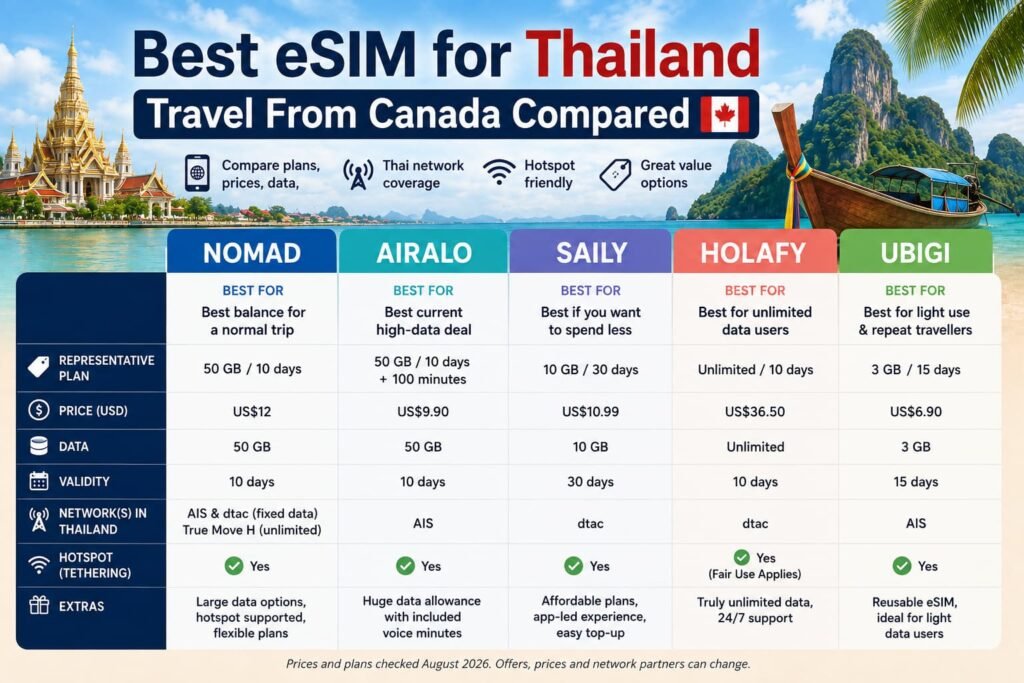
These are the providers I would shortlist first based on how Canadians are likely to use their phones in Thailand.
| Provider | Best fit | Representative plan | USD | CAD |
|---|---|---|---|---|
| Nomad | Best balance for a normal trip | 50 GB / 10 days | US$12 | C$16.75 |
| Airalo | Large short-trip data allowance | 50 GB / 10 days + 100 minutes | US$9.90 | C$13.82 |
| Saily | Lower-cost fixed data | 10 GB / 30 days | US$10.99 | C$15.34 |
| Holafly | Unlimited phone data | Unlimited / 10 days | US$36.50 | C$50.94 |
| Ubigi | Light use and reusable eSIM | 3 GB / 15 days | US$6.90 | C$9.63 |
Important: Prices and plan availability can change. Use these examples as a current comparison point and check the provider’s latest price before buying.
The important point is how close some of these prices are.
For a normal holiday, paying C$14, C$15 or C$17 is not enough of a difference to make the cheapest provider automatically better. I would look at the amount of data, local network, hotspot support and activation rules next.
If you want to compare additional current plans, use the eSIM Plan Comparison Tool.
Nomad: Best Balance for a Normal Thailand Trip
Nomad is one of the first providers I would check for a straightforward Thailand vacation because it currently combines large fixed-data packages, smaller plans, unlimited options and hotspot support.
Its Thailand lineup includes smaller allowances for lighter users along with a particularly strong 50 GB for 10 days at US$12 option.
Fifty gigabytes is far beyond what many holiday travellers need, but at that price the large allowance can make sense simply because you no longer need to monitor normal usage closely.
Nomad’s current fixed-data Thailand plans use AIS and dtac, while its unlimited plans use True Move H. The network therefore depends on the package you buy rather than every Nomad Thailand plan sharing the same network access.
That is one reason I give Nomad the overall edge. The attraction is not only the headline price. It is the combination of plan choice, hotspot support and useful network options.
For the latest packages, check the official Nomad Thailand eSIM page.
Where Nomad Fits Best
I would start here for a traveller spending roughly one or two weeks moving between Bangkok, Chiang Mai, Phuket, Krabi or other mainstream destinations.
A large fixed-data plan gives you plenty of room for navigation, Grab, social media, cloud photos and some hotspot use without pushing you into the higher cost of an unlimited package.
Nomad also sells unlimited-style products, but those use a daily high-speed allowance before speeds are reduced. That is why I would compare the large fixed-data option first rather than assuming unlimited is automatically better.
For more on the provider itself, see my Nomad eSIM Review.
Airalo: Best Current High-Data Deal
Airalo is particularly interesting in Thailand because one of its current packages looks very different from the small data-only plans many travellers associate with the brand.
The current Thailand selection includes 50 GB for 10 days plus 100 minutes for US$9.90.
That is an unusually large data allowance at a low price.
For a one- or two-week trip, 50 GB effectively removes data anxiety for most normal users. Maps, Grab, restaurant searches, WhatsApp, social media and ordinary video use are unlikely to put much pressure on that amount unless your phone is being used very heavily.
The included minutes also make this particular package different from a conventional data-only travel eSIM.
You should still confirm exactly what the selected Airalo package includes before buying because Airalo sells different plan types and features can vary.
Check current availability on the official Airalo Thailand eSIM page.
When I Would Choose Airalo Instead of Nomad
If the current 50 GB package remains available at roughly the same price when you travel, Airalo could easily be the better buy for a short Thailand-only trip.
Nomad gets my broader recommendation because its current Thailand catalogue offers more ways to match the plan to different travel styles.
Airalo becomes especially compelling when you simply want a huge amount of data for a short stay and the specific package features line up with your trip.
See my Airalo eSIM Review for the wider provider comparison.
Saily: Best If You Want to Spend Less
Saily is the provider I would look at when you want enough data for a normal vacation without paying for far more than you expect to use.
Its current Thailand options start at US$2.99 for 1 GB over 7 days, with larger 30-day fixed-data packages including 3 GB, 5 GB, 10 GB and 20 GB. The current 10 GB plan is US$10.99.
For someone mainly using Google Maps, Grab, WhatsApp, email, restaurant searches, travel apps and moderate social media, that can be a very comfortable amount of data.
Saily also uses an app-led setup and lets travellers keep adding future destinations to the same installed eSIM rather than reinstalling a new profile every trip.
You can review current packages on the official Saily Thailand eSIM page.
Saily also sells unlimited-style Thailand options. As with any unlimited product, I would read the current high-speed allowance and reduced-speed rules before paying extra, then compare that structure against Thailand’s inexpensive fixed-data offers.
For ordinary holiday use, I would still compare the cheaper fixed-data plans first.
Read my Saily eSIM Review for more on the provider.
Holafly: When Unlimited Is Actually Worth Paying For
Holafly takes the clearest unlimited-data approach of the providers in this shortlist.
Instead of buying a fixed number of gigabytes, you choose the number of days you need.
Its current Thailand product includes unlimited-data options such as 10 days for US$36.50. Because Holafly changes pricing and duration offers over time, I would confirm the live product page immediately before paying rather than relying on an older comparison.
That higher price solves a different problem from the fixed-data providers.
Who Should Pay More for Holafly?
I would consider it for travellers who use their phones heavily enough that monitoring a fixed data bucket would genuinely be annoying.
That includes people doing lots of streaming, video calls, photo and video uploads or extended mobile use away from Wi-Fi.
For a normal sightseeing holiday, though, Thailand’s large fixed-data plans are so inexpensive that I would have a hard time justifying the additional cost.
Check the current offer on the official Holafly Thailand eSIM page, or see my Holafly eSIM Review for more detail about the provider.
Ubigi: Best for Light Use or Repeat Travellers
Ubigi makes more sense when you look at what it does differently rather than comparing only raw gigabytes.
Its Thailand options include smaller packages that suit light users who mainly need maps, messages and transportation while relying on hotel or café Wi-Fi for heavier tasks.
Ubigi also uses a reusable eSIM profile.
Once installed, the same profile can be used to buy eligible Ubigi packages for future destinations, which is convenient for travellers who use the provider repeatedly.
I would choose it over the bigger Thailand packages when I knew my mobile-data use would be low or I already had the Ubigi eSIM installed from a previous trip.
As data requirements increase, Nomad, Airalo and Saily become harder to ignore because of their current Thailand pricing.
For the broader provider experience, see my Ubigi eSIM Review.
Jetpac: The Useful Backup Option
Jetpac does not need to displace one of the main five to deserve attention.
Its Thailand plans support hotspot sharing and let you reuse the same Jetpac eSIM on future trips.
The more interesting feature for Thailand is what can happen after your normal data allowance is exhausted.
On qualifying plans of 3 GB or more, Jetpac provides continued access to selected essential apps including WhatsApp chat, Google Maps, Uber and Grab.
Grab and Google Maps are particularly relevant in Thailand.
Running out of normal data while away from your hotel is much less stressful if you can still navigate or request a ride.
I would treat Jetpac as an alternative for someone who values hotspot flexibility or the essential-app fallback more than simply getting the largest data allowance.
For a closer look at its app, hotspot rules, plan structure and how the essential-app fallback works, see my Jetpac eSIM Review.
What eSIM I’d Buy for Different Thailand Trips
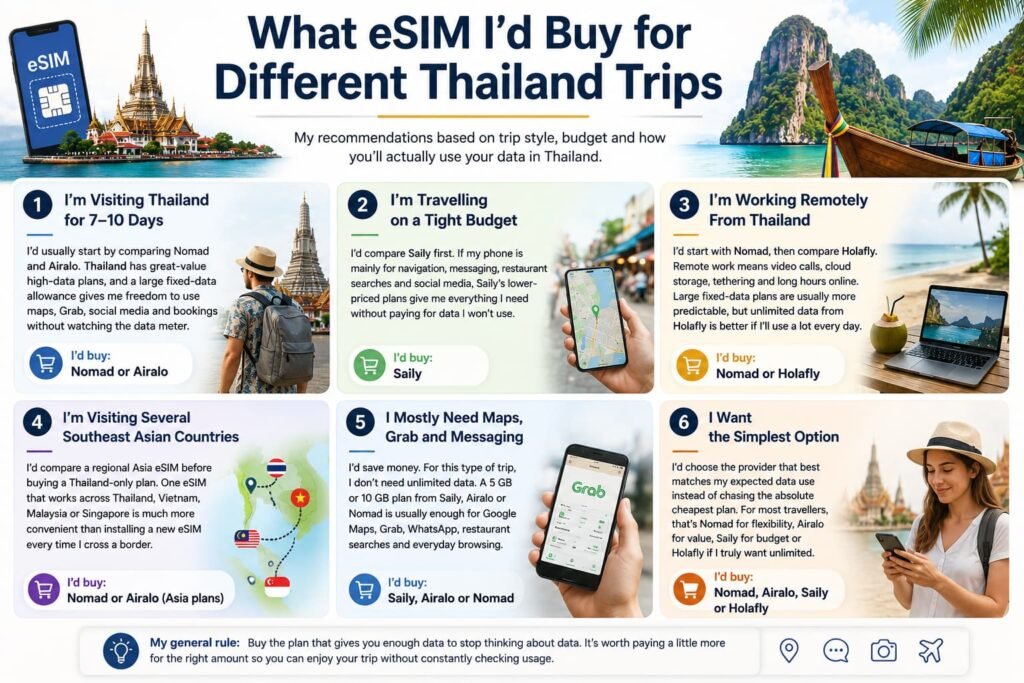
Rather than ranking the same five providers again, this is how I would approach actual itineraries.
One Week in Bangkok
You probably do not need unlimited data.
A 5 GB or 10 GB fixed-data plan should be plenty for many travellers using maps, Grab, messaging, restaurant searches and normal social media.
Saily, Nomad and Airalo are the first three I would compare.
Bangkok, Chiang Mai and Phuket Over Two Weeks
This is where I like having a larger fixed-data allowance.
You will probably use your phone more as the trip becomes more complex, and moving between destinations means more navigation, bookings and transportation apps.
Nomad or Airalo make particularly strong sense if their current large-data offers are still available.
Island Hopping or Rural Travel
Price becomes less important.
Check the Thai network attached to the actual plan before buying, especially if the trip involves smaller islands, rural roads or areas away from the main tourist centres. A provider cannot create coverage where its partner network has weak reception.
I would also download offline maps, accommodation details, ferry tickets and anything else time-sensitive before boarding an island transfer. A connection that works perfectly on land can weaken or disappear once a ferry moves away from populated coastal areas, so important travel information should not depend on having mobile data throughout the crossing.
Remote Work From Thailand
Start by checking hotspot rules.
A plan that sounds excellent for phone use can become frustrating if tethering is restricted.
Large fixed-data packages can sometimes be better than unlimited plans for remote workers because you know exactly how much high-speed data can be shared.
Thailand Plus Vietnam, Malaysia or Singapore
Compare a regional plan before buying a Thailand-only eSIM.
Keeping one eSIM active as you cross borders is often worth a small price premium, particularly if the itinerary has several short stops.
How Much Data Is Actually Enough in Thailand?
Most people do not use huge amounts of mobile data on maps and messaging.
Video, uploads and hotspot use are what change the equation.
| Travel style | Suggested starting range |
|---|---|
| Maps, Grab and messaging | 3–5 GB |
| Normal sightseeing and social media | 5–10 GB |
| Heavy social media and some video | 10–20 GB |
| Frequent streaming or hotspot | 20–50 GB |
| Remote work or very heavy use | 50 GB or unlimited |
For a typical one- or two-week trip, 10 GB is a sensible starting point.
You may use much less if your hotel Wi-Fi handles streaming, app updates and photo backups.
A traveller who tethers a laptop, uploads video every day or spends hours streaming can move through 10 GB quickly.
Thailand’s current plan pricing makes it relatively inexpensive to buy extra headroom, but that still does not mean everyone needs unlimited data.
Do You Need a Thai Phone Number for Grab, Hotels or Bookings?
Most Canadian tourists do not.
A data-focused eSIM is normally enough for WhatsApp, FaceTime, Signal, Messenger, Grab, Google Maps, airline apps, online hotel bookings, email and social media.
Grab’s everyday app functions depend on mobile data rather than requiring a Thai SIM simply to get online. That means you can request rides, view the route and use supported in-app communication through a regular travel eSIM data connection.
A Thai phone number becomes more useful if a specific local business or service requires conventional domestic calling or SMS.
That is a separate requirement from mobile data.
Do not assume every Thailand eSIM includes a Thai number because one particular provider happens to sell a package with voice minutes.
Thai Tourist SIM Registration Matters More If You Need a Local Number
Locally issued Thai tourist SIMs and eSIMs are subject to identity-registration requirements.
AIS tells foreign tourists to register their tourist SIM before use and uses passport-based verification. True and dtac likewise require their tourist SIM products to be registered with a valid passport under NBTC rules. Depending on the product and registration method, the process can include online identity checks or a selfie alongside the passport.
That matters most when you are choosing a Thai-carrier tourist SIM or eSIM with local mobile service, particularly if a Thai number, conventional calls or SMS are part of the reason you are buying it.
International travel-eSIM marketplaces work differently, and I would not assume that every foreign data-only product follows the same registration process as an AIS, True or dtac tourist number.
The practical rule is simpler: check the identity requirements shown for the exact product you are purchasing. If all you need is prepaid travel data, choose based on the plan, network and trip. If you specifically need a Thai phone number, confirm the registration process before you rely on that number after arrival.
For comparison, you can review the current AIS Tourist SIM and eSIM information and the True/dtac Tourist SIM information.
Keep Your Canadian Number Without Using It for Data
A dual-SIM phone gives Canadians a useful middle ground.
Use the Thailand eSIM for mobile data while leaving your Canadian SIM available if you still need your normal number for verification texts or important communications.
The two lines need to be configured carefully.
Keeping your Canadian SIM enabled does not make overseas use free. Select the Thailand eSIM as your mobile-data line, turn data roaming off on the Canadian line, and disable automatic cellular-data switching unless you intentionally want your Canadian carrier to take over.
Many travel eSIMs require data roaming to be enabled on the travel eSIM itself.
That is normal because travel eSIMs often connect through roaming agreements with partner networks.
The key is keeping the settings for the Canadian line and Thailand line separate.
For more detail, see Travel eSIM vs International Roaming for Canadians.
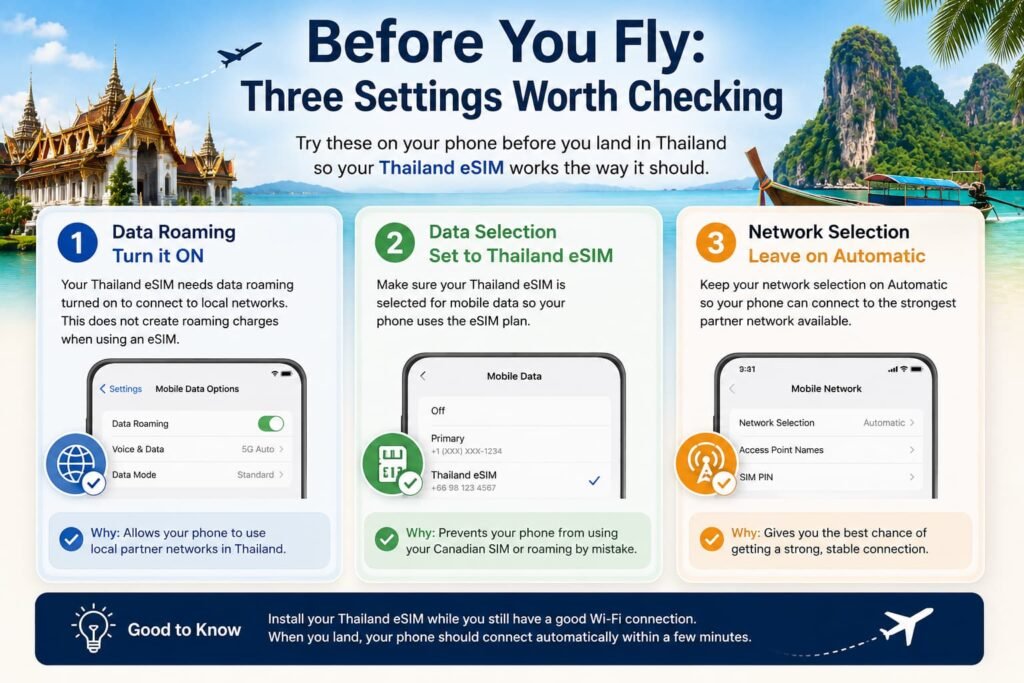
Before You Fly: Three Settings Worth Checking
You do not need a full technical setup lesson inside a destination guide, but I would check three things before leaving Canada.
Confirm Your Phone Supports eSIM
Your phone needs eSIM support and must be able to use the travel provider’s profile.
If you are unsure, use the eSIM Compatibility Checker before paying.
Install the eSIM on Reliable Wi-Fi
When the provider allows advance installation, doing it at home gives you time to solve a QR-code or account problem before the trip.
Installation and plan activation are not always the same event, so read the specific provider instructions before assuming the validity starts immediately.
Label the Canadian and Thailand Lines Clearly
Use names such as Canada and Thailand rather than leaving both lines with generic labels.
When you arrive, that makes it much easier to confirm that the Thailand eSIM is handling mobile data and your Canadian line is not.
Thailand eSIM FAQs
What is the best eSIM for a two-week Thailand holiday?
For a typical two-week trip, I would compare Nomad, Airalo and Saily first. Nomad has a strong balance of plan variety, hotspot support and Thai network options, while Airalo’s current high-data Thailand package can provide exceptional value if it still matches your travel dates.
Saily is the better starting point when you know you do not need an enormous allowance and would rather keep the price low. The final choice should depend on the current package, local network, hotspot rules and whether Thailand is the only country on your itinerary.
Is 10 GB enough for Thailand if I use Grab and Google Maps every day?
Ten gigabytes should be enough for many travellers using Google Maps, Grab, messaging, browsing and moderate social media over a one- or two-week trip. Navigation and ride-hailing apps normally use much less data than video streaming or large uploads.
Your usage can climb much faster if you watch a lot of mobile video, make frequent video calls, upload high-resolution content or tether another device. If that describes your trip, consider 20 GB, 50 GB or an unlimited-style plan instead.
Which Thai mobile networks should I look for in a travel eSIM?
AIS, True and dtac are the main Thai network names you are likely to see when comparing travel eSIM plans. The actual network available to you depends on the provider and sometimes the specific package you buy.
For example, Nomad currently separates its Thailand network arrangements by plan type: fixed-data plans use AIS and dtac, while unlimited plans use True Move H. That is why I would verify the actual package rather than assuming one provider always connects through the same network.
Will the same Thailand eSIM work in Bangkok, Chiang Mai, Phuket and Krabi?
A Thailand country eSIM is normally sold for use across the country rather than one specific city, so you should not need a new eSIM every time you move between Bangkok, Chiang Mai, Phuket and Krabi.
Actual signal quality can still vary by location and network. Major tourist centres are generally easier coverage environments than remote beaches, smaller islands or rural roads, so check the provider’s Thai partner network when those areas are important to your itinerary.
Is unlimited data worth paying for in Thailand?
Unlimited data is worth considering when you genuinely expect heavy mobile usage, such as frequent streaming, video calls, large uploads or using your phone as a primary internet connection throughout the day. It is also convenient if you simply do not want to monitor remaining data.
For an ordinary sightseeing trip, I would compare large fixed-data plans first. Thailand currently has enough inexpensive 10 GB, 20 GB and 50 GB options that many travellers can get effectively worry-free usage without paying the higher price of an unlimited plan.
Do I need a Thai phone number for Grab, hotels or restaurant bookings?
Most short-term travellers can manage normal Thailand travel without buying a local number specifically for internet-based apps. Grab, Google Maps, WhatsApp, email and online hotel systems work over mobile data.
A local Thai number becomes more useful when a particular hotel, business or service requires conventional domestic calling or SMS. If that is important to your trip, also check the identity-registration requirements attached to the Thai tourist SIM or eSIM before buying.
Should I buy a Thailand-only eSIM if I am also going to Vietnam or Malaysia?
Not automatically. Once the itinerary includes Thailand plus another Southeast Asian country, compare a regional Asia plan against the cost of separate country eSIMs.
A regional plan can be especially useful when you are making several short stops because one eSIM can keep working as you cross borders. For a long stay almost entirely in Thailand with only a brief side trip, separate country plans can still be cheaper, so compare the actual itinerary rather than buying regional coverage by default.
What should I check before using an eSIM on Thailand’s islands?
Start with the local network attached to the plan. Coverage on Phuket or other major tourist islands is a different scenario from smaller or more remote islands, where terrain, distance from populated areas and the available tower network can have a larger effect.
Download offline maps, ferry information, accommodation details and anything time-sensitive before travelling between islands. An eSIM can work very well around populated destinations and still lose its connection temporarily when you are offshore.
Can I keep my Canadian SIM active for verification texts in Thailand?
A dual-SIM phone can normally keep your Canadian line available while the Thailand eSIM handles mobile data. That is useful if your bank, credit card or another account still sends verification codes to your Canadian number.
Set the Thailand eSIM as the mobile-data line and keep data roaming disabled on the Canadian SIM unless you intentionally plan to use carrier roaming. Calls, sent messages and other activity on the Canadian line can still have roaming implications, so keeping the line active should not be treated as the same thing as free overseas service.
Is an eSIM better than buying a tourist SIM at Bangkok airport?
An eSIM is usually more convenient because you can arrange it before departure and have your data setup ready without visiting a mobile counter after a long flight. That is especially useful if your first priorities are opening Grab, checking hotel directions or messaging someone as soon as you land.
A Thai tourist SIM or eSIM can still be the better choice when you specifically want a local phone number, local calls or a package sold directly by AIS, True or dtac. Those locally issued products also have identity-registration requirements, so convenience, local-number access and registration are all worth comparing rather than assuming one option is automatically better.
Related Guides
Compare Thailand eSIM Providers
Plan Your Mobile Setup
- Best eSIM for International Travel
- Travel eSIM vs International Roaming for Canadians
- eSIM Providers by Country
- eSIM Plan Comparison Tool
- eSIM Compatibility Checker
Final Thoughts
Thailand has enough inexpensive travel eSIM competition that I would not choose from a generic provider ranking.
Start with the trip.
For a normal one- or two-week holiday, Nomad and Airalo are the two providers I would compare first because their current Thailand plans combine large data allowances with very competitive pricing. Saily is particularly attractive when you want to spend less and know a moderate fixed allowance is enough.
Holafly becomes easier to justify when unlimited phone data is the actual priority rather than simply a reassuring label. Ubigi is a better fit for lighter users and repeat travellers, while Jetpac has a useful niche if hotspot flexibility or essential-app access after your main data runs out appeals to you.
The network behind the eSIM becomes more important as the itinerary moves away from Thailand’s easiest tourist areas. For Bangkok, Chiang Mai, Phuket and other major destinations, several providers can make sense. For rural routes, ferry journeys and smaller islands, I would pay closer attention to AIS, True or dtac access and keep important trip information available offline.
If you specifically want a Thai phone number, also check the registration requirements attached to that local tourist SIM or eSIM. A traveller who only needs data has different priorities from someone who wants conventional Thai calls and SMS.
And if Thailand is only one stop in a longer Southeast Asia trip, compare regional coverage before buying anything. One eSIM working across several countries can be more useful than saving a few dollars on the Thailand portion alone.