If you’re comparing Airalo and Holafly and want something more flexible in between, this Nomad eSIM review walks you through pricing, coverage, speeds, and how it actually performs when you travel.
Nomad isn’t trying to be the cheapest or the most “set it and forget it.” It sits in the middle. You get control over how much data you buy, which works well if you’re moving across countries or don’t want to overpay for unlimited.
Nomad eSIM Review: Is It Worth It for Travel
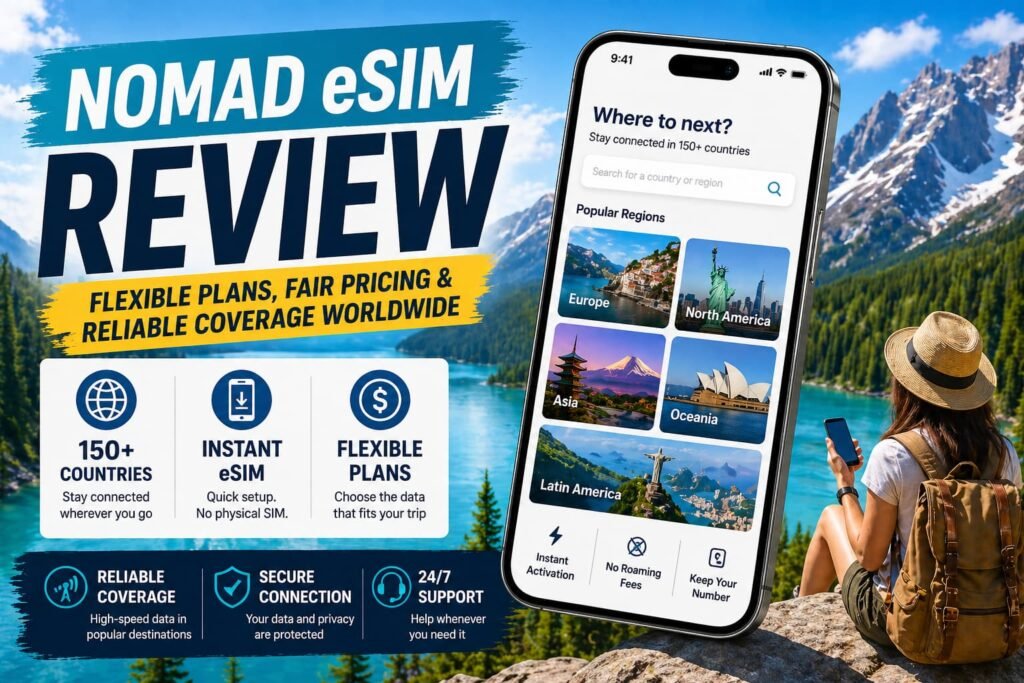
Nomad is worth a look if you want flexibility without paying for unlimited data you might not use. It’s easy to set up, the app is straightforward, and you can track your usage without guessing.
Across major review platforms, Nomad tends to sit in the mid to high 4-star range. Most people like how simple it is to install and manage, and pricing is usually competitive, especially on mid-size plans.
If you mainly use data for maps, messaging, and some browsing, Nomad often ends up being more practical than unlimited plans. Where it really makes sense is regional travel, where one plan can cover multiple countries.
What Is Nomad eSIM and How It Works
Nomad is a global eSIM provider that lets you access mobile data without a physical SIM card. You can explore available plans and destinations directly on the Nomad website.
You buy a plan, install it through the app or QR code, and your phone connects to local networks in your destination. Setup takes a few minutes and works on most modern eSIM-compatible phones.
Nomad doesn’t run its own network. Like most providers, it connects you to local carriers in each country.
If you’ve used Airalo before, this will feel familiar. The difference is how Nomad structures its plans, especially for regional use.
One thing to keep in mind: Nomad is data-only. You won’t get a phone number, but apps like WhatsApp, FaceTime, and iMessage will continue working normally.

Nomad eSIM Coverage and Supported Countries
Nomad covers more than 150 countries, mainly in places where travelers need reliable data.
Coverage includes:
- Europe: United Kingdom, France, Spain, Italy, Germany
- North America: United States, Canada, Mexico
- Asia: Japan, South Korea, Thailand, Singapore
- Oceania: Australia, New Zealand
- Latin America: Brazil, Argentina, Chile
Where Nomad stands out is its regional plans. If you’re moving across Europe or Asia, you can often stick to one plan instead of switching every time you cross a border.
Under the hood, Nomad connects to major local carriers (like Verizon or AT&T in the US, EE or Vodafone in the UK, Telus or Bell in Canada). In many regions, it can switch between networks to keep you connected.
To check availability by destination, see the eSIM Providers by Country guide.
Nomad eSIM Data Plans Explained
Nomad uses fixed data plans, so you choose how much data you want upfront.
Typical options:
- 1GB to 3GB for short trips
- 5GB to 10GB for regular use
- Larger plans for longer stays
Most plans run from 7 to 30 days.
There are also regional plans that cover multiple countries, and in some destinations you’ll see “unlimited” options that include a daily high-speed cap before speeds slow down.
This setup works well if you want to control your costs. You’re not paying for unlimited data you may not use.
Compared to Holafly, you trade unlimited access for better pricing control. Compared to Airalo, you can sometimes get better value on regional plans.

Nomad eSIM Speeds and Real World Performance
In real travel use, Nomad performs well in cities and busy areas.
You can expect:
- 4G or LTE in most places
- 5G where available
- Stable connections in urban areas
It handles everyday tasks without issues:
- Google Maps
- WhatsApp and messaging apps
- Social media
- Light streaming
Performance can drop in rural areas, and some regions may be less consistent. Some travelers notice slower speeds outside major cities or limitations in places like China depending on how traffic is routed.
In certain countries, traffic may be routed through nearby regions (like Hong Kong for China), which can affect how some apps behave.
Unlike unlimited providers, your speeds don’t get throttled after heavy use. But once you run out of data, that’s it until you top up.
Nomad eSIM Pricing and Plan Costs
Nomad prices plans by data amount, not just days, so you pay for what you’ll actually use.
What you’ll typically pay
| Destination | Data | Duration | Price (USD) |
|---|---|---|---|
| USA | 10GB | 30 Days | $15–$18 |
| Canada | 10GB | 30 Days | ~$18–$22 |
| Mexico | 5GB–10GB | 30 Days | ~$14–$18 |
| UK | 5GB | 30 Days | ~$15 |
| Japan | 10GB | 30 Days | ~$16–$20 |
| Europe (Regional) | 10GB | 30 Days | ~$18 |
Where Nomad gives the best value
Most travelers get the best deal with mid-size plans (around 5GB to 20GB). In busy markets, the cost per GB can drop well under $1, which is often cheaper than Airalo at similar data levels.
Single-country vs regional plans
- Single-country plans make sense if you’re staying in one place and want the lowest price for that network.
- Regional plans are better if you’re crossing borders. One plan covers multiple countries, so you don’t need to install a new eSIM each time.
What about unlimited plans?
Nomad does offer “unlimited” options in some countries, but they usually come with a daily high-speed limit. After you hit that cap, speeds slow down for the rest of the day.
Real-world takeaway
If you use moderate data and plan ahead, Nomad is one of the better options for keeping costs predictable. It’s especially strong for multi-country trips where regional plans save both time and money.
Nomad pricing is based on how much data you buy.
Here’s what typical pricing looks like across popular destinations:
| Destination | Data | Duration | Price (USD) |
|---|---|---|---|
| USA | 10GB | 30 Days | $15–$18 |
| Canada | 10GB | 30 Days | ~$18–$22 |
| Mexico | 5GB | 30 Days | ~$14–$18 |
| UK | 5GB | 30 Days | ~$15 |
| Japan | 10GB | 30 Days | ~$16–$20 |
| Europe (Regional) | 10GB | 30 Days | ~$18 |
In practice, mid-size plans (around 5GB to 20GB) are where Nomad usually gives the best value. In more competitive regions, the cost per GB can drop well under $1, which is often cheaper than what you’ll see with Airalo at the same data level.
Nomad pricing is based on how much data you buy, not just the duration.
Typical ranges:
- 1GB from around $4 to $5
- 5GB from $14 to $25
- 10GB from $18 to $35
Here’s what that looks like in real travel use:
- USA: about $15 to $18 for 10GB (30 days)
- Canada: roughly $18 to $22 for 10GB
- Mexico: around $14 to $18 for 5GB to 10GB
- Europe (regional): roughly $18 for 10GB across multiple countries
- South & Central America (regional): usually higher, with smaller plans offering better value depending on the country
- Japan: around $16 to $20 for 10GB
Where Nomad really stands out is with regional plans. If you’re visiting a few countries on the same trip, you can stick to one plan instead of switching eSIMs every time you cross a border.
You’ll also see “unlimited” options in some destinations. These usually come with a daily high-speed limit, then slow down once you hit that cap.
Nomad pricing is based on how much data you buy.
Typical ranges:
- 1GB from around $4 to $5
- 5GB from $14 to $25
- 10GB from $18 to $35
n practice, mid-size plans (around 5GB to 20GB) are where Nomad usually gives the best value. In more competitive regions, the cost per GB can drop well under $1, which is often cheaper than what you’ll see with Airalo at the same data level.
Nomad pricing is based on how much data you buy, not just the duration. You can view the latest plan pricing directly on Nomad pricing page.
Examples you’ll see in real pricing:
- USA: around $15 to $18 for 10GB (30 days)
- Japan: roughly $16 for 20GB
- Europe regional plans: about $18 for 10GB across multiple countries
Nomad also offers regional and global plans. If you’re visiting 3 or more countries, these are usually the best value and save you from installing a new eSIM every time you cross a border.
In some destinations, you’ll also see “unlimited” plans. These typically include a daily high-speed cap (for example, a few GB per day), after which speeds slow down.
Nomad vs Airalo
Nomad and Airalo are both solid options for fixed data plans.
- Airalo is usually cheaper for small plans
- Nomad can be better for regional travel
If you’re moving across countries in the same region, Nomad often makes more sense.
See the Airalo eSIM review for a full comparison.
Nomad vs Holafly
Nomad and Holafly are built for different types of users.
- Nomad = fixed data, more control
- Holafly = unlimited data, less tracking
If you don’t want to think about data at all, Holafly is easier.
If you want to manage your costs and avoid paying for unlimited, Nomad is the better fit.
See the Holafly eSIM review for full details.
Nomad eSIM Pros and Cons
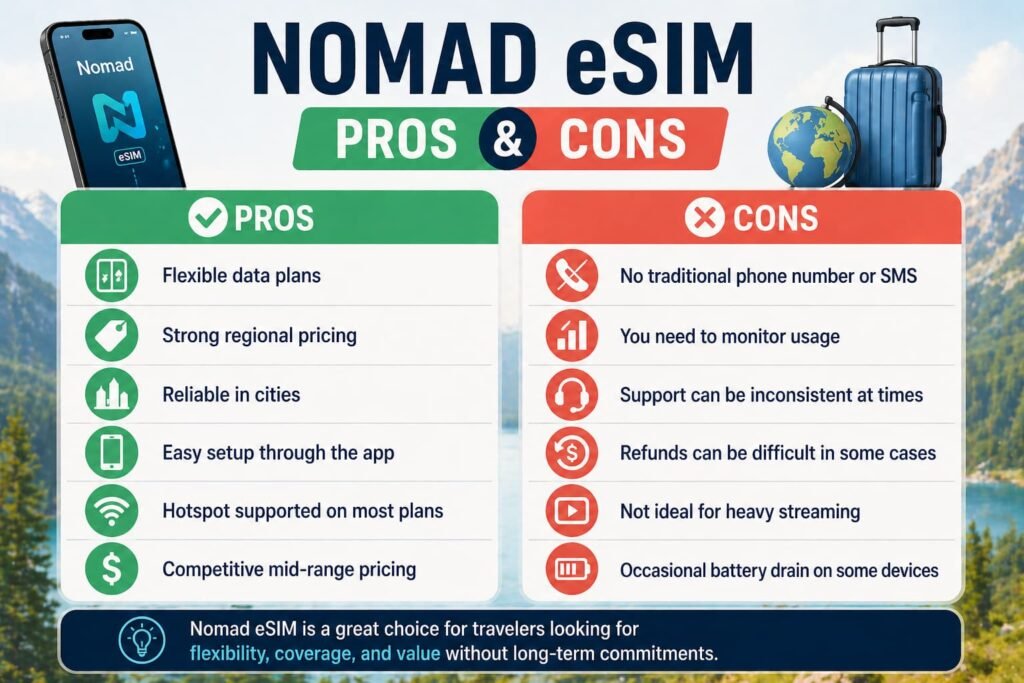
| Pros | Cons |
|---|---|
| Flexible data plans | No traditional phone number or SMS |
| Strong regional pricing | You need to monitor usage |
| Reliable in cities | Support can be inconsistent at times |
| Easy setup through the app | Refunds can be difficult in some cases |
| Hotspot supported on most plans | Not ideal for heavy streaming |
| Competitive mid-range pricing | Occasional battery drain on some devices |
How to Set Up Nomad eSIM
Setup is straightforward:
- Buy your plan
- Install it using the app or QR code
- Turn on the eSIM when you land
- Enable data roaming for that line
Most setups are automatic, but if data doesn’t work, you may need to check APN settings (usually set to data.esim).
For setup help, see the iPhone eSIM setup guide and Android eSIM setup guide, or follow Nomad’s step-by-step instructions on the Nomad help center.
Best Use Cases for Nomad
Nomad works best if:
- You use moderate data
- You’re traveling across regions
- You want predictable pricing
It’s not ideal if you stream a lot or need constant high data usage.
Alternatives to Nomad
Depending on what you need:
- Airalo for lower-cost plans
- Holafly for unlimited data
If you’re comparing options, see the Best eSIM for International Travel guide.
Related Guides
If you’re still comparing options or setting things up, these guides will help:
- Airalo eSIM review if you’re looking for a lower-cost option
- Holafly eSIM review if you want unlimited data without tracking usage
- eSIM Providers by Country to check coverage where you’re going
- iPhone eSIM setup guide if you’re using an iPhone
- Android eSIM setup guide if you’re on Android
Final Thoughts
Nomad sits right in the middle, and that’s exactly why it works. It’s not the cheapest option out there, and it’s not built around unlimited data, but it gives you control, which is what most travelers actually need.
If you’re using maps, messaging, and browsing throughout the day, Nomad gives you enough flexibility without overpaying. It really starts to make sense when you’re traveling across multiple countries, where regional plans save you from switching eSIMs every time you move.
If you want something completely hands-off, then an unlimited plan like Holafly is easier. But if you care about pricing, flexibility, and getting solid value for what you use, Nomad is a strong choice.